
Being an organiser and an Autistic/ADHD person meant that I spent the opening evening running around, starting many chats, but being unable to really finish any, unintentionally leaving many meanings opened and fragmented. After a few weeks of health-related misfortunes, I am closing the exhibition with my vocal chords overtaken by a cold, temporarily without a voice.
There is a risk of some simplifications in this short text, of course, but I hope I will be forgiven by the reader, (and manage to tolerate it myself, too), for the benefit of putting these thoughts together when still fresh and raw. With time, I might learn how to cook these thoughts a bit better, so they might become something more palpable, a gourmet dish of a chapter. Or, maybe, not.
It was such a good question. The inadequacy of my answer which I only remember an inkling of makes me boil inside, because there is so much more to say about this. So I will try to address it here, however briefly.
My job is a Core Lead in a charity. I like my job and the ways our team makes a difference to grassroots organisations in the city. It also allows me to pay my bills. In contrast, organising and curating this exhibition, or programming experimental film screenings, is certainly not something that contributes to my material survival. As a filmmaker and artist, I do it to keep my soul alive. I recognise this as a privilege, one that I haven’t had for many years of my life: having enough time and mental energy on top of one’s “day job”, or “paid job”, to create, and to make things happen. To be part of a community, to initiate gatherings, and to hold space.
But I think it’s especially true for neurodivergent artists who spend their lives juggling under the cloudy sky of capitalism. I am an experimental filmmaker, artist, and researcher. I am Autistic and ADHD. I work as a Core Lead. I do many other things, some of which count as occasional jobs, many of which count as work but are most certainly unpaid, and many that are just my life, and the venn diagram presenting the overlap between these different things would actually be quite funny to make.
I often think about this belief I carried from growing up in a lower socio-economic background, as a woman, in central Europe’s mega-Catholic country, in the capitalistic world. It’s a belief that says you need to work really hard to earn a living. It’s an ideal of an “earnest worker”, the person who gets paid because they suffer, and they’ve learnt how to suffer quietly, so it looks like they’re enjoying it. A “simple” life, a measure of material success and stability. After having no choice but ruining my early twenties in similar vein, with the addition of the burden of autistic masking in services industry, I can’t keep myself quiet now. Even when my vocal chords refuse to work.
But when I am doing them for free, or not as “part of my job“, I want this to be known. Because this also matters. It matters that making and experiencing art is a fundamental human need and right, and that artists are generally not paid fairly for the work they do. It matters that artists and arts organisations are struggling to get funding, spending weeks of free labour writing applications which seem accessible only to those who have “cracked the code“, for incredibly competitive and limited funds. It matters that artists, organisations, collectives, those who create and who make things happen, are treated by the government as a luxury, and not as the necessity they really are.
Art, and connecting people of all backgrounds to art, is a crucial element of building strong communities who have a voice, an identity, a cultural awareness that empowers them to unite and to be active contributors to building a world which we all want to live in.
The importance of holding spaces where people celebrate the artists’ work extends way beyond aesthetic awareness, into deeper connections to this world, and the building of sociopolitical resilience.
In addition, the sharing of Autistic and ADHD experiences and perspectives can happen in a very different way through art, whether that’s painting, mixed media, installations, moving image, sound, or performance, than it could happen through a conversation. A conversation takes place mostly in spaces of the dominant (neurotypical) model of interaction which dictates what social rules and expectations are, what behaviours, rhythms, paces, and gestures are appropriate and tolerable.
I often end up being too chaotic and overstimulated to say what I want to say. To answer questions fully. It bothers me, but in some way it often happens to drive my writing. What I am trying to articulate here is about artists pay, about universal income, about disability justice. One of my closest friends, a neurodivergent artist, has recently decided to quit her job and go freelance. It’s a decision that nobody takes lightly. Yet, unless you hold generational wealth, it is generally frowned upon as a risky venture. Especially when you are an artist. Even more if you are neurodivergent. But I keep thinking about how beautiful and courageous it is to step towards the work one deeply cares about, on their own terms that align with our needs and rhythms. I believe we all deserve systemic support to be able to do this. I want to call us to stop for a second and really listen to the answers that arise in us to the following questions:
How much more could we build together if we didn’t have to compete for means of survival? How much better would our societies function, if our systems weren’t leaving people behind in poverty, and didn’t discriminate against those unable to work under the capitalist system long term?
I don’t know, I’m just an artist, foreign at that, and unable to fully express myself in conversation because of my neurotype. All I’m saying is that yes, these spaces are exactly for this, for coming together to look at art, drink beers, chat shit, smoke cigs, ask stupid questions, fall silent in tension while listening to the performers, catch up in unfinished conversations, feel welcomed, laugh a bit too loudly, exchange fragments of thoughts and of emotion, and go home with your mind wondering just a little bit further this time.
***
We organised this exhibition a few months after we were lucky enough to become studio holders at KARST, in the UNDER unit, which features a shared testing space which occasionally opens to the public. “We” are Seaing/Hereing, an experimental film/sound duo, working together on audiovisual and performance pieces. I’m a part time PhD student at University of Plymouth, with a thesis working title “Neurodivergent psyche-revealing: exploring the state of sensory absorption through experimental filmmaking“, if that’s in any way informative. Sam Johnson is a musician, sound artist, and sound engineer, studying part time MA Fine Art at UoP. As most artists in the UK currently, we both have day jobs that have little to do with our art-making.
***
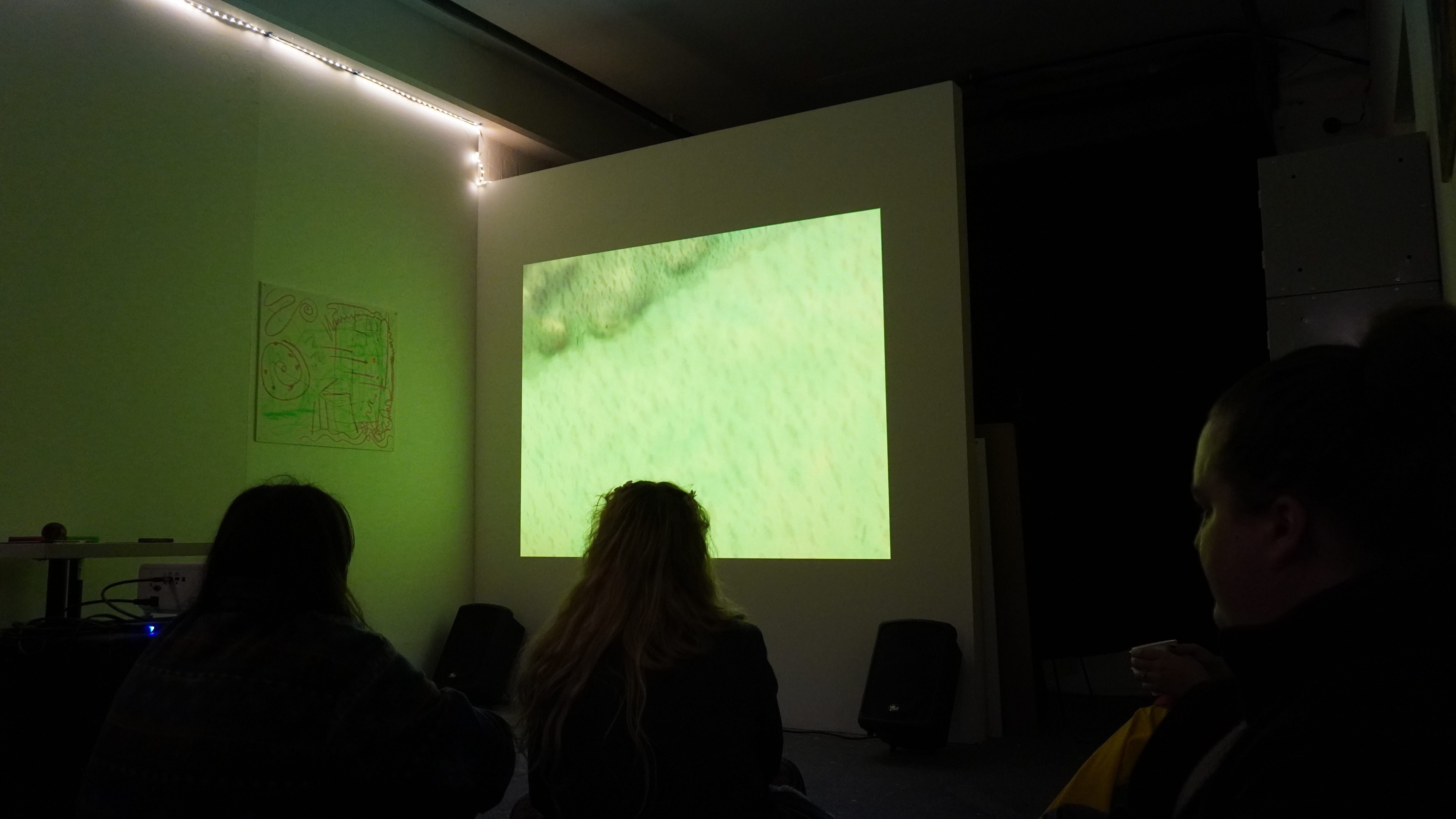
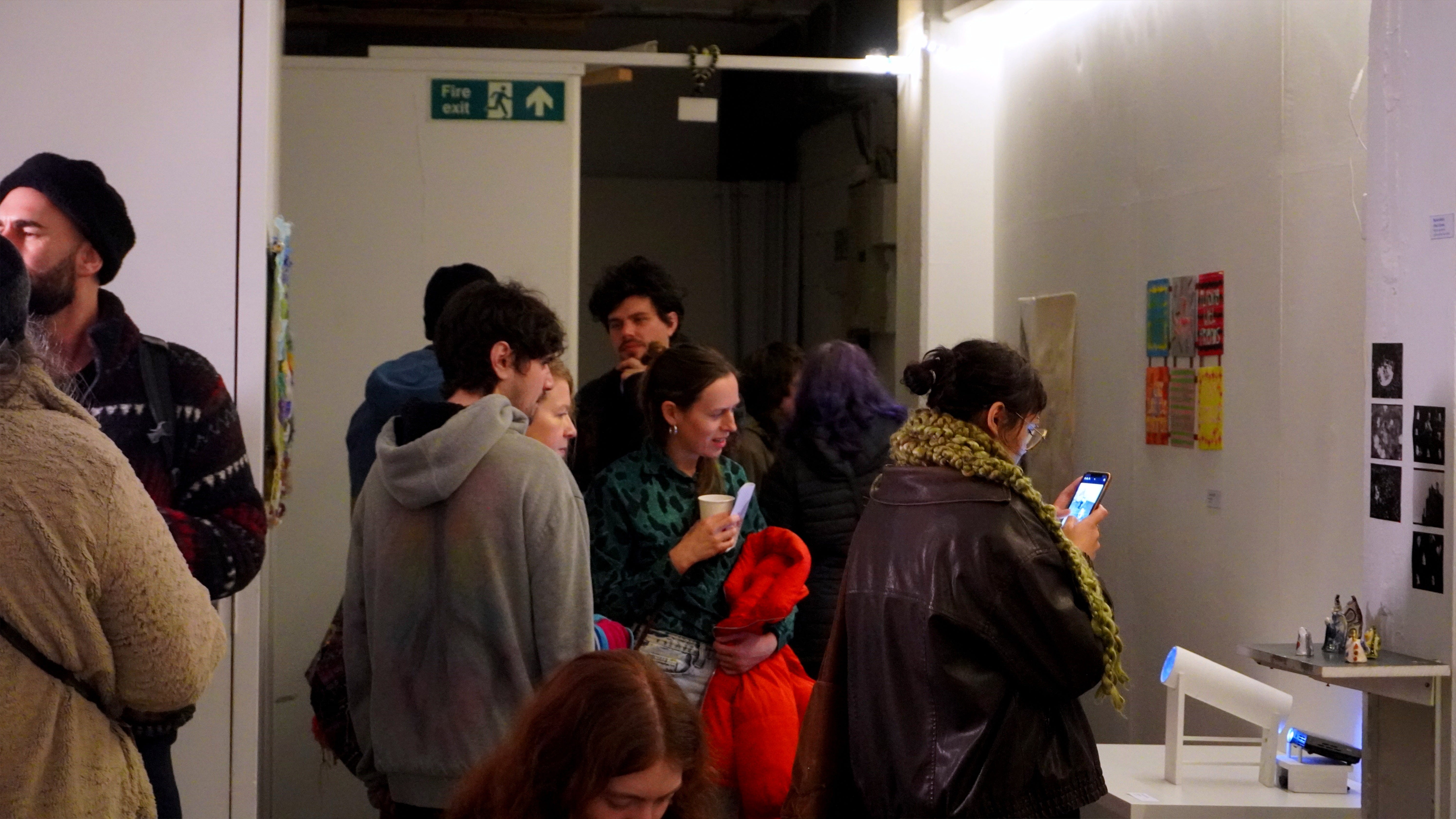
The opening evening was packed, and then many people dropped in to see the show over the weekend. For an exhibition organised with zero funding, by Autistic/ADHD artists for Autistic/ADHD artists, it was really a great success and a sign that the grassroots artists community in Plymouth is strong and keen to support each other and to celebrate work by neurodivergent makers. We had an excellent mix of professional artists and students’ work on display, showing the power of mutual uplifting of the work we do in so many different mediums, creating different sensory realities and emotional atmospheres.
***
EXHIBITION INTRO
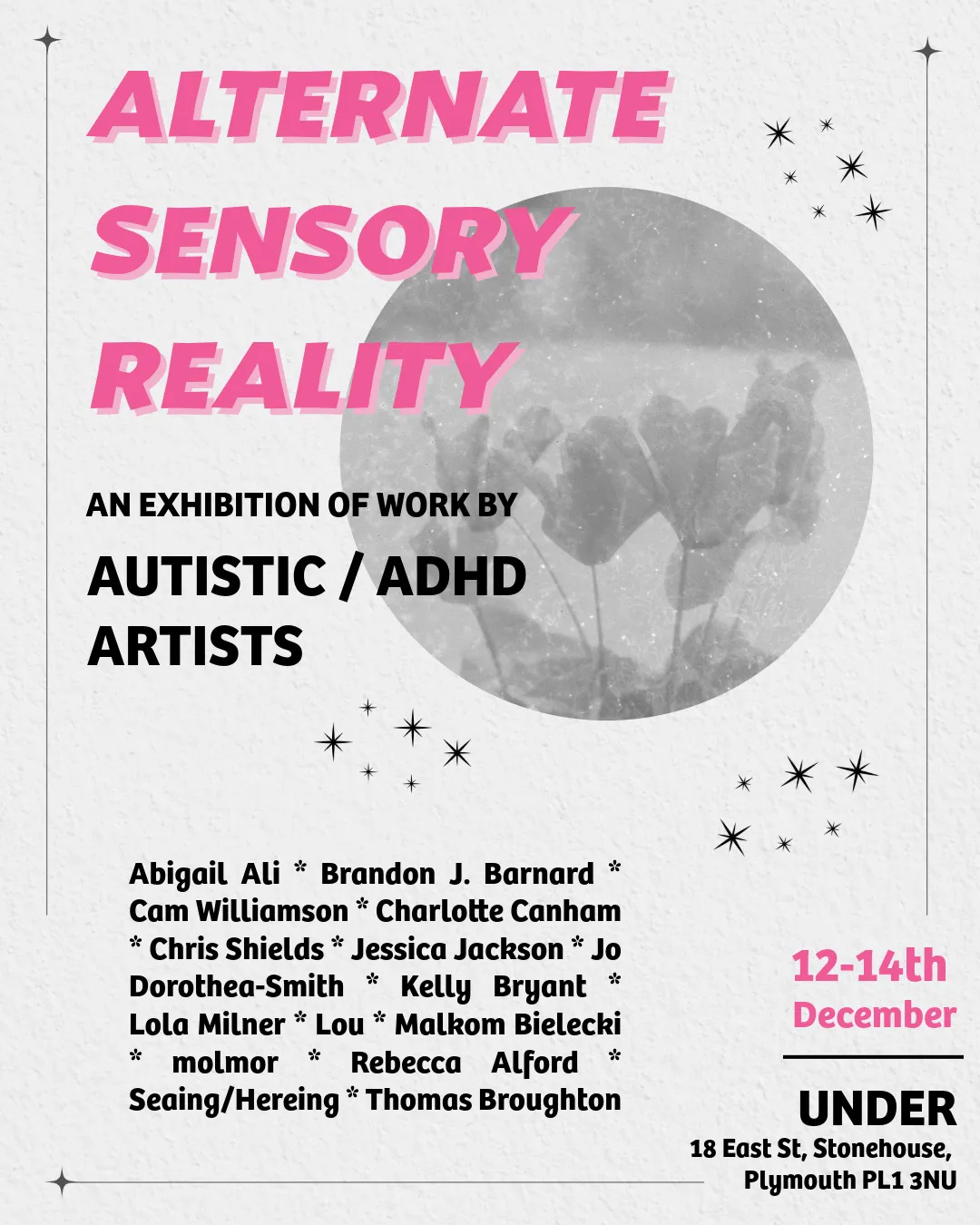
This group exhibition curated by film/sound duo Seaing/Hereing highlights the work of Autistic/ADHD artists in Plymouth, while providing a space for conversation and informal networking. Exploring diverse themes through a range of mediums, the works open up a community dialogue around how the lived experience of these neurodivergent conditions shapes the ways we engage with objects, nature, spaces, and people. Acknowledging the shared barriers in access and challenges Autistic and ADHD community members face in life, as well as in art making and sharing, was part of the motivation to come together to celebrate the wide range of themes, methods, and mediums we express ourselves in. In addition to the drive for increasing inclusivity and accessibility in the light of the neurodiversity paradigm, the exhibition was born from curiosity towards how unique perceptual and attentional experiences inform creative practice. Sensory sensitivities and attentional differences common in these types of neurodivergence are the subject of Seaing/Hereing’s practice and research, and we are excited and honoured to bring a multiplicity of perspectives from this group of local artists together. We invite you to immerse yourself in the alternate sensory realities within this supportive space for considerations around Autistic/ADHD art-making and belonging.
Seaing/Hereing
(Patrycja Loranc & Sam Johnson)
No posts
Comments
Nothing yet. Say the first thing.
Sign in to join the conversation.