
Editor’s Note
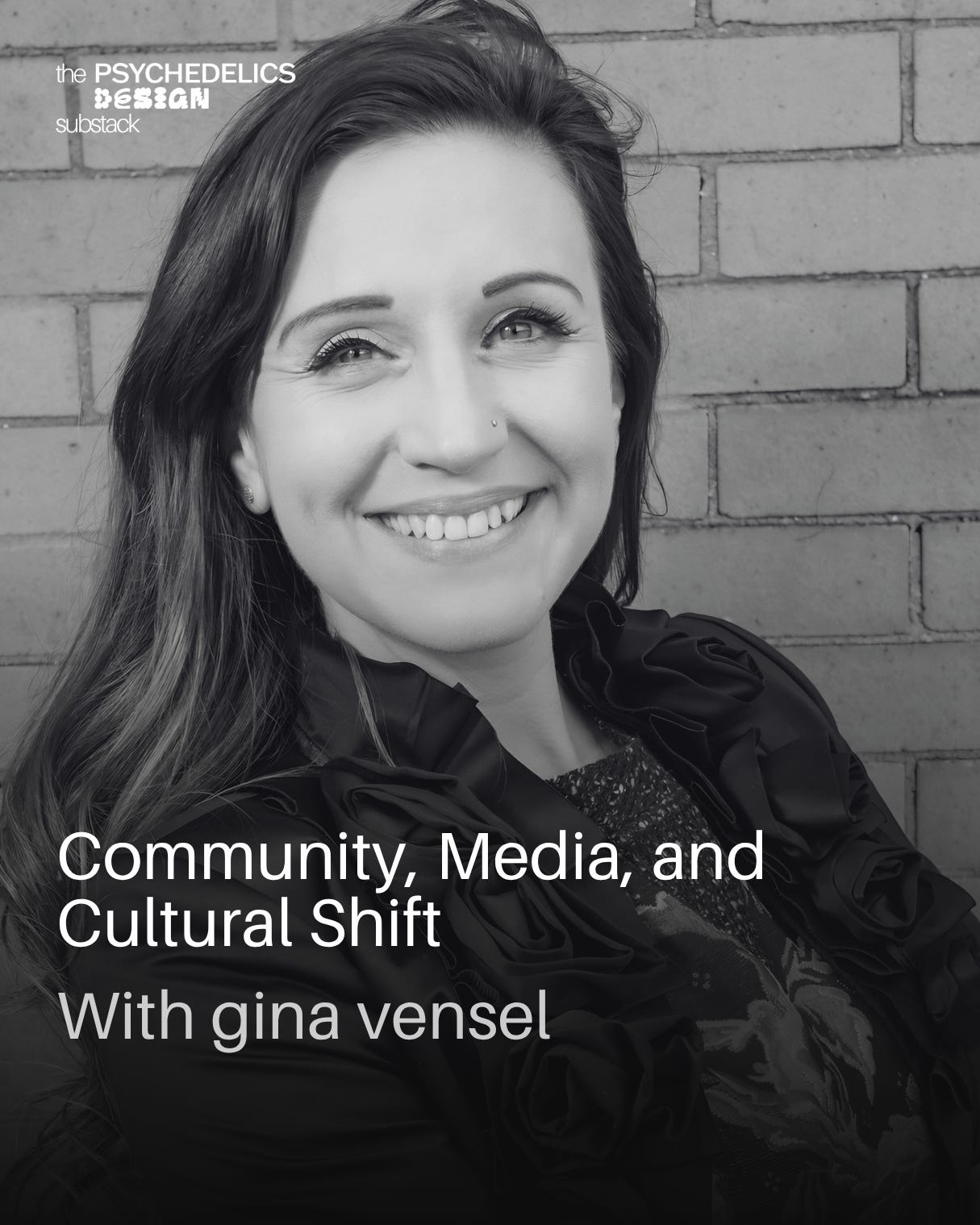
Some people you meet and immediately understand: this is someone who holds things together. gina vensel is one of those people.
gina works at MAPS on Educational & Community Impact, where she manages community partnerships as part of the Psychedelic Science team. She’s also a co-steward of the Three Rivers Psychedelic Society in Pittsburgh — and one of the founding voices behind the Psychedelic Writers Guild, a coalition working to reshape how mainstream media covers this field.
What drew me to this conversation was Gina’s refusal to separate the personal from the systemic. She talks about community as something you tend to, protect, fund, and sometimes take a break from. She brings that same groundedness to questions about harm reduction, media representation, commercialisation, and the ongoing consequences of the War on Drugs.
This is a conversation about what it actually takes to build something that lasts.
For gina, it comes down to something simple but demanding: compassion, trust, protection, and solidarity. “When communities look out for one another, they become stronger.” That’s the baseline. Everything else — the events, the content, the partnerships — is built on top of that foundation, or it isn’t worth building. “There has been a growing number of predators in the space, and many retreats and leaders are causing more harm than good. I'd like to see more coverage on this and how we can keep our community safe.”
The gap gina points to is significant. Most psychedelic use happens outside clinical settings — and most media coverage ignores that entirely, particularly when it involves Indigenous communities and underground practice. The newly-founded Psychedelic Writers Guild is working to change that, bringing together journalists who are part of the movement themselves to produce content that reflects its actual diversity and complexity. “When we focus on collaboration over competition,” gina says, “our stories will be shared more widely.” It’s a media ecosystem built from the inside out.
gina is clear-eyed about the current moment. A recent executive order has sent another wave of momentum through the psychedelic movement — but she's cautious. "Flashy headlines can lead the public to misunderstand the laws governing adult use." Psychedelics remain Schedule I under the Controlled Substances Act. Personal use can still result in prison time. Staying grounded in evidence-based content isn't just good practice — it's a form of harm reduction in itself. Her role at MAPS, managing community partnerships, is one way she holds that line: connecting organisations to share information, resources, and wisdom. "We are co-creating this community together, like a mycelial web."
"By being an active listener, staying grounded, and being impeccable with my word." gina’s answer to this question could have been structural — about policies, vetting, accountability frameworks. Instead it's personal. Show up when the community needs support. Don't rush to judge. Offer resources freely. "I love serving as a community connector and helping others find the resources they need." Integrity, in her framing, is a daily practice — not a positioning statement.
Harm reduction. Understanding local and national laws. Testing your substances. The importance of set and setting. Integration. These are the core of what it means to educate responsibly as psychedelics move into mainstream awareness. The knowledge gap isn't just about clinical outcomes; it's about keeping people safe in the real conditions they're actually navigating.
Holding space for others — especially those dealing with emotional and mental struggles — takes something out of you. gina knows this from experience. "I have to give myself time in solitude to replenish my energy. I meditate and give myself permission to rest." It's a small thing to name, and an important one. The people doing the most essential community work are often the ones least resourced to keep doing it.
Whether it’s a large nonprofit or a small meetup group, the challenge is the same: funding. So much of the psychedelic movement runs on unpaid volunteer labour. “I hope we can lean on each other for support” — a sentence that functions both as observation and as invitation.
Trust takes time. Don’t rush it. Once trust is established, you can go deeper. And critically: leaders who try to carry everything alone don’t just burn out — they risk being perceived as ego-driven rather than community-focused. Her advice: “Delegate responsibility, offer transparency, and be open to feedback.” It’s a model for community leadership that applies well beyond the psychedelic space.
Storytelling works, gina argues, because it lets people hear firsthand how transformative psychedelics can be — for personal growth and healing, for raising consciousness, for connecting with nature, for deepening relationships. Stories do what data can’t. They make the abstract viscerally real.
“I believe that we’re designing a culture of community care, rooted in compassion and harm reduction.” And embedded in that is a longer reckoning: the War on Drugs has left lasting damage on communities. Restorative justice isn’t optional — it’s foundational. The field’s future has to be built on ethics and safety, or it will repeat the patterns it claims to be moving beyond.
🎙️ PODCAST
Prefer to listen? Before this interview, we already had gina as a guest on our podcast.
NEWS FROM PSYCHEDELICS DESIGN
We’re delighted to share that gina vensel will be returning as a judge for the Psychedelics Design Awards — for the second year in a row.
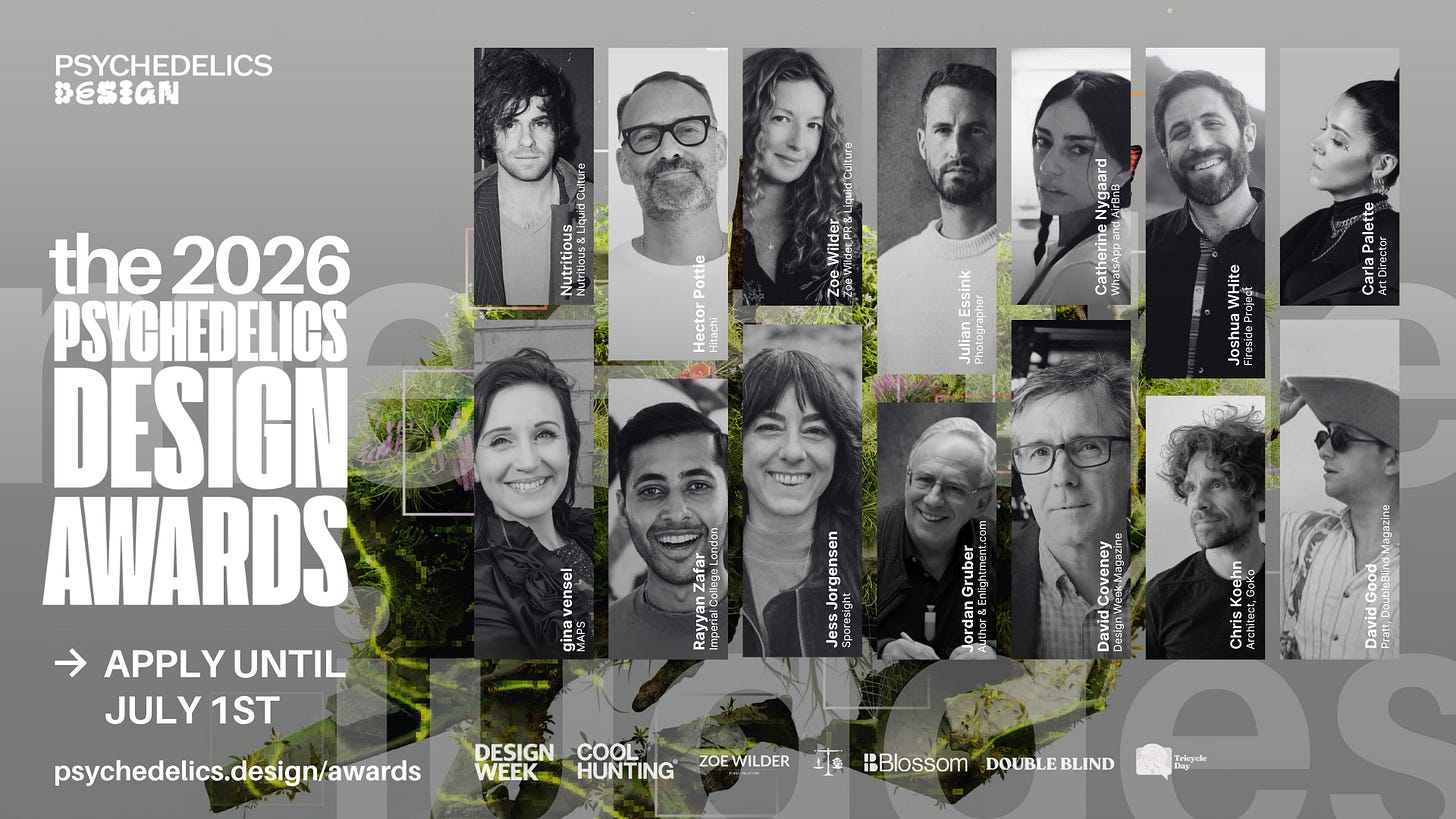
Her perspective on community, integrity, and what it means to build something lasting in this space is exactly the kind of lens these awards need. We’re grateful to have her back.
We are in the midst of co-curating the upcoming online awards and event – and much more. Stay tuned!
Find gina on:
LinkedIn • Instagram • MAPS
NEWS FROM PSYCHEDELICS DESIGN
• The Psychedelics Design Awards are getting noticed.
We’re honoured that the Awards were featured in both the Tricycle Day newsletter — one of the most widely-read publications in the psychedelic space — and the Dieline Newsletter, a go-to for the global packaging and branding community. Two very different worlds, one shared signal: design and psychedelics belong in the same conversation. Applications are open across nine categories — branding, architecture, storytelling, music, and more — and close July 1. → Apply for the Awards
• Introducing The Huxley Club — our new membership community.
We just launched The Huxley Club: a membership for designers, creatives, and curious people working at the intersection of psychedelics and culture.
Named after Aldous Huxley — who took mescaline in 1953 and wrote The Doors of Perception, the book that gave the counterculture its intellectual framework — the club is the space for the conversations that don’t fit in a newsletter. Full session recordings, a growing digital library, monthly community calls, and a WhatsApp group of 100+ psychedelic creatives already inside.
Founding memberships are $90/year — locked forever, and available until October 2026. The first 20 members get a free advisory 1-on-1 with Alexandra Plesner, designer and founder of Psychedelics Design.
“The man who comes back through the Door in the Wall will never be quite the same as the man who went out.” — Aldous Huxley
• It’s an honour to share that Pernille Brostrup joined us as a strategic advisor!
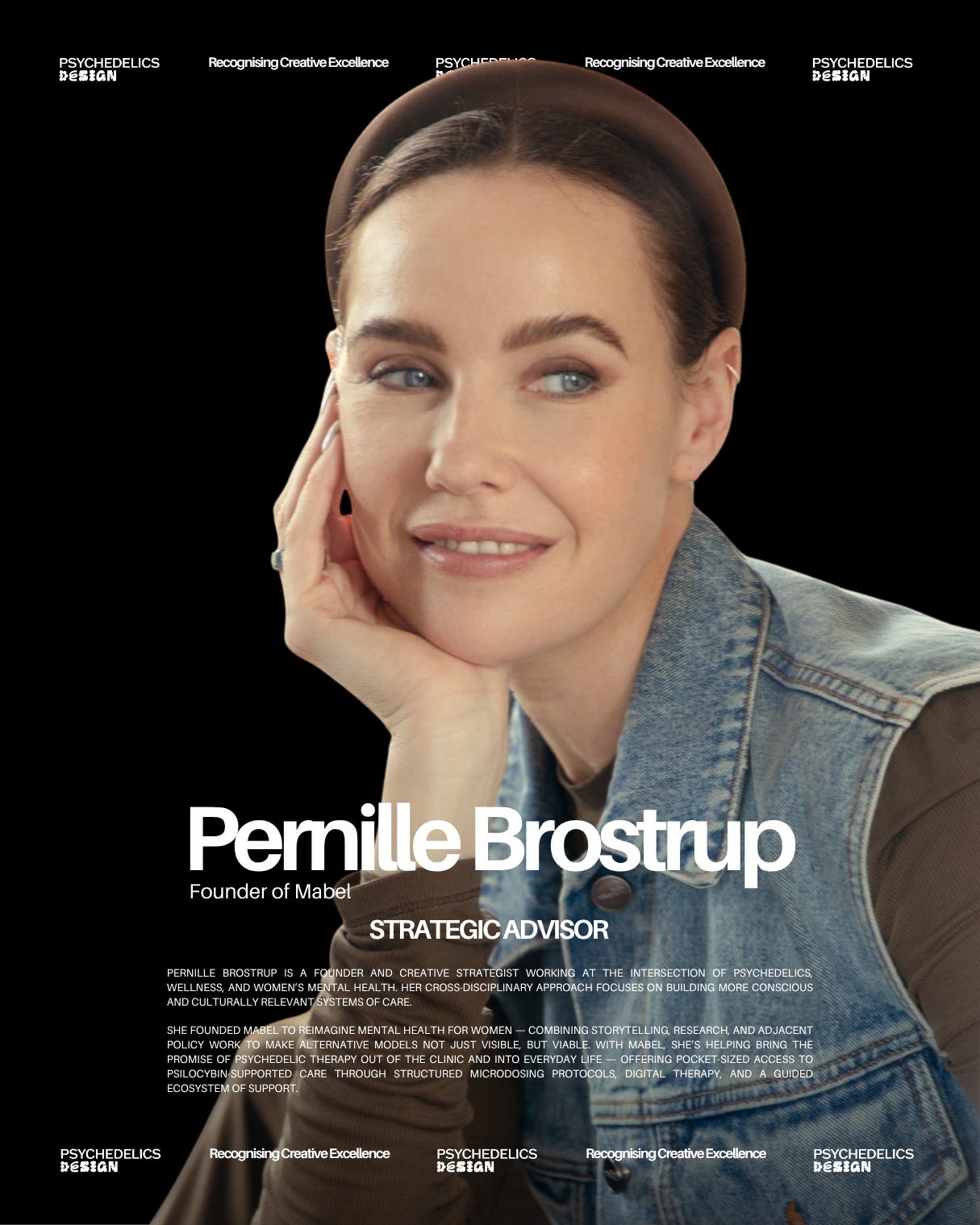
A Danish native who built Mabel as a civilian, not a clinician or academic. Her path sits in the tradition of citizen science that shaped much of late nineteenth-century discovery, where curiosity and lived struggle, not credentials, moved the work forward. Her own version of that struggle came as years of stress, anxiety, and burnout that found no relief in conventional approaches. It led her to medicinal plants and earth medicines, and she didn’t look back.
That journey became Mabel: a company operating at the intersection of psychedelics, mental health, and functional mushrooms, with a particular focus on women. Mabel pairs psilocybin microdosing protocols with multi-week guided programs and continuous outcome tracking. Microdosing softens the inner architecture that holds old patterns in place. The program provides the scaffolding for what comes next. Together they produce meaningful change on a timeline neither tool can reach alone.
The mission is accessibility without compromise.
What sets Mabel apart is the depth of the work behind the product. The broader microdosing conversation has too often relied on anecdote, or extrapolated findings from full-dose clinical research and presented them as if they applied directly to microdosing. Mabel has built a structured Mindful Microdosing Program co-designed with Dr. Shauna Shapiro, with neuroscientist Dr. Amir Lotfi serving as Mabel’s Chief Scientific Officer and leading the research arm. The company has gathered proprietary data across more than 8,000 clients and is currently developing AI tooling designed to help individuals shift patterns, rework lifestyle, and process trauma with real precision. Mabel was articulating the compounding effects of microdosing long before the current wave of microdosing guides entered the market, and is now pushing the practice into territory the wider community has not yet caught up to.
The ambition is a new category in mental health. One that moves past GAD-7 and PHQ-9 scores as the only signal of progress, and develops new modalities for assessing where a woman actually is in her life. Not just symptoms ticked off a list, but agency, self-trust, creative capacity, direction.
Pernille brings to Psychedelics Design a founder’s instinct, a personal relationship with the subject matter, and a sharp eye for where culture and wellness are heading, particularly for women, a community still underserved by the mainstream psychedelic conversation.
We are building the upcoming awards and conference together — more to come.
And on a personal note: I have long been an admirer of Pernille and her work — having her as an advisor is another genuine pinch-me moment.
Connect via Pernille Brostrup · Mabel Life · Dr. Shauna Shapiro · Dr. Amir Lotfi
FROM OUR PARTNERS
• Jalen Salazar at SF Design Week – The Unconscious Creative
We’re excited to share that our friend and advisor Jalen Salazar will be hosting an intimate gathering during this year’s SF Design Week in the Bay Area on June 9th. The Unconscious Creative is a blend of plenary and small-group conversations designed to invite deeply engaged, unguarded, and intentional dialogue—exploring the creator behind the creator.
If you are in San Francisco during SF Design Week, we highly recommend attending.
Learn more here: https://sfdesignweek.org/event/the-unconscious-creative-an-intimate-salon-of-creative-inquiry/
We're always open to partnerships — whether you're a speaker, sponsor, event collaborator, contributing designer or editor, or an organisation whose work aligns with ours; community support is unpaid and mutual: we champion what we believe in, and stand behind those who stand behind us. Reach out if you feel like connecting.
“Design is one avenue through which consciousness makes itself visible.”
– Alexandra Plesner
Comments
Nothing yet. Say the first thing.
Sign in to join the conversation.