
When reading widely in a specialist field, in my case drug writing, one often reflects that a particular subject or topic really ought to have a book written about it—something that’s missing from the oeuvre or which requires a more thorough treatment. As a historian, this occasionally reveals itself as a eureka moment and becomes the kernel of thought that mutates into a project. At other times, feeling oneself ill-equipped for the job, it’s the hope that some other much more able individual turns their pen to the idea so that, quite indulgently, I might just sit back and enjoy reading it.
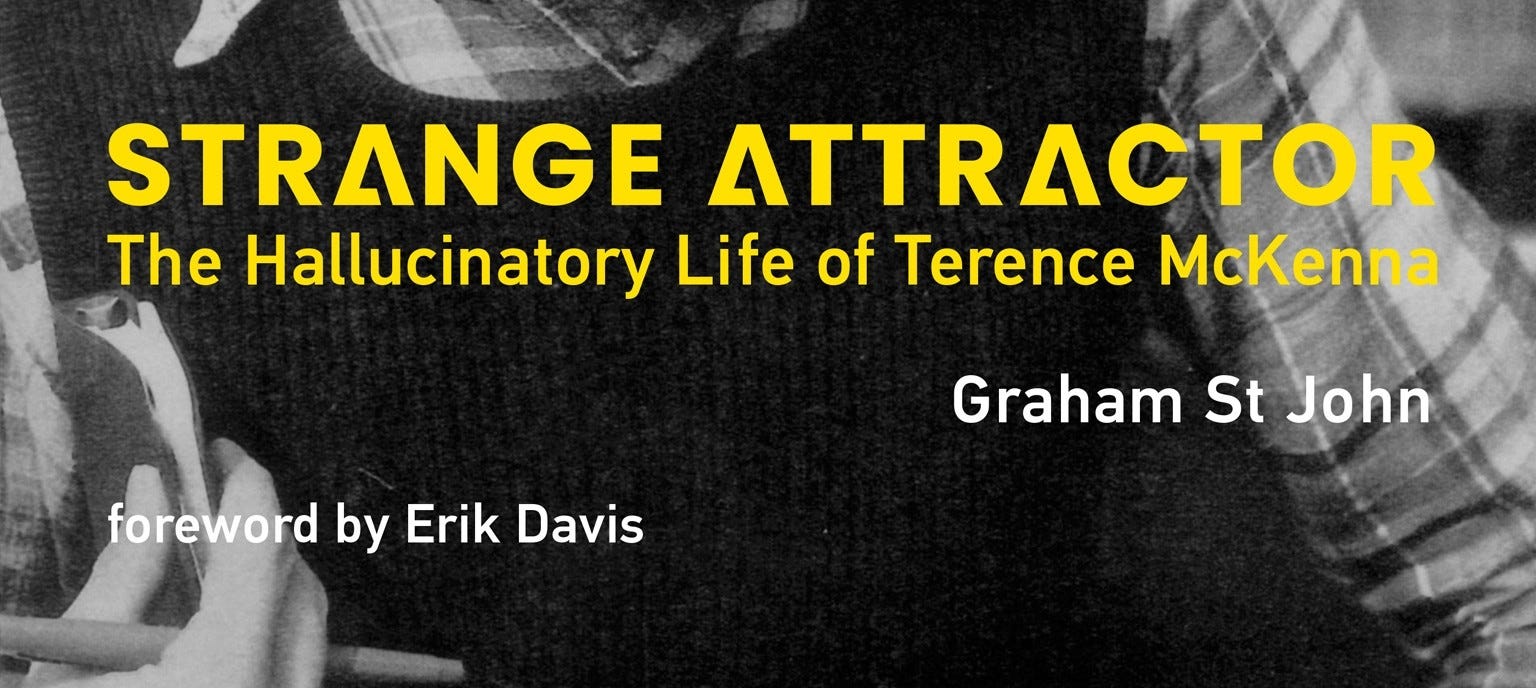
The latter is undoubtedly the case with the newly published Strange Attractor: The Hallucinatory Life of Terence McKenna by Graham St John—a book I have long wanted to read and, now that I have, am very grateful for. Excellent scholarship, eloquently written, and deeply illuminating of its subject.
I first became aware of Terence McKenna in the years after he died in April 2000. He had, I feel sure, already woven himself into my sub-conscious through some of the music that sampled his famous drawl, especially throughout the Nineties. However, it was through internet forums, message boards and alike that I eventually became acquainted with him, especially through listening to his many recorded talks. Then, working in a secondhand bookshop in 2005, a copy True Hallucinations: Being an Account of the Author’s Extraordinary Adventures in the Devil’s Paradise turned up too—I quickly devoured it.
McKenna was, I believe, a far more loquacious speaker than he was a talented writer—yet his subjects in The Invisible Landscape, Food of the Gods and The Archaic Revival are always tantalizingly thoughtful. He also provokes interesting reactions from people. From those who treat him with the kind of reverence reserved for holy teachers, through to others derogatorily denouncing him as a guru or false prophet. Somewhere in between is an entertainer who not only riffed on subjects taboo in the mainstream, but who still inspires others to think deeply about psychedelics.
Such myriad reactions do of course give rise to the question: Who was this person really? Who was Terence McKenna? We got a very partial answer with his brother Dennis’ Brotherhood of the Screaming Abyss, which was first published in that very auspicious year for McKenna fans, 2012. However, it always felt like a proper biography would be a difficult task—not least because of several fires that have destroyed much of Terence’s writing, correspondence and library.
However, with Graham St John, who has previously authored such great books as Global Tribe and Mystery School in Hyperspace, the right person for the job came along. Thanks to St John undertaking extensive interviews, archival research, and God knows how much listening to McKenna’s voluminous back catalogue of talks that a very thorough biography has now appeared. Obviously a fan of McKenna, and the McKennaverse, St John has managed to walk the tight-rope of an apparently fair assessment. Terence McKenna was a complex individual.
Buy Psychedelic Press Books Here!
Accusations of guru-ism would have bemused McKenna. Terence’s childhood stories, especially those related by himself later in life, reveal a kind of father figure rebellion manifesting against all authority. This underpins not only his own character, but arguably much of his generation too. He was someone who was essentially afforded every opportunity and comfort in life, especially compared to prior generations, but this then manifested as a radical individualism defined by a rejection of anything vaguely resembling authority. Not only politically, but right down to rejecting shamanistic oversight in ayahuasca ceremonies—he even disdained ritual as a ‘substitute for the mystery’.
As McKenna told a crowd in Esalen in 1997, ‘I discovered that that was the path of wisdom: a total rejection of the culture I came up with.’ ‘Culture’ he also famously said, ‘is not your friend’. He was taking part in the great mythology of his generation—that they had liberated themselves, and were the great liberators of society. This is of course nonsense, but on some level McKenna did appear to recognise this too—not only with wry irony in his talks but also in his desire to remove himself (some would say retreat) from everyday culture.
As St John notes, McKenna was paradoxical so far as he wanted to live as a ‘cave man’ but was also someone who desired to be the centre of attention. Bridging these psychological desires was his intellectual life—a bibliophile who enjoyed nothing more than smoking weed (which he did habitually) and quietly reading books, and also wishing to share what he understood with the world. Carl Jung, Mercea Eliade, and Marshall McLuhan all had an important impact on McKenna, and St John does an excellent job at tracing his intellectual influences in the woven fabric of his talks—the public face of quiet reading.
There are several key moments for Terence that came to dominate the trajectories of his personal and public life, including: his failure to see his mother before she died while he was on the run from the law; the events at La Chorrera; the discovery of a method to grow magic mushrooms at home; and his so-called ‘terror trip’ in 1988 (which was deeply wrapped up in his increasingly troubled relationship with his then wife Kat Harrison)—all of which are described and handled with great care by St John.
In particular, the story of the infamous ‘Experiment at La Chorrera’—related in True Hallucinations—is grounded and enigmatic in St John’s retelling. Yet it is the aftermath that is most revealing. McKenna worked maniacally on the ideas the experiment generated, all the while with friends seriously questioning his state of mind and wondering if they needed to intervene. This was a period of expansive, creative thinking for McKenna yet with a sense he was just burying himself away from the paranoia-inducing reality of being on the run for hash smuggling.
While the situation with the authorities was finally sorted in 1972, as St John observes, ‘McKenna spent the remainder of his life coming down from La Chorrera, toying with the “eschatron” and its successors, while contending with the reaction of his peers.’ Indeed, it is through the documentary and oral evidence of his friends, family and peers that one gets a real sense of McKenna’s notably obsessive pursuit of ideas and novelty, conversely coupled with a kind of inflexibility in his personal worldview. It conjures a complicated depiction.
Strange Attractor charts well these two interwoven trajectories of public intellectual and private individual, drawing out their mutual paradoxes and contradictions along with the way in which they were so inextricably linked. McKenna entertained without acting, which is to say, he appears to have rarely knowingly pretended to be someone he wasn’t. St John often describes him as a ‘trickster’, but I must confess to seeing little of this archetype in him—McKenna lacks the cold manipulation of a psychedelic trickster figure like Michael Hollingshead, instead being confessedly aware of his own flaws and limitations.
However, of McKenna the entertainer, St John writes, ‘As his unique style was cultivated in daytime workshops at Esalen and at nightclubs in New York, and perfected on an international circuit, McKenna became a bard for multitudes, his raps showcasing an ability to seed an ecosystem of ideas terraformed for unique audiences.’ Ultimately, for those who did not know him personally, this will always be McKenna’s lasting legacy. But at least now it is possible to see the complexity of the man behind the raps.
You can read an extract here.
Comments
Nothing yet. Say the first thing.
Sign in to join the conversation.