
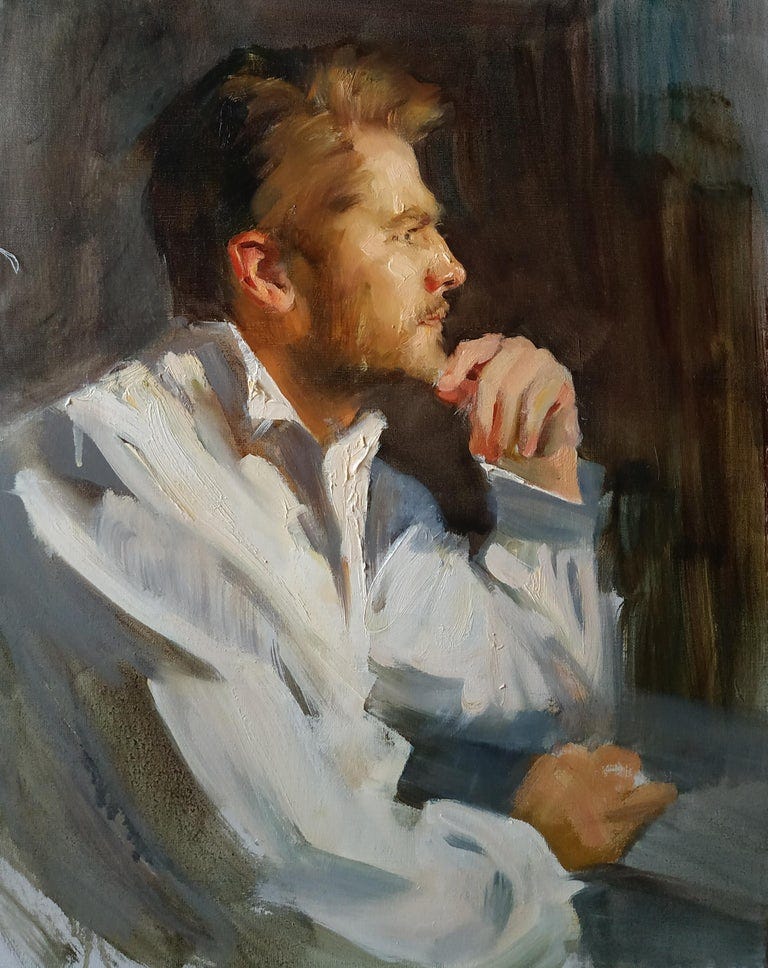
Fatherhood today is often presented in soft colors.
Be gentle. Be understanding. Be supportive. Never raise your voice. Never impose too strongly.
And of course, there is truth in those things.
But there is another truth that many modern conversations avoid:
Sometimes a father must be the “bad guy”.
Not because he enjoys it.
Not because he is harsh.
But because someone must draw the line.
I know this is a difficult topic to talk about today. The moment someone mentions discipline, authority, or different roles of fathers and mothers, criticism usually follows.
In a culture that prefers comfort over responsibility, the idea that a father sometimes has to be the “bad guy” can easily be misunderstood.
In the earliest years of life, a child lives almost entirely in the world of the mother.
She is the warmth.
She is the nourishment.
She is the safe harbor.
A mother carries the child, feeds the child, comforts the child. Even after birth, the child still orbits around her like a small planet around its sun.
Every father who has held a crying newborn knows this truth.
You can try everything.
Rocking.
Walking.
Changing diapers.
Whispering softly.
And yet somehow your wife comes in, holds the baby for thirty seconds, and everything is suddenly peaceful again.
It can be humbling.
But it also reveals something important: father and mother are not competing roles. They are complementary ones.
Where one is not strong, the other fills in the gaps.
And in those early years, the mother’s strength in nurturing is almost impossible to surpass.
The importance of mothers runs deep in the Christian tradition.
We honor the Blessed Virgin Mary not merely as a historical figure, but as the Mother of Christ and Queen of Heaven.
Even the Son of God entered the world through a mother.
Even He had one.
That alone should humble any man who tries to diminish the role of mothers.
They are counselors, protectors, and the emotional center of the family.
A good mother is a fortress of tenderness.
But a fortress alone does not build a civilization.
For that, something else is required.
As children grow older, the center of gravity slowly begins to shift.
The world begins to widen.
The child must learn discipline.
Responsibility.
Boundaries.
And this is where the father becomes crucial.
A child cannot grow properly if the world feels like a playground with no fences.
Freedom without boundaries does not produce strength.
It produces chaos and even danger.
A father introduces something every young person must eventually face:
limits.
Like a gardener trimming a growing tree, he cuts away what grows in the wrong direction so the tree can grow stronger and straighter.
Without pruning, a tree becomes wild and fragile.
Without discipline, a child does the same.
Sooner or later, every father reaches this moment.
The child refuses to listen.
Rules are ignored.
Respect begins to slip.
You try explaining.
You try patience.
You try asking nicely.
And sometimes none of it works.
That is when the father must step in and say:
“Enough.”
Not with cruelty.
Not with rage.
But with authority.
Phones get taken away.
Privileges disappear.
Voices may rise.
The line is drawn.
And in that moment, the father may look like the villain of the story.
But discipline is not hatred.
It is responsibility.
Something else will happen very quickly after that moment.
The child’s chief advocate arrives.
The mother.
And this is not a problem. It is a feature of how families work.
A mother is biologically wired to protect her child.
She may have scolded the child five minutes earlier, but if someone else raises their voice, her instincts activate instantly.
Every good mother has a little mama bear inside her.
And the father must understand this.
He is not fighting his wife.
He is standing firm in his role.
A strong family is not built when both parents play the same role.
It is built when each parent fulfills their own role well.
Many men hesitate to discipline their children because they are afraid of doing it wrong.
And they will.
Every father will sometimes raise his voice too much.
Lose patience.
Go a little too far.
Fatherhood is not performed by perfect men.
It is performed by present men.
An imperfect father who tries is infinitely better than a passive father who never intervenes.
Because children do not need fathers who are flawless.
They need fathers who are awake.
Fathers who care enough to step in.
Here lies the real secret.
Discipline must never be the final act.
After the lesson comes the repair.
Perhaps thirty minutes later.
Perhaps an hour.
The father sits down beside his child.
The voice softens.
A joke is made.
A smile appears.
A hand lands on the shoulder.
And something powerful happens.
The child learns two things at once:
“My father is strong.”
“And my father loves me.”
Both are necessary.
Without love, authority becomes tyranny.
Without authority, love becomes weakness.
A good father holds both.
These moments teach children far more than anything else.
They teach them how relationships work.
In life they will argue with friends.
They will fight with colleagues.
They will disagree with their spouse.
Conflict is inevitable.
But if they learned from their father that conflict can be followed by reconciliation, they carry an invaluable skill into adulthood.
They learn that relationships are not destroyed by conflict.
They are strengthened by repair.
A child must both love his father and respect him.
If love exists without respect, the father becomes a friend but not a guide.
If respect exists without love, the father becomes a tyrant.
Healthy fatherhood stands exactly between those two cliffs.
Firm discipline.
Warm reconciliation.
b working together.
For Christians, there is an even higher example.
God Himself is called Father.
He gives commandments.
He sets limits.
He disciplines.
But He also forgives.
Again and again.
The pattern is clear.
Justice and mercy.
Authority and love.
Earthly fathers will never fulfill this perfectly.
But we are called to imitate it as best we can.
And when we fail, we ask for guidance.
In the end, fatherhood requires courage.
The courage to say no.
The courage to stand firm.
The courage to risk being misunderstood for the sake of your child’s future.
Because discipline is not about winning an argument today.
It is about shaping a human being for the next fifty years.
And sometimes that means being the bad guy for a moment...
So that one day your child can become a good man.
No posts
Comments
Nothing yet. Say the first thing.
Sign in to join the conversation.