
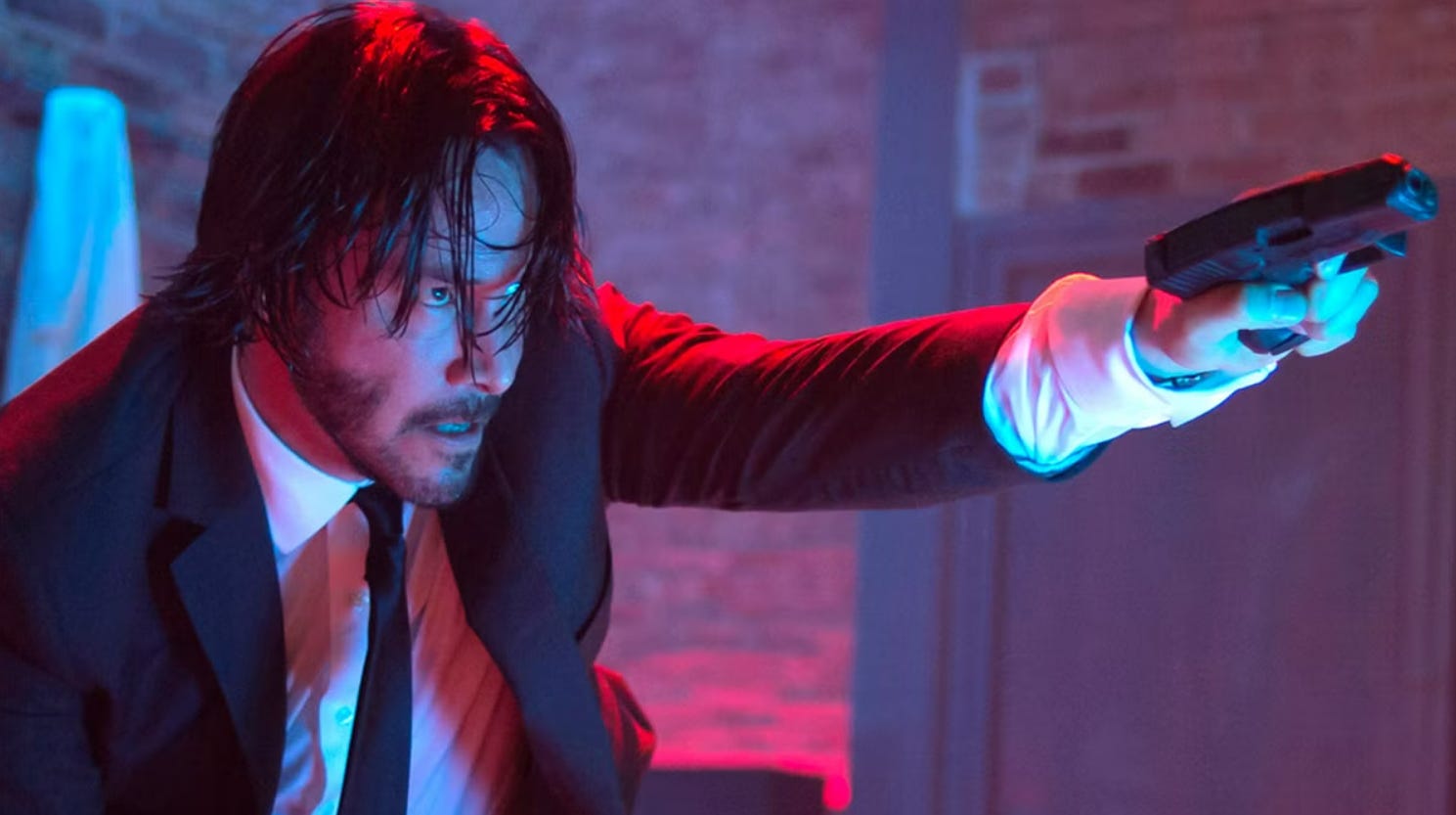
Anyone that knows anything about classic action cinema in the 1980s and 1990s knows about John Woo, the legendary director of the movie Face/Off, and the inventor of the stylish, ultraviolent style of action called “Gun-Fu.” The style of action he introduced was fine tuned and perfected 20 years later with the now iconic John Wick franchise. The kinetic blend of martial arts and gunplay is presented in a vibrant, stylized way that make the action come off as slick and cool, in a way that very few films had done before. You might have been inspired to write a story that evokes a similar feeling as those films. While it can be a challenge to translate this very visual style into prose, it is possible to replicate the rhythm and feel of gun-fu action in written stories. Here are some tips on how to pull it off.
Short and sweet sentences
One of the basic tips of increasing pace in storytelling is to shorten your sentences. This works well in action scenes and especially in gun-fu. Writing gun-fu action is not the time for flowery, literary prose. You want your scenes to have a visceral, kinetic flow that moves briskly. Short sentences help to establish that rhythm that I previously mentioned. Longer sentences in the action slow the tempo down. You generally don’t want that, but that slowdown can be useful when you want to emphasize certain key moments in the action, or even try to write something like the bullet-time effect made popular in movies like The Matrix. Keep your sentences punchy and to the point. here’s an example:
“The hallway narrows. No cover. He moves anyway. Two shots. A body drops. The third man hesitates — and that’s enough.” Notice how the sentences keep the action and tension moving briskly while also showing vividly what is going on.
Emphasize Transitions
In a good action scene, and especially in gun-fu, actions lead directly into other counter actions. You want to show these transitions flowing smoothly. There’s more to gun-fu than shooting, and Wick demonstrates this brilliantly. In one sequence he will shoot somebody at long range, grab an assailant that is getting close to him, flip the guy over to compromise his position, shoot him, throw a nearby object at another oncoming attacker to knock him down before shooting him, then getting up and ducking for cover behind a column, reloading, and shooting another guy, before grabbing an assailant rushing by, using him as a human shield while shooting everyone else, and then shooting his human shield again for good measure. There is very little wasted motion and every move leads right into the next move. Don’t just show attacks, show how one motion becomes the next. This works at the macro level too. You want to the transitions between major points in your scene to move naturally, too. Start your action scene with a brief setup, establishing the location, the stakes and the tension. when the action starts, accelerate the pace with the aforementioned short sentences and rapid action beats. At key emotional or stylistic moments like your characters reloading or a brief stand-off, you slow the action down, only to speed back up and resume the action and fast pace.
Form follows function
When writing your gun-fu scenes, you want to keep your violence visual, kinetic, and most of all functional. Every movement has purpose: A punch creates distance. A shot creates an opening. A takedown clears a firing lane. Your cool action moments must serve the greater tactical focus of the fight. The thing that makes Wick and the other top killers in the franchise so impressive is that their violence is efficient. So when you write your characters in action, make sure they are moving with economy, and each of their moves makes sense given their situation. If they’re not dodging bullets or ducking for cover, there is no need to write your character doing a somersault, dive, tuck and roll.
Another tool for achieving this efficiency is having a good spatial awareness for the setting where the action is taking place. Be sure to keep your reader environmentally oriented, both at the start of the scene and throughout the action. Features such as doorways, pillars, choke points, and staircases provide natural obstacles for some and strategic vantage points for others. Use the geography of the setting to ground the action and draw attention to the tactics of the fight.
Emphasize Physical Choreography
If you look at a good gun-fu fight scene, or really any fight scene in most mediums, it moves like a dance routine, with each move and countermove moving in synch. Sequence and structure are the most important things to keep in mind to keep the fight flowing smoothly. Track the character’s position, movements, and physical flow during the fight. Describe body mechanics of each combatant. Where do their hands go? How does their weight shift from move to move? The reader should be able to see the progression of the scene, with each action leading into its reaction, which flows into the adjustment of the situation. It’s a movement chain that creates the kinetic energy you want your gun fu scene to convey. I also recommend writing your action scenes to music, preferably something uptempo with high energy. Some of the most memorable fight scenes in The John Wick franchise have high octane techno music in the background. Try it and use the music as your metronome to setting the rhythm of your action scene.
Keep it Real
Using authentic language from gun and martial arts culture will do a lot towards adding mystique and aura to your gun-fu fight. Don’t be afraid to use terms from martial arts or gunplay like “center axis relock,” “tap-rack,” “double tap,” and terms like that. Of course, you don’t want to overdo it and risk going over your reader’s head, but sprinkled in it fan he very effective.
Also, your fight scene should be grounded in some semblance of reality, regardless of how outrageous your fight gets. Guns only carry so many bullets, so be sure to show mid-fight reloading. Bullets that miss ricochet and leave marks wherever they land. People (not just your protagonist) take cover and try to use their environment. Not every bullet hit is a kill shot: some bullets graze, others injure. Injuries hurt and can slow down a fighter that has to deal with them. And sometimes a bullet wound isn’t enough to stop an oncoming attacker if their adrenaline is running high enough (especially from a weaker gun). And guns are noisy, even ones using silencers. People scream, especially when they are hurt. Teams of assailants communicate. Be sure to add the sounds of combat to your scene to give it added authenticity.
Make it flashy
The final ingredient to a good gun-fu action scene is the stylish visuals. John Woo’s original action movies used lots of symbolism and imagery one wouldn’t normally associate with gun violence: doves (lots of doves), mirrors, rain and other images that create a certain atmosphere and tone for the battle. Wick does the same with its neon and purple-toned nightclub battles and outrageous props. Good gun-fu fight scenes are an assault on the senses, and you want to create that in your reader’s minds eye. So go heavy with the vivid imagery as you describe the fight. Describe sparks from bullets hitting a nearby chandelier. Mention the floor being slippery from spilled blood. Tell of how the darkness of the warehouse gets lit up when bullets break holes into the glass window, letting in slivers of sunlight that hit the enemy like targeting lasers. Compare that thug getting shot on the balcony and dropping off to a falling angel. Try to make your prose scene as visual as possible.
The mindsets of your combatants can also dictate the pace and style of your action. Agent 47’s detached professional style of fighting in the Hitman franchise flows differently than Eve’s desperate, improvisational fights in Ballerina. Wick fighting for vengeance in his first movie feels different from him fighting for survival in his third, which feels different from him fighting for freedom in his fourth. The mindset of the fighter should be reflected in the way they fight, and specifically in how you depict the way they fight.
Conclusion
Translating a visual storytelling style like gun-fu into prose can be a daunting task, but it can be done, and you can do it. Keep the pacing brisk and the imagery vivid, and you should be able to add some thrilling action sequences to your story.
Is this article helpful? If so then subscribe! I post storytelling advice weekly, with monthly author interviews.
And BTW, I have merch! Show the world how proud you are of being a writer by rocking an I SELL WORDS t-shirt or coffee mug. (I got other stuff too). Visit the link below to get yours

Comments
Nothing yet. Say the first thing.
Sign in to join the conversation.