
I watched the movie! A little late to the trend, perhaps, but excited to discuss it nonetheless. Will keep this top section vaguely spoiler-free as usual, though I don’t think there’s much to ruin with foreknowledge here.
While I vaguely knew about the idea of the Backrooms going into this, I wasn’t quite up on it enough to realize that its lore and origins are (supposedly) entirely distinct from the SCP about the infinite IKEA. (Though the fact that the film also features a furniture store would seem to indicate they’re pulling on both fandoms in order to get butts in seats.)
Today I’ll examine what Backrooms is about, the degree to which it succeeds in its various goals, and briefly discuss how it relates to two of my favourite novels: House of Leaves and Piranesi.
Follow me; you wouldn’t want to get lost.
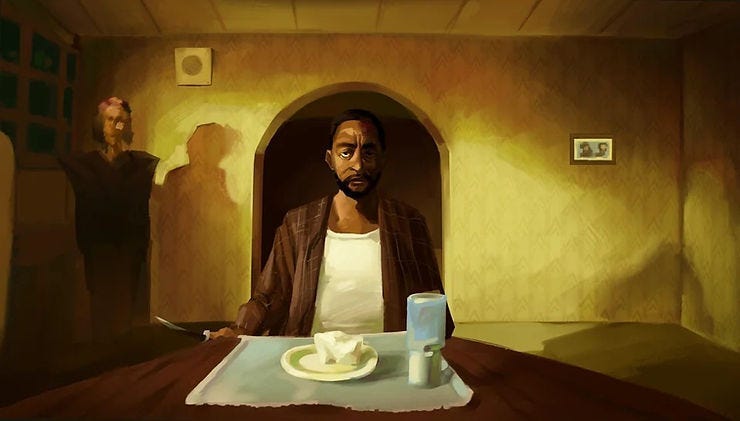
If you’re as yet unfamiliar, the Backrooms originated as an online scary story (“creepypasta”) based on a vaguely off-putting picture of empty office spaces. It added to the internet’s fascination with abandoned and liminal spaces and attracted contribution through imaginative storytelling and further photographs of unsettling places.
One such creator, Kane Parsons, apparently took the idea and ran with it, to the point that his web series was adapted into a feature film by A24. The internet is chock-full of articles on all of that if it’s of interest to you.
The Backrooms film follows Clark, the manager of a furniture store, and Mary, his therapist. Clark discovers an entrance into the infinite, liminal Backrooms in the basement of his store, and explores it before bringing it up to Mary in their next appointment. He then returns with his assistant manager and her boyfriend, both of whom are killed while exploring.
Clark disappears for weeks, prompting Mary to check in. She enters the Backrooms and finds Clark, who has somehow come to learn that the Backrooms are echoes of reality — content degradation and copy decay of the real world. He’s then killed by an echo of his own furniture selling-pirate persona, and she barely escapes by finding a staging area for a corporation investigating the Backrooms.
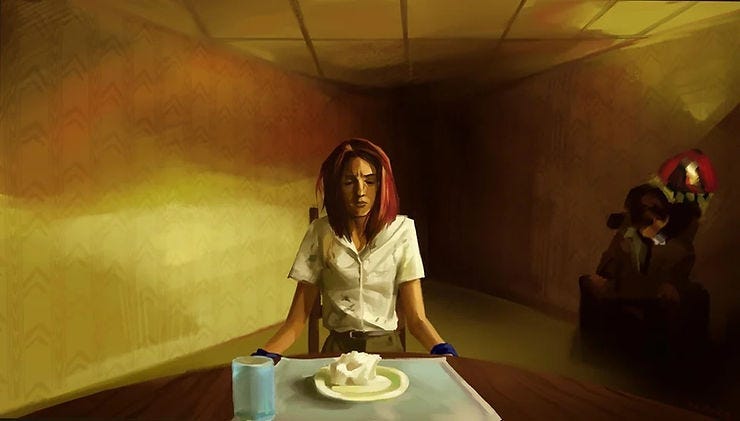
On a visual level, I think Backrooms does a phenomenal job of portraying the uneasy feeling that has always been associated with this idea, as well as the strange wonder of exploring these spaces. The fuse box at the beginning is one of my favourite moments from the film; new switches growing diagonally like tumours and eventually controlling the store’s entire power flow.
The other excellent part for me is seeing hints of human life in this alien world; the corporation exploring this place becoming as alien and unnerving as this other world itself simply by their presence within it.
As a feature film, Backrooms is also obligated to tell an actual human story — something audiences can relate to and maybe even learn from, in addition to necessarily adding stakes and tension. I thought the actors and characters were great, and I really appreciate how hard they pushed the therapy angle with Clark needing to ‘find a new path’ forward.
The idea is that he’s not responding to therapy; that he believes he’s just wired this way — and so has become stuck, lost in the infinite labyrinth of his own mind. Mary as therapist tries to go in and help him, and he attacks her both consciously and otherwise. She barely escapes, having failed to help her patient and with some new trauma to process herself.
It works, if you don’t think about it too hard. But mostly because the filmmakers are jamming a square peg into a round hole with enough blunt force that just about anything would’ve worked.
The Backrooms has its own lore and rules and, most importantly, fans: those certainly came first for the filmmakers, and telling a fully cohesive and meaningful story necessarily came second.
Thankfully, the fraying-mind-as-infinite-liminal-world idea has been done before, and better, in House of Leaves and Piranesi.
I’ve written about both of these novels in great depth before, so I’ll keep this fairly brief — and spoiler-light, in case you want to check them out for yourself.
To massively oversimplify House of Leaves, it follows a man’s growing obsession with exploring the apparently infinite liminal space which suddenly appears in his home. It’s a powerful allegory for his discomfort living as a simple husband and father after a career as a front-line journalist, and it’s only one of many examples in the novel showing how obsession can pull you in and destroy your life before you even realize it’s happening.
Piranesi moves in the opposite direction, beginning with its protagonist living a simple, innocent life in a strange and endless space. (Filled with statues which seem to echo ideas from our own world, in an interesting parallel to Backrooms.) Over the course of the book, ‘Piranesi’ learns more about his past and present and must accept his own agency in determining his future. Both my readings of Piranesi have taken place in single afternoons, and I can’t recommend it highly enough.
The difference between these stories and Backrooms is again simply creative liberty: the filmmakers were bound by the property they were adapting, and so could only messily nod to the same ideas that House of Leaves and Piranesi are able to explore so profoundly.

Backrooms is a fun, well-acted and well-executed film that manages to faithfully and intriguingly adapt the best parts of its source material. In order to have it function as a film, the creators behind it attempted to graft on a Backrooms-esque echo of stories like House of Leaves and Piranesi, which works just well enough while still making me appreciate the originals more.
Currently, Backrooms is the closest thing that exists to an adaptation of either of those books (though stop-motion animation studio Laika is apparently working on a Piranesi film), so I’ll accept it as a fun simulacra of what could be.
What did you think of the film? Any details or allusions I missed?
If you’re a fan of SCP and other online creepypasta, have you read (my review of) There Is No Antimemetics Division?
Thanks for reading and until next time ❤
Comments
Nothing yet. Say the first thing.
Sign in to join the conversation.