
The Knives Out movies are some of my favorites from recent years. Glass Onion is a personal comfort film, with its bright colors and island antics. Wake Up Dead Man has the same grounded feel as the original Knives Out at first, but quickly proves itself to be a deeper look into Catholicism and ideas of faith and guilt. I find that Father Jud’s perspective on Catholicism is one I resonate with even though I don’t attend church regularly anymore.
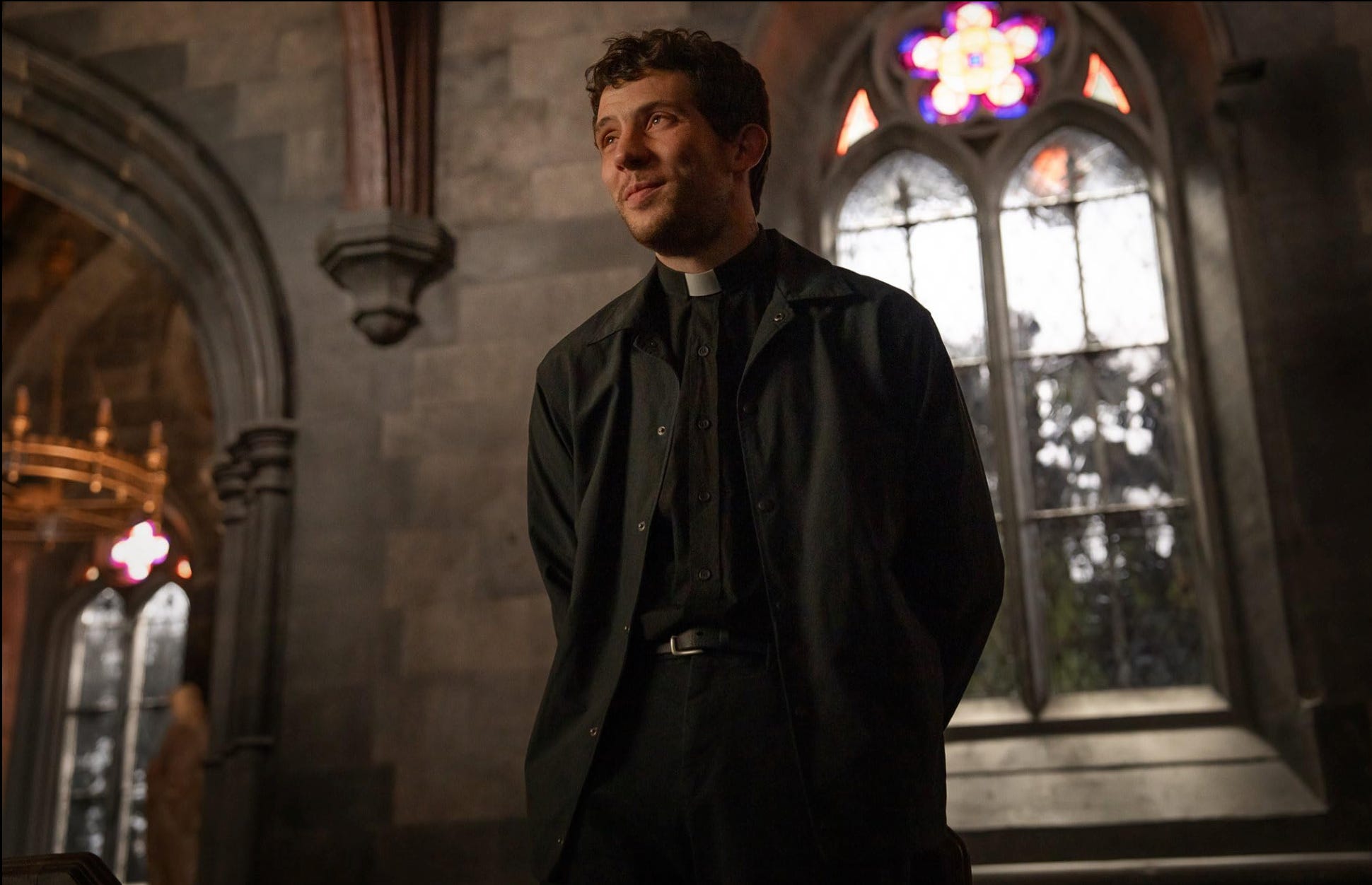
All within the first five minutes of the movie, we gain an understanding of Father Jud’s character and his relation to religion. He punches out a deacon, then argues to the panel of his fellow priests that they should not view those outside the priesthood as something to tame but rather as people to embrace. While the movie still revolves around the murder, Father Jud’s relation to his priesthood takes center stage as the main conflict.
There’s a point when they call a construction company to get information and the woman at the phone won’t let Father Jud get to the point. His patience is tested and his frustration clearly builds, yet all that dissipates as soon as she asks him to pray for her. Father Jud pauses, allows her to unload her troubles and even takes the time to sit down and pray with her over the phone, much to Benoit Blanc’s dismay. Immediately after, despite Blanc’s insisting they resume their search for the killer, Father Jud goes to close the church ahead of the impending storm. Father Jud even rambles to Blanc how this murder case is interfering with his purpose and reasoning for coming to Chimney Rock. This moment is one of many references to the “Road to Damascus,” representing a moment of clarity relating to one’s purpose (keep an eye out for the lighting at moments like these).
Father Jud’s approach to Catholicism directly opposes that of Monsignor Wicks in order to create immediate tension between the two. But I find Father Jud’s preachings also contradict a lot of what we in Catholicism today.
Part of this is due to the fictionalization of Catholicism. The Catholic church is a global institution, meaning all the readings are standardized amongst all churches. In fictional depictions, this standardization takes a backseat to allow the priests more expression outside of their homilies. In Sinners, Sammie’s father gives him a passage to read that conveniently relates to Sammie’s life and impending future. Fictional Catholic priests usually read passages alluding to the story to allow the religion to connect to the narrative. Real life priests must follow the designated passages as set by the Catholic church, making personal connections to the text harder to come by unless sought out by those listening.
Another aspect of Father Jud’s practice that sticks out is his perspective on sin. He aspires to follow in Christ’s footsteps and accept those who sin instead of frowning upon them. A lot of what I can remember from church is this encouragement to find God when tempted by sin, to fight the temptation and to find the strength to fight it with God. What goes rarely mentioned is what to do with God’s forgiveness. Christ’s whole shtick is forgiveness and being friends with anyone—Father Jud is the first fictional priest I’ve seen that follows this philosophy and makes it his mission. While all the other fictional priests reflect the focus on fighting temptation, Father Jud’s was lead to priesthood by his guilt and uses it to inform his practice. With all this talk of “Catholic guilt” (that is, guilt as a result from being raised in Catholicism), rarely is there a discussion surrounding how to use Catholicism to find peace with guilt.
Maybe these ramblings are rooted in my outdated memories of being Catholic, but Father Jud really resonated with my dormant religious side. He represents what Catholicism should aspire to be, especially in this modern age. Father Jud comments on Blanc’s claim that religion is just a set fairy tales, agreeing that religion is storytelling. Father Jud asks “do these stories convince us of a lie? Or do they resonate with with something deep inside us that’s profoundly true? That we can’t express any other way…except storytelling.”
Narratives that explore the role of faith interest me because I find personal beliefs to be not only fascinating, but necessary. My favorite show, Yellowjackets, explores this type of belief as something to keep the girls alive in the wilderness. Whether they truly believe in an entity in the wilderness or not, each surviving character has a truth they hold within themselves that allows them to keep going, to keep wanting to survive. Characters who die either die after losing their faith in their internal truth or by believing in it so strongly they unintentionally sacrifice themselves to it…maybe this is an article for another time.
The point stands, though, that faith in an internal truth, like Father Jud mentions, can manifest itself outwardly through stories. And when Father Jud is able to express that, when the light shines on his first road-to-Damascus moment, he feels like a priest again. His story, being a boxer who found peace in priesthood, represents his internal truth of guilt needing to be accepted rather than avoided.
No posts
Comments
Nothing yet. Say the first thing.
Sign in to join the conversation.