
This week’s digging produced a remarkable find: A three-page letter from Walter Quigley to Vice President Richard Nixon, offering his dark services in the 1960 presidential campaign. Quigley lays out his methods in exceptionally clear, startling language.
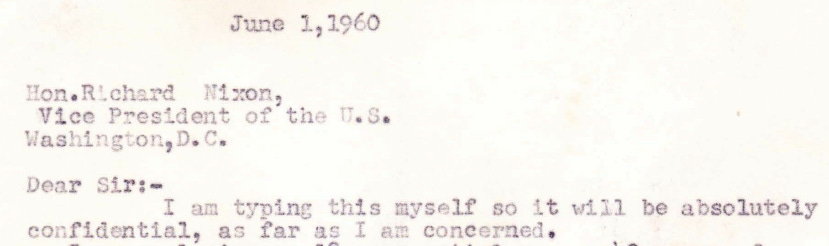
“My plan of operation is this: I go through the Congressional Record, checking every word my ‘victim’ says and analyzing every vote. After this basic research I prepare a four-page newspaper. Then I take the Postal Guide and send these to every boxholder, rural, local and star route, and use telephone books to get them to people in the cities with mail delivery.”
Quigley offers to work for Nixon digging up dirt on the Democratic ticket. (At this point, John F. Kennedy was the presumptive nominee, but he had not picked a running mate.) “No matter how conscientious a Senator is, after he answers several hundred rollcalls he can be blasted,” Quigley writes. “I would, across the front page, run pictures of Lenin, Stalin, Khruschev and Reuther. Under the three Russians some damning quotes about religion.”
Quigley takes some credit for Hubert Humphrey’s loss to Kennedy in the 1960 Democratic primary, then says he has “literally a suitcase” of similar dirt on Lyndon Johnson. Quigley details his work in California for Dwight Eisenhower in 1952, noting that “voters like to go against a man, being mad at him, rather than vote on fundamental issues.”
Quigley says he publishes his papers using a front organization, The Veterans Good Government League. He suggests that it would be better to have an individual, rather than a political committee, finance the operation, which will cost $7,000. He says “John Johnson” will make all the arrangements, then points out that there are 106 John Johnsons in Minneapolis alone.
The letter is dated June 1, 1960 and addressed to Nixon in Washington. Did Nixon receive it or reply? I do not know. (I would ask if there are records in Nixon’s presidential library, but it is closed due to the government shutdown.) The letter is filed among others to which he did receive replies, so there is an absence of evidence if not evidence of absence. I know of no smear newspapers produced against Kennedy in the 1960 campaign, which Kennedy, of course, narrowly won.
Besides, it sounds too crude, even for Nixon, who rose to power during the Red Scare by calibrating his outrage. Nixon found Joseph McCarthy useful, but he let McCarthy be extreme so that he didn’t have to. By 1960, tying politicians to Soviet leaders was less effective than it had been in 1950. Nixon had plenty of other dirty tricks, and his own dirty workers to do them.
Read the whole letter here.
Enjoy this post? Learn something? Why not:
Comments
Nothing yet. Say the first thing.
Sign in to join the conversation.