
This post is the second in a series that looks at noteworthy works to see how they are put together. The first installment was on E.L. Doctorow’s Ragtime; read it here.
All the King’s Men (1946) is Robert Penn Warren’s book about the relationship between time, truth and knowledge. It’s about America’s ideas about itself and the relationship between those ideas and the truth. It’s about men — pretty much all men — whose idealism is also their undoing. I really loved rereading this book, from the structure to the ideas to the prose. (Warren won the Pulitzer Prize for this book, but he also won it for poetry — twice.) ATKM often gets talked about as an allegory for the rise and fall of Louisiana Governor Huey Long, but the book’s real concerns are much deeper than indicting corrupt populism.
The story is not linear. Almost every chapter — there are 10 — could stand as a novella.1 Each chapter circles around an idea as it tells a chunk of the overall story. The first-person narrator, Jack Burden, rambles metaphysically while going on long walks or long drives, smoking cigarettes and steadying himself with liquor. After telling a tale, Jack returns to the idea to see how it holds up to the events. Some are stories about Jack’s youth or his family, while some are told from Jack’s present day (the late 1930s).
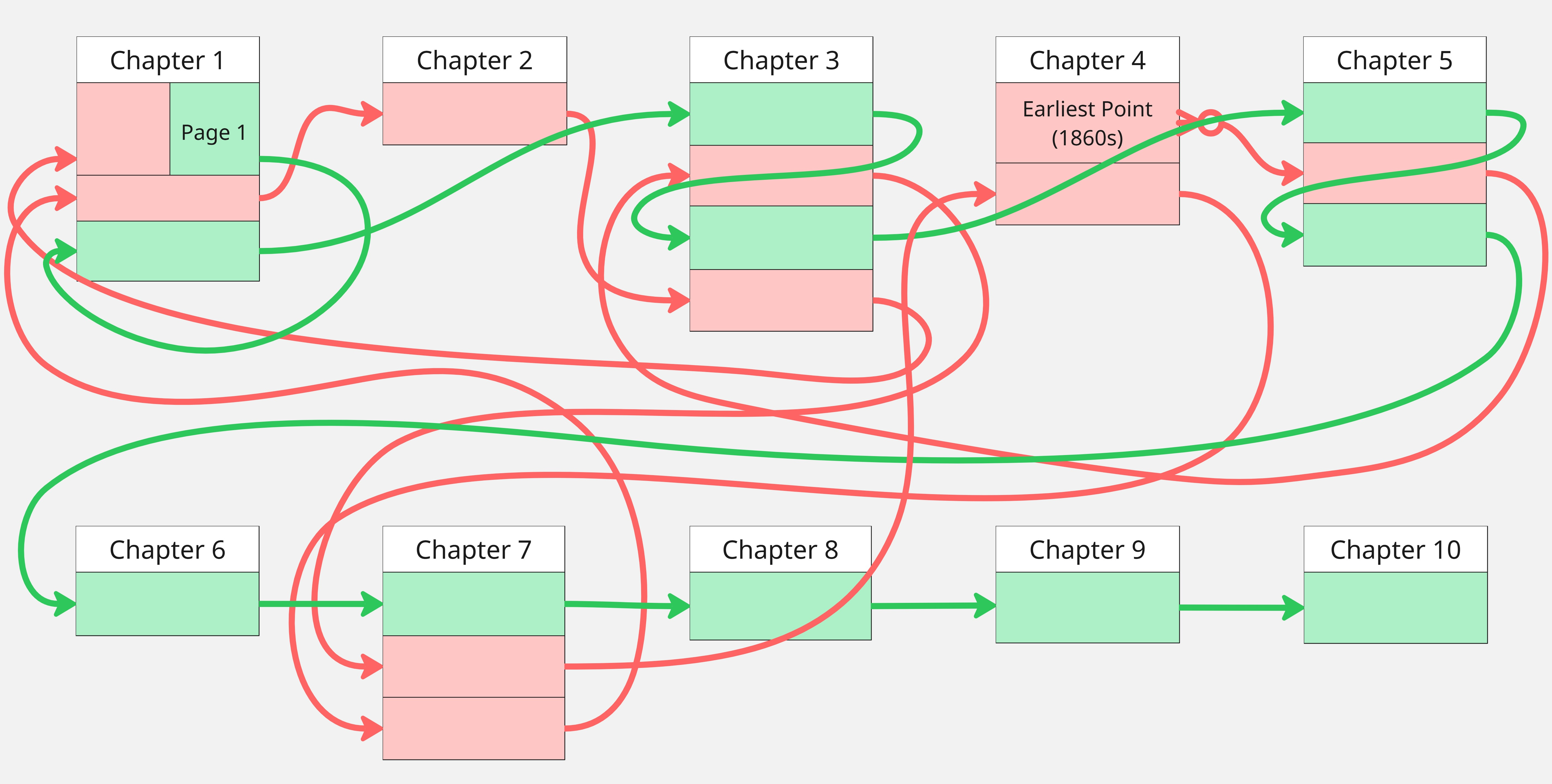
Once the book is done, its development seems quite deliberate, as does the order of the chapters. Warren knew what he was doing, setting aloft ideas in the earliest pages that do not land until the book’s end. I wanted to see how he did it. First, I tried to put the chapters in chronological order to see whether that would shed light on the story. If you fix each chapter in time during the bulk of its events, you get this:

This shows us that Warren paces his story creatively, but it’s otherwise not very illuminating. (Chapter One and later events are in green because Chapter One is where the reader starts.)
Next, I diagrammed the book’s rough structure in two timelines. One, in green, is Jack’s “present-day” story, the main narrative. The other, in red, tracks the stories that come before the start of that story, in the order they are relayed. (There is a third chronology that’s not pictured: The order in which we read the chapters, namely, 1-10.) Some chapters contain both present events and flashbacks, so this gives us a more complex picture of how Warren thought about the chronology.2
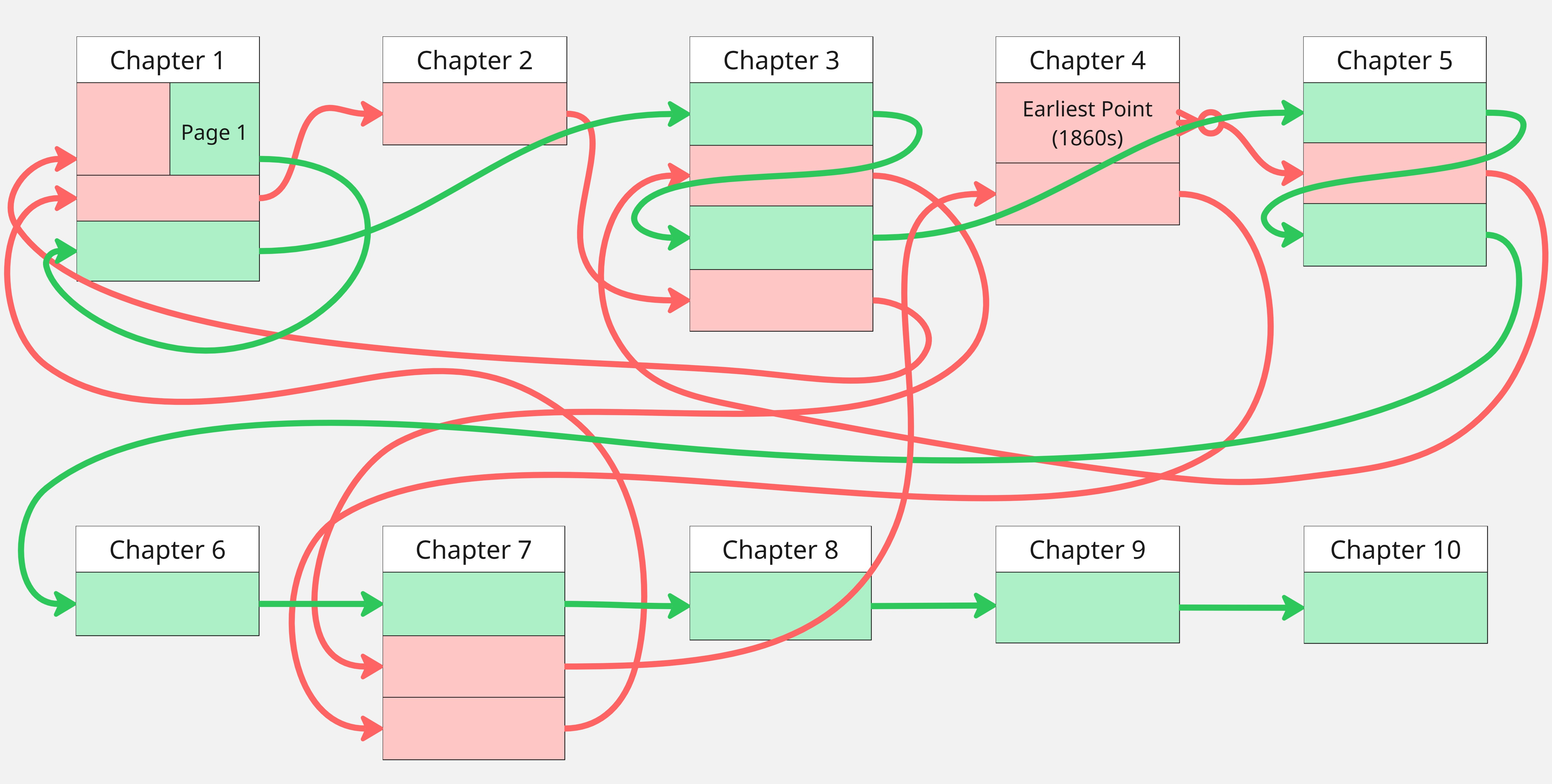
Let me try to explain how to read this, starting with Chapter One. Chapter One is great because the whole book is in it. Warren lays out the characters and their conflicts masterfully. Jack is one of the “king’s men,” an all-purpose fixer for Willie Stark, the populist governor of an unnamed Southern state.3 Jack introduces us to Willie’s family and his top aides; he also retells his first meeting with Willie some 15 years earlier. The chapter dramatizes a standoff between Willie and Judge Irwin, a father figure to Jack, that sets the plot in motion. This standoff starts a conflagration, a Greek tragedy, that will change everyone by the end of the book—most not for the better. Chapter Two then jumps back in time to recount how Jack helped create Willie’s political career.
Let me point you to one other spot. Check out Chapter Four, which sits near the middle of the book but takes place first chronologically. In it, Jack tells the history of his Civil War ancestors.4 You might wonder why Warren interrupts the main narrative with a lengthy history lesson. And why here? It seems like an unnecessary digression to a time when Jack studied for a PhD in history, which he eventually abandoned, along with his marriage, for journalism and politics. My answer is that in the next chapter, Jack investigates his former mentor, Judge Irwin. He’s looking for dirt to blackmail the judge. The reader needs to believe that Jack has the research skills to pull off the investigation, and Jack’s exegesis of his family’s past shows that he does.
Does the diagram make sense? If so, why not click:
The chapter also develops Jack’s character as he absorbs lessons from his ancestors and measures himself and his contemporaries against them. One lesson may be Warren’s metaphorical take on the poisoned history of the South:
[T]he world is like an enormous spider web and if you touch it, however lightly, at any point, the vibration ripples to the remotest perimeter and the drowsy spider feels the tingle and is drowsy no more but springs out to fling the gossamer coils about you who have touched the web and then inject the black, numbing poison under your hide. It does not matter whether or not you meant to brush the web of things. Your happy foot or your gay wing may have brushed it ever so lightly, but what happens always happens and there is the spider, bearded black and with his great faceted eye glittering like mirrors in the sun, or like God’s eye, and the fangs dripping.
This butterfly effect holds true for Jack, for our history, for ourselves. Jack ultimately abandons his studies, and his naive idealism, when he realizes that despite all his research he can never understand his ancestor’s choices. If time is a web, not an arrow, then my diagram starts to make more sense.
In a later chapter, Warren contrasts the spider web with a more deterministic metaphor of humans as twitching muscles that merely respond to stimulus. We can attach good or evil to our actions only after the fact; we make it up as we go. As Willie Stark puts it, “What folks claim is right is always just a couple of jumps short of what they need to do business.” That ought to sound familiar if you’ve been reading the news lately. Jack’s task in the book is to reconcile Willie’s notion of politics with the moral concerns from which he feels descended. It is our task now, too.
Many books these days have dozens of chapters. But, like ATKM, Animal Farm has 10; The Great Gatsby has nine, while Lord of the Flies has 12. Are these “classics” on to something?
Speaking of Gatsby, it uses a similar structure to construct Jay Gatsby’s backstory, though I think ATKM’s is more elaborate and effective. I also see a resemblance between their final paragraphs. Here’s ATKM, which I rather liked and had nowhere else to put in this post:
We shall come back, no doubt, to walk down the Row and watch young people on the tennis courts by the clump of mimosas and walk down the beach by the bay, where the diving floats lift gently in the sun, and on out to the pine grove, where the needles thick on the ground will deaden the footfall so that we shall move among trees as soundlessly as smoke. But that will be a long time from now, and soon now we shall go out of the house and go into the convulsions of the world, out of history into history and the awful responsibility of Time.
The diagram reflects some subjective decisions, and you might make them differently.
Also, it’s possible to make a similar diagram showing how theme topics arise and develop across the book. That endeavor is too complicated and requires too much explanation for this post.
Warren is pretty good with the ironic aptonyms.
His ancestors are two brothers, one a tragically doomed idealist and the other a practical success. Both fight for the Confederacy, a cause to which the idealist loses his life, even though he’s an abolitionist. At one point, the brothers meet Jefferson Davis, to whom Warren gives this memorable line: “I have in the present moment only the melancholy pleasure of an easy conscience.”
Comments
Nothing yet. Say the first thing.
Sign in to join the conversation.