


The global micro-drama market represents a fundamental structural shift in digital entertainment, replacing traditional long-form video with hyper-compressed vertical series optimized for mobile consumption. Originating from the domestic Chinese market, which surpassed seven billion dollars in 2024 to overtake domestic theatrical box office, the category expanded into an eleven to fourteen billion dollar global app economy by early 2026. This expansion is driven by cumulative in-app purchase revenue exceeding two point three billion dollars and quarterly consumer spend reaching seven hundred fifty million dollars.
The operational architecture relies on a sharp geographic divide. High-monetization mature markets, primarily the United States, serve as the commercial anchor by contributing roughly half to sixty percent of global in-app revenue. US monetization is supported by average daily active user revenues between one dollar twenty cents and one dollar forty cents. Conversely, volume growth is concentrated in mobile-first regions such as Southeast Asia, Latin America, and India, which collectively account for over three-quarters of global downloads. This geographic divergence forces operators to adopt hybrid business models, combining direct micro-transactions in Western markets with ad-supported distribution in emerging economies.
Unlike conventional subscription video platforms, vertical drama applications operate at the intersection of performance marketing, mobile gaming mechanics, and serialized melodrama. Content is delivered in ninety-second vertical episodes designed around rapid emotional engagement. Rather than relying on organic brand loyalty, platforms deploy paid acquisition campaigns to capture mobile viewers during short leisure windows.
Competitive moats in this space are defined by algorithmic distribution efficiency, rapid production cycles, and specialized storytelling frameworks like the four-part beat engine. Market leadership is concentrated in a duopoly of ReelShort and DramaBox, which together represent roughly seventy percent of global in-app spending. Secondary challengers such as ShortMax, FreeReels, NetShort, and MyDrama are carving out market share through localized content translation or studio partnerships. Ultimately, platforms built to win must balance high-frequency user acquisition with disciplined content execution across globally fragmented audiences.

Financing the growth of vertical micro-drama platforms requires a capital allocation strategy distinct from traditional media enterprises. Rather than placing heavy long-term capital into balance-sheet intensive studio infrastructure or multi-million-dollar production assets, operators distribute capital into rapid content manufacturing and aggressive user acquisition channels. The financial profile is defined by an ongoing operational tension between low upfront production expenditure and extremely high ongoing performance marketing costs.
A typical hundred-episode vertical series requires a modest production budget between one hundred fifty thousand and three hundred thousand dollars. Production teams employ asymmetrical capital allocation, devoting a disproportionate share of funding and high-end camera equipment to the first ten episodes. These initial episodes serve as free conversion assets designed to pass the initial viewer threshold, while subsequent episodes are produced at maximum throughput to fulfill content delivery.
The primary drain on operating capital is customer acquisition cost. Because viewer retention experiences sharp decay, falling from nearly twenty-seven percent on day one down to five percent by day fourteen, platforms cannot rely on passive organic retention. Marketing expenses routinely consume up to ninety percent of total platform budgets, often exceeding initial production expenditures by nine times. Paid user acquisition accounts for sixty to seventy percent of total app installs, with acquisition costs reaching twenty to thirty dollars per install in competitive North American markets.
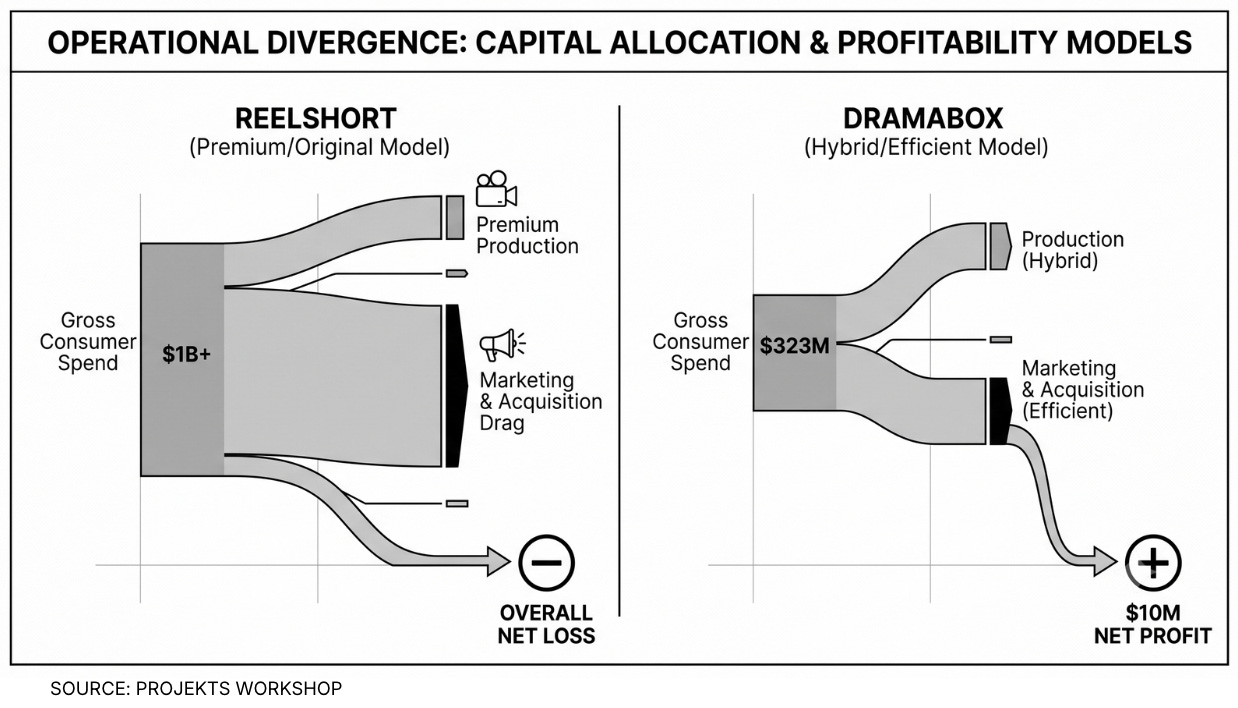
This high marketing drag creates a clear divide in profitability across major industry peers. ReelShort, backed by Shenzhen-listed COL Group, achieved over one billion dollars in gross consumer spend by 2025 through premium original productions filmed in Los Angeles. However, high marketing costs and capital-intensive production standards have kept the entity operating at an overall net loss. To spread financial risk, the parent firm expanded into a multi-platform portfolio. In contrast, DramaBox, operated by StoryMatrix and backed by Beijing Dianzhong Technology, achieved ten million dollars in net profit on three hundred twenty-three million dollars in revenue in 2024. DramaBox achieved capital efficiency by utilizing lower-cost localized translations of proven scripts alongside targeted original shoots.
Capital efficiency is further dictated by payment processing fees and platform commissions. Native mobile transactions through the Apple App Store and Google Play carry a standard thirty percent fee, netting seven hundred thousand dollars per million dollars of gross billing to the publisher. To optimize capital recovery, platforms are increasingly directing users toward web-based checkout portals managed by Merchant of Record processors. Direct web processing reduces transaction expenses to approximately four to five percent for card processing and tax management, returning ninety-five percent of gross revenue to the publisher.
Monetization relies on dual revenue streams: coin-based micro-transactions and auto-renewing weekly subscriptions. Individual episodes cost thirty to fifty cents in virtual coins, bringing the total cost of an eighty-episode series to thirty or fifty dollars. Weekly subscriptions, ranging from five dollars ninety-nine cents to nineteen dollars ninety-nine cents, provide consistent cash inflows while lowering the barrier to entry. Supplemental capital is increasingly generated through programmatic ad sales, such as DramaBox integration with demand-side ad platforms, and strategic funding from legacy media entities like Fox Entertainment.

Platforms view marketing as a short-term liquidity funnel rather than a long-term brand builder. Because ninety-four percent of users churn within two weeks, profitability relies on immediate monetization. High-frequency micro-transactions and weekly subscriptions extract maximum capital from a converting minority during peak emotional engagement, allowing platforms to recycle cash directly back into user acquisition channels.
A hybrid model provides superior capital efficiency and rapid scaling. By taking proven domestic scripts and adapting them via AI translation, localized dubbing, or selective re-shooting, operators dramatically reduce script development cycles and per-episode costs. This allows platforms to test high volumes of content in international markets while reserving higher production budgets for proven concepts.
Operators utilize legal framework changes and direct web checkout mechanisms. Following regulatory shifts like the European Union Digital Markets Act, platforms route mobile users through external web portals using Merchant of Record billing. This approach reduces processing fees from thirty percent down to roughly five percent, substantially boosting net margins on coin purchases and subscription renewals.
Regulatory enforcement targeting recurring billing structures and subtle user interface prompts presents severe operational compliance risk. Divergence between high app store ratings and low customer review scores highlights growing consumer dissatisfaction with non-consensual coin deductions and hidden auto-renewals. Regulatory penalties or forced billing redesigns could reduce conversion rates and increase customer service overhead.
Legacy media entities treat vertical drama platforms as low-cost intellectual property incubators and alternative monetization channels. Through direct capital contributions, accelerator programs, and distribution partnerships, studios gain access to highly engaged mobile audiences. Simultaneously, micro-drama platforms gain institutional legitimacy, premium brand alignment, and potential long-term development opportunities for breakout vertical series.

The vertical micro-drama industry has transitioned from a localized mobile experiment into an established global digital entertainment sector. Its long-term viability depends on resolving the structural tension between low-cost production efficiency and exorbitant performance marketing expenditures. High consumer acquisition costs combined with rapid retention decay mean that top-line gross consumer spend is an incomplete measure of operational health. True enterprise sustainability requires disciplined capital deployment and aggressive margin optimization.
Market viability will be determined by three core strategic pivots. Platforms must reduce dependence on native app store payment channels by scaling direct web-based checkout systems, reclaiming substantial gross margin. Operators must also balance paid micro-transactions with programmatic ad monetization and rewarded ad integrations to extract value from non-paying user cohorts. Additionally, integrating artificial intelligence tools into script translation, pre-production planning, and post-production workflows will remain vital to compressing production schedules and lowering episode baseline costs.
Furthermore, deep institutional alignment with legacy media companies and ad-tech ecosystems offers a path toward lower user acquisition friction and broader commercial distribution. However, management teams must proactively address regulatory scrutiny surrounding subscription auto-renewals and coin deduction mechanics to avoid operational disruption. Platforms that successfully combine disciplined hybrid content sourcing, direct billing architectures, and compliance-first consumer design are best positioned to achieve durable profitability and long-term market leadership in the mobile video ecosystem.

State of Short Drama Apps Report - Sensor Tower (2025)
Microdrama Apps Overtake Streamers on Mobile - Media Marketing (2026)
Hollywood Moves into Vertical Dramas and Micro-Series - Business Insider (2025)
Global Micro-Drama Distribution Platforms Market Guide - Vitrina AI (2025)
SAG-AFTRA Verticals Agreement Contract Framework - SAG-AFTRA (2025)
Fox Entertainment Strategic Investment in Holywater and MyDrama - 36Kr (2025)
Short Drama Apps Performance and Profitability Analysis - Media Partners Asia (2025)
No posts
Comments
Nothing yet. Say the first thing.
Sign in to join the conversation.