

The direct to consumer streaming industry has completed a full economic cycle, moving from radical unbundling back toward centralized platform aggregation. During the initial growth phase, media conglomerates aggressively dismantled traditional cable packages to establish direct billing relationships with audiences. That strategy operated on the assumption that consumers would indefinitely stack standalone subscription tiers. However, macroeconomic forces quickly triggered an operational retreat. Retail pricing for ad-free tiers rose by 54 percent between 2021 and 2025, outstripping wage growth and broader inflation. As household subscription stacking capped at four services in the United States and two in Europe, industry subscriber growth dropped from 12 percent in 2024 to 7 percent in 2025, marking acute platform fatigue.
To offset plateauing additions and escalating customer acquisition costs, entertainment providers are pivoting toward multi-platform bundling. Packaging competing platforms together, including combinations like Disney+, Hulu, and Max, or Netflix, Peacock, and Apple TV, functions as a structural realignment. Modern re-bundling is far more than a discount strategy. It serves as an economic architecture designed to recreate the high margin, low churn stability of legacy cable television while concealing underlying subscriber turnover.
Consequently, the primary competitive moat in digital media has shifted from single app exclusivity to defensive portfolio aggregation. Frictionless monthly cancellation mechanisms previously enabled consumers to binge single titles and churn immediately. By contrast, joint ventures, wholesale distributor arrangements, and operating system hubs construct defensive moats by combining diverse libraries spanning prestige drama, family content, and live sports. This content breadth smooths engagement gaps, elevates perceived utility, and establishes discounted multi-service packages as the foundational mechanism for long-term operational endurance.

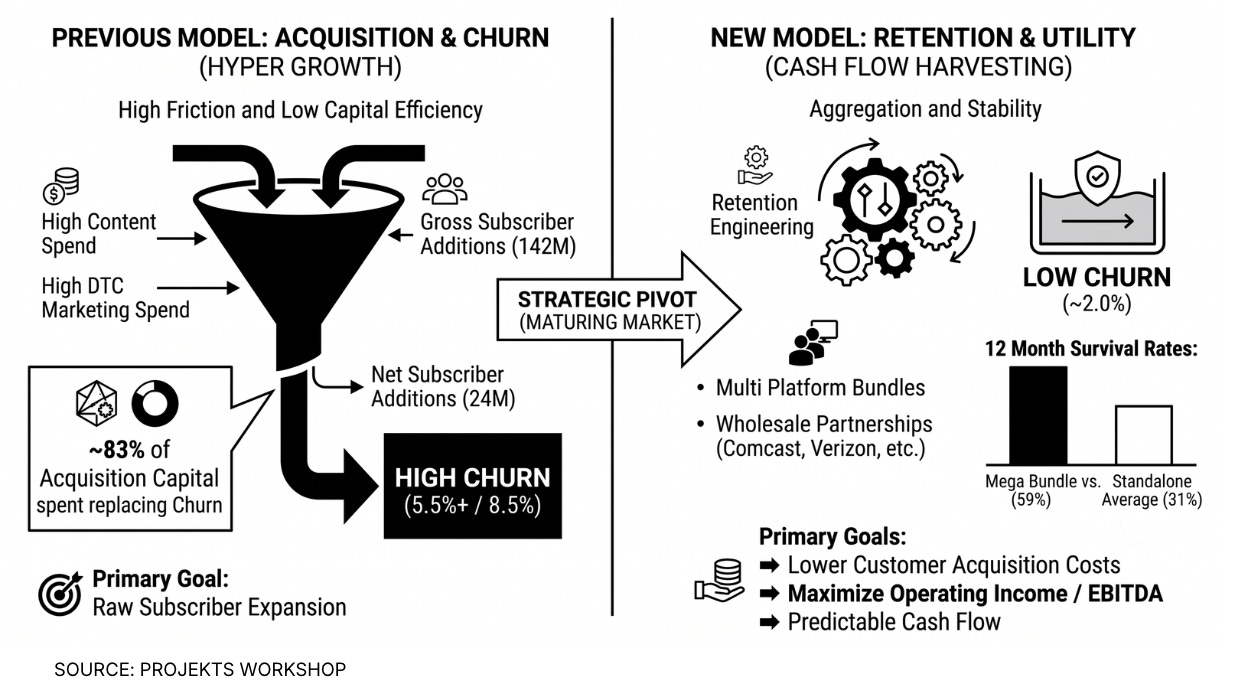
The financial profile and capital allocation strategies of direct to consumer streaming platforms have undergone a fundamental shift. During the hyper growth phase, media networks deployed vast amounts of capital toward exclusive content creation and aggressive performance marketing to maximize top line subscriber counts. However, the standalone subscription model proved capital inefficient over time. Frictionless monthly cancellation mechanisms enabled serial churners to subscribe, binge specific titles, and cancel immediately. In 2023 alone, premium domestic streaming services generated 142 million gross subscriber sign ups but realized a net addition of only 24 million accounts. Over 83 percent of gross customer acquisition capital was effectively spent merely replacing lost subscribers. This continuous turnover severely impaired capital efficiency and return on invested capital across the media sector.
Re-bundling alters this financial equation through retention engineering and cost structure optimization. From a financial health perspective, multi platform bundling stabilizes customer lifetime value and lowers customer acquisition costs. Average active monthly churn for standalone platforms ranges between 5.2 percent and 5.5 percent, with second tier services experiencing churn as high as 8.5 percent. In contrast, multi service offerings like the Disney, Hulu, and Max mega bundle achieve 12 month subscriber survival rates of 59 percent, significantly outperforming standalone platform averages of 31 percent. Lowering active monthly churn across the industry toward 2.0 percent eliminates the burden of acquiring roughly 45 million gross subscribers annually just to maintain a flat user base. Capital previously allocated to churn replacement marketing can consequently be preserved or reallocated toward high return operational priorities.
To strengthen balance sheets and secure predictable cash flows, media conglomerates have restructured their distribution funding mix through wholesale telecommunications partnerships. Hybrid carriage deals, such as the agreement between Charter Communications and Disney, as well as aggregator models like Comcast StreamSaver and Verizon myPlan, trade higher retail pricing for guaranteed wholesale volume. Under these arrangements, telecom carriers pay media networks a discounted wholesale rate per subscriber line in exchange for embedding streaming access directly into broadband and mobile utility packages. While this wholesale model dilutes average revenue per user, domestic Disney+ ARPU remained flat at $8.09 despite retail price increases, it substantially improves segment risk profiles. Wholesale agreements carry near zero direct marketing expenses, eliminate subscriber credit risk, and establish multi year distribution contracts that insulate corporate cash flows from direct consumer volatility.
Furthermore, accounting standards under U.S. GAAP allow media platforms to recognize revenue and report users as paid subscribers as long as the provider receives wholesale compensation, regardless of whether the end user ever activates or streams content. This accounting mechanism enables streaming networks to absorb retail subscription cancellations by replacing them with wholesale entitlements, masking underlying consumer churn on corporate balance sheets and preserving reported platform scale.
Recognizing that top line subscriber expansion no longer drives market valuations, major media networks have moved to alter their primary reporting disclosures. Led by industry pivots from Netflix, Disney, and Paramount, media companies are permanently phasing out quarterly paid subscriber counts and regional ARPU figures by 2026. Financial reporting is shifting entirely toward direct to consumer segment operating income, adjusted EBITDA, and operational cash flow generation. Capital structure management in the streaming sector has maturely transitioned away from high beta expansion funding. Media enterprises now manage their streaming segments as cash flow harvesting utility assets, prioritizing margin expansion, debt reduction, and sustained operational liquidity over raw user growth.

Direct joint ventures allow competing media companies to pool content portfolios, reducing reliance on individual hit titles. By combining diverse libraries into a single bill at a significant discount, platforms smooth out viewer engagement lulls and lower monthly customer churn. This shared distribution model cuts customer acquisition spending while extending average subscriber lifetimes across all participating platforms.
Wholesale agreements trade higher retail subscription pricing for lower wholesale per-line fees across millions of telecom customers. Although this structure depresses average revenue per user, it eliminates direct marketing costs, absorbs customer credit risk, and provides guaranteed multi-year revenues. The result is higher structural profitability and superior customer lifetime value despite lower per-user revenue figures.
Ad-supported tiers provide a lower retail price entry point for cost-conscious consumers while unlocking dual revenue streams from subscriptions and digital advertising inventory. Although standalone ad tiers suffer from elevated churn, embedding them inside multi-platform bundles stabilizes retention rates. This strategy allows streaming networks to capture price-sensitive audiences without sacrificing operational yield or overall platform scale.
Operators are removing subscriber disclosures to redirect market focus away from short-term user volatility and wholesale revenue dilution. As organic direct-to-consumer growth matures, headline subscriber gains no longer correlate directly with financial performance. Eliminating these metrics allows executive management to focus public reporting on direct-to-consumer segment operating income, cash flow generation, and disciplined margin expansion.
Serial churners subscribe to watch specific program releases and cancel immediately after viewing. Bundling combats this behavior by surrounding specialized content with broad libraries spanning family, drama, and sports programming. The resulting higher perceived value threshold makes canceling unappealing, effectively locking consumers into continuous monthly billing cycles and significantly improving cohort survival rates over time.

The convergence of market saturation, escalating price fatigue, and elevated churn rates has forced a structural redesign of the direct to consumer media sector. Standalone streaming services operating without broader ecosystem protection faced unsustainable acquisition economics, spending over 83 percent of acquisition budgets simply replacing churned users. In response, media conglomerates have abandoned pure unbundling in favor of aggregated platform bundling and wholesale carrier integrations.
Connecting these strategic shifts to corporate financial structures reveals a clear operational alignment. By trading direct retail billing for joint ventures, wholesale entitlements, and carrier packages like Comcast StreamSaver and Verizon myPlan, entertainment companies are willingly sacrificing unit ARPU growth to secure structural retention. Lowering active monthly churn from over 5 percent down toward 2 percent provides the exact retention protection needed to stabilize subscriber survival curves over 12 month periods. Furthermore, accounting standards that permit counting wholesale entitlements as paid accounts allow media firms to conceal retail cancellations behind broad telecom distribution networks.
The definitive strategic direction for the streaming sector is a permanent transition into a cash flow harvesting utility model. Phasing out quarterly subscriber disclosures and regional ARPU metrics by 2026 marks the official end of streaming as a high growth asset class. Media organizations will increasingly utilize forced bundling, ad tier monetization synergies, and deep telecom utility integrations to maximize direct to consumer segment EBITDA and operating income. Aggregation has successfully reconstructed the structural economics of the legacy cable bundle, ensuring predictable recurring revenues in a fully saturated media market.

The Re-Bundling of Media: Navigating Platform Fatigue and Aggregation - Boston Consulting Group (2025)
Charter Communications and Disney Multi-Year Distribution Agreement - Disney Investor Relations (2023)
How Media Giants Are Hiding Churn Inside Cable and Wireless Bundles - The Wall Street Journal (2024)
Streaming Services Embrace Re-Bundling to Curb Churn as Growth Slows - Variety (2024)
Disclosure Framework Modifications and Segment Income Reporting - Netflix Investor Relations (2024)
Telecom Aggregation Models and Wholesale Carrier Unit Economics - MoffettNathanson Equity Research (2025)
No posts
Comments
Nothing yet. Say the first thing.
Sign in to join the conversation.