

The theatrical film distribution sector operates within a highly compressed monetization window where a product’s commercial success is frequently decided during its first seventy-two hours of wide release. To navigate this high-stakes environment, major entertainment studios have developed a sophisticated strategic framework designed to manage the release of qualitative information. At the center of this market positioning is the review embargo, which functions as a tactical corporate shield to maintain structural information asymmetry, suppress early critical consensus, and lock in high-margin pre-sales.
This business model systematically exploits consumer behavioral patterns through strategic non-disclosure. According to classic economic principles, withholding product information should signal low quality to rational buyers, causing the market to unravel. In theatrical distribution, however, complete unraveling fails because a large segment of the consumer base operates with bounded rationality. These buyers do not interpret a late embargo as a negative signal, allowing studios to capture a substantial cold-opening revenue premium.
From an external environment perspective, this strategy serves as a vital defensive moat. In a landscape marked by depressed domestic box office revenues and hyper-accelerated digital word of mouth, studios face intense pressure to recover massive upfront investments. To mitigate the risk of negative critical bias, which exerts severe downward pressure on initial sales, distributors leverage structural moderators like recognizable talent and large production budgets. These elements serve as economic insurance, buffering the impact of poor reviews.
While this system is built to maximize immediate liquidity, it introduces long-term operational vulnerabilities. The intentional suppression of information protects opening-weekend capital but accelerates the front-loading of the theatrical lifecycle. Once the initial window closes and organic public word of mouth spreads, the constructed marketing narrative decays, leading to historic second-weekend revenue drops. This institutional report examines how the modern review embargo functions as a tool for capital preservation, balancing short-term cash flow optimization against long-tail commercial stability.

Financing operations within the theatrical distribution sector requires a delicate balance between massive upfront capital expenditures and rapid cash recovery. Wide-release theatrical rollouts demand substantial investments, with prints and advertising budgets routinely ranging from twenty million to forty million dollars per title, separate from actual production costs. To fund these slates, major entertainment conglomerates rely on a mix of corporate debt, revolving credit facilities, and equity financing through retained earnings. Given the high fixed costs and inherent volatility of the creative marketplace, managing the capital structure efficiently is essential for maintaining corporate solvency and strong credit ratings.
A primary challenge in this capital structure is the highly front-loaded nature of cash inflows. Because theatrical exhibitors retain roughly half of all domestic ticket sales, distributors must maximize gross revenues during the initial release window to service their short-term obligations. This operational reality elevates the importance of the weighted average cost of capital, which becomes highly sensitive to consecutive box office underperformance. If a studio delivers multiple high-budget failures, its credit profile weakens, driving up borrowing costs and restricting access to future production capital.
To mitigate these financial risks, studios utilize the review embargo and digital ticketing architecture as tools for capital preservation. Advance ticket sales act as an immediate liquidity injection, effectively providing interest-free working capital before the product is even delivered. By delaying professional reviews, studios ensure that this pre-sale capital is locked past the point of transaction return. Digital ticketing aggregators assist in this preservation by implementing rigid transaction rules that introduce significant financial friction for consumers seeking refunds. Non-refundable convenience fees, which typically range from one dollar and fifty cents to two dollars and fifty cents per ticket, create a direct capital loss for consumers who attempt to cancel reservations. Furthermore, the prevalence of exchange-only credit loops ensures that even when a transaction is altered, the cash liquidity remains trapped within the theatrical ecosystem rather than exiting the platform.
This capital efficiency framework is particularly vital given the long-tail volatility observed in recent financial cycles. Major tentpole releases that experience immediate audience rejection suffer historic second-weekend revenue collapses, sometimes exceeding seventy-eight to eighty-one percent. When these steep drop-offs occur, the film frequently fails to recoup its heavy production and marketing costs, leading to significant capital destruction. For instance, recent industry data highlights multiple high-profile projects that opened below tracking projections and exited theaters rapidly, failing to achieve profitability thresholds.
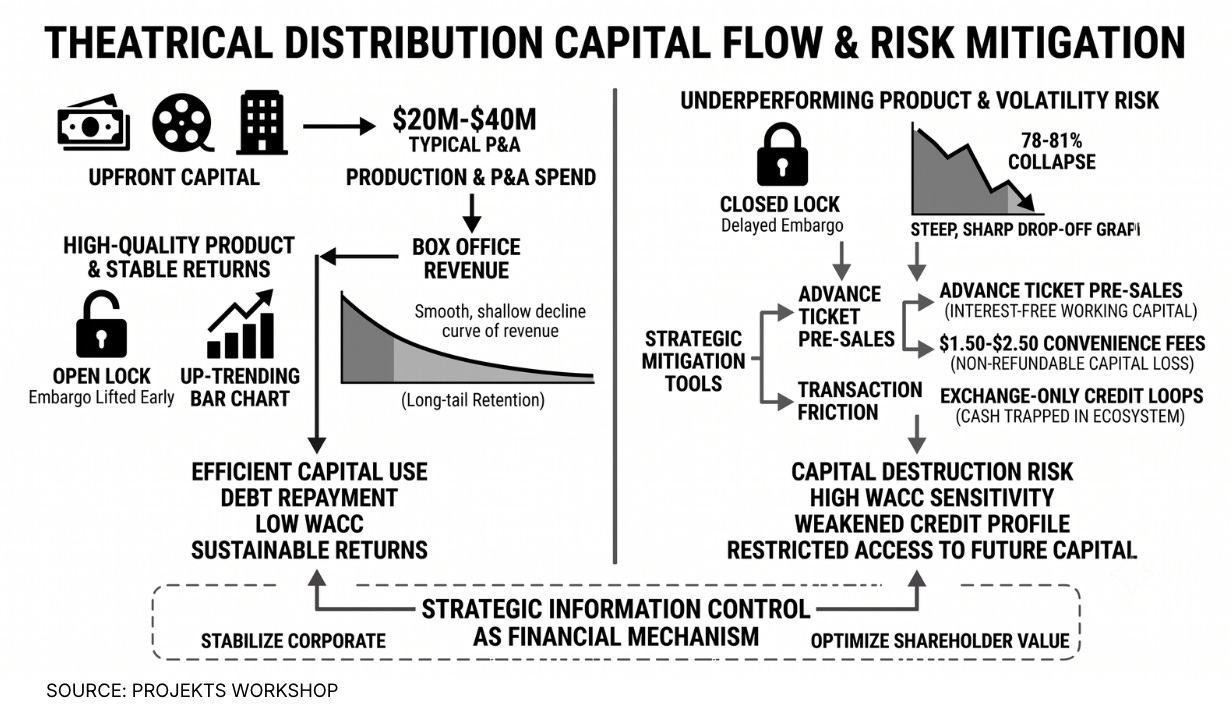
Conversely, when a studio possesses high-quality products, it can utilize a standard information-disclosure strategy, lifting embargoes well in advance of the premiere. This approach drives stable, long-tail revenue retention week over week, demonstrating a highly efficient use of capital that generates sustainable returns. However, because approximately fifty-nine percent of widely released films operate at a loss across the wider market, the corporate capital structure must remain insulated against downside variance. By treating information control as a financial stabilization tool, management protects its capital base, manages its debt-to-equity risk profile, and ensures the continuous funding of its upcoming production slate despite prevailing market headwinds. Consequently, the strategic manipulation of the information environment operates not merely as a marketing tactic, but as a core financial mechanism designed to manage risk, stabilize corporate balance sheets, and optimize shareholder value.

Studios deploy late embargoes to secure an opening weekend revenue premium by capitalizing on consumers who do not associate missing reviews with low quality. This strategy protects upfront cash flow against negative critical bias. While it causes sharp revenue declines in subsequent weeks, it ensures the immediate recovery of substantial marketing and distribution expenses before organic word of mouth spreads.
Ticketing platforms function as operational partners by creating financial friction that locks in consumer capital. Non-refundable convenience fees and strict cancellation deadlines prevent mass ticket returns when negative reviews finally drop. By trapping refunded capital within platform credits rather than returning cash, these systems protect the overall liquidity of the theatrical ecosystem during critical release windows.
Management decouples early social media reactions from long-form critical analysis by lifting restrictions for handpicked influencers a week before release. These non-traditional reviewers generate hyperbolic praise that establishes a positive public narrative. This artificial consensus insulates advance ticket sales from the subsequent, more critical evaluations published by professional journalists right before the premiere occurs.
Statistical models indicate that star power and massive production spend serve primarily as economic insurance policies. For critically acclaimed titles, these factors add little incremental value because audience demand is already driven by quality. Instead, their true utility lies in buffering poorly reviewed films, allowing them to maintain a baseline commercial appeal during their opening frames.
Management must carefully curate early screening access to mitigate inverted predictive signals from highly analytical reviewers. Because the artistic preferences of these critics run counter to mass-market tastes, their praise can alienate casual audiences while their disapproval signals crowd-pleasing potential. Restricting their early input ensures that promotional narratives remain aligned with mainstream consumer expectations.

The structural alignment between studio capital requirements and information management indicates that review embargoes are a direct response to fiscal necessity. Because entertainment conglomerates depend heavily on immediate, front-loaded cash generation to service fixed production debts and high marketing expenses, maintaining information asymmetry during the initial release phase remains a primary mechanism for corporate stabilization. Given the highly compressed seventy-two hour monetization window, a failure to capture rapid opening-weekend liquidity directly threatens a firm’s borrowing costs and overall credit standing.
Consequently, the long-term operational outlook for the theatrical distribution sector points toward the permanent integration of split-embargo structures and restrictive digital ticketing transaction frameworks. While this defensive posture accelerates second-weekend revenue declines and impacts long-term consumer goodwill, it effectively isolates corporate balance sheets from the immediate financial downside of poorly received products. Shifting commercial risk to the consumer base through transaction friction and curated promotional narratives allows management to preserve vital cash liquidity and protect the underlying capital architecture. Ultimately, the strategic control of qualitative data represents an essential operational adaptation designed to balance structural industry volatility against immediate balance sheet mandates.

The Shift to Extreme Front-Loading and Historic Second-Weekend Box Office Drops – Variety (2025)
Inside the Digital Ticket Trap: How Convenience Fees and Exchange Credits Lock Liquidity – The Hollywood Reporter (2024)
Wide Release Profitability Thresholds and P&A Budget Benchmarks – Boxoffice Pro Analytics (2025)
Entertainment Conglomerate Leverage: Capital Structures and Box Office Risk Mitigation – Media Financial Management Association (2024)
Information Asymmetry and Bounded Rationality in Opening Weekend Film Selection – Journal of Media Economics (2023)
No posts
Comments
Nothing yet. Say the first thing.
Sign in to join the conversation.