
Most arguments about how forensic laboratories should be funded, staffed, and managed are arguments about what kind of thing forensic science is. The phrase “forensic science is a public good” gets repeated often enough that it sounds settled, and the word “privatization” gets used as either a threat or a promise depending on who is talking. Both moves skip over the economics. The economics has a small vocabulary and a few useful distinctions, and once you have them, a surprising amount of the noise goes away.
This post lays out that vocabulary, places forensic science inside it, and then asks the harder question: even when a service behaves like a private good in technical terms, what follows from that? The answer is less obvious than the loudest voices on either side suggest.

(This will make sense later on)
Economists classify goods using two questions, both about how the good behaves when more than one person wants it.
Is it rivalrous? A good is rivalrous if one person’s use of it reduces what is available for someone else. An apple is rivalrous: if you eat it, I cannot. A streetlight is non-rivalrous: your benefit from the light shining on the sidewalk does not subtract from mine.
Is it excludable? A good is excludable if a provider can prevent people who do not pay from consuming it. A movie in a theater is excludable: no ticket, no seat. National defense is non-excludable: once it exists, the country gets it whether any individual citizen paid taxes or not.
Crossing those two questions produces four categories.
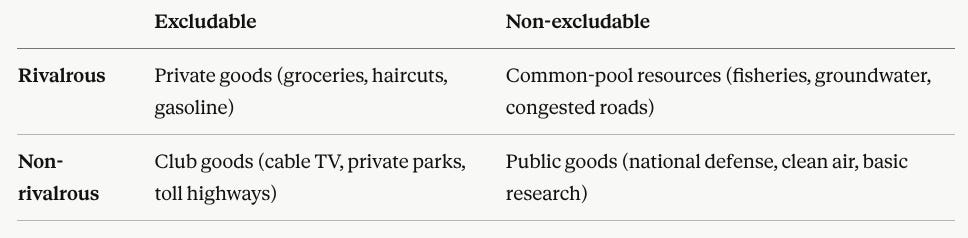
A pure public good is non-rivalrous and non-excludable. A pure private good is rivalrous and excludable. Most real-world goods sit somewhere in the middle, and forensic science is one of them.
Day-to-day casework behaves like a private good. The hours your DNA analyst spends on case A cannot be spent on case B. The reagent consumed on one extraction is not available for the next. The bench time, the instrument time, the report-writing, the testimony preparation: all rivalrous. Forensic services are excludable in practice too, because access is gated by who submits the case, who pays for it, and what the lab agrees to accept. McAndrew (2012) makes this point directly: examined closely, the operations of a forensic laboratory do not look like a public good in the technical sense.
This is not a rhetorical concession. It matters because the standard argument “forensic science is a public good, therefore it must be publicly provided” is doing work the underlying economics does not support, at least not on its own. A good can benefit many people, serve an important social function, and still behave as a private good in production and consumption. Groceries benefit everyone, are essential to life, and are private goods. The “public good” label, used loosely, conflates social importance with the technical question of how the good behaves under shared use.
Some elements of the forensic enterprise do behave more like public goods. Research and methodological development have non-rivalrous and partially non-excludable features: once a validated method exists, every lab can use it without diminishing anyone else’s access. Standards, like those produced by OSAC, behave similarly. Database infrastructure (CODIS, NIBIN, IAFIS) has elements of a club good, with restricted access among qualified participants but non-rivalrous use within the club. The point is that forensic science is a portfolio of goods of different kinds, not a single thing with a single classification.
The portfolio view is more useful than the binary one. It tells you that the management questions for casework, research, and infrastructure are different questions, and that policies sensible for one type may be wrong for another.
McAndrew’s analysis is correct on its own terms, and the technical point is worth holding onto. But the rivalrous-excludable question is not the only one worth asking, and treating it as if it were misses much of what a public forensic laboratory actually does. Three considerations extend the analysis.
Externalities. A forensic analysis benefits parties who are not part of the transaction between the laboratory and its customer. Communities get deterrence value when crimes are solved. Future potential victims get protective value. Other jurisdictions benefit when database hits link serial cases. Innocent people benefit when analysis excludes them. These are positive externalities and they are large. Economics is clear that private markets systematically underproduce goods with large positive externalities. This is the standard textbook argument for public funding of education: classroom instruction is rivalrous and excludable, but society funds it publicly because the spillover benefits to everyone else are too large to leave to private willingness to pay. Similar logic applies to forensic services.
Equity outputs. Public services usually have equity outputs bundled into the service itself, not added on. Universal mail delivery is part of what a postal service produces, not an extra. For a public forensic laboratory, the equity output is that analysis is available to anyone whose case enters the justice system, regardless of who they are or what they can pay. If you describe the product as “analysis,” forensic casework looks like a private good. If you describe the product as “analysis available to all comers under the rules of the justice system,” it looks different. The second description is more honest about what a public laboratory delivers.
Merit goods. Some goods are publicly provided not because they are efficient to provide that way but because society has judged that everyone should have access to them regardless of willingness or ability to pay. Justice is the canonical merit good in this category, and economists treat the merit-good argument as a legitimate addition to the framework rather than a departure from it. This is the point at which the analysis is no longer purely economic. It is partly normative, and forensic services delivered inside a criminal justice system are an unusually clear case where the normative argument matters.
The honest position is that casework is technically a private good in production, and that this technical fact does not by itself settle how forensic services should be funded and provided. The economic argument extends naturally into externalities and equity, and from there into the normative question of what a justice system owes its citizens. Reasonable people can weigh those considerations differently. They cannot responsibly ignore them.
If casework behaves as a private good, does it follow that private provision is better? Elliott Sclar’s You Don’t Always Get What You Pay For: The Economics of Privatization (Cornell, 2000) is the most disciplined treatment of when contracting works and when it does not. Sclar is not an ideologue. He grants that about half of all public money is already dispensed via contracts and that this is unlikely to change. His argument is not anti-contracting; it is against the lazy comparison that drives most privatization decisions: an existing public agency, with all its accumulated inefficiencies, against a hypothetical private contractor that has none of them. Sclar’s response is that the honest comparison is three-way: the agency as it now exists, contracting as it is likely to exist in practice, and direct service provision as it could feasibly be improved. When you run the comparison that way, the answer changes more often than the slogan suggests.
The rest of Sclar’s framework lays out the conditions that have to hold for contracting to deliver what it promises. A forensic laboratory manager reading him will recognize that almost none of those conditions hold for casework.
You have to be able to specify the output. Street paving is specifiable: dimensions, materials, depth, finish, all verifiable after the fact. Forensic casework is the opposite. Quality is partly judgment-based, the specification of “good analysis” includes elements that emerge during the work itself, and the consumer often cannot evaluate the product directly. The resulting information imbalance between contractor and customer drives contracting costs over time.
Transaction costs have to be manageable. Writing contracts, monitoring performance, verifying quality, handling disputes, replacing underperforming vendors: all of this costs money, and the more uncertain the service environment, the higher the cost. Forensic work has legal consequences, chain-of-custody requirements, accreditation obligations, and expert testimony exposure. Transaction costs are not a footnote here. They are most of the question.
The market has to be genuinely competitive. Sclar’s school bus case in New York is the cleanest illustration of what happens when this condition fails. The system is privatized but not competitively contracted; the same companies have held the same routes for decades at cost-plus prices, because the service is too operationally complex to allow frequent vendor changes. The market has the form of contracting without the discipline of competition. Forensic services in most jurisdictions look more like the school bus case than like street paving: few qualified providers, high entry costs, deep operational entanglement with prosecution timelines and case-specific institutional knowledge. Thin markets do not discipline price or quality the way textbook markets do.
Sclar’s empirical conclusion is sober rather than dramatic. Privatization works when outputs are specifiable, providers are plentiful, switching costs are low, and transaction costs are low. It fails when those conditions are absent. Forensic casework lives on the wrong end of every one of those dimensions.
The clearest test case for these arguments is not theoretical. From 1991 to 2012, the United Kingdom ran a multi-decade experiment in moving forensic services from public provision toward something more market-like. The Forensic Science Service was reorganized as an Executive Agency in 1991, given Trading Fund status in 1999, converted to a government-owned company in 2005, and wound down by March 2012.
The closure is often described in two ways, both of which miss what actually happened. One version, popular among defenders of public provision, is that “marketization” broke a world-class scientific institution. The other, popular among advocates of privatization, is that the FSS was an inefficient public monopoly that could not adapt to competition. Neither survives contact with the record.
Wilson and Gallop, writing in 2013 with the closure complete, identified what the loud arguments missed. For most of its existence, the FSS was not really operating in a market. It was a dominant supplier in a planned arrangement that used market vocabulary. The DNA Expansion Programme, which expanded the forensic market enormously in the early 2000s, was itself a government subsidy that lowered barriers to entry for competitors and only then created the conditions for genuine competition. Pluralism in UK forensic science emerged from a series of policy decisions that mixed public funding, public standards, and private provision, not from pure market forces.
The closure, when it came, was a transition failure rather than a market verdict. The FSS had been instructed to behave like a competitive firm but had never developed an accurate understanding of its own costs. Police forces were increasingly insourcing work in response to budget pressure, shrinking the external market just as the FSS was trying to compete in it. The £50 million restructuring grant arrived too late and was cut short when the closure was announced.
Three lessons map directly onto Sclar’s framework. First, marketization without the conditions for genuine competition produces neither public-sector resilience nor market discipline; it produces a hybrid that has the costs of both and the benefits of neither. Second, the parts of the FSS story that worked best came from professional and institutional commitments that neither pure public provision nor pure market provision would have produced on its own. Third, the closure was conducted on the basis of cost accounting that participants on all sides later acknowledged was incomplete.
The full historical treatment of the FSS is worth its own post, and we will give it one in the Insights track. For Basics, the takeaway is that the most discussed real-world test of forensic privatization is more complicated than either of its standard interpretations, and the complications are exactly the ones Sclar’s framework predicts.
You probably do not get to decide whether your laboratory is public or private. That decision was made by statute long before you arrived, and it will not be revisited by you. So the practical value of these distinctions is not in answering that question. It is in three other things.
First, when someone argues that forensic science “must be” publicly provided because it is a public good, you can recognize the argument is more nuanced than it sounds. Casework is technically a private good. The case for public provision rests on externalities, equity, and the normative claim that justice is a service a society owes its citizens regardless of ability to pay. That is a defensible case, but it is a different case than the one the loose slogan makes.
Second, when someone argues that forensic services should be opened to private competition to drive down costs, you can identify the conditions that argument depends on and ask whether they actually hold in your jurisdiction. Often they do not. Sclar gives you the questions: can the output be fully specified, are there enough capable providers to generate real competition, what are the transaction costs of monitoring quality, and what happens if you need to switch vendors midway through a case? If the answers are unfavorable, the case for privatization is weaker than its advocates assume, and the case for investing in “best practice” public operation is stronger than its critics assume.
Third, and most useful for your day job: the language of public goods, private goods, externalities, and contracting economics is the language in which budget arguments and oversight conversations actually happen. Funders, elected officials, and oversight bodies use these terms, often loosely. Using them precisely is one of the cheapest ways to make your laboratory’s case more credible. When you can explain that casework is a private good in technical terms but that the externalities to the justice system are large, that the market for forensic services is thin, that transaction costs of contracting are high, and that the honest comparison is between your laboratory operating well and any alternative also operating well, you have shifted the conversation from ideology to operations. That is where you want it.
The next Basics post turns to a distinction that runs underneath every budget argument and gets misused constantly: cost is not the same as expenditure. Until those two words are separated, no laboratory can give an honest accounting of what its work actually costs.
The full FSS story, with the institutional history that produced both its successes and its closure, is the subject of an upcoming Insights post. Wilson and Gallop’s 2013 analysis is the best single reading on the case if you want to get ahead of it.
What argument about forensic science have you heard repeated as obvious that you suspect is not? Send it. We are building a list.

Comments
Nothing yet. Say the first thing.
Sign in to join the conversation.