
TAKE ACTION: Public comments on proposed 9 NYCRR Part 6225 due August 16, 2026
New York has already authorized ballot drop boxes. Now the State Board of Elections is writing the rules — and New Yorkers have until August 16 to comment.
The New York State Board of Elections is accepting public comments on proposed Part 6225, the regulations governing ballot drop boxes.
Send comments to comments@elections.ny.gov.
Project CIVICA has submitted detailed comments calling for strong safeguards involving security, surveillance, bipartisan custody, reconciliation, documentation, incident reporting, and transparency. Now it’s your turn.
A Sample Public Comment on Proposed Ballot Drop Box Regulations you can adapt is at the end of the article.
In 2024, New York enacted S.610/A.7243 as Chapter 500 of the Laws of 2024, adding Election Law § 8-416. The law authorizes local boards of elections to establish one or more ballot drop-off locations as an additional means of returning ballots. Chapter 109 of the Laws of 2025, enacted through S.752/A.1014, made technical changes expressly covering both absentee and early mail ballots.
Election Law § 8-416 also directs the New York State Board of Elections to promulgate regulations addressing matters including location, chain of custody, pickup times, labeling, and security.
That rulemaking is happening now. The State Board has proposed a new Part 6225 of 9 NYCRR governing ballot drop boxes. The proposal addresses box design, fire mitigation, accessibility, location, video surveillance, collection schedules, bipartisan retrieval, chain-of-custody forms, ballot counts, and record retention.
So the immediate question is no longer simply whether New York should authorize ballot drop boxes. The Legislature has already done that. The questions now are whether counties should use them, what safeguards should be mandatory if they do, and whether the additional convenience justifies the cost and complexity.
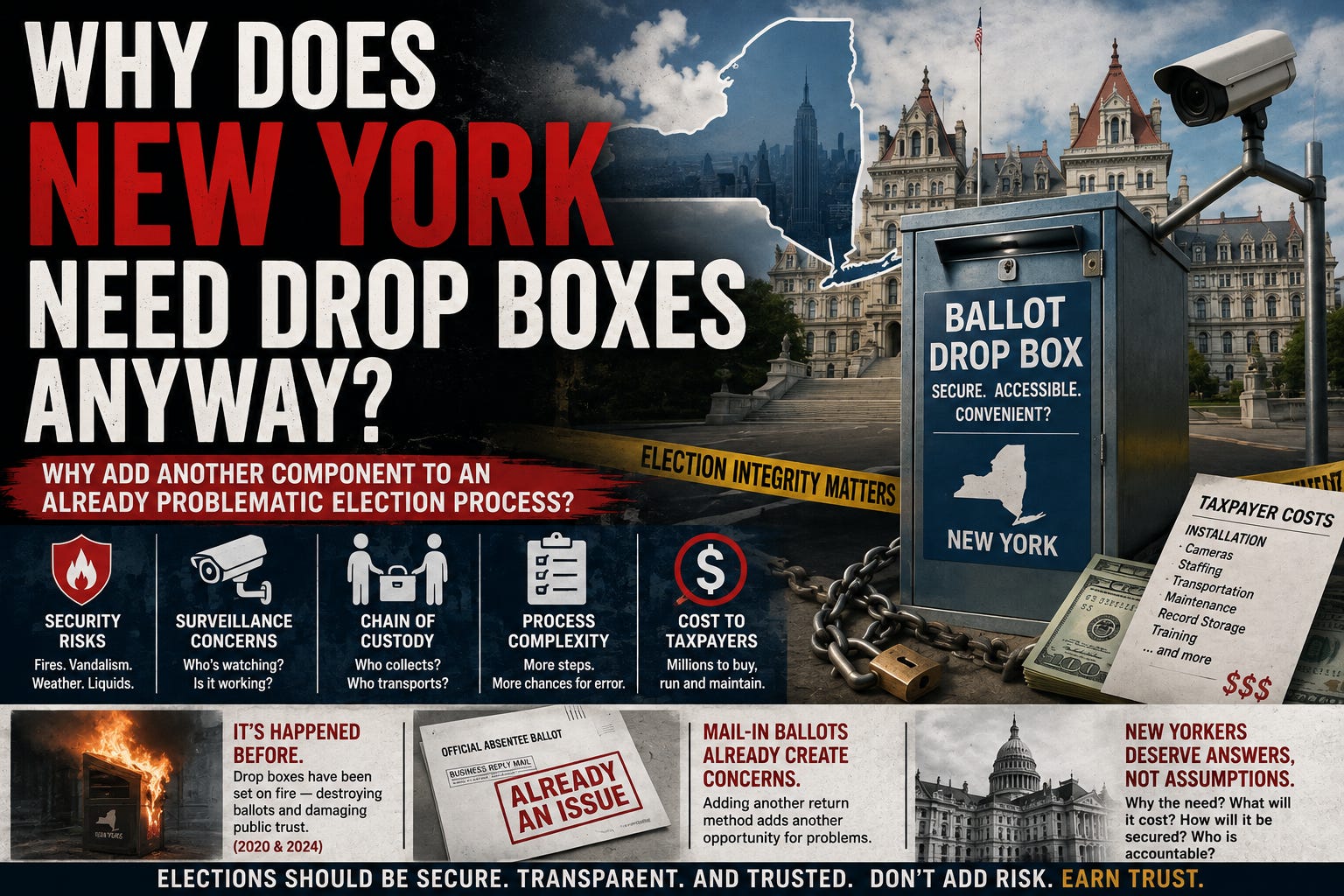
And there is still a more basic question worth asking: Why does New York need ballot drop boxes in the first place?
New Yorkers already have multiple ways to vote: Election Day voting, early voting, absentee voting, and early mail voting. Before taxpayers pay for boxes, installation, surveillance, bipartisan collection teams, maintenance, record storage, and another layer of election administration, the State should explain what problem ballot drop boxes are intended to solve.
The standard answer is convenience. Drop boxes supposedly make voting easier. There may be voters for whom another ballot-return option is useful. But convenience should not end the discussion.
If someone can drive to a ballot drop box, in many circumstances that person can also drive to an early-voting or Election Day polling location. More importantly, a drop box is not simply another mailbox. Once voted ballots are deposited, government becomes responsible for securing those ballots until election workers retrieve them.
That means another system of surveillance, inspections, retrieval, transportation, chain of custody, documentation, record preservation, training, and incident response.
Does the additional convenience justify the additional cost and complexity? New Yorkers deserve an answer.
Polling places operate with election workers present. Drop boxes can operate for extended periods without continuous bipartisan human observation. That creates a different security challenge.
In October 2024, incendiary devices were used against ballot drop boxes in Vancouver, Washington, and Portland, Oregon. Hundreds of ballots were damaged or destroyed in Vancouver; in Portland, a fire-suppression system limited the damage to three ballots. Authorities connected those incidents to an earlier October device at another Vancouver drop box.
In 2020, an official Los Angeles County ballot drop box in Baldwin Park, California, was also set on fire. More than 230 pieces of ballot material were recovered from the damaged box after firefighters extinguished the blaze. The incident provides another example of the physical risks election officials must account for when voted ballots are stored in unattended public receptacles.
These incidents do not establish widespread election fraud. They establish something much simpler: once voted ballots are placed in public receptacles, election officials must protect them from vandalism, fire, weather, liquids, equipment failures, and other forms of interference.
Election administrators themselves recognize those risks. California regulations require outdoor drop boxes to withstand vandalism, removal, and inclement weather and require ballot slots designed to minimize the ability to pour liquid into the box or allow rainwater to seep in.
New York’s own proposed regulations now recognize many of the same concerns. Proposed Part 6225 would require durable construction for outdoor unstaffed boxes, fire-mitigation features, ballot slots designed to minimize liquid intrusion and prevent rain or snow from entering, tamper evidence, secure fastening, lighting, and video surveillance.
Those are not imaginary concerns. They are risks that election administrators are now attempting to address through regulation.
If a drop box operates without continuous bipartisan human supervision, surveillance becomes critical. But putting up a camera is not enough.
Who verifies that it is recording? Is the date and time accurate? What happens if the camera stops working? How long is the video retained? Who can access it? What happens after a security incident? Who preserves the recording if litigation or an investigation follows?
The proposed New York regulations require all drop boxes to be monitored by a video security surveillance system or internal camera capable of capturing images or video useful to law enforcement. Yet when surveillance video is controlled by a third party, the proposal requires only that boards take reasonable measures to request that the video remain accessible for at least 30 days.
Then there is ballot retrieval. Proposed Part 6225 would require at least two designated ballot retrievers on a bipartisan basis. Retrieval forms would document the box location, unique identifier, arrival and departure times, seal numbers, ballot counts, transfer of custody, and receipt at the board or processing location.
Those safeguards matter. Project CIVICA believes the final regulations should make the chain of custody as complete, standardized, auditable, and publicly accountable as possible. Who opened the box? When? Were the seals intact? Who transported the ballots? When did they arrive at the Board of Elections? Who accepted custody? Do the ballots retrieved reconcile with the ballots ultimately received for processing?
These are the types of safeguards Project CIVICA recommended in its comments to the New York State Board of Elections. They are necessary because adding another method of returning ballots means adding another process that must be secured, monitored, documented, and auditable.
And none of that is free.
Here is something taxpayers should know.
When the legislation authorizing ballot drop boxes was introduced, the sponsor memorandum listed the fiscal implications as “To be determined.” New York therefore authorized another component of election infrastructure without providing taxpayers with a clearly identified statewide estimate of what it would ultimately cost.
And the expense is not simply purchasing a metal box. There can be installation costs, concrete work or permanent mounting, cameras, recording equipment, lighting, physical security, maintenance, video storage, bipartisan retrieval teams, transportation, inspections, training, chain-of-custody documentation, incident response, and record preservation.
The proposed regulations themselves illustrate the potential expense. They contemplate durable and weather-resistant construction, fire mitigation, accessible design and placement, secure fastening, nighttime lighting, video surveillance, daily retrieval during operation, bipartisan retrieval teams, secure transfer containers, seals, documentation, and record retention.
Some expenses may ultimately be absorbed into existing state or county election budgets, making the true cost difficult for taxpayers to identify.
So what will this actually cost, and who will pay for it — the State or the counties?
A separate 2026 proposal shows how quickly the scale — and therefore the cost — could grow.
The original version of Assembly Bill A.9626, introduced in January 2026, proposed at least one ballot drop box for every 15,000 registered voters in each board’s jurisdiction. The bill was amended in March. A.9626-A would instead require each board of elections to establish at least one ballot drop-off location, while permitting additional locations at the board’s discretion. As of this writing, A.9626-A has not become law.
The original 15,000-voter formula nevertheless provides a useful illustration of the potential scale of a broad statewide deployment.
New York State Board of Elections enrollment data for February 20, 2026 reports 13,408,058 registered voters statewide. A simple statewide equivalent of one box per 15,000 voters is about 894 boxes. Because the original bill applied the formula separately to each board’s jurisdiction and added boxes as voter totals crossed each 15,000-voter increment, the actual statewide requirement under that version could have been somewhat higher.
Based on vendor pricing reviewed by Project CIVICA of approximately $2,800 to $5,600 per ballot drop box, 894 boxes would represent approximately:
· $2.50 million at $2,800 per box
· $5.01 million at $5,600 per box
And that is just the purchase price of the boxes.
Security requirements can significantly increase the cost beyond the box itself. California's regulations, for example, contemplate secure fastening of outdoor drop boxes, locks or tamper-evident seals, and, where feasible, video surveillance. New York's own proposed regulations similarly contemplate security measures including secure fastening, fire mitigation, lighting, video surveillance, bipartisan ballot retrieval, secure transfer containers, seals, and chain-of-custody documentation. Each safeguard may be reasonable from a security standpoint, but each also illustrates why the true cost of a ballot drop-box program extends well beyond simply purchasing the boxes.
It does not include installation, concrete work or permanent mounting, cameras, recording systems, lighting, video storage, maintenance, repairs, transportation, inspections, training, bipartisan collection teams, or administrative recordkeeping.
The $2.50 million to $5.01 million figure is not a forecast of the cost of New York’s current program. It is an illustration of the purchase cost alone if roughly 894 boxes were deployed, using the vendor price range reviewed by Project CIVICA.
Before taxpayers finance another piece of election infrastructure, shouldn’t government tell them what it is expected to cost?
This may be the most important question of all.
Many voters already have concerns about election administration. Officials may disagree with some of those concerns. But dismissing concerns does not necessarily restore confidence.
Every additional component added to an election system becomes another component that has to work correctly — and another component the public has to trust.
A drop-box system creates another physical location containing voted ballots. Another surveillance system. Another chain of custody. Another transportation process. Another collection schedule. Another set of administrative records. Another opportunity for equipment failure, vandalism, or procedural breakdown.
Why add that complexity unless the benefit clearly justifies it?
Eligible voters should have reasonable opportunities to cast their ballots. But accessibility and security are not mutually exclusive.
New York already provides Election Day voting, early voting, absentee voting, and early mail voting.
So let’s return to the question we started with: Why does New York need drop boxes anyway?
If state officials have a compelling answer, make the case to the public.
Tell us what problem drop boxes solve that existing voting methods cannot adequately address. Tell taxpayers what they will cost. Tell us what the State will pay and what counties will pay. Tell us how the boxes will be protected from fire, vandalism, liquids, weather, and tampering. Tell us what happens when surveillance fails. Tell us who has custody of the ballots. Tell us how those ballots will be reconciled. And give the public appropriate access to the records demonstrating that those safeguards were actually followed.
Project CIVICA does not support adding ballot return drop boxes to New York’s election system. But the Legislature has already authorized local boards of elections to establish them, and the New York State Board of Elections is now developing the regulations that will govern how they operate.
That makes the current public-comment period important.
If New York is going to permit ballot drop boxes, there should be no shortcuts on security, surveillance, bipartisan custody, reconciliation, documentation, incident reporting, or transparency.
New Yorkers should review the proposed regulations and submit their own comments to the State Board of Elections.
Tell the State Board what safeguards you believe should be required before ballot drop boxes are used in your county.
Ask how ballots will be protected from fire, vandalism, liquids, weather, and tampering. Ask what happens when surveillance fails. Ask who will retrieve and transport the ballots and how that custody will be documented. Ask how ballots retrieved from each box will be reconciled with ballots received for processing. Ask what records will be retained and made available to the public. And ask what this additional election infrastructure will cost taxpayers.
The regulations being considered now will determine how this system operates in practice.
Before New York adds another link to the election chain, that link should be as secure, documented, auditable, and transparent as possible.
Review the Proposed Regulations: Visit the New York State Board of Elections Election Law page and click on Proposed Regulations to review proposed Part 6225 governing ballot drop boxes and information on submitting public comments. Read the Proposed regulation 9 NYCRR Part 6225 here.
PUBLIC COMMENTS ARE DUE AUGUST 16, 2026.
Email comments to: comments@elections.ny.gov
Sample Public Comment on Proposed Ballot Drop Box Regulations — 9 NYCRR Part 6225
New York State Board of Elections:
I am writing to submit public comment on the proposed regulations governing ballot drop boxes under 9 NYCRR Part 6225.
I have concerns about adding ballot drop boxes to New York’s election system when voters already have multiple ways to cast and return ballots, including Election Day voting, early voting, absentee voting, and early mail voting. I believe the State should carefully consider whether the additional convenience provided by drop boxes justifies the additional cost, security risks, and administrative complexity.
If ballot drop boxes are going to be used, I urge the State Board of Elections to adopt strong, uniform safeguards that apply throughout New York.
At a minimum, the final regulations should require:
Continuous and reliable video surveillance of ballot drop boxes, with appropriate retention requirements and procedures for surveillance failures or security incidents.
Bipartisan teams for ballot retrieval and transportation, with complete chain-of-custody documentation.
Tamper-evident seals and documented inspection of each box whenever ballots are retrieved.
Reconciliation procedures documenting the number of ballots removed from each drop box and their receipt by the Board of Elections for processing.
Clear deadlines for the final collection of ballots, particularly at the close of polls on Election Day.
Detailed incident reporting requirements for vandalism, attempted tampering, fire, surveillance failures, broken seals, unauthorized access, or other security problems.
Meaningful retention of surveillance footage, chain-of-custody forms, retrieval logs, incident reports, and other records necessary to audit the process.
Appropriate public transparency so voters can verify that required security and chain-of-custody procedures were followed.
Clear statewide minimum standards rather than leaving critical security procedures to vary significantly from county to county.
I also encourage the State Board to provide greater transparency regarding the expected cost of implementing and operating ballot drop boxes, including the costs of purchasing and installing boxes, surveillance systems, maintenance, ballot retrieval, transportation, training, record retention, and other administrative requirements.
Regardless of one’s position on ballot drop boxes, voted ballots should be protected by rigorous, documented, auditable procedures from the moment they are deposited until they are delivered to the Board of Elections and processed.
I urge the State Board to strengthen Part 6225 before adopting the final regulations.
Thank you for considering my comments.
Thanks for reading! This post is public so feel free to share it.
1. New York Election Law § 8-416; S.610/A.7243, Chapter 500 of the Laws of 2024. https://www.nysenate.gov/legislation/laws/ELN/8-416 and https://www.nysenate.gov/legislation/bills/2023/S610
2. New York State Board of Elections, proposed 9 NYCRR Part 6225, Drop Box Regulations for Public Comment. https://elections.ny.gov/system/files/documents/2026/06/drop-box-regulations-for-public-comment-part-6225.pdf
3. New York State Board of Elections, Proposed Regulations page. Public comments are due August 16, 2026. https://elections.ny.gov/election-law
4. S.752/A.1014, Chapter 109 of the Laws of 2025, technical amendments addressing absentee and early mail ballots. https://www.nysenate.gov/legislation/bills/2025/S752
5. Associated Press, October 2024 reporting on incendiary devices at ballot drop boxes in Vancouver, Washington, and Portland, Oregon.
6. California Code of Regulations, Title 2, § 20132, Drop Box Design and Requirements. https://www.law.cornell.edu/regulations/california/2-CCR-20132
7. New York State Board of Elections, Voters Registered by County as of February 20, 2026; statewide total 13,408,058. https://elections.ny.gov/node/566
8. Assembly Bill A.9626/A.9626-A (2025-2026 session), concerning required ballot drop-off locations. https://www.nysenate.gov/legislation/bills/2025/A9626
9. Vendor-price range of approximately $2,800-$5,600 per box is based on vendor pricing reviewed by Project CIVICA and is used only as an illustrative purchase-cost range, not as a forecast of statewide program cost.
No posts
Comments
Nothing yet. Say the first thing.
Sign in to join the conversation.