
Welcome 👋🏽
I deployed again on 14 April 2026 👇🏽
Which means I’m (investment capital) cash poor

The benefit of investing on a high time frame is that we only need to make a few big decisions each year.
On that basis, rather than discussing markets this week (because there’s nothing new worth adding beyond what’s already been covered in the community chat), I want to outline the PROJECT 10X Framework and its tools so that everyone can independently answer:
Should we be adding risk, reducing risk or doing nothing?
Let’s start with a 30,000-foot view of each tool 👇🏽

The TLDR:
Risk-On Risk-Off (RORO) and Capital Deployment Framework (CDF) are the only valid tools for increasing exposure.
Selling the Top Indicators (STTI), Take Profit (TP), and Circuit Breakers (CB) manage distribution and downside protection.
Exposure Rule (ER) caps exposure depending on whether momentum is on our side.
Buying the Bottom Indicators (BTBI) provides additional confluence to assess whether conditions resemble cycle lows.
When combined, the full process flow looks like this 👇🏽
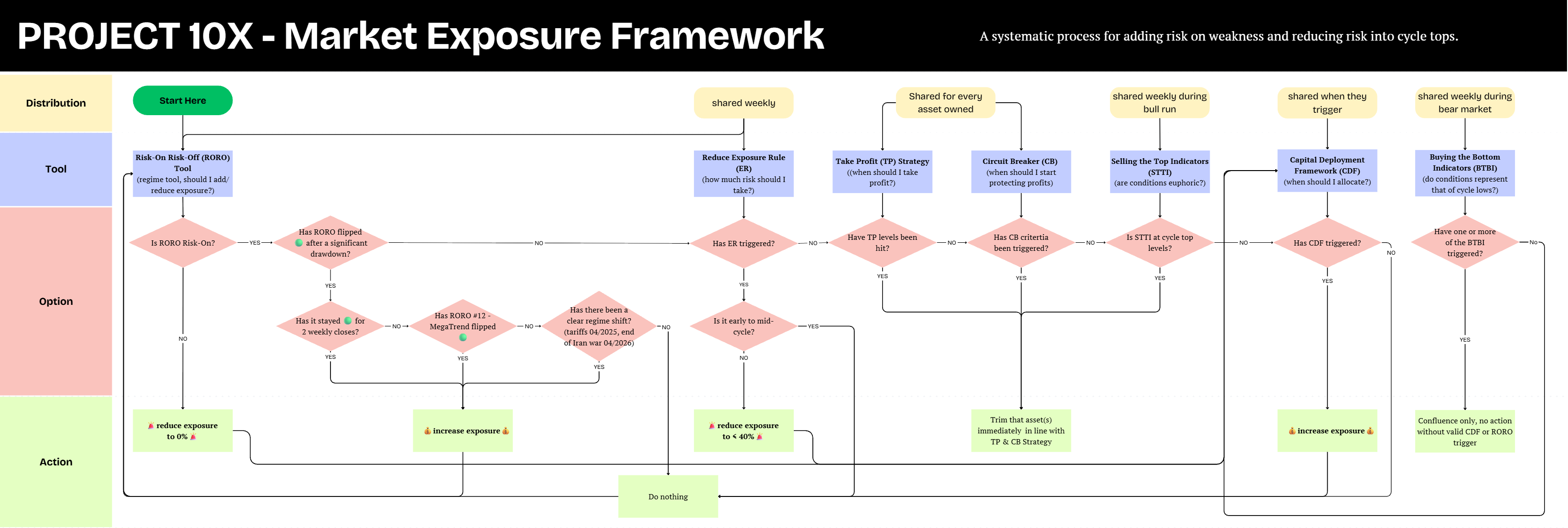
We now have a decision path for every plausible scenario.
There is still discretion (and there should be) - for example, how much exposure to add - but more nuanced questions like “what defines a significant drawdown?” or “what do we do with sidelined capital?” are addressed below 👇🏽
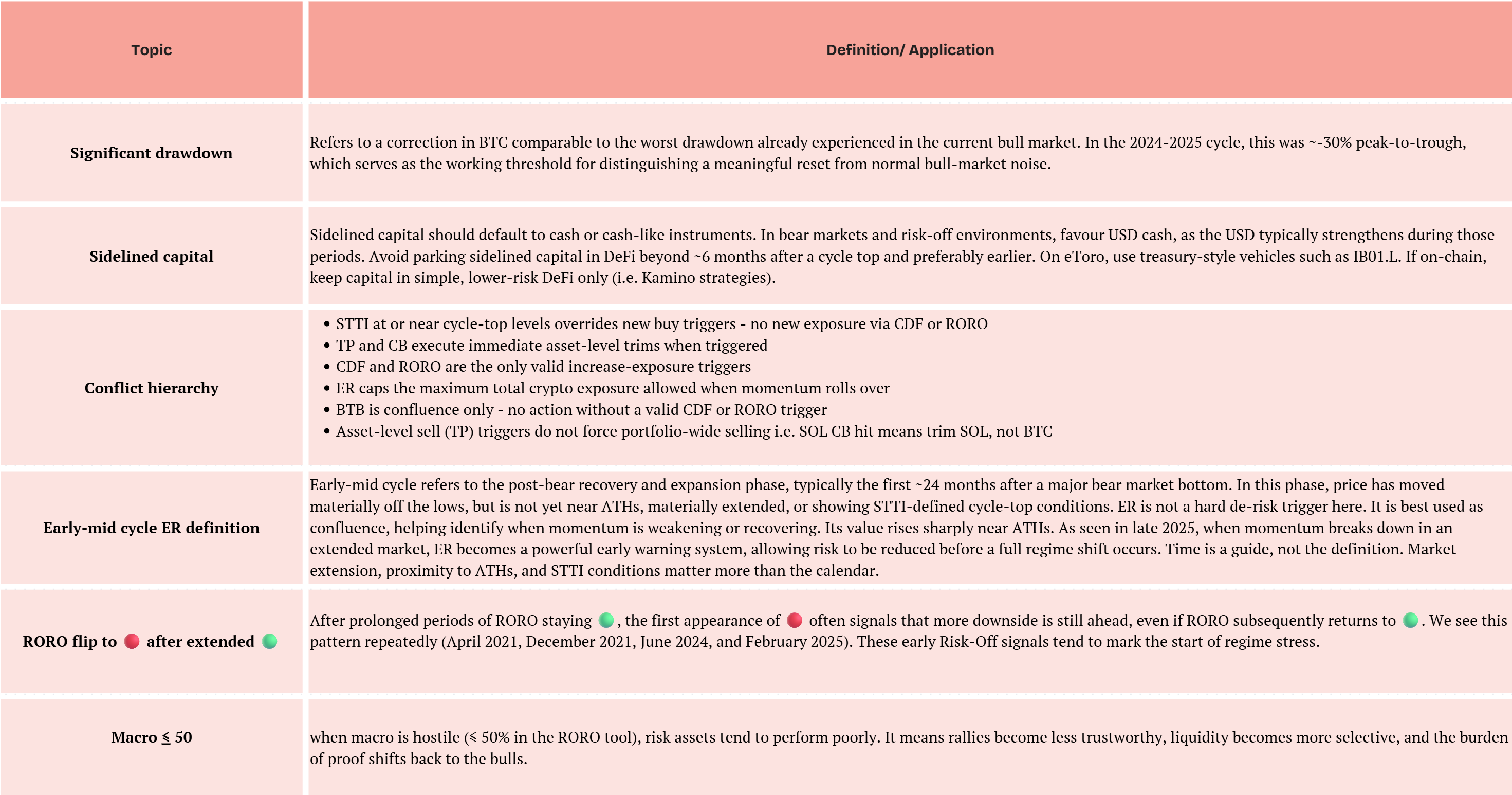
What follows is a deeper dive into each tool. The goal is for this newsletter to serve as a one-stop reference whenever the question arises:
“What is the strategy from here?”
As an aside, I highly recommend building your own version of this process flow if you’re not using these tools.
Why? To internalise it and build confidence, especially in high pressure conditions where we’re asking questions like “when the f*** do I deploy” or “should I sell my bags now?”. But also because I have no doubt that along the way, you’ll tweak, improve and develop a process you can execute with confidence in real time.
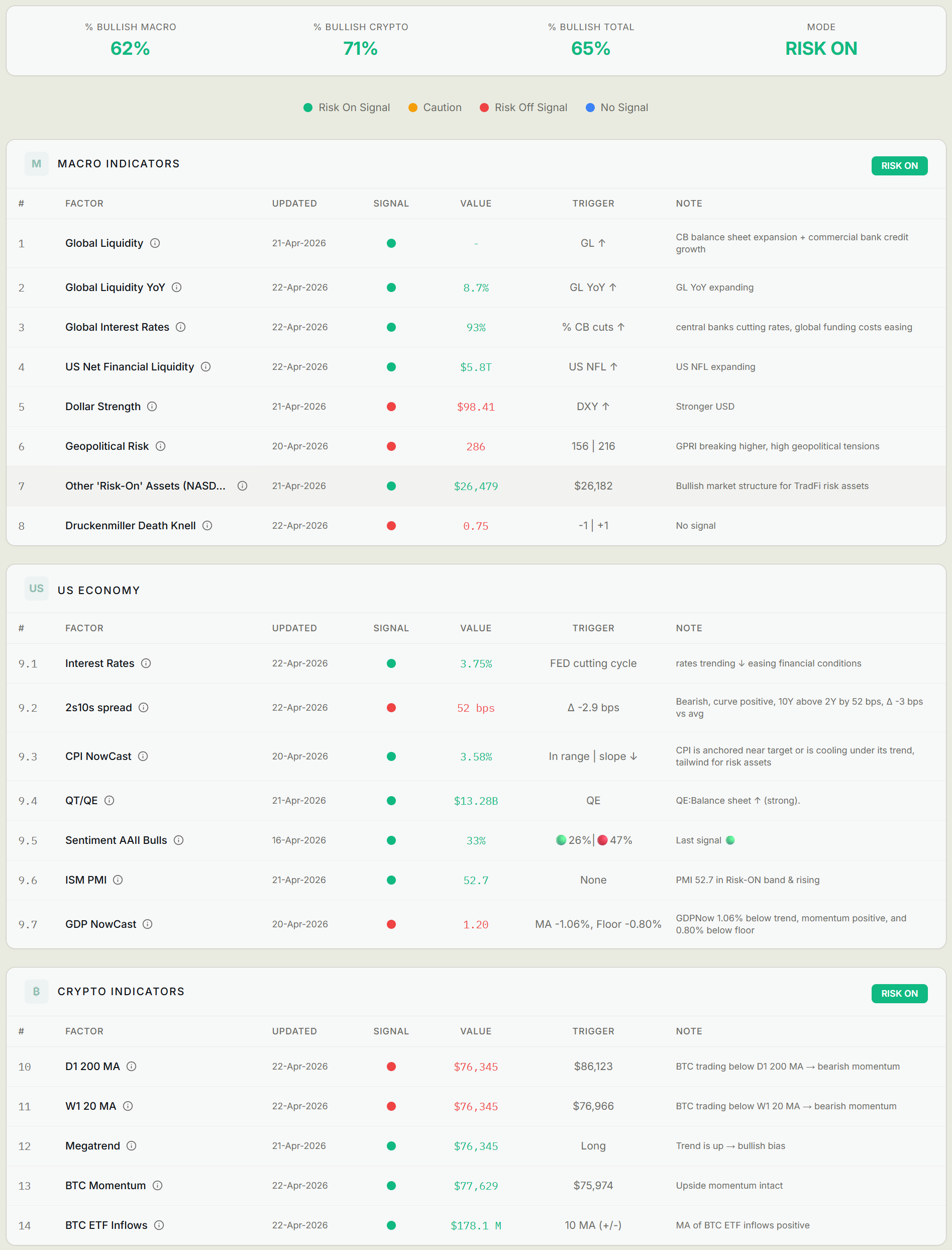
This is the highest-level regime tool in the framework. It answers:
Is the market environment broadly supportive of risk?
Risk-On → supportive backdrop
Risk-Off → hostile backdrop, reduce exposure to 0%
RORO is not designed to catch every local top or bottom. Its role is to keep us aligned with the broader macro and crypto regime.
Here are the backtest results (Dec 2025).
RORO does two things:
Reduces exposure when the market flips Risk-Off
Adds exposure when the market returns to Risk-On after a meaningful reset
This makes it one of the two valid exposure-increase triggers (alongside CDF).
Not all flips are equal.
A flip back to Risk-On can justify re-risking, but the first signal is often noisy. Cleaner confirmation comes from:
Two consecutive weekly Risk-On closes
Momentum returning (RORO #12 - MegaTrend)
A clear regime shift
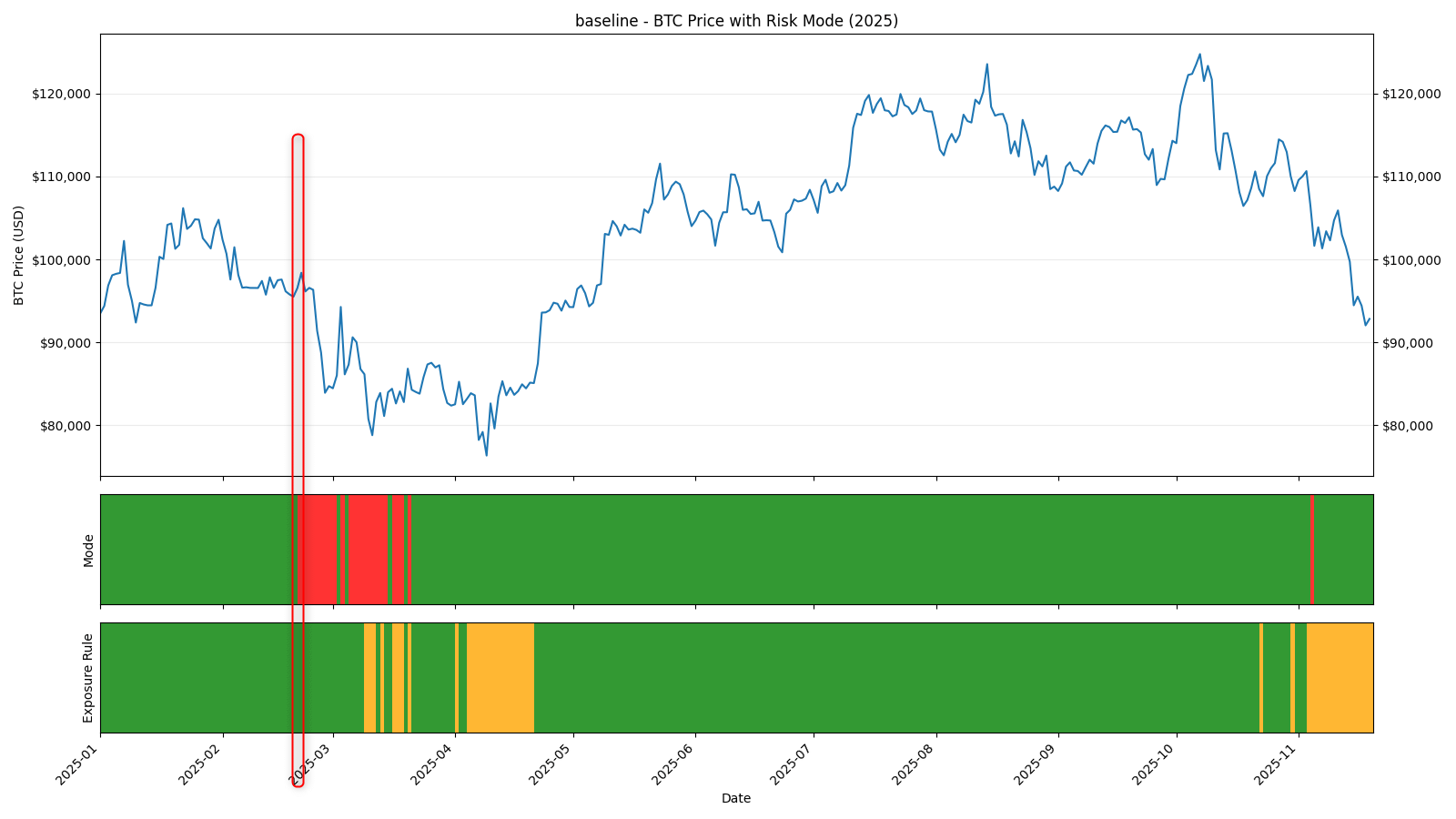
More important is the first flip to Risk-Off after a prolonged Risk-On period.
Historically, this often marks the start of regime stress—even if RORO later flips back.
Example: February 2025
RORO flipped Risk-Off after 7 months of Risk-On. This led to reducing exposure to 0% at ~$99K before the pullback to ~$74K.
CDF answers:
How aggressively should we deploy capital after a major drawdown?
CDF is the framework’s capital deployment tool. It identifies statistically significant drawdowns where allocating capital has historically produced strong high-timeframe results.
Across ~9 years, every trigger has aligned with a major high-timeframe opportunity.
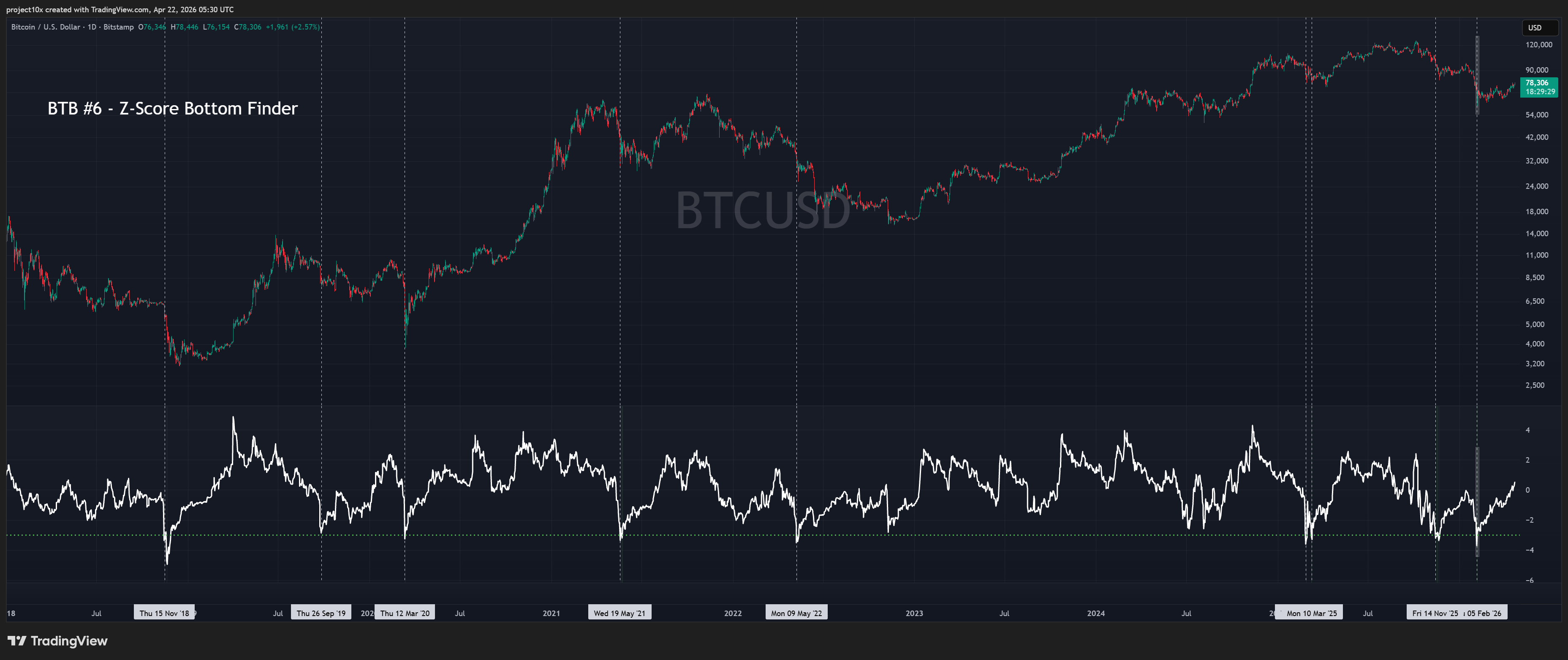
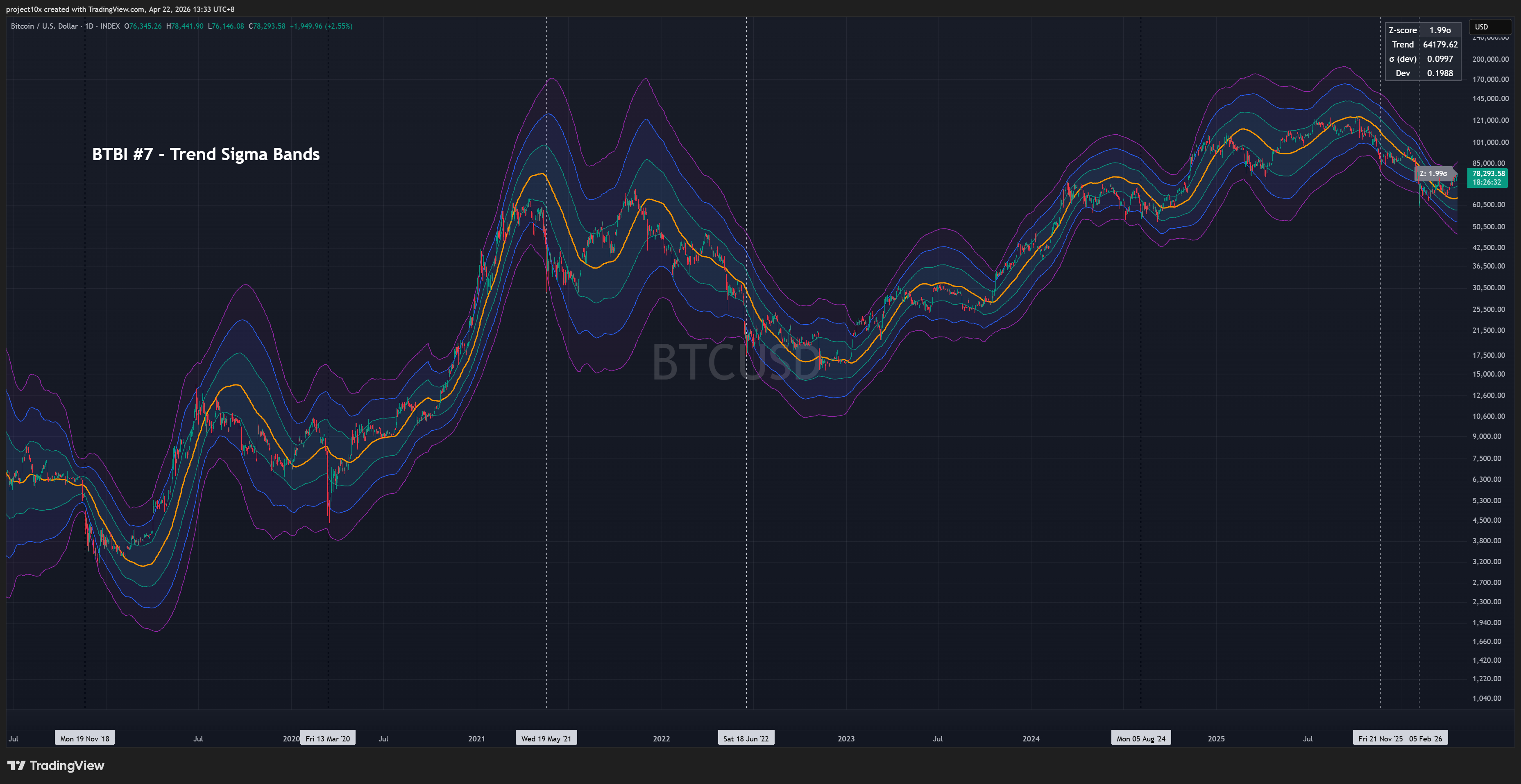
A key point: CDF does not require RORO to be Risk-On. If CDF signals a major statistical drawdown, that alone is sufficient to allocate.
CDF can trigger when one core condition is met:
Price has fallen far enough.
In other words, the drawdown must be meaningful, not just a normal pullback.
The macro component of RORO is then used as confluence. When Macro Risk-On is active, or the macro component of RORO is ≥50%, the setup receives a higher score. But macro does not need to be ≥50% for CDF to trigger.
This is important because some of the strongest CDF setups can occur after macro has been weak for an extended period (see November 2018 and June 2022). By then, sellers have often been in control for long enough that a CDF trigger can mark the final flush of weak hands and a high-conviction bottoming setup.
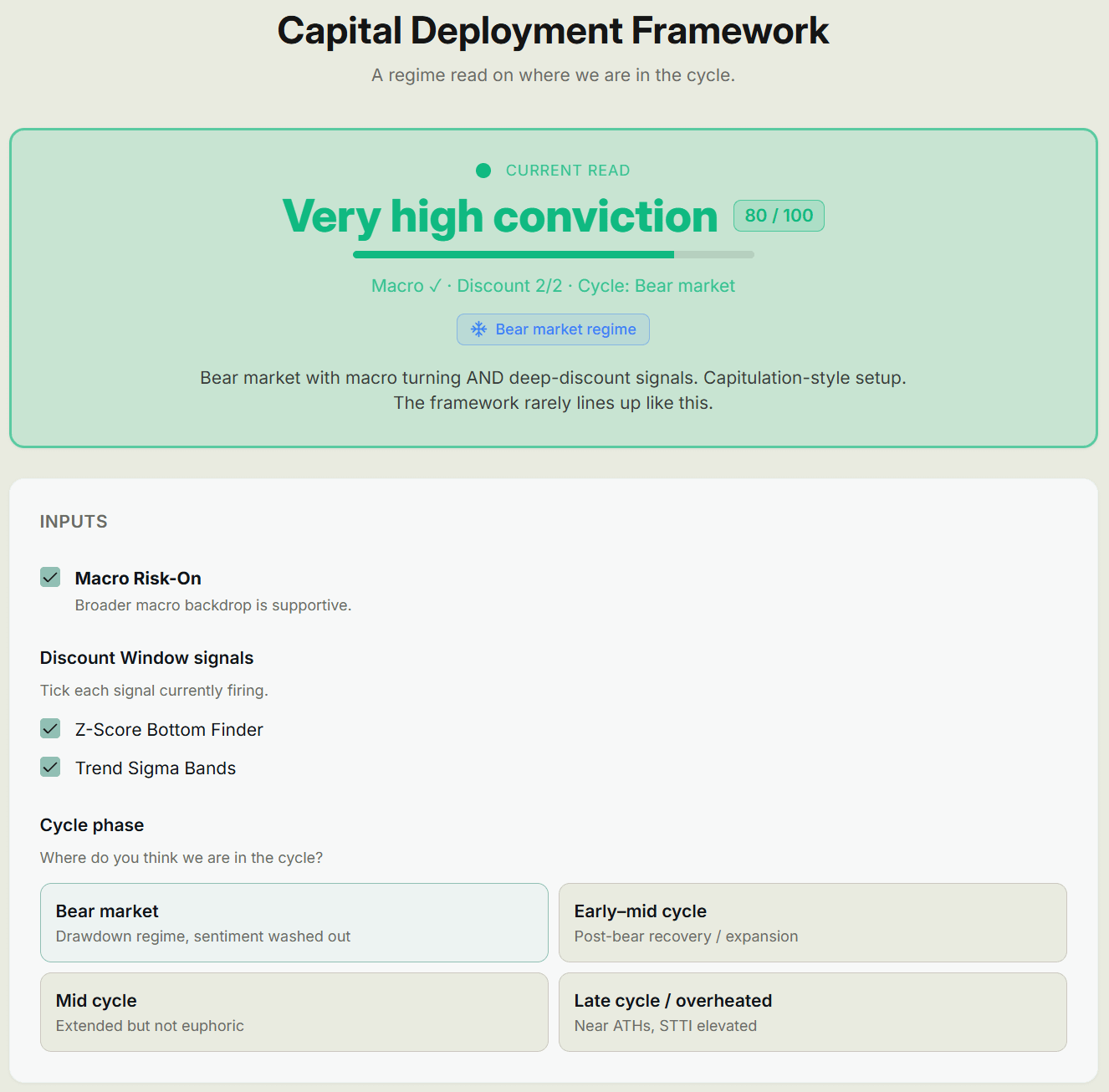
CDF scores the setup from 0 to 100 and helps determine how aggressively capital can be deployed.
If no discount signal is active, CDF remains in Watching - no trigger mode.
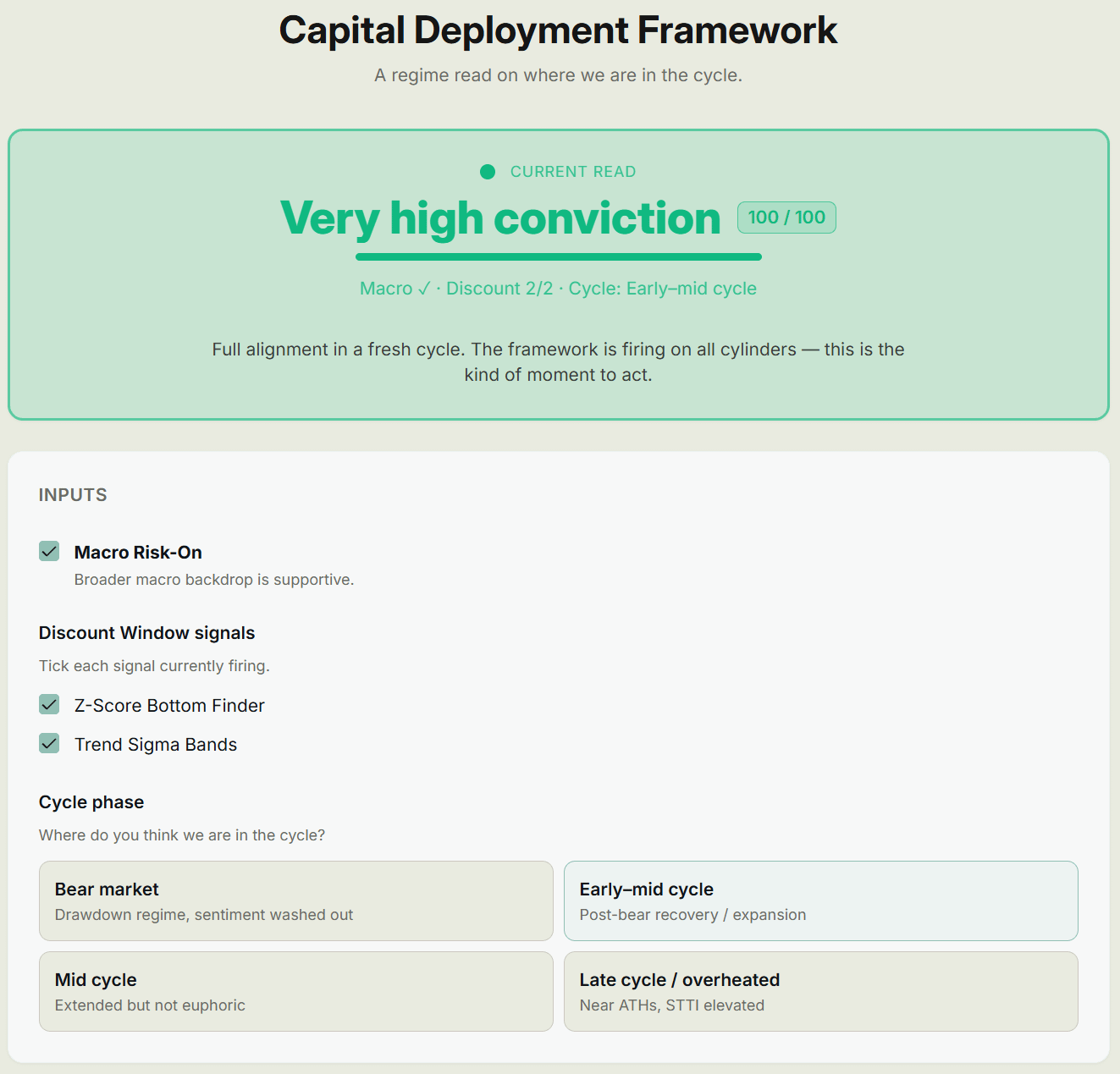
Example: 13 March 2020 (COVID Crash)
Score: 100/100 → Full capital deployment (100%)
This was a “go all in” moment, and, in hindsight, a highly profitable one (see charts above).
Example: 21 November 2025 (first major crash following the BTC top in Oct 2025)
Score: 48 → ~48% exposure
BTC was ~$80K when CDF triggered and later dropped to $60K before a second trigger in February 2026.
If deployed at the first trigger, the max total portfolio drawdown would be ~-12%
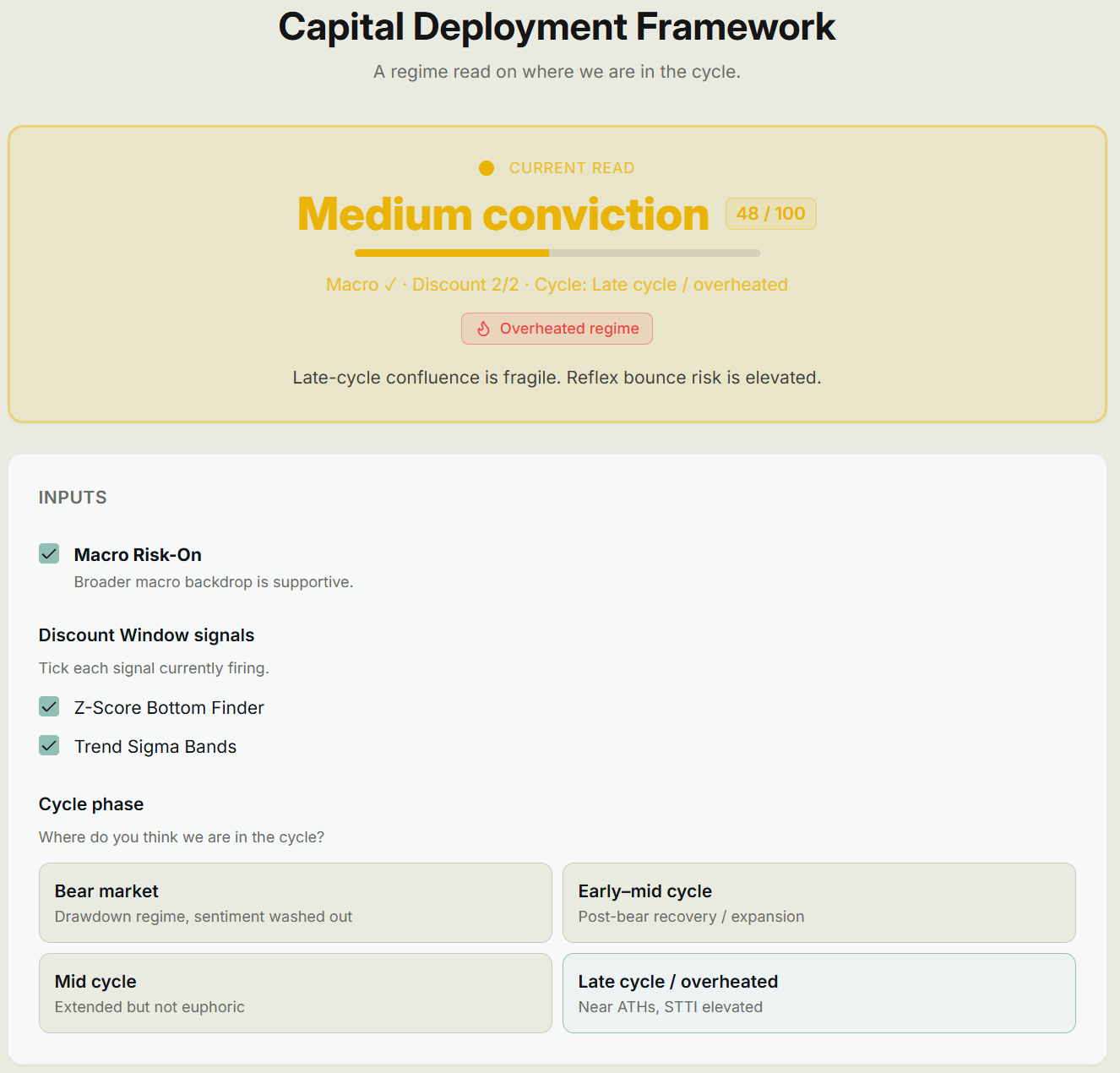
The second CDF trigger on 5 February 2026 would have led to an additional 32% deployed in what is increasingly looking like the 2026 cycle lows. This is an average purchase price of ~$72K.
ER answers:
Is momentum deteriorating enough to reduce or cap exposure?
Crucially, ER is not applied symmetrically across the cycle.
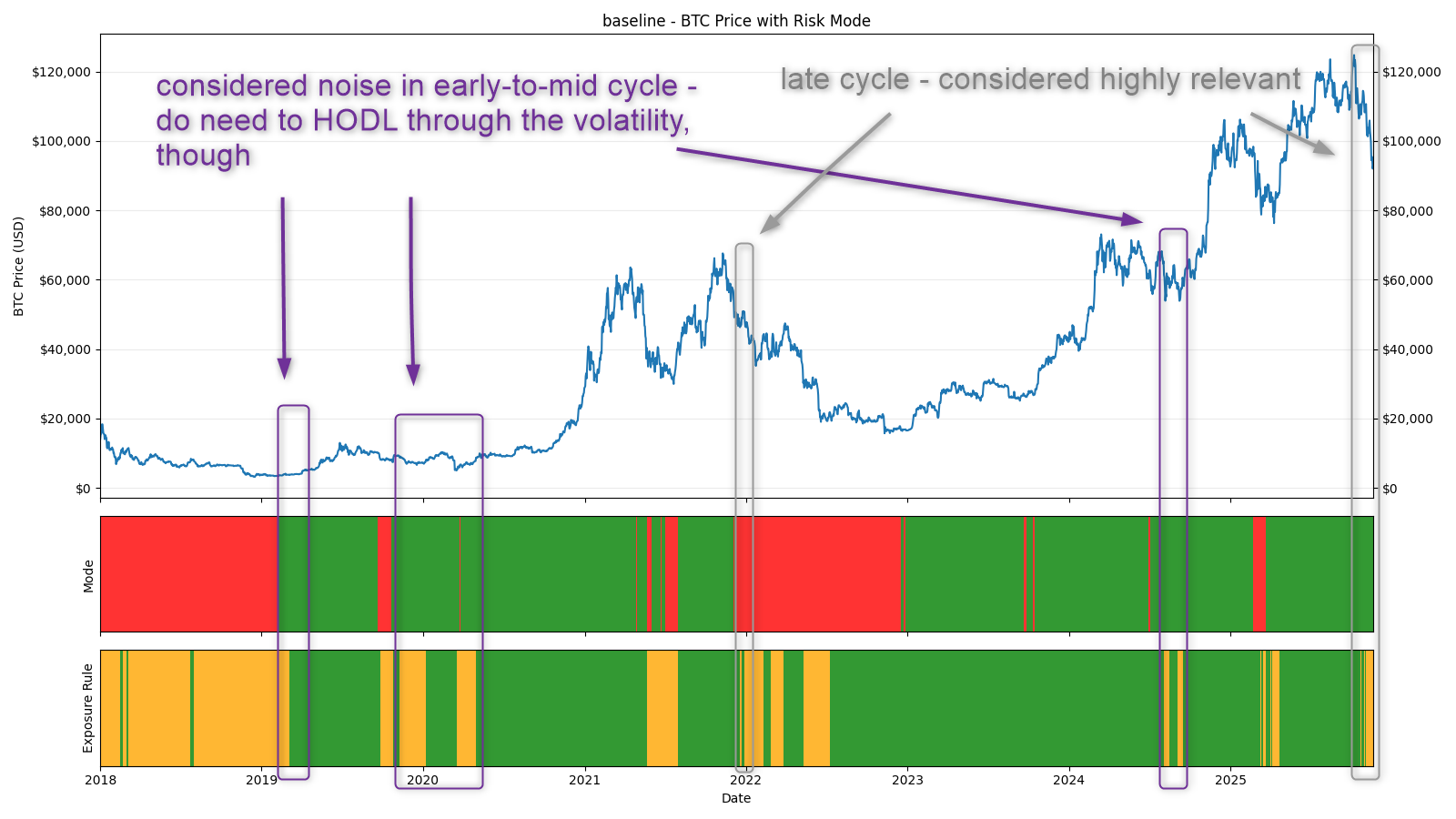
In this phase, ER is not a hard de-risk trigger. Early-mid cycle refers to the post-bear recovery and expansion phase, typically the first ~24 months after a major bear market bottom. In this phase, price has moved materially off the lows, but is not yet near ATHs, materially extended, or showing STTI-defined cycle-top conditions.
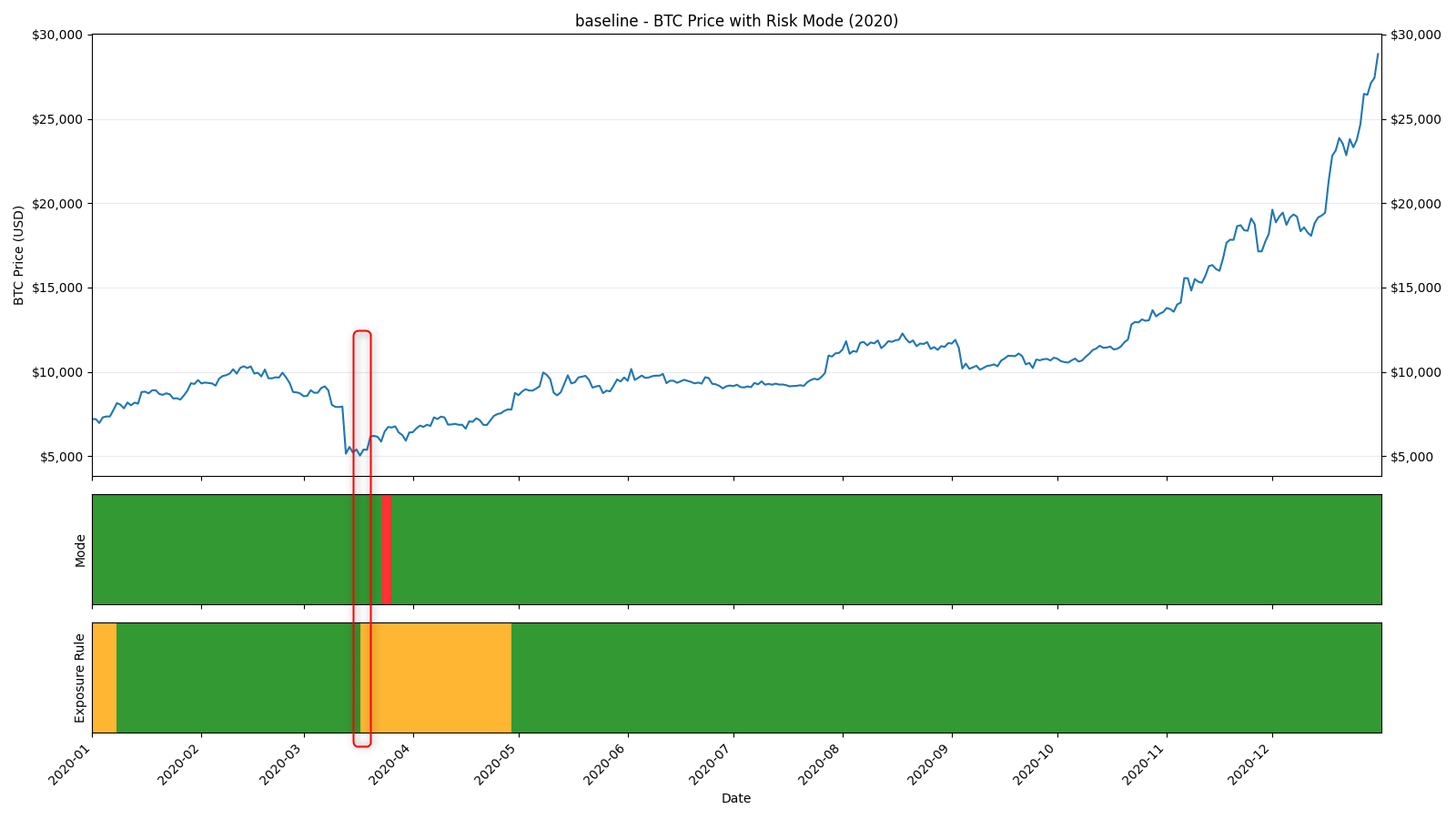
Example: March 2020 (Black Swan event, COVID crash)
Despite ER triggering, price had already dropped -66%. This was a moment to add, not reduce, especially with CDF also triggering.
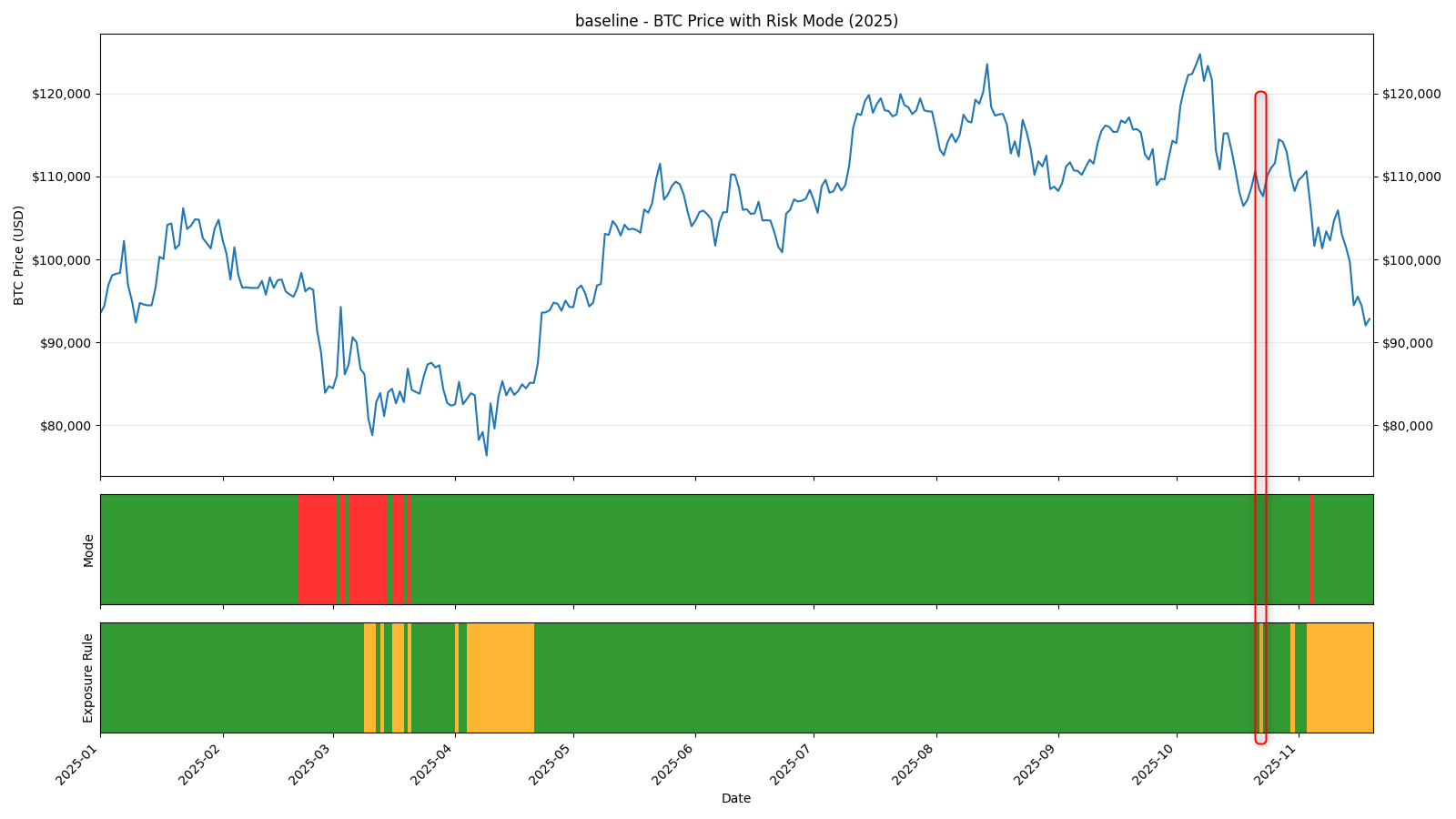
Late cycle is different.
When price is near ATHs and momentum deteriorates, ER becomes a powerful early warning signal.
This is what occurred in late 2025.
STTI answers:
Are conditions approaching cycle-top / euphoric levels?
When triggered, the framework enters Distribution Mode:
No new exposure via CDF or RORO
Assets are trimmed according to TP and CB rules
Trim size varies (0–100%) depending on the asset
STTI signals when to distribute. TP and CB determine how much.
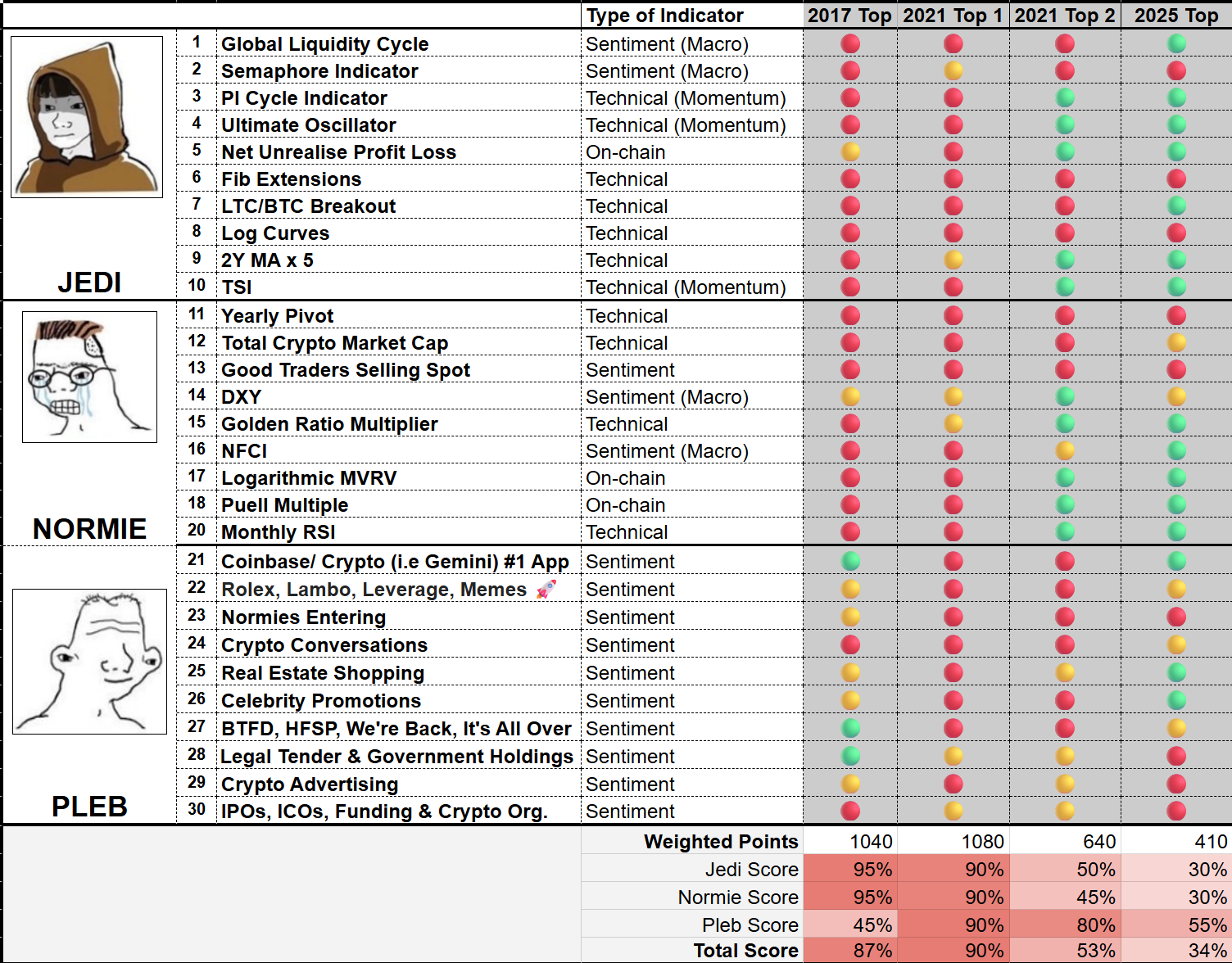
TP answers:
Has this asset reached a level to realise profits?
This is the execution layer for distribution.
It’s not about selling the pico top - it is absolutely about selling into strength.
Here are some examples:
The TP framework usually follows tranche structures i.e. 20% at TP1 / 40% at TP2 / 40% when STTI is at all-time-highs.
CB answers:
Has this asset triggered a protection rule?
CBs protect gains and limit reversals.
They are asset-specific:
If SOL triggers → trim SOL
Do not automatically sell BTC
Rule: If an asset hits its CB after a predefined level → trim according to TP/CB strategy.
Here is an example CB strategy 👇🏽
BTBI answers:
Does this drawdown resemble a bottom?
Not that bottom…

This bottom!
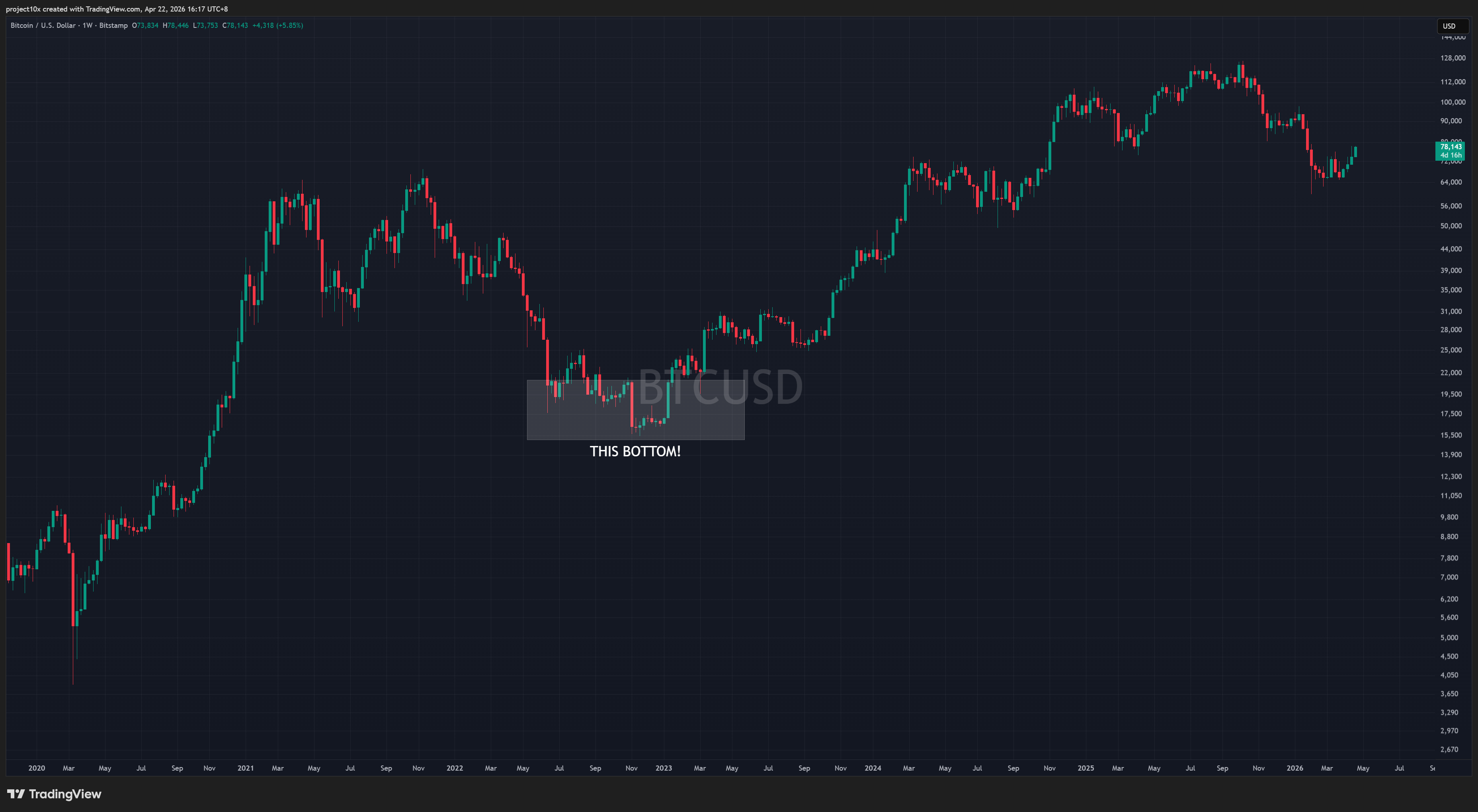
BTBI is confluence only, not an action trigger. It is especially useful in bear markets.
👉🏽Here👈🏽 is a deep dive into the indicators along with an outline below 👇🏽

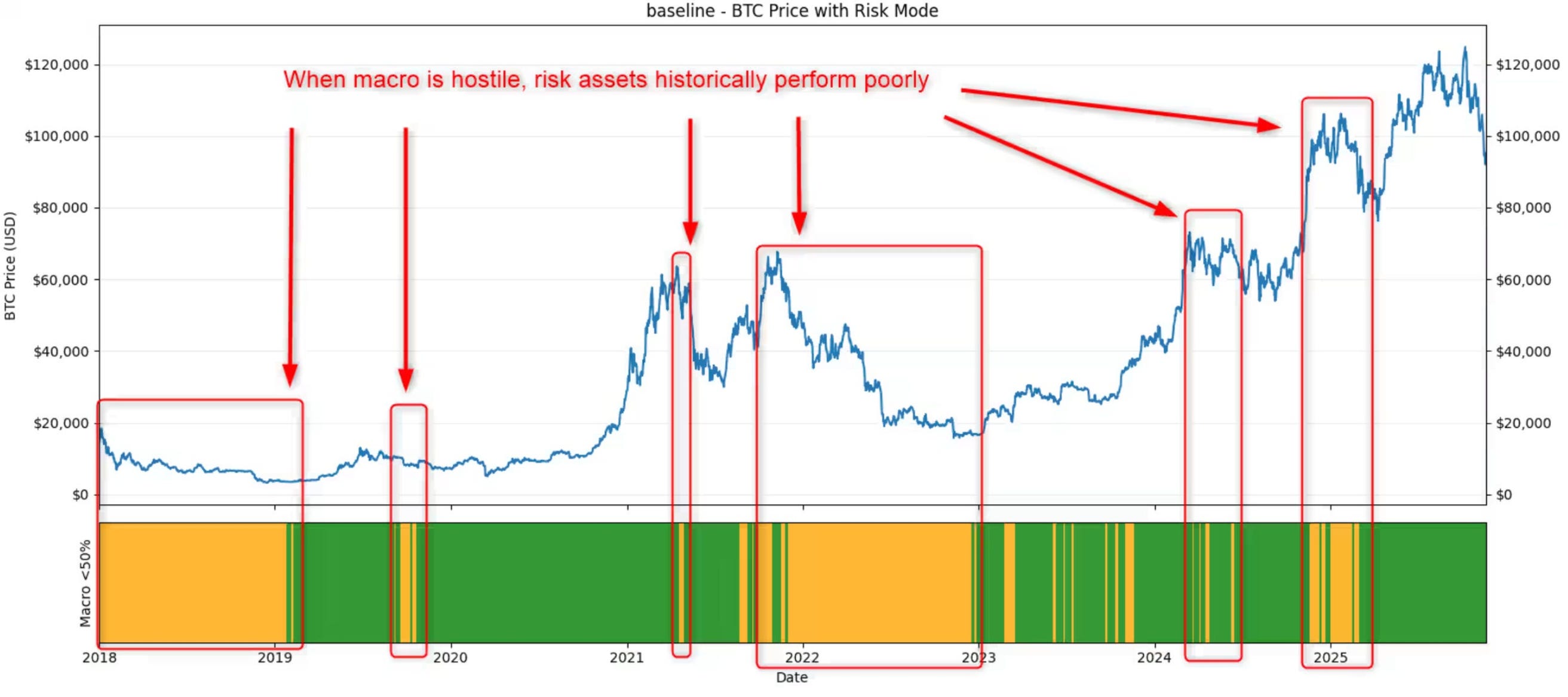
The macro score provides context for the broader environment and is used as a gate in the CDF.
Key threshold: Macro ≤ 50 in RORO
When macro is weak:
Risk assets underperform
Stronger confirmation is required before adding exposure
Macro is not a trade signal, but it is context. For example, a CDF trigger in strong macro conditions is different from one in a hostile environment.
That’s all for now.
Catch you next week!
✌🏽
Comments
Nothing yet. Say the first thing.
Sign in to join the conversation.