

I’ve been sitting with a question lately, one I keep coming back to in my own life and in conversations with women in this community.
What is actually keeping us stuck in midlife? Not the reasons we give other people. The real ones.
Over the next few weeks I’m exploring what I think those reasons are, one honest post at a time. This is the first.
At the end of this post I’m sharing a free tool that will help you see exactly where to begin. Stay with me.
There is a particular kind of loss that nobody warns you about.
Not the loss of a person, a job, a home or a relationship.
The loss of yourself.
The loss that didn’t happen in one moment or in a crisis you could point to and name. But in a thousand small moments of choosing everyone else first. Of answering every need around you before you ever turned inward. Of being so thoroughly present for the people you love that you gradually, imperceptibly, became absent to yourself.
And the cruellest part?
You didn’t lose yourself because you stopped caring.
You lost yourself because you cared so much.
Think back to who you were before life got loud and complicated.
The version of you before the children came along or the career consumed you. The good old days before you had extra family members who needed you or relationships that required your constant management. Before you realised it, your responsibilities had stacked themselves so high you couldn’t see over them.
There was once a woman who had opinions about her own life. Who knew what excited her, who had things she wanted to try, places she wanted to go, a version of herself she was quietly moving toward. She had preferences, not just preferences about what everyone else needed, but about what she needed.
She asked herself questions.
What do I want to do this weekend? What do I actually think about this? What would make me feel alive right now?
And at some point, not dramatically, not all at once, she stopped asking. Her voice got softer and softer, until it became hard to hear her above the noise of everything else that needed answering first. Every day. For years.
Here is what I have noticed, both in my own life and in the women I work with.
When we stop asking ourselves what we want for long enough, something happens that goes beyond simply not knowing the answer. We start to feel like the question itself is somehow selfish. Like wanting things for ourselves is an indulgence we haven’t quite earned, like our desires belong somewhere lower on the priority list. Not deleted, just perpetually deferred until some future season when everyone else’s needs have finally been met.
That season, of course, never quite arrives. I remember looking at the shadow of the tiny infant I was carrying and secretly wondering when he would be able to stand on his own two feet and need me a little less. With two more children who came after him, that so-called season of freedom didn’t arrive until thirty years later. Thirty years of quietly putting the question aside, telling myself there would be time for it eventually.
And so in the intervening years, many of us become extraordinarily skilled at a particular kind of self-abandonment. The polite kind. The kind that wears the costume of love and responsibility and selflessness so convincingly that we don’t even recognise it as loss because it doesn’t feel like loss. It feels like being a good mother, a good partner, a good daughter and a good friend.
We become experts in everyone else. We know what our children need to feel safe without them having to ask, what our partner needs when they’re stressed, what our ageing parents need before they’ve finished the sentence. We can read a room full of people we love and know instinctively what each one requires from us.
But here is the question I keep coming back to. Do the people in our lives know our interior world with the same fluency? And more honestly than that, do we even know it ourselves anymore?
Because quietly, without ceremony, without any single moment we could point to, many of us have become strangers to our own.
For many women, there is a moment when something finally clicks. Not always a dramatic one. Sometimes it arrives in the most ordinary, unsuspecting circumstances — a conversation over coffee that takes an unexpected turn, a book you picked up on a whim that suddenly describes your interior life with uncomfortable accuracy, a song that comes on in the car and catches you completely off guard. Sometimes it is a single line someone says that you find yourself turning over for days afterward, unable to explain quite why it won’t leave you alone.
And sometimes it is the bigger moments. The children leaving home and the house going quiet, and instead of feeling the relief you had quietly been looking forward to, you feel something closer to emptiness. A relationship ending, or a career chapter closing, and discovering that without the role to inhabit you weren’t quite sure who you were underneath it. The realisation that you had been so defined by what you did for others that when the doing stopped, you didn’t quite know what remained.
Maybe nothing dramatic happened at all. Life is fine. Functional. Good by most measures. But somewhere along the way it lost its freshness, its aliveness, its sense of meaning and significance. The days are full but something in them feels thin, like you are going through the motions of a life rather than actually living one.
And still, underneath all of it, a quiet voice. A whisper that has been trying to get your attention for years, patient and persistent in equal measure.
Who am I, when I’m not being what everyone else needs me to be?
That voice is not a symptom of ingratitude and it is not a sign that something is wrong with you. It is the part of you that never stopped existing, even when you stopped listening to her. It is a call to come back to yourself. And the fact that you can still hear it, however faintly, means it is not too late to answer.
Here is something I want to say clearly, because I think it is one of the most unhelpful stories we tell women in midlife.
That to be happier, more fulfilled, more alive, you need to reinvent yourself. Completely. Urgently. As if the woman you are right now is somehow not enough to build from, as if everything you have lived and learned and become needs to be dismantled before anything better can begin.
That story is not only untrue. It is exhausting. And for many women, it is the very thing that stops them from starting at all. Because if the only option is a complete overhaul, then the bar is so high and the task so enormous that staying exactly where you are starts to feel like the more sensible choice.
But that is a false choice and I refuse to offer it to you.
Because here is what I actually believe, and what I have seen to be true in my own life and in the lives of the women I work with. You do not need to tear anything down, walk away from everything you have built or become someone unrecognisable to the people who love you. You do not need to be ashamed of who you are now or measure yourself against some imagined version of who you could have been if you had made different choices.
What you need is simpler and more sustainable than any of that.
You need to come back to yourself. Slowly. Intentionally. On your own terms and in your own time.
This is what I think of as the Progressionist way. Not a revolution but a return. Not an overnight transformation but a patient, ongoing process of choosing yourself a little more each day. Of developing the parts of yourself that have been quietly waiting. Of growing, gradually and without pressure, into the woman you have always had the potential to be — the one who was there before life got loud, and who is still there now, waiting not for a dramatic moment of change but simply for your attention.
There is no deadline on this process, no finish line you are racing toward and no version of it you are doing wrong. Some of what you want will come quickly once you give yourself permission to want it. Others will need time to develop and that is not a failure — that is simply how real, lasting change works.
The woman who does the quiet inner work, who gets honest with herself about what she wants and begins moving toward it one small deliberate step at a time, gradually becomes someone who is ready to receive the life she has been imagining. Not by accident but because she chose to grow into it.
That is the Progressionist way.
Progress over perfection. Development over demolition. Choice over circumstance.
And it begins not with a plan or a deadline or a dramatic declaration.
It begins with a single honest question.
What have I been putting on hold that is finally ready to come forward?
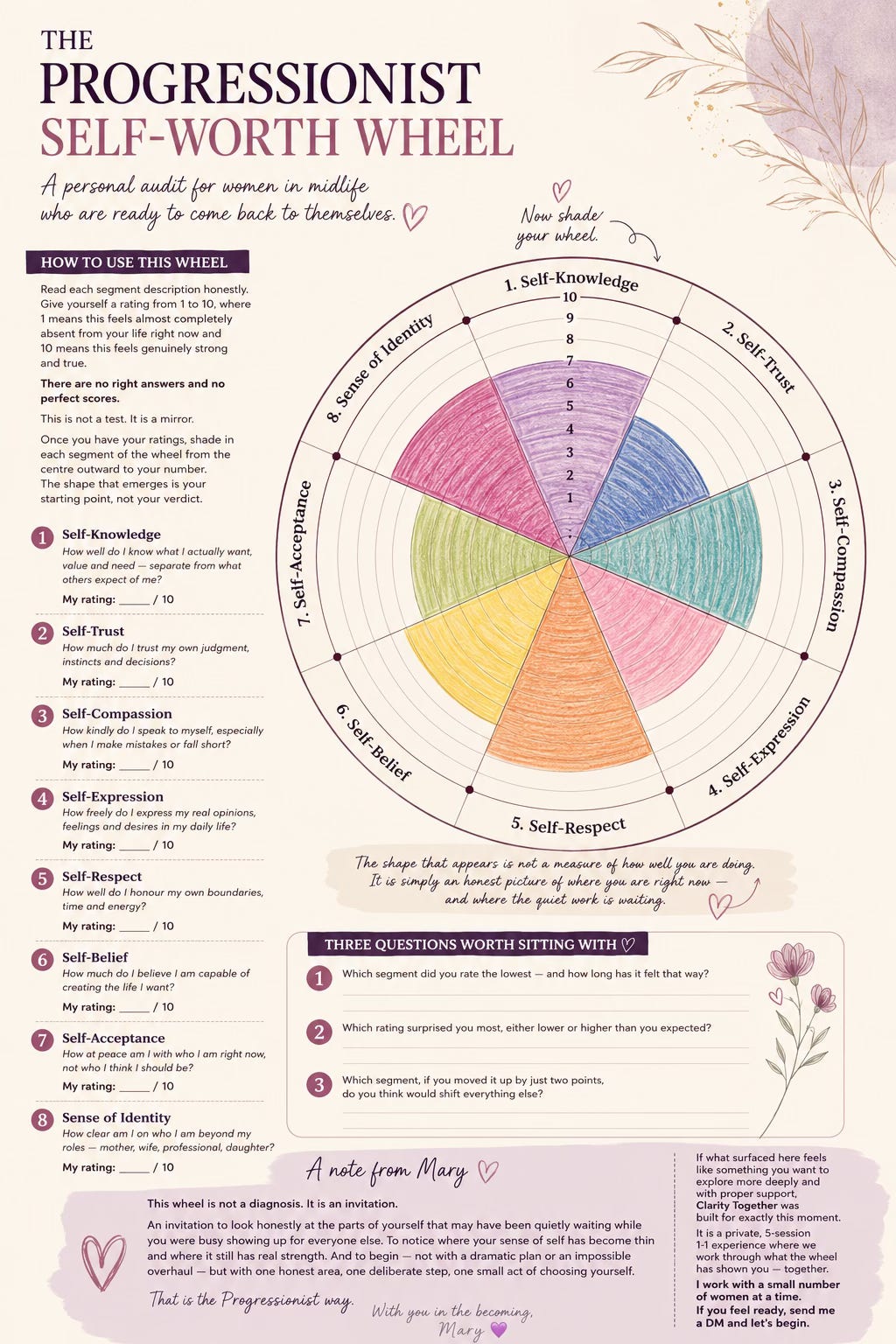
If this post has stirred something in you, I want to leave you with something to make it real.
Not a plan. Not a programme. A simple, honest tool.
I created The Progressionist Self-Worth Wheel — a personal audit designed specifically for women in midlife who are ready to stop and look honestly at where they are. Not as a measure of how well you are doing, but as a mirror. A way to see clearly which parts of yourself have been quietly waiting while you were busy showing up for everyone else.
It takes about ten minutes to complete. It will show you exactly where your sense of self needs the most attention right now. And it will give you one honest place to begin.
Download a blank version of The Progressionist Self-Worth Wheel below. It is free.
If what surfaces feels bigger than something you want to sit with alone — if what comes up feels like something you want to explore more deeply and with proper support — that is what Clarity Together is for. A private, 5-session 1-1 experience where we work through exactly this, together. Not a course. A real conversation, built entirely around you.
I work with a small number of women at a time. If you feel ready to take that mini but mighty step, send me a DM.
This post is the first in a series I am writing on what actually keeps women in midlife stuck. The next one is already coming and it goes somewhere a little different but equally honest.
If this resonated with you, subscribe so you don’t miss what comes next. And if you know a woman who needs to read this today, share it with her.
Because this is a conversation worth having properly. And I am only just getting started.
With you in the becoming,
Mary 💜
Comments
Nothing yet. Say the first thing.
Sign in to join the conversation.