
Introduction
This will be a will be a two-part essay: the first part developing a better foundation for understanding human intelligence and the second half focusing on the kind of environment required to nurture, extend and enhance it.
The essay is necessarily a bit theoretical or academic in nature because the position presented diverges, significantly, from mainstream ideas and practices. The goal, however, is to provide a concrete foundation from which to launch immediate practical efforts.
Metaphor
W. V. O. Quine said, “Along the philosophical fringes of science we may find reasons to question basic conceptual structures and to grope for ways to refashion them. Old idioms are bound to fail us here, and only metaphor can begin to limn the new order.”
Cognition and intelligence are topics at the speculative edge of science. At the moment and in the context of the AI mania, it is essential to recognize the metaphor behind prevailing theories before presenting the contrasting/contradicting metaphor.
The Computational Metaphor. The idea that human thinking, human intelligence, involved the formal manipulation of discrete, well defined, tokens is, at least, as old as the Age of Enlightenment and the thought of Pascal and Leibniz. Alan Turing’s famous test established the potential equivalence of human and machine “thinking.” Fast forward to the advent of AI and Alan Newell announcing to his class that, “over break, Herb Simon and I invented an artificial intelligence.” Today we encounter the bald-faced assertion that LLMs and Deep Learning have achieved human level intelligence and will, very shortly, exceed it.
When computers were new and ,with regard what they did, poorly understood it made sense to, metaphorically, compare human thinking with what was happening inside the computer. Unfortunately, our understand of the human mind, even the human brain, was minimal.
As our understanding of human intelligence increased the metaphor should have died. Instead, it became a pernicious “truth;” an assertion of fact.
The vTAO Metaphor. A “virtual Topographic Adaptive Organism,” or vTAO, is an alternative metaphor, first proposed in my doctoral dissertation in 1988. It is based on Hopfield’s metaphor for understanding “learning” in a neural net. Inputs enter the net, pass through intermediate nodes and exit via output nodes. Feedback causes threshold weights to adjust at various nodes creating greater or lesser resistance at that node. The adjusted weights can be seen as a kind of landscape, [Figure 1], with, metaphorically, inputs falling like rain drops and being channeled to ‘seas’ that are the outputs.
The essence of the vTAO metaphor is also a virtual topography generated by the learning of the entire organism, not just the electrical circuitry of the human brain.
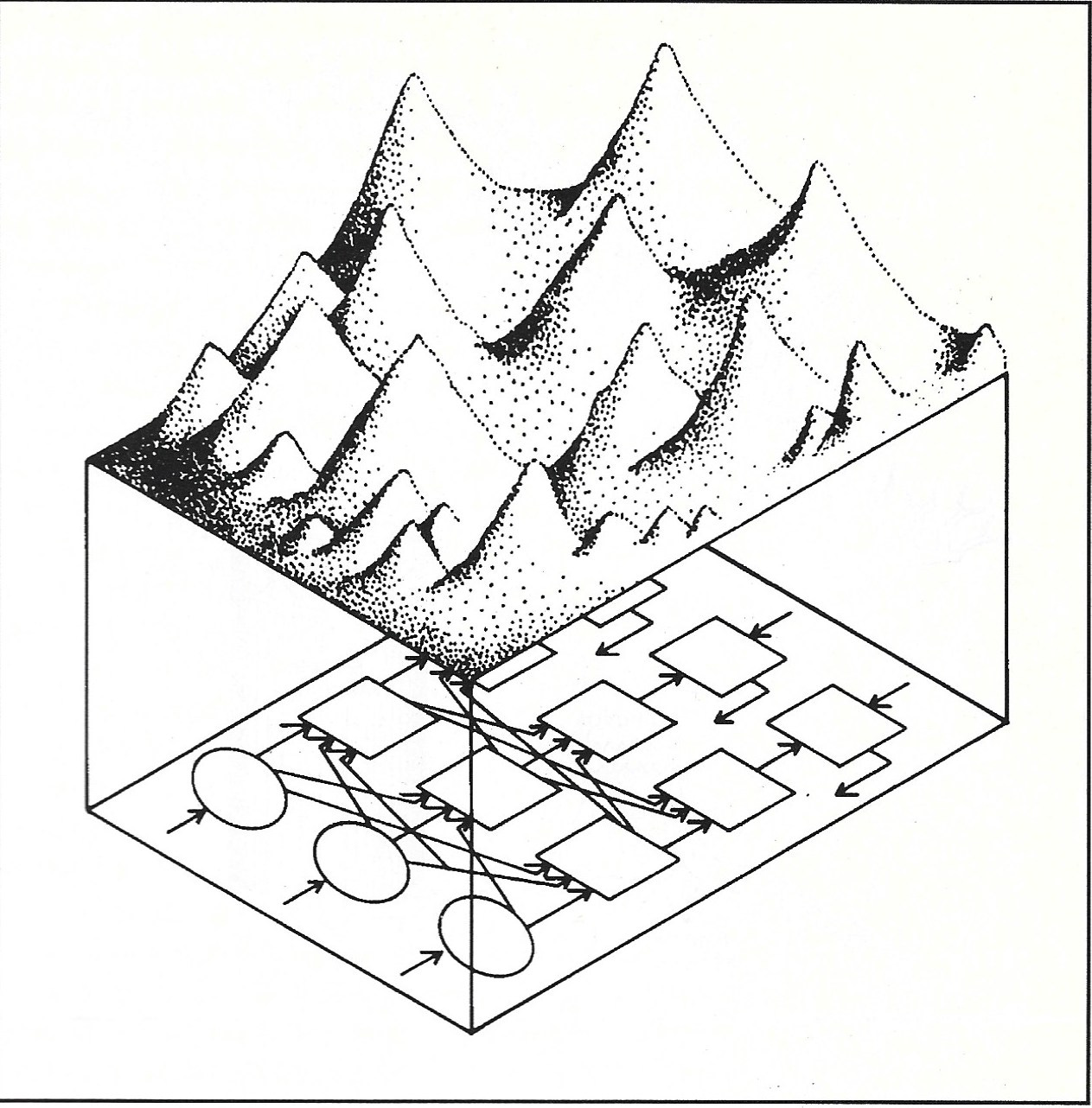

Figure 1
vTAO
Hopfield’s landscape metaphor is ‘one-dimensional’—reflecting only the adjusting weights assigned to the faux neurons. To model human intelligence, embodied in a biological organism, multiple shaping forces must be acknowledged. Six such forces, along with analogs of landscape shaping forces, are:
Cellular [planetary core] – Bergland and Conrad discuss in detail the information processing capabilities of enzymes and cellular (and sub-cellular) entities. Inputs at this level are highly constant, usually variance is seen only as a consequence of mutation or malfunction. Seen as a constraint, this force limits the “altitude” of the peaks and “depth” of the basins. Organisms with different cellular foundations—for example octopi with chromatophores—would have differently shaped or bounded landscapes as a result.
Organismic [tectonic plates] – Maturana and Varela, extended by Winograd and Flores, show how organismic organization affects cognitive behavior as well as the arbitrary classification of behavior into “intelligent, cognitive, and aware” on one hand and “instinctive, stimulus-response, and non-intelligent” on the other. Their general argument, widely accepted, is that so-called higher functions like cognition are structured by the organism and its ontogeny and phylogeny.
Sensual [planetary crust] – This force is the most extensive of the six. Every cell in the organism, every nerve ending, is a sensor receiving signals. Not only is the volume of those signals massive, it is constant and constantly in flux. Making sense of this information flow requires multiple adaptations in any organism.
Habitual [geography] – repetitive patterns of activity. All organisms except, perhaps, the simplest, exhibit such patterned activity.
Cultural [landscape] – this level embodies the heart of the hermeneutic argument; alterations of constancy giving rise to the social construction of meaning, the cultural parameters of cognition, and the behavior-symbol-context-cognition associations that are empirically evident.
Analytic [architected surface variation] – A thin veneer layer commonly associated with “thinking,” the kind of activity at the focus of efforts in AI and cognitive psychology. Constancy is least evident, but clearly present, at this level.
All six forces operate simultaneously, they are not hierarchic, nor are they reductionistic. Just as an orchestra combines and synthesizes multiple threads of sound to produce a single performance.
The result of this extension is a far more interesting and complex “landscape” than offered by the Hopfield metaphor. [Figure 2]
To this point we have an organism, a VTAO, in isolation. We want to put that organism in a context, an environment. Then, embellish the model in two ways: one focusing on inputs and the other outputs.
Inputs. In a standard neural net, inputs are mere signals; the VTAO assigns an attribute to those signals, “Constancy.” Constancy is a value resulting from a function that synthesizes how often the signal is received (frequency); the strength of the signal is the same each time received (consistency); and, the signals being received via the same node(s) (regularity). Constancy adds stability to the net; in large part because inputs from cellular and organismic forces have high Constancy.

Figure 2
Outputs alter, introduce change to, the environment. Something as basic as a cell consuming a bit of sucrose, metabolizing it, and excreting a byproduct, changes the environment surrounding that cell. Changes in the environment alter the Constancy of inputs: e.g., the “here be sugar” input decreases in constancy the “here be excretion,” input increases in constancy.
This model asserts that human intelligence is not a type of computation that happens to run on biological hardware. Instead, it is an emergent property of a living organism total engagement with reality across multiple simultaneous dimensions—only one of which, the analytic, can be replicated on a computer.
Further: humans alter their environment to alter constancy. A human, consciously or not, is an active co-author of the virtual landscape. A human is not merely the product of a landscape shaped by six forces—it is an agent that participates in the shaping.
Nurturing Human Intelligence
The first idea that, likely, pops into mind when considering an environment that will nurture the acquisition and extension of human intelligence is “school.” There is a vast system of schooling already in place. Unfortunately, that system is deeply flawed and in capable of nurturing the fullness of human knowledge.
The problem, succinctly stated: the U.S. educational system, from pre-kindergarten to graduate school, addresses but one facet of human intelligence—the thin veneer layer of the analytical force shaping the human intelligence “landscape.”
Almost all schools, as presently constituted, are merely places for content transmission. Content being that part of human knowledge that can be captured in formalisms and manipulated with algorithms. Additionally, we have convinced ourselves that this kind of formal thought/thinking is the epitome of human intelligence; leading to the erroneous belief that “Computational Thinking” is the only kind of thinking with value, and a “must be taught at all levels of schooling” basis for education.
In fact, this mindset reduces human intelligence to that which can be emulated with a machine—totally dismissing the other five forces noted in the vTAO model as irrelevant or immaterial. It is this assertion that lends any degree of credibility to claim of AI and AGI.
Human intelligence requires an environment in which all six forces shaping the vTAO landscape are simultaneously addressed, over long periods of time, and with sufficient depth that the resulting changes in the constancy of inputs becomes part of the student’s permanent intelligence topography.
Less like a university and more like a monastery, an atelier, a wilderness, and a philosophical community might produce.
Yes, there are instances and exemplars that support this claim. Most art, both fine and applied, institutions move in this direction. Summerhill and Montessori, for younger children, are far more holistic than typical schools. The Platonic Academy; the Pythagorean community at Croton; traditional versions of the madrasa, the yeshiva, the shedra, the seminary, and the ashram; the medieval apprenticeship, Waldorf Education System (Rudolf Steiner); and indigenous rites of passage; all are exemplars.
The Greek concept of paideia is, perhaps, the best illustration. The term means development of the complete human being, the cultivation of arete, the full flowering of human abilities in proper relationship.
What made paideia work—when it worked— was that these (the gymnasium, the music hall, the polis, the sanctum, the agora) were not separate institutions offering separate services but a single integrated culture of formation in which every dimension reinforced every other. Athenian society progressively paideia into competing specialisms (bemoaned by Plato) just as the university moved from an integrated quadrivium to a plethora of competing and disconnected majors.
Attempting to establish a multi-year boarding school, deeply inter- and cross-disciplinary paideia academy is impractical.
But it might very well be possible to create a place with a more limited focus that realized, at least partially, many of the same ideals.
…a studio in Renaissance Florence; a master and several advanced apprentices; multiple arts being worked shoulder to shoulder: sculpture, painting, goldsmithing, even poetry with masters for each; a spectrum of younger apprentices eager to master one of them but eager also to learn another, or three. This the ideal of the bottega:
• a “storefront” where goods and services are produced and delivered to paying customers
• a workshop simultaneously engaged in the craft, in building the tools and discovering the techniques that advance and support the craft, and teaching that craft to apprentices
• a place noisy with multiple projects and activities; walls and benches covered with works in progress and exemplars of the craft
• a place filled with the tools of the craft (add computers and digital displays to the easels, brushes, hammers, chisels, carving, forges, kilns, model making, etc. tools found in a typical bottega); with room for lounging and eating facilities as well
• an intellectual center that is a “must visit” for masters, scientists, and thinkers visiting the area, overseen (deliberately avoiding the term managed) by local masters and journeymen
• an environment and atmosphere that is very self-consciously multi- and inter-disciplinary; that mixes theory and prac- tice almost without differentiation
• a place full of music, especially “after hours”
• a place to share food and drink (and perhaps sleep)
• a fountain of innovation and creativity
Now imagine a computer science education based on this model. All learning would be based on bottega projects—software projects executed in teams—each project bristling with a set of required skills and knowledge that when learned (at various depths and degrees) educate the student. In the bottega there would be few if any “lectures”—instead there would be brief expositions, explorations, readings, and web searches— with a preference for hands-on learning or learning in a context, typically for a purpose, for a particular audience.
It might also be possible, and practical, to develop a mini-version of the Bottega established in-house akin to the software Dojo’s that were popular a few years ago. Of course, such a Dojo would, necessarily, include more than software developers as participants and would simultaneously address far more issues than coding and testing.
No posts
Comments
Nothing yet. Say the first thing.
Sign in to join the conversation.