

I found fascinating, The Name of the Rose (1986), a murder mystery drama based on the book by the same name written by Italian author Umberto Eco. The plot of the mystery murders was based on a (spoiler alert) toxicology problem and a book.
I want to note, here, that this movie along with The Da Vinci Code (2006), and Angels & Demons (2009) inspired me to write a movie script and cast, direct and produce the movie, Blood Vow (2018) (which you can see on Amazon Prime at https://www.amazon.com/Blood-Vow-Victoria-Sutton/dp/B0GYNZPJG4 ).
But back to The Name of the Rose — I do not want to spoil the movie for you, so I will just say it has something to do with Monks who wrote in a book, and everyone who read the book seemed to die. I was disappointed to learn this interesting toxicology murder plot was not based on a true story. But I have since learned there is a true story that involves poison books, but with a purpose to save lives, rather than to end them.
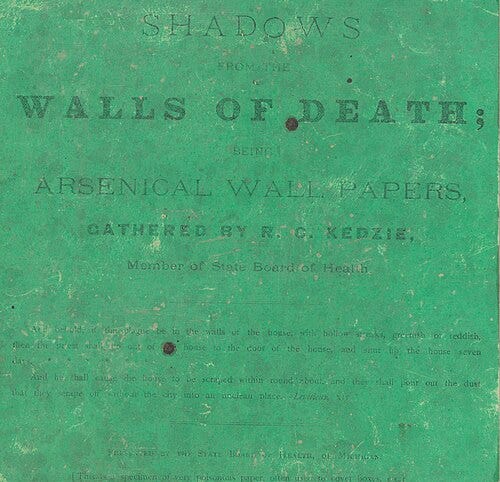
In 1874, Dr. Robert C. Kedzie,1 created a book entitled, Shadows from the Walls of Death: Facts and Inferences Prefacing a Book of Specimens of Arsenical Wall Papers.2 His book was an advocacy product meant to demonstrate the deadly nature of a product of the industrial revolution — mass produced paint used for wallpapers and fabric. The book was a collection of different types of wallpaper using the vivid paints, Scheele’s Green. Swedish chemist, Carl Wilhelm Scheele invented copper arsenite paint that rendered rich greens, yellows, and violets at an affordable price.3 Kedzie believed that the slow descent into madness of those confined to bedrest was due to the chronic inhalation of the dust from the arsenic-laden wallpapers of the bedrooms.
Dr. R. M. Kedzie, who served on the Michigan Board of Health in the 1870s, explains his unique strategy for raising awareness in the preface to Shadows from the Walls of Death. Originally printed in a run of one hundred copies, only a half-dozen of which remain due to recipients fearfully destroying their copies, the book is contaminated by the very substance under indictment. That is, to eradicate the poison, Kedzie chose to archive its vehicle. “[T]o call attention to this source of danger, and to assist persons in detecting these dangerous colors in wall paper, the State Board of Health Directed me to prepare specimen books of such dangerous wall papers. . . . The wall papers in this book all contain arsenic.”4
Kedzie produced 100 copies of these books and sent them out to libraries. Once the recipients realized the deadly potential for the books they were destroyed. The last book was only sealed in 1998, and the four remaining copies are sealed from public access. We can still see the book through a digital copy which is available at these footnotes (see footnotes 3 and 4).
Arsenic is risky because it bioaccumulates in the body, meaning it is not eliminated from the body but is stored and accumulates eventually reaching deadly levels.5 The toxicological mechanism is to interfere with the production of ATP, the source of energy for cells, and shuts down the ability for cells to function. The results of this is liver, kidney, nervous system damage, resulting in death. If you want to read more details of the graphic death from arsenic, see this article.6
According to an environmental consulting firm in the UK, dealing with Victorian Era wallpapers can have some rare poisonings with arsine gas, the most deadly form of arsenic,7 producing molds:
In some rare cases, specific mould species that grow on damp wallpaper can metabolise arsenic compounds into arsine gas, a colourless, highly toxic vapour. This process was first identified in 1891 by the Italian chemist Bartolomeo Gosio, who demonstrated that the combination of arsenic pigments and mould growth could generate a poisonous gas capable of causing severe illness or death. Although such conditions are uncommon in modern buildings, poorly ventilated or water-damaged interiors containing historic wallpapers can still create a comparable risk environment.8
The deaths of four children in Great Britain were first diagnosed as Diphtheria, but eventually attributed to the newly green wallpapering of their nursery.9
When major public health exposures like this one — both the wallpapers themselves and the book of them produced by Kedzie—would have resulted in federal regulation, it was still too early in our administrative law history to address these risks.
Scheele’s Green was under scrutiny for its deadly properties by 1860 and was phased out by 1900.10 Air quality was not regulated until 195511 and consumer products like wallpapers were not regulated until 1972,12 and even that regulation is limited to recalls for unsafe products.13 Indoor air quality is not regulated by the federal government. However, the removal of lead paint is regulated by U.S. EPA,14 but not the removal of arsenic-laden wallpaper!
Around the turn of the century, the risks of chemicals and metals were still being discovered. Contaminated vaccines for children led to the passage of the Biologics Control Act of 1901,15 which was followed by the Food, Drug and Cosmetic Act in 1906, and the FDA. So the period when deadly wallpapers were sold and installed ended before an institution to capture and protect the public from its risks existed. The tort litigation system for individuals harmed by defective products was at least one mechanism to protect the public from such risks.
If a wallpaper was created today, with a copper arsenite paint, it would be regulated by the Toxic Substances Control Act (TSCA), that requires any new chemical (like copper arsenite) to demonstrate safety through scientifically conducted safety testing.16 (Because copper arsenite was used as a pesticide, today it would also be regulated by the Federal Insecticide, Fungicide and Rodenticide Act (FIFRA); but we will limit this to wallpaper uses.)
However, the existence of these wallpapers in Victorian Era homes is still a real risk, and falls into a regulatory gap that poses a real risk of death. The buyer of such a home is limited to the age old property doctrine, “buyer beware”. However, if you are purchasing a house with the risk of having arsenic containing wallpapers, there may be a disclosure requirement for any “defect” that is a safety hazard, but each state has its own language and disclosure requirements. This leaves the tort system as the public health risk system which may be totally inadequate given a case is brought due to damages, and in this case the damages may be death.
https://en.wikipedia.org/wiki/Robert_Langdon_(franchise)
https://publicdomainreview.org/collection/kedzie-shadows/
https://publicdomainreview.org/collection/kedzie-shadows/
https://publicdomainreview.org/collection/kedzie-shadows/
https://www.merriam-webster.com/dictionary/bioaccumulation
https://www.sciencedirect.com/topics/biochemistry-genetics-and-molecular-biology/arsenate
https://www.sciencedirect.com/topics/biochemistry-genetics-and-molecular-biology/arsenate
https://envirochem.co.uk/articles/the-dangers-of-arsenic-in-victorian-wallpaper--paint
https://www.researchgate.net/publication/274666002_Deadly_Decor_A_Short_History_of_Arsenic_Poisoning_in_the_Nineteenth_Century
https://en.wikipedia.org/wiki/Scheele%27s_green
https://www.epa.gov/clean-air-act-overview/evolution-clean-air-act
The Consumer Product Safety Commission was created in 1972 at https://www.cpsc.gov/Newsroom/News-Releases/2022/CPSC-Celebrates-50-Years-of-Making-Consumer-Safety-our-Mission
https://www.cpsc.gov/Recalls
https://www.epa.gov/lead/lead-renovation-repair-and-painting-program
https://en.wikipedia.org/wiki/Biologics_Control_Act
https://www.epa.gov/assessing-and-managing-chemicals-under-tsca/industry-testing-requirements-under-tsca-section-4
Comments
Nothing yet. Say the first thing.
Sign in to join the conversation.