
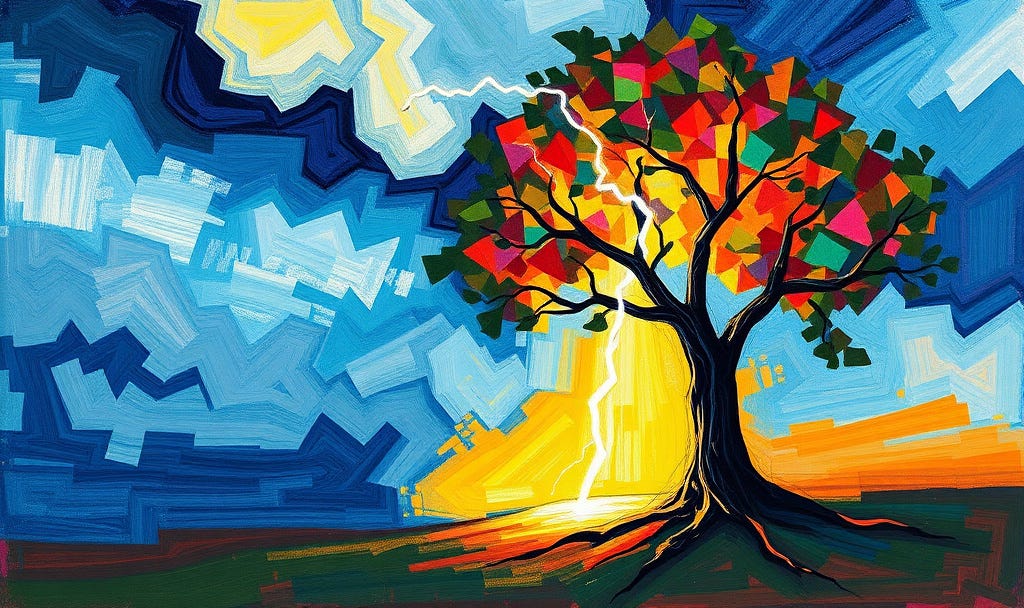
Lightning has been regarded as a powerful sacred force by humans since the beginning of time, and often attributed to a deity (e.g., Zeus, Minerva). When someone is struck by lightning, rightly or wrongly, it is often thought of as a divine act of judgment.1 So it is not surprising that when it came time to attribute liability for damages from lightning, liability could not be attributed to “Acts of God”. The theory took root as a legal principle in tort law.
Lightning begins with static electricity in the clouds from water and ice rubbing against each other. These charged particles are positive and negative. The positive particles move up and the negative ones move toward the ground, resulting in a release of the energy by making contact with the earth —- seen as lightning, heard as thunder. The light waves of the lightning are about a million times faster than the sound waves of the thunder, so you can estimate the distance of the lightning roughly by every four second between seeing the lightning and hearing the thunder, is equal to one mile. 2
The most common way to describe the risk of being struck by lightning is one in a million chance.3 But where you are can shift that probability.
Worldwide, about 240,000 people are struck by lightning each year, and about 90% survive; however, many sustain long term neurological, cardiac or other injuries.4
States with the highest numbers of people struck by lightning (based on long-term National Weather Service data):
Florida
Texas
Colorado
North Carolina
Georgia
Tennessee
Alabama
Pennsylvania
Ohio
New York
Florida has, by far, the most lightning strikes, it is often called the “Lightning Capital of the United States.” This could be due to the almost daily thunderstorms in Florida and high humidity in the atmosphere, as well as the prevalence outdoor activities.5
Then there is the myth that lightning never strikes the same place twice. It apparently comes from the belief that someone would not suffer the same misfortune twice. However, scientifically, it is just not true. Lightning seeks the shortest path to the ground and reaching tall and isolated structures is the most common pathway. For example, the Empire State Building is struck about 25 times each year, and the Eiffel Tower, about ten times.6
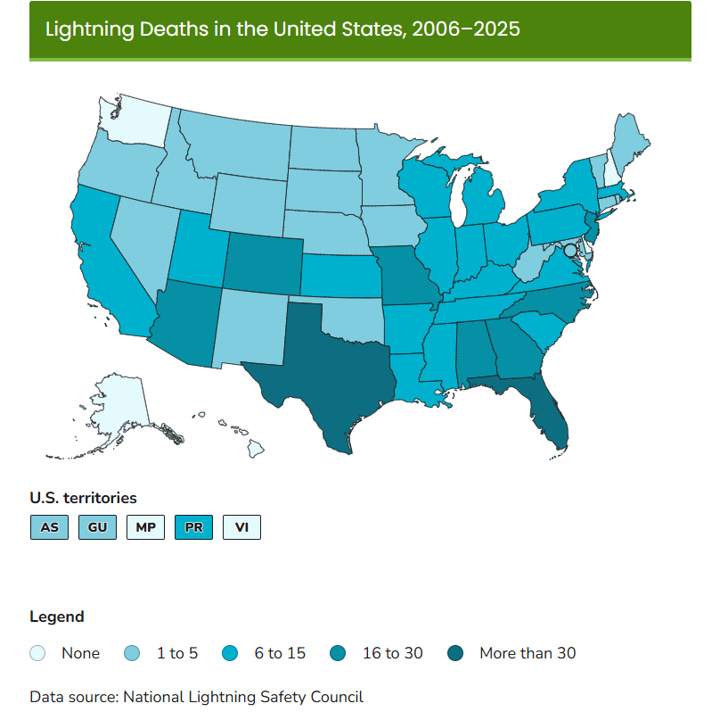
So far this year, there have been five deaths from lightning strikes in the United States (2-Florida; 1-Wisconsin; 1-Illinois and Utah-1). This is significantly below the usual 10-20 deaths by this time of the year.7 Overall, lightning deaths are down from the past 30-50 deaths to 10-20 because of the increase in technology and the ability to warn those when exposure is a risk.
In 1939, a landmark case, Central Georgia Electric Membership Corp. v. Heath,8 held that while lightning was an Act of God, the fact that it traveled through a house through an electrical system design that was faulty led to the conclusion that the utility-defendant had a duty to keep their customers safe — hence, there was liability for that damage. The court opined, “When the lightning struck the main line of the defendant it was an act of God; but permitting it to travel across the lateral wire into the room occupied by the plaintiff, instead of arranging so that it would be conducted into the ground, was not an act free from human agency.”9
Up until the 1970s, lightning was primarily treated as this '“Act of God” for which there could be no liability. However, from the 1970s to 1995, courts would attribute some liability if the defendant had assumed the risk of their exposure to lightning.
In 1995, the case, Maussner v. Atlantic City Country Club,10 a golfer was struck by lightning. The golf club argued that it was an Act of God for which no one could be liable. However, the court found that when lightning is foreseeable (as it was in this case), the golf club has a duty to exercise reasonable care by taking steps to prevent golfers from being exposed to lightning risk, including shutting down the golf course, monitoring storms and having appropriate shelter, for example. The courts began to look at foreseeability and the duty to monitor for storms was largely due to the development of better science and technology for predicting and tracking storm and lightning data. This coincides with the date that doppler radar became fully available across the United States.11 It was adopted by the National Weather Service in 1942 and by 1959 the National Weather Service was installing its nationwide weather monitoring system. The next generation radar systems of NEXRADs, were developed using doppler that improved on ordinary radar by detecting movements within storms. The NEXRAD system gave it accessibility and increased refinement of the data so that predictive duties arose.
So after 1995, not only golf courses, but governments, schools, outside events and sports events have a duty to keep their participants safe through monitoring storms and taking precautionary steps to prevent exposure to the risk. It also weakens the assumption of risk defense, if there are expectations of warnings and predictive monitoring of weather-inducing lightning.
Lightning strikes as well as other weather disasters, like floods, freezes and extreme heat events have also become predictable enough to create a duty to warn. Current litigation against Camp Mystic and local government, involves the “Act of God” defense, despite the National Weather Service warnings to evacuate that were ignored for hours according to the pleadings.12
https://www.biblestudytools.com/dictionary/lightning/
https://sciencemadesimple.co.uk/item/the-science-of-lightning/
https://www.cdc.gov/lightning/data-research/index.html
https://www.cdc.gov/lightning/data-research/index.html
https://www.cdc.gov/lightning/data-research/index.html
https://lpsfr.com/en/blog-lightning-never-strikes-twice/
http://lightningsafetycouncil.org/2026-Fatalities.html
60 Ga. App. 649, 4 S.E.2d 700 (Ga. Ct. App. 1939) at https://www.cetient.com/case/central-georgia-electric-membership-corp-v-heath-5774401 .
60 Ga. App. 649, 4 S.E.2d 700 at 832 (Ga. Ct. App. 1939).
https://caselaw.findlaw.com/court/nj-superior-court-appellate-division/1310448.html
https://www.weather.gov/about/radar
www.courthousenews.com/wp-content/uploads/2025/11/bellows-v-camp-mystic-lawsuit.pdf
Comments
Nothing yet. Say the first thing.
Sign in to join the conversation.