
Most people think American power is measured by the size of its military. How many aircraft carriers does the United States have? How many overseas bases? How many soldiers, submarines, fighter aircraft, missiles and nuclear weapons? These are important questions, but they miss the deeper mechanism of power.
An empire does not remain powerful simply because it can destroy things. It remains powerful because other countries depend upon systems that it controls. Finance is one system. Energy is another.
Trade routes are another. Weapons are another. Once you understand this, American grand strategy begins to look less like a collection of unrelated foreign policy decisions and more like an attempt to preserve a global structure of dependence.
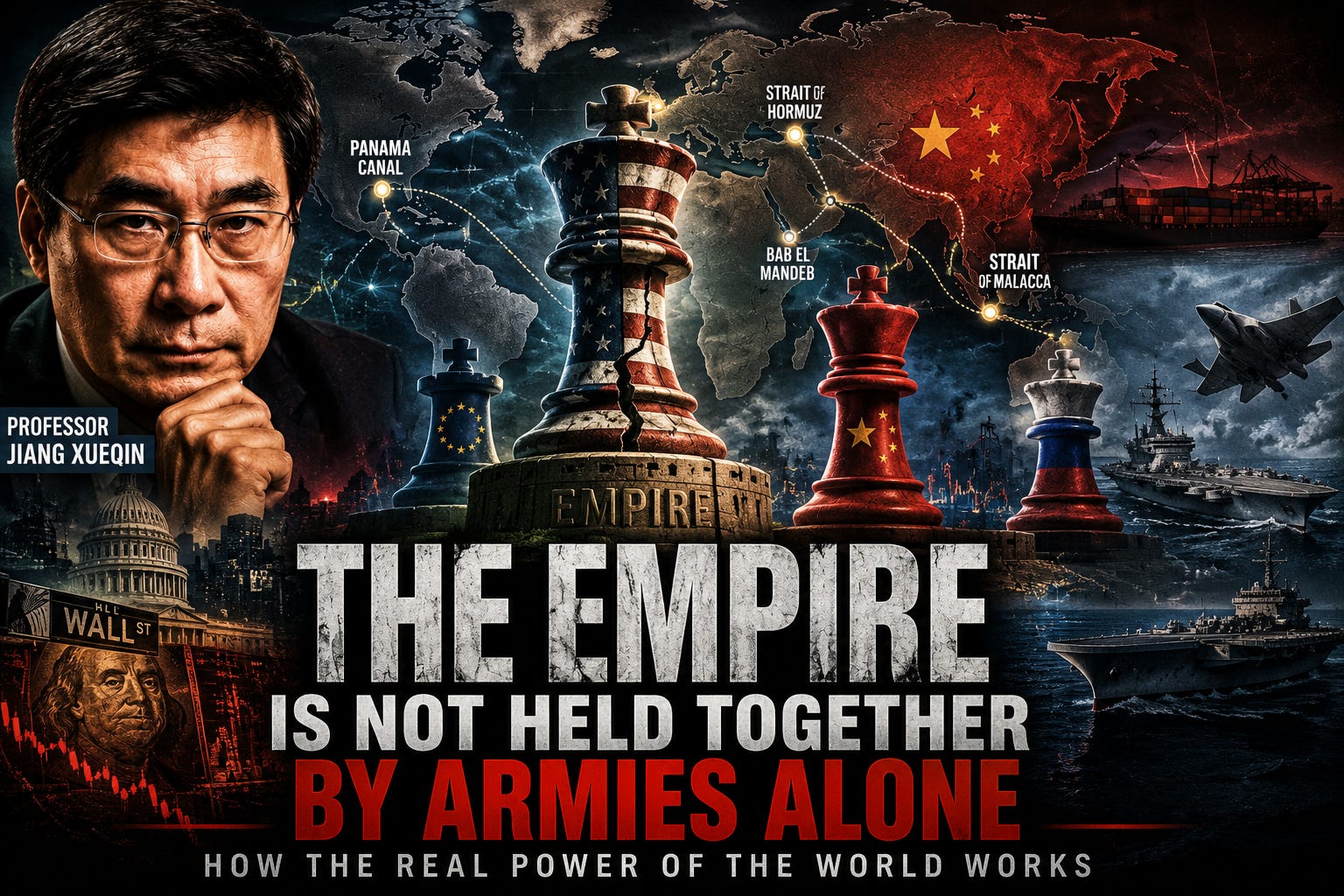
The framework I want to propose is simple. Think of American power as resting on three broad pillars. The first is the Western Hemisphere. The second is control over critical maritime routes through which global commerce moves.
The third is maintaining a favorable balance of power across Eurasia. I am not saying every American decision is secretly coordinated according to these three principles. I am saying that these principles provide a useful way to interpret why Washington repeatedly focuses on certain regions, certain alliances and certain strategic chokepoints.
The transcript presents essentially this argument, describing a strategy built around keeping rival powers from gaining excessive influence in the Western Hemisphere, maintaining leverage over maritime chokepoints, and preventing the consolidation of a Eurasian economic bloc.
Start with geography. The United States is uniquely protected by two enormous oceans, with a relatively secure northern and southern border and access to the Atlantic and Pacific simultaneously.
Thanks for reading! This post is public so feel free to share it.
That geography gives Washington something most historical empires never possessed: strategic depth. But geography alone does not create a global empire. The United States also has to prevent rival great powers from establishing themselves in the Western Hemisphere.
This is where the old Monroe Doctrine becomes important. The original doctrine was formulated in a very different historical environment, but the underlying idea remains strategically understandable. Washington has long viewed the Western Hemisphere as an area where hostile external powers should not gain a dominant military position.
The contemporary version of this problem is not simply military. China has spent years expanding trade, investment and infrastructure relationships across Latin America, while countries throughout the region have sought to diversify their economic partnerships.
The podcast transcript highlights China’s growing commercial relationships with South America, including agricultural trade and access to strategically important minerals in countries associated with the so called lithium triangle. The point is not that Chinese trade automatically equals Chinese political control. It does not.
The point is that economic relationships can eventually create strategic influence, and Washington has a strong incentive to prevent a rival power from becoming indispensable in its own neighborhood.
This brings us to the second pillar, and in my view it is the most underappreciated one: maritime chokepoints. Global commerce depends overwhelmingly on shipping because moving enormous quantities of commodities by sea is generally cheaper than moving them by land or air.
That makes certain passages disproportionately valuable. The Strait of Malacca matters because so much Asian trade passes through it. The Strait of Hormuz matters because of the energy resources flowing through the Persian Gulf. Bab el Mandeb matters because it connects the Red Sea to the wider global shipping system.
The Panama Canal matters because it shortens the distance between the Atlantic and Pacific. These are not merely pieces of geography. They are points of leverage.
Imagine a global economy as a giant network of roads. Most roads are replaceable. If one small road closes, traffic finds another route. But some roads are bridges, and some bridges are narrow enough that there is no easy substitute. A state that can influence those bridges has leverage far beyond the size of its territory.
This is why naval power matters even when no warship fires a single shot. The ability to keep maritime routes open, close them, protect them, patrol them or threaten them changes the calculations of every commercial and military actor that depends upon those routes.
Now consider the third pillar, Eurasia. This is where the geopolitical problem becomes much more complicated. Eurasia contains the overwhelming majority of the world’s population, industrial capacity, energy reserves and major civilizational centers.
If the great powers of Eurasia become sufficiently integrated, they could create enormous economic and political structures that reduce America’s ability to influence the global system. China, Russia, Iran, India and Europe do not need to become one formal alliance for this to matter.
They only need to trade more with one another, build infrastructure between one another and develop financial mechanisms that reduce their dependence on American-controlled systems.
This is why conflict in Eurasia matters so much. The argument presented in the podcast is that a fragmented Eurasia is easier for Washington to manage than a consolidated Eurasia.
The transcript identifies three important areas of tension: Europe and Russia, Iran and Israel, and China and Japan. The underlying logic is that persistent strategic rivalry makes it harder for neighboring powers to combine their economic and military capabilities into one coherent bloc.
Again, this should be understood as an analytical framework rather than as proof that Washington consciously created every conflict. The important question is simpler: does fragmentation of Eurasia tend to preserve American leverage? Obviously, it can.
Think about Europe and Russia. In a peaceful environment, Europe can purchase Russian energy, sell manufactured goods abroad, invest across borders and build deeper economic relationships with Eurasia.
A major geopolitical rupture interrupts those flows. It forces countries to reconsider energy suppliers, defense spending, trade routes and strategic dependencies. The same logic applies in the Middle East. A prolonged regional conflict changes energy markets, military procurement, shipping patterns and diplomatic relationships.
In East Asia, tension between China and Japan increases the importance of American security guarantees. In every case, instability can increase dependence on the United States even when instability itself imposes enormous costs.
This produces an important paradox. The United States can benefit strategically from alliances while simultaneously imposing economic costs on its allies. The podcast transcript describes this as a process of “cannibalizing” allies through tariffs, increased defense burdens and geopolitical pressure.
That is a provocative way to describe the relationship, but the underlying phenomenon deserves serious attention. An alliance is sustainable only when both sides believe they benefit from it. If one side increasingly views the other as a source of revenue, military obligations or political compliance, the alliance can become fragile.
This is where imperial decline becomes relevant. Historical empires rarely collapse because they suddenly become weak. More often, they become expensive to maintain. They accumulate commitments faster than they accumulate resources. They intervene in more regions. They maintain more bureaucracies.
They fight more wars. They demand more from allies. They borrow more money. Eventually, the cost of preserving the system begins to undermine the very foundation that made the system powerful.
This is what historians mean when they discuss imperial overstretch. A state can possess enormous resources and still become strategically overstretched if those resources are committed simultaneously across too many theaters. The problem is not simply the number of enemies.
It is the number of commitments. Defending Europe, deterring China, supporting partners in the Middle East, maintaining maritime security, managing the Western Hemisphere and sustaining a global financial system all require resources. Those resources are not infinite.
And this is where demographics and domestic institutions become important. The podcast presents what it describes as a series of structural pressures within Western societies: an aging political class, expanding bureaucracy, inequality, financialization and political polarization.
Whether one accepts every part of that diagnosis or not, the larger principle is sound enough to consider. A great power cannot maintain an external empire indefinitely if its domestic political system becomes too divided to agree on basic strategic priorities.
The most dangerous stage is not disagreement. Healthy societies disagree constantly. The dangerous stage is when disagreement destroys the ability to make long term decisions. When every election completely reverses foreign policy, when every strategic question becomes a culture war, and when citizens no longer trust the institutions making decisions on their behalf, the cost of maintaining an international system rises dramatically.
You begin spending political capital simply to maintain policies that previously required very little explanation.
And once a state reaches that stage, externalization becomes tempting. Governments facing domestic contradictions can shift political attention toward external enemies. Foreign threats provide an easy narrative. They create urgency. They justify extraordinary spending.
They can temporarily unite people who disagree about almost everything else. But the problem is that external conflict can become addictive. Once a country builds a political economy around permanent threats, disengagement becomes politically difficult.
That is why I think the most important question about American power is not whether America is strong. America is obviously strong. The more important question is whether American power is becoming more expensive to maintain than it was twenty or thirty years ago.
If the answer is yes, then Washington eventually has to choose. It can reduce its commitments, increase the contributions of allies, extract more economic value from the existing system, or attempt to prevent rival powers from becoming strong enough to challenge it.
Every one of these options carries costs.
This also explains the rise of China in a different way. China does not necessarily need to overthrow the American system. It can simply build alternatives. Build ports. Build railways. Build factories. Build financial relationships. Buy commodities. Develop new technologies.
Increase trade with countries that previously depended heavily on Western markets. The goal is not necessarily to conquer the existing system. It may be enough to make that system less exclusive.
That distinction is enormous.
If China can create a world where countries have alternatives to American markets, American finance, American technology and American security guarantees, then Washington loses some of the leverage that made its empire inexpensive to maintain. A country becomes powerful not only when it can command others, but when others have no practical alternative.
This is why I am skeptical of analyses that reduce the American and Chinese competition to who has more aircraft carriers. Military power matters enormously, but military power is only one layer of the system.
A navy protects trade routes. But trade creates wealth. Wealth finances technology. Technology creates military power. Military power protects the trade routes. The system is circular.
The real strategic contest is therefore over the entire circle.
Who finances whom?
Who manufactures what?
Who controls the critical minerals?
Who insures global commerce?
Who operates the ports?
Who provides the security guarantees?
Who controls the currency in which trade is settled?
And who has alternatives when the dominant system says no?
Those questions tell you much more about the future than a single battlefield map.
The United States still possesses enormous advantages. The dollar remains central to global finance. American capital markets remain extraordinarily deep. The US military remains unmatched in the breadth of its global reach. Washington still has a remarkable network of alliances and partnerships. It would be foolish to declare the American system finished.
But it would be equally foolish to assume that these advantages are permanent.
Every empire eventually confronts the same problem. The system that created its wealth becomes the system it must spend more and more resources defending. At first, the cost is manageable.
Then the commitments accumulate. Then the rivals learn. Eventually the empire discovers that maintaining the old order requires more coercion, more spending and more political effort than maintaining it once did.
That is the moment when history begins to turn.
The world we are moving toward may therefore not be a world in which China replaces America overnight. I think that is too simplistic. A more plausible possibility is a fragmented world in which several systems coexist. An American financial system.
A Chinese manufacturing and trade network. Regional energy systems. Alternative payment arrangements. Competing security architectures. More countries attempting to remain independent rather than choosing one permanent camp.
That world would be messier.
But it would also be more realistic.
The central strategic mistake would be to assume that because America dominated the post Cold War system, it must continue dominating that system indefinitely. History does not work that way. Power is relational. You can remain extremely powerful while becoming less dominant.
And that is the distinction I want people to understand.
America does not need to become weak for the American century to end.
It only needs the rest of the world to become strong enough that American power is no longer the only viable option.
That is the real contest taking place today. Not simply between Washington and Beijing. Not simply over Taiwan or the Middle East or the Western Hemisphere. The deeper contest is over whether the world will continue operating primarily through one dominant system or gradually reorganize into several competing systems.
Once you see the world that way, the individual conflicts become easier to understand.
The trade wars.
The sanctions.
The naval deployments.
The energy battles.
The semiconductor restrictions.
The competition over ports.
The struggle over critical minerals.
The arguments over currencies and financial systems.
They are all connected to the same underlying question.
Who gets to define the rules of the next international order?
And that is why I believe the next decade will be much more important than the last one. The question is not whether America will remain powerful. It almost certainly will. The question is whether American power will remain sufficient to make the rest of the world organize itself around Washington.
That is a much harder question.
And history has a very clear lesson for anyone willing to look at it.
An empire rarely falls because someone suddenly knocks down the front door.
It declines when the people outside the walls gradually discover that they no longer need to enter.
No posts
Comments
Nothing yet. Say the first thing.
Sign in to join the conversation.