
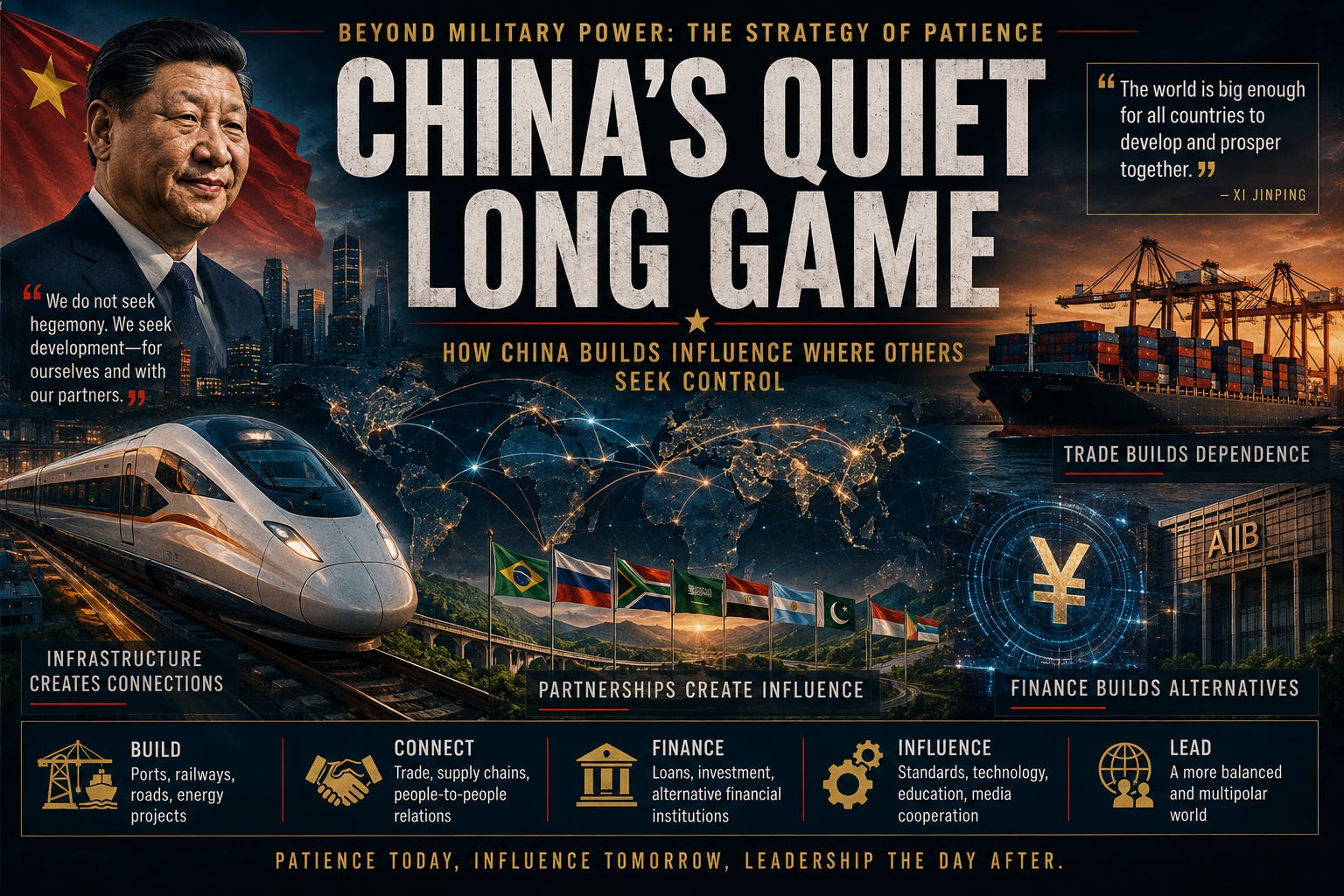
China does not need to defeat the United States in a dramatic confrontation. It does not need to destroy the American Navy, collapse the dollar overnight, or occupy another country’s territory to become more powerful. There is another way to change the balance of power, and it is much quieter. Build factories. Build ports. Build railways. Build trade relationships.
Secure access to resources. Develop financial alternatives. Connect countries together until the system begins functioning differently from the way it did before. That is the strategy I would call China’s quiet long game.
Most people instinctively think about power in military terms. They look at aircraft carriers, missiles, fighter aircraft and nuclear weapons. These things obviously matter. But military power is only one part of a larger system. A country becomes strategically powerful when other countries depend upon it for things that are difficult to replace.
That could be energy. It could be manufacturing. It could be technology. It could be finance. It could be infrastructure. And once dependency begins spreading across several categories at the same time, influence can emerge without a single soldier crossing a border.
This is where China is particularly interesting. China’s rise did not happen because Beijing suddenly decided to become a military empire. China’s transformation began through manufacturing, trade, infrastructure and integration into the global economy.
The country became the factory of the world, accumulated industrial capacity and developed an extraordinary logistics network. Over time, that industrial base became something much larger. It became a platform from which China could build relationships far beyond its own borders.
Look at trade first. The podcast transcript emphasizes China’s increasing diversification of trade relationships, particularly in South America. It points to China’s purchases of agricultural commodities from Brazil and its interest in the mineral rich countries of the region, including Bolivia, Peru and Chile. The important point is not simply that China buys commodities.
The important point is that China is building multiple channels of economic dependence at the same time. Trade creates relationships. Infrastructure deepens those relationships. Financing can lock them in for decades.
This is a very different strategy from trying to conquer territory.
Suppose China builds a port in a foreign country. That port creates jobs. It moves goods. It attracts logistics companies. It connects local producers to global markets. A railway can do the same thing.
So can an industrial park. So can a telecommunications network. None of these projects looks like military expansion when viewed individually. But put enough of them together and you create influence.
That is the first principle of the quiet long game.
Infrastructure creates relationships that outlast political cycles.
Thanks for reading! This post is public so feel free to share it.
A politician may come to power promising to change foreign policy. But if the country depends on a port, railway, refinery, power plant, telecommunications system or export market connected to China, changing that relationship can become expensive. The relationship becomes embedded in the economy itself. That is much harder to reverse than a diplomatic agreement.
And this is why China’s strategy can sometimes look invisible to people watching geopolitics through the lens of military conflict. A missile launch is obvious. A new naval base is obvious. A military alliance is obvious. A thirty year commercial relationship is not obvious.
A Chinese financed railway is not obvious. A container port becoming the center of regional trade is not obvious. But these quieter developments can have strategic consequences that last much longer than a news cycle.
The second principle is manufacturing.
China does not simply export finished products. It increasingly controls large sections of the supply chain that makes those products possible. Machinery, electronics, batteries, solar panels, electric vehicles, chemicals and industrial equipment all depend on networks of suppliers.
This creates a kind of structural power. If a country becomes the most efficient place in the world to obtain a particular component, then other countries have to think carefully before confronting it.
That does not mean China is invulnerable.
It means China has created leverage through interdependence.
This is one of the great paradoxes of globalization. Countries become interconnected because trade is profitable. But interdependence also creates strategic vulnerability. If one country controls a critical part of the supply chain, that country gains influence even without explicitly threatening anyone.
America understands this now, which is why Washington has increasingly focused on semiconductors, critical minerals, advanced technology and supply chain security. But there is a problem.
It is much easier to recognize dependence after it has already been created than to prevent it from being created in the first place.
China spent decades building industrial capacity while many Western countries were optimizing for efficiency, lower consumer prices and financial returns.
That difference matters.
The third principle is finance.
Military power depends on money. Infrastructure depends on money. Industrial development depends on money. Trade depends on financial systems. So if China wants to build a long term alternative to American influence, it cannot rely on trade alone.
It needs mechanisms that help countries finance projects, settle transactions and move capital without depending entirely on Western institutions.
This is where institutions such as the Asian Infrastructure Investment Bank and other regional or multilateral arrangements become strategically interesting. Their importance is not that they immediately replace institutions dominated by the United States. They do not. Their importance is that they create alternatives.
And alternatives are power.
Imagine that for decades there is only one major highway connecting two cities. That highway operator has enormous leverage. Then someone builds a second highway. The second road does not have to carry most of the traffic to matter. Its existence alone changes the bargaining position of everyone using the first road.
This is how I think we should understand China’s financial strategy.
It does not need to replace the dollar tomorrow.
It needs to make the dollar less indispensable over time.
That could happen through more bilateral trade arrangements, more regional financial institutions, more local currency settlements, more Chinese financing, and greater diversification of reserves and payment mechanisms.
Again, none of these developments has to destroy the existing system.
The system simply becomes less exclusive.
And this is where China’s patience becomes strategically important.
The United States often thinks in terms of immediate results. Elections happen every few years. Political administrations change. Public opinion moves quickly. Financial markets react to quarterly earnings. Foreign policy is heavily influenced by the next crisis.
China has a much stronger incentive to think in longer time horizons.
A railway can take years to build.
A port can take years to become commercially important.
An industrial supply chain can take decades to mature.
A new currency relationship may begin as a tiny experiment and grow slowly.
A country that thinks in decades can therefore accept results that would be politically unacceptable to a government seeking results within one election cycle.
This is why comparing American and Chinese power simply by counting military assets can be misleading.
America may have the stronger military position today.
China may be building stronger economic positions for tomorrow.
Both can be true.
And if China’s economic position continues expanding, its military power will benefit from that economic foundation as well.
There is another important aspect to this strategy.
China does not need every country to become pro Chinese.
That would be unnecessary.
It only needs enough countries to conclude that cooperation with China is useful.
This is a much lower threshold.
A government can maintain its political relationship with Washington while purchasing infrastructure from China. It can trade heavily with China while maintaining defense agreements with the United States. It can buy Chinese machinery, export commodities to Chinese markets and still publicly declare itself nonaligned.
That is precisely what makes economic influence so difficult to contain.
Countries do not have to choose one side.
They can choose both.
And if enough countries do that, the idea of a single dominant geopolitical system becomes weaker.
This is especially important in the developing world.
Many countries do not share the same historical priorities as Washington or Beijing. Their primary concern is economic development. They want electricity. They want roads. They want ports. They want industrial jobs. They want access to markets. They want financing.
If China offers those things more quickly or cheaply than competing alternatives, many governments will accept the deal.
That does not necessarily make them Chinese allies.
It creates Chinese relevance.
And relevance is the beginning of influence.
This is why I think China’s greatest long term advantage may be its ability to convert economic capacity into geopolitical relationships.
Factories create exports.
Exports create trade.
Trade creates shipping.
Shipping creates port infrastructure.
Infrastructure creates financing.
Financing creates long term relationships.
Relationships create political influence.
And political influence creates more opportunities for trade.
The system reinforces itself.
America has its own version of this cycle. The United States has enormous financial markets. It has the dollar. It has global military alliances. It has advanced technology. It has major corporations and universities. Its system reinforces itself too.
The future competition therefore will not be decided by one country suddenly defeating the other.
It will be decided by which system can create the stronger feedback loop.
That is why the next decade is so important.
China is trying to create a world in which Chinese manufacturing, Chinese infrastructure, Chinese financing and Chinese trade relationships become increasingly difficult to replace.
America is trying to preserve a world in which American finance, American technology, American security guarantees and American markets remain central.
These two strategies are not always directly opposed.
But increasingly, they compete for the same space.
Consider South America.
China wants access to commodities and markets.
The United States wants to prevent strategic rivals from becoming dominant in the Western Hemisphere.
Consider Southeast Asia.
China wants trade routes and regional integration.
The United States wants to preserve freedom of navigation and maintain its alliances.
Consider the Middle East.
China wants energy security and commercial relationships.
The United States has long maintained military alliances and strategic commitments throughout the region.
Consider technology.
China wants domestic technological independence.
The United States wants to preserve its advantage in advanced semiconductors and other strategic technologies.
The competition is therefore becoming systemic.
And systemic competition is much harder to solve than ordinary military rivalry.
There is another reason China’s quiet strategy may be effective.
China can sometimes allow other countries to make the first move.
Suppose a country needs infrastructure.
China does not have to force it to choose China.
The country chooses the financing because the infrastructure is useful.
Suppose a country wants to expand exports.
China offers a huge market.
The country sells into that market because doing so is economically rational.
Suppose a country needs cheap industrial goods.
Chinese manufacturers provide them.
Again, no coercion is required.
This is perhaps the most important lesson in geopolitics.
Influence does not always come from forcing people to do what you want.
Sometimes it comes from becoming the easiest country with which they can do what they already want to do.
That is a much more sustainable form of power.
And it explains why China’s rise can be underestimated.
People look for dramatic moments.
They ask when China will defeat America.
They ask when China will replace the dollar.
They ask when China will become the world’s dominant military power.
But those questions assume that geopolitical transitions happen like sports matches.
One country wins.
The other loses.
History is usually messier.
A great power can remain extremely strong while another power becomes increasingly difficult to ignore.
A currency can remain dominant while alternatives grow.
An alliance can remain intact while its members diversify relationships.
A military can remain superior while its relative strategic advantage shrinks.
This is why I do not expect China to announce one morning that the American era is over.
The transition, if it happens, will probably feel much more ordinary.
Another port.
Another railway.
Another trade agreement.
Another industrial park.
Another investment.
Another local currency transaction.
Another country deciding that it is useful to maintain strong relations with both Washington and Beijing.
Individually, none of these events changes the world.
Together, they can change the structure of the world.
That is the quiet long game.
And it is why patience can sometimes be more powerful than confrontation.
The United States has the ability to respond immediately. China has the ability to build gradually.
America can move a carrier.
China can build a port.
America can impose a tariff.
China can develop another market.
America can restrict a technology.
China can invest in domestic alternatives.
America can threaten sanctions.
China can build relationships that reduce the impact of those sanctions.
The question is not which strategy looks stronger today.
The question is which strategy produces more options tomorrow.
That is the strategic contest I would watch.
Because power ultimately belongs to the country that has the most choices.
And the quietest form of power is the ability to make other countries discover that they need you.
China is trying to build exactly that kind of world.
The question for America is whether it can remain indispensable without becoming dependent upon its own system.
That may be the great geopolitical competition of the next generation.
No posts
Comments
Nothing yet. Say the first thing.
Sign in to join the conversation.