
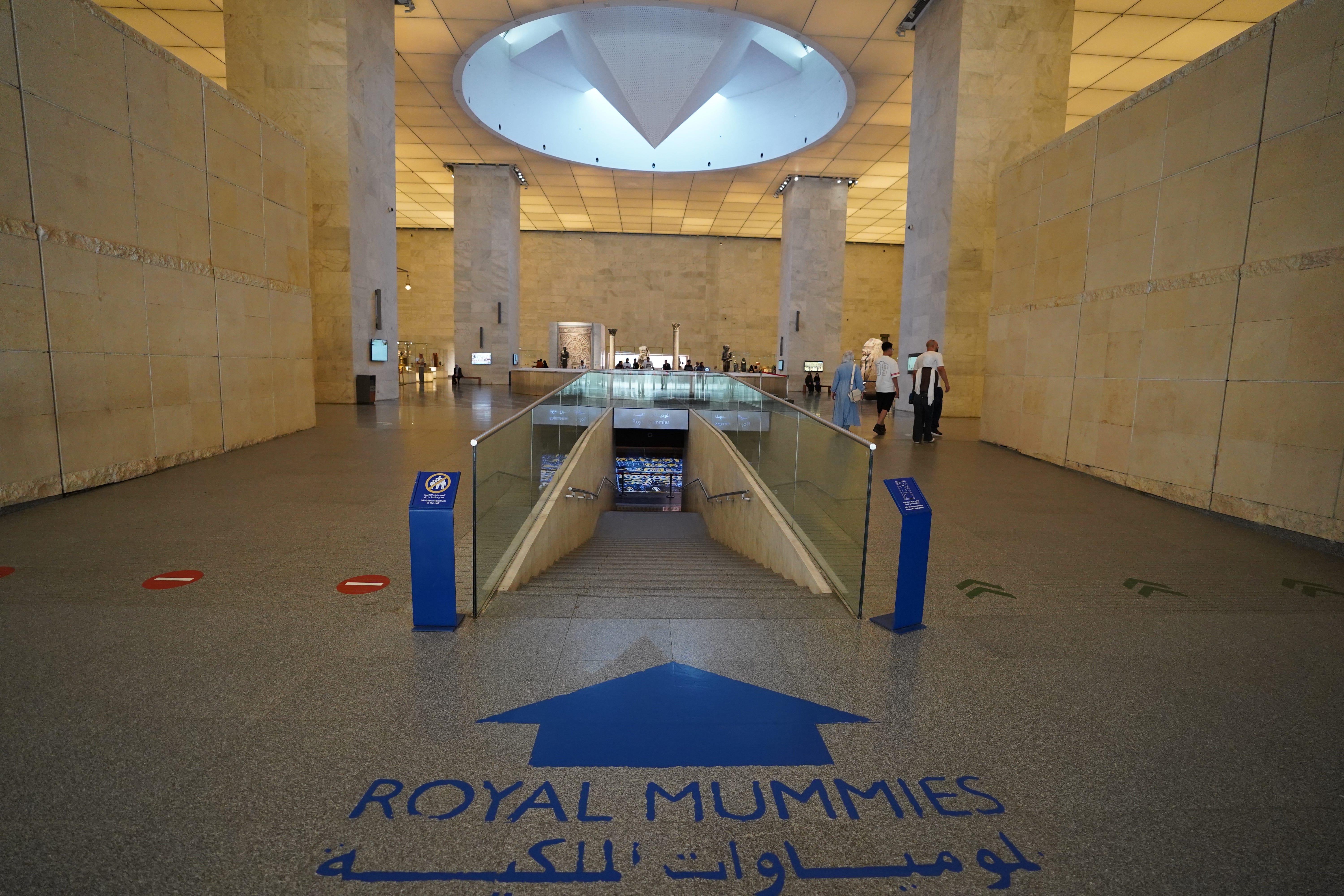
This is my fourth Egypt-focused dispatch. The series began with The Resurrection of Tutankhamun (aka King Tut), continued with Into the Underworld: King Tut’s Burial Chamber and Its Secrets, and most recently reached the threshold of the Royal Mummies Hall in Curating Egyptian Civilization at the NMEC. New readers may want to start with them.
~ ~ ~
In my most recent essay, I introduced the second of Egypt’s newly opened, world-class museums, and promised to guide you into its crown jewel, the Royal Mummies Hall.
A question that often arises when I encounter artistic presentations or visit museums is, What are these artists, or curators, trying to get people to think, feel, and do?
That question came to mind as I descended a tunnel that made me think of the tomb passages I’d walked in Giza and the Valley of the Kings. A signboard explained mummification, tomb robbery, and the science illuminating these rulers’ diseases, diets, lives, and deaths. The curators presumably wanted visitors to understand both the rationale and technology of mummification and what researchers could still learn from the bodies.
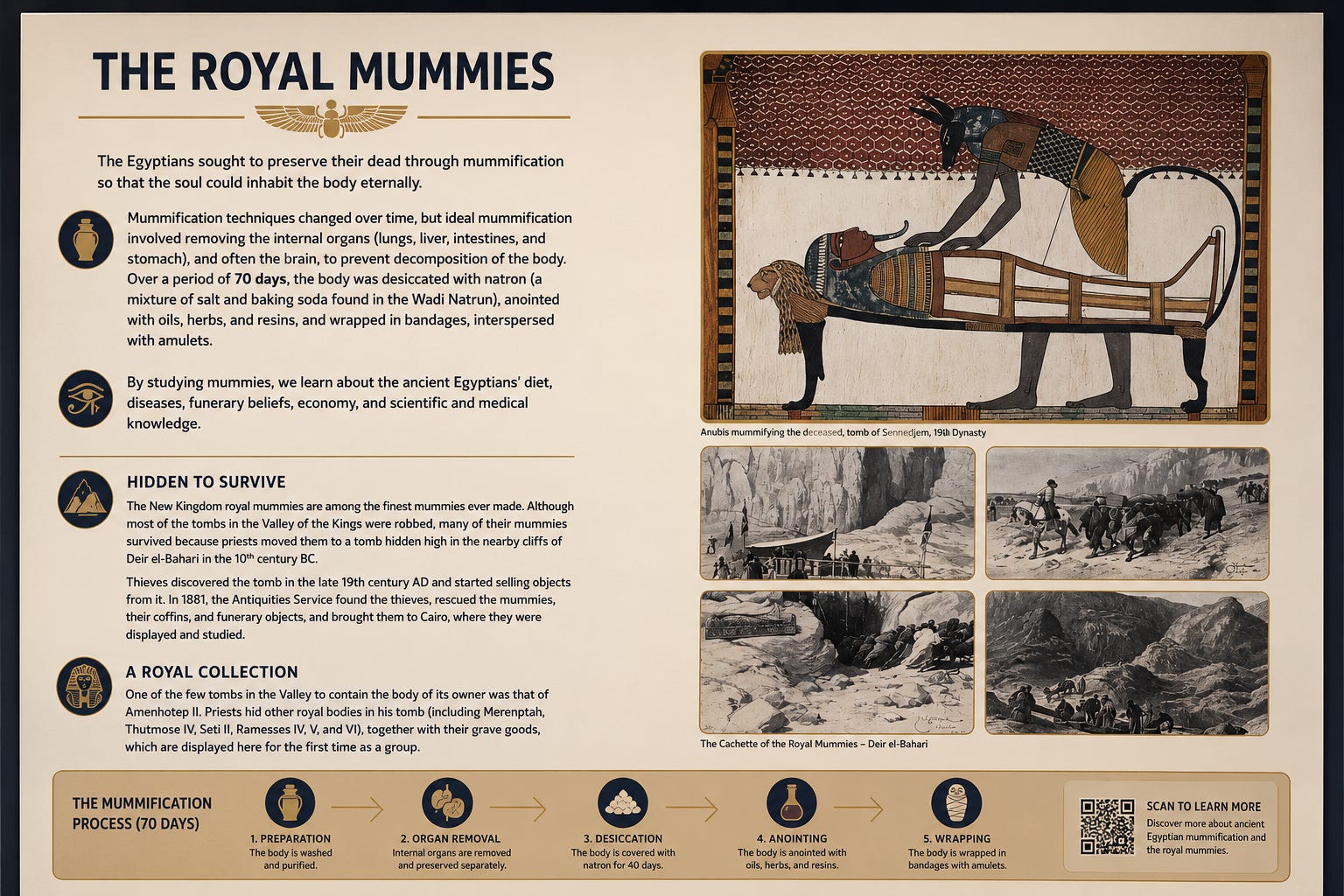
Signs and guards asked visitors to remain quiet and take no photographs. Each mummy lay horizontally in a sealed, climate-controlled case within a cool, dim room. The descent, darkness, and silence reminded me of how people often behave when entering religious sanctuaries. One travel writer expressed a similar perception, calling the hall “a sacred encounter with immortality, where the gods of Egypt rest within arm’s reach.” These were apt words given these bodies were once considered divine, destined for a magical, bodily resurrection.
Although one curator said that the ban on photographs was to prevent flash photography from damaging the mummies, it also seemed plausible that the curators were seeking to create a mood—to evoke feelings of respect, if not also reverence, for these ancient bodies.
The twenty displayed mummies—eighteen kings and two queens—came from two caches found in the late nineteenth century: one where priests of the 21st Dynasty had hidden royal bodies from tomb robbers, and another in the tomb of Amenhotep II. Among them were Ramesses II, famed for his long reign and grand temples, and Seti I, whose face remains exceptionally well preserved. I found especially interesting what scientific analysis revealed about several of these rulers.
Queen Hatshepsut (18th Dynasty, r. ca. 1479–1458 BCE) lay, unidentified, in an unremarkable tomb until 2007, when scientists matched a loose molar in a box bearing her name to a nearby, anonymous mummy, convincing most specialists that they had identified the queen. They also found evidence that this mummified woman had cancer. A bottle bearing Hatshepsut’s name contained a carcinogenic skin lotion, leading some researchers to speculate that it may have contributed to her illness.
A 2021 CT study documented multiple deep wounds to the face and skull of Seqenenre Taa II (17th Dynasty, died ca. 1558 BCE); I recall seeing a large opening on the mummy’s skull. The researchers matched the injuries to several types of weapons. The position of his hands led researchers to surmise that he had been captured, bound, and executed.
Most striking was Ramesses III, the warrior pharaoh I introduced in my previous essay, who died about four centuries after Seqenenre. Ancient trial records describe a conspiracy involving a secondary wife, Tiye, and her son Pentawer, but do not say clearly whether the attack succeeded. A 2012 CT study revealed a deep cut across Ramesses III’s throat, probably made with a sharp knife, and an Eye of Horus amulet placed in the wound beneath layers of linen. The evidence strongly suggests that the conspiracy ended in murder. The dysfunction and power struggle that took the life of this great Pharaoh symbolized and perhaps accelerated the decline of the dynastic period that he had, for the most part, held at bay.
The care taken with these bodies, the choices about what to display, and the science brought to bear on how they lived and died—together with the mummified cats, crocodiles, and birds elsewhere in the museum—gave me a deeper appreciation of Egyptian history and religion. But are such displays morally objectionable?
Soon after I released my first essay about King Tut, Donald Murphy commented that in his view, the excavation and display of Tutankhamun’s body and funerary objects constituted a form of grave robbing. Therefore, “The tomb of King Tut should be restored and his remains and funerary objects reburied.”
I first met Murphy when he was a Training Officer at California State Parks’ training center, and I was there to add Peace Officer to my responsibilities as a State Park Lifeguard. I quickly learned that he was also a well-read and erudite cat. (See, for example, his consciousness-focused Substack, @thinkerdonmurphy.) He later became director of the California Department of Parks and Recreation—and served as one of the National Park Service’s two deputy directors.
His perspective, he explained, was rooted in decades of work with the Native American Graves Protection and Repatriation Act, or NAGPRA. Enacted in 1990, the law rests on the moral premise that the dignity of the deceased and the rights of surviving loved ones must be respected, and it requires federally funded museums and federal agencies to inventory certain Native American human remains and cultural items, consult with tribes and Native Hawaiian organizations, and repatriate them when the law’s criteria are met. That work, Murphy wrote to me, sensitized him to the sacred character of graves and placed him in conflict with archaeologists who wanted broad freedom to study human remains regardless of how institutions had obtained them.
This law and views akin to those Murphy expressed have pushed museums to reconsider whether it is morally permissible to exhume, study and display human remains, including mummies, and if permissible, to rethink the ethics involved during every stage of the process.
Not long before I saw Cairo’s royal mummies, I was in Europe researching a book about how museums and oceanariums provide environmental education, evoke human connections to nature, and sometimes encourage proenvironmental behavior. In Paris, the Musée de l’Homme (Museum of Man) happened to be hosting a mummies-focused special exhibition, titled in French, Momies.
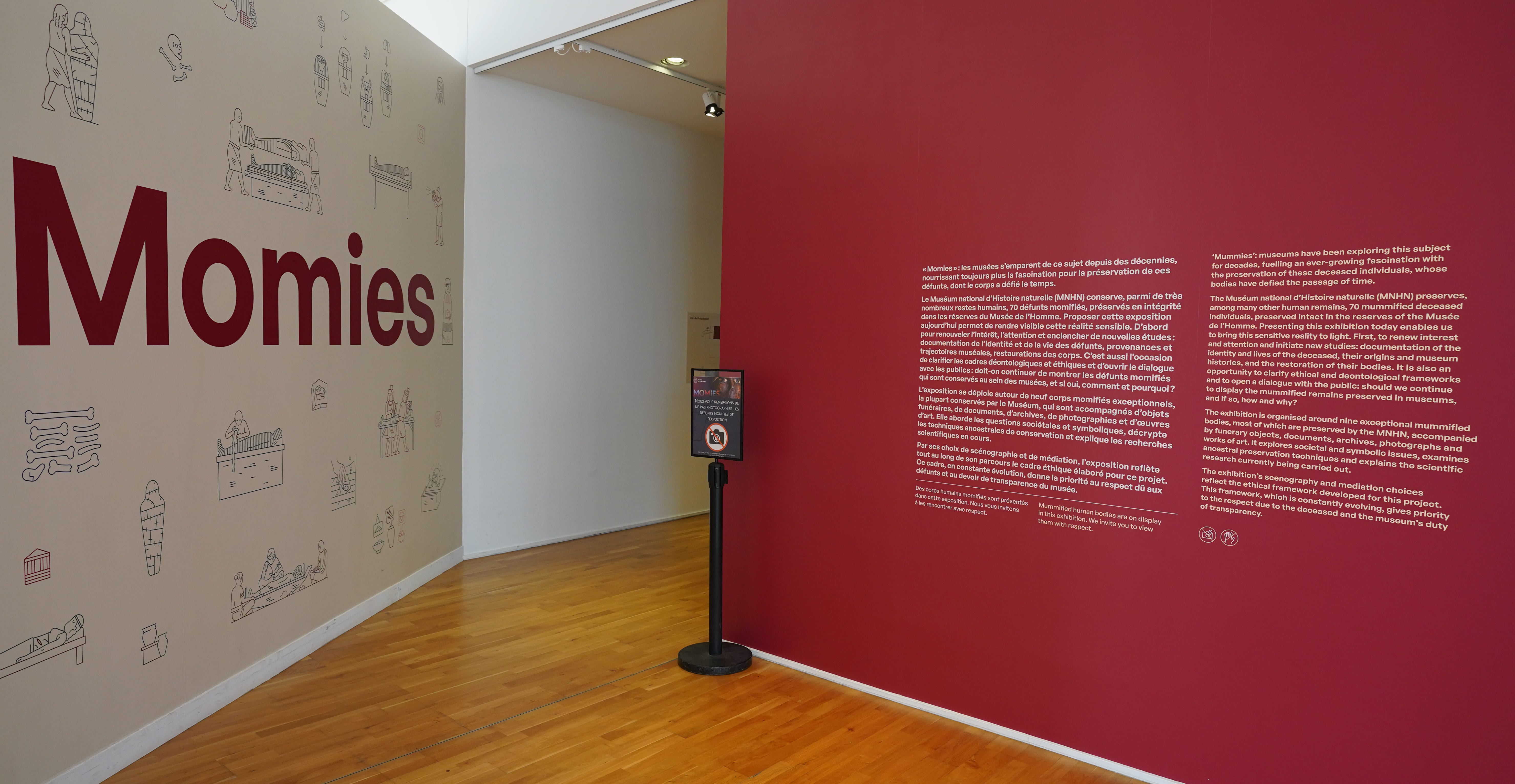
Like the Cairo Mummy Hall, photography was not allowed.
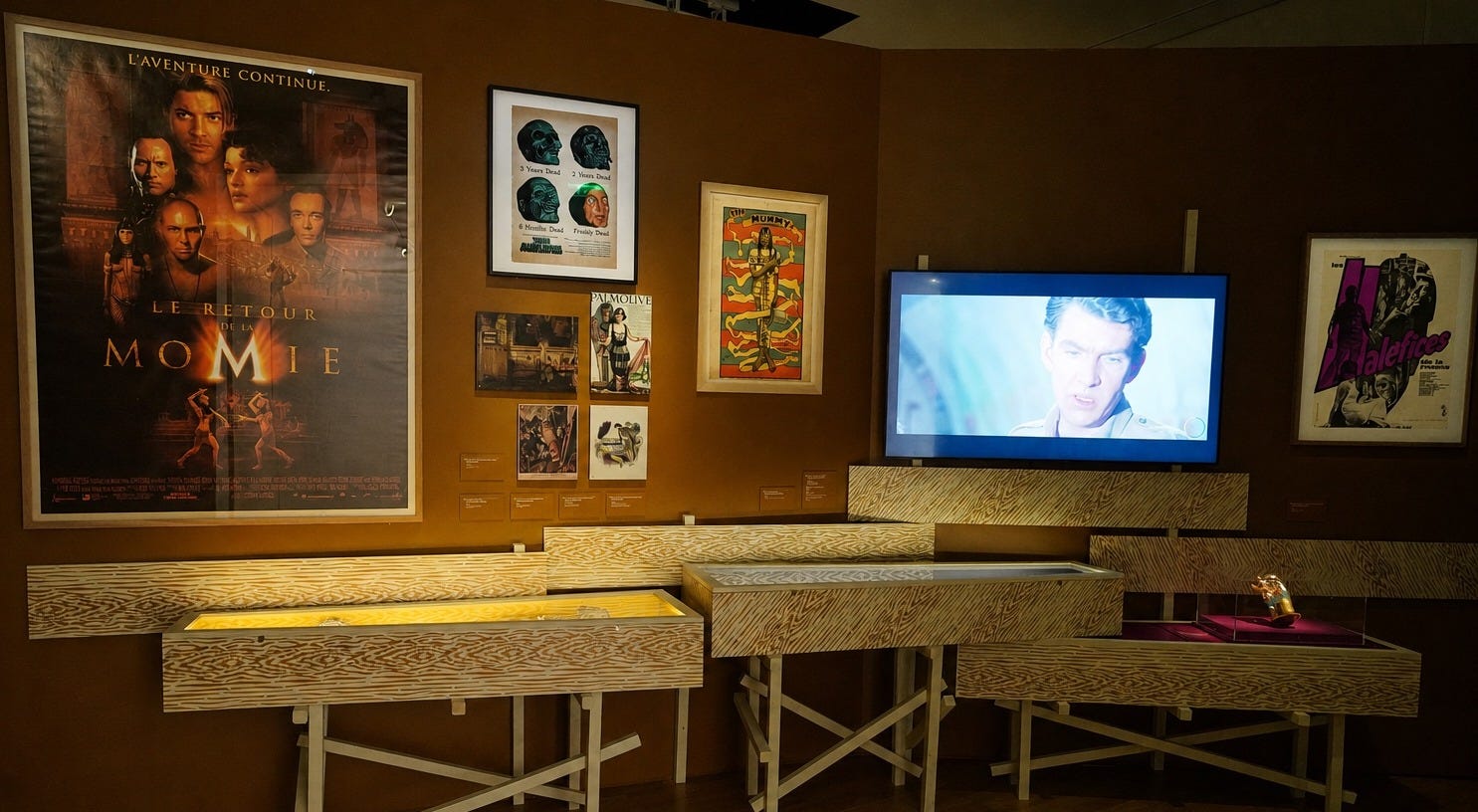
Unlike Cairo, the Paris curators acknowledged the ethical dispute at the entrance. After noting that mummy exhibitions had fueled an “ever-growing fascination with these deceased individuals,” they said they wanted to “open a dialogue with the public: should we continue to display the mummified remains preserved in museums, and if so, how and why?” Their ethical framework, they added, was “constantly evolving” and gave priority to “the respect due to the deceased and the museum’s duty of transparency.” Near the no-photography symbol was an advance notice (and one likely provided as a kind of “trigger warning”) that “mummified remains are on display in this exhibition,” followed by a request that visitors view them respectfully. Inside, the nine mummified bodies appeared in cases much like those in Cairo. Other displays traced the mummy’s long afterlife in movies, toys, games, and books.
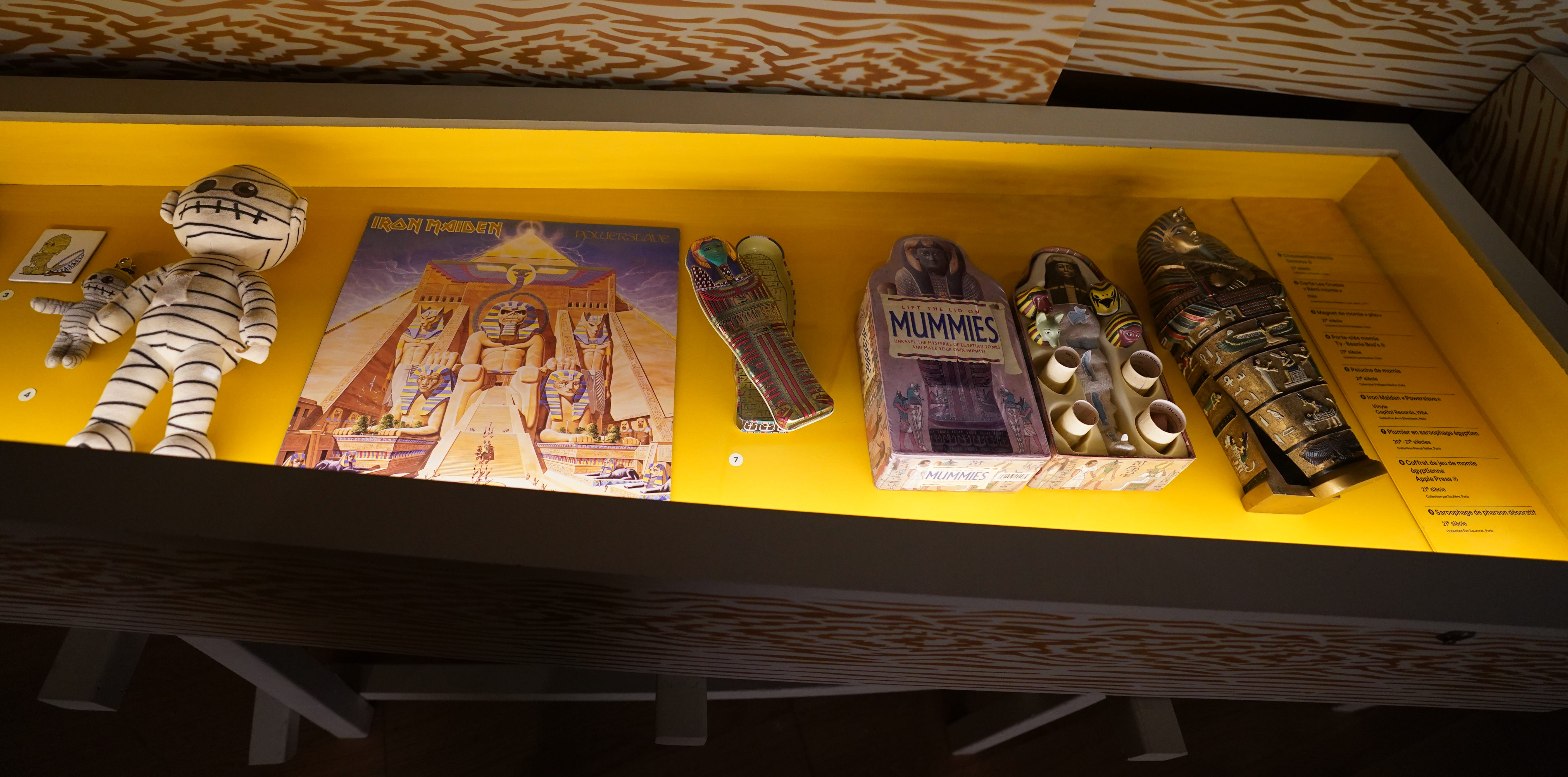

After seeing the Cairo and Paris exhibitions, I looked for evidence that museums were reconsidering their practices. I found no systematic study but learned that many museums around the world display mummies, and several had made changes. In 2018, the Rhode Island School of Design Museum closed the lid of Nesmin’s coffin after consultation. The Metropolitan Museum of Art now makes available, upon request, a map identifying galleries that contain human remains, so visitors choose whether to view them.
Egyptians, too, have debated what to do with their mummies. Heba Mady Khalil traces objections at least to 1925, when a member of Egypt’s parliament unsuccessfully asked King Fouad to prevent the unwrapping of Tutankhamun’s mummy. In 1977, President Anwar Sadat raised the issue publicly, and the mummy hall later closed before reopening in 1987. A 1980 fatwa—an Islamic legal opinion—prohibited display, but other Muslim authorities said it was permissible, while providing a few broad guidelines that, I think, boil down to treating the mummies with respect. During my time in Egypt, I asked two Egyptian guides and one professor whether they knew of objections to the displays; none did. One guide thought too much tourist money was at stake for such objections to gain significant support.
In February 2024, Khalil surveyed 1,301 Egyptians through a Facebook questionnaire. The sample was disproportionately young—65.8 percent were between eighteen and twenty-four—and was not randomly selected, so it did not represent the Egyptian public as a whole. Nevertheless, it helpfully revealed divergent views, ambivalence, and inconsistency in the responses. Nearly two-thirds of respondents called displaying human remains morally permissible while 12.6 percent disagreed; 23 percent thought the remains should be reinterred. Khalil found that 66 percent viewed the mummies as historical or artistic objects rather than as remains of deceased people. This may help explain the similar proportion that accepted display.
Among the thirteen Egyptian museums Khalil examined, eight displayed mummies in special rooms. Arrangements varied, however, and no national curatorial standard governed them. My hunch is that the NMEC’s recent design, with its clear effort to set a respectful mood, reflects growing international attention to the objections and ambivalence some people have about such exhibitions.
I have often pointed out to students in my ethics classes that although some ethical values are widely shared and largely uncontroversial, the most wrenching ones are those that involve diverse moral intuitions or cultural understandings that cannot be reconciled. This means that in specific cases, not every value that is widely accepted can be upheld. Tough ethical cases often involve morally ambivalent if not tragic decisions by whoever has the power to make them. Disputes about morally-relevant facts, can also make it difficult, in specific cases, to confidently arrive at firm conclusions about what is right or wrong, good or bad.
Let’s look at some of the complications and contentions in this case that make questions about what to do with mummified remains a real ethical conundrum. But first, a brief word about justice, as some of these questions are directly related to the notion. Without getting into different, substantive understandings of justice, procedurally, justice is about rendering to each their due, about treating similar cases equally, about considering who shares the burdens and benefits of social arrangements and personal decisions. This is worth bearing in mind as I present some difficult-to-answer questions about how we should relate to ancient bodies:
I’ll now present some difficult-to-answer questions that illustrate the conundrums about how we should relate to ancient bodies:
What can we surmise about the wishes of the deceased? Do we think they would object to their bodies being exhumed, studied, and displayed? If so, do contemporary humans have an obligation to comply with their wishes? What weight if any should be given to the views of those who think we cannot know, or that these individuals (or some of them) would not object to such displays were they to have a voice today? Perhaps not incidentally, one curator expressed the view I would modestly expand on in this way: These were prominent people who wanted to be known and might well approve of receiving a different kind of immortality than they might have expected thousands of years ago.
Is it a violation of religious liberty to remove bodies from tombs, when presumably the deceased and their religious caretakers believed they were destined to a bodily resurrection? If few, if any, hold such religious beliefs today, must we nevertheless do our best to respect those beliefs by restoring these bodies to the state wherein they were supposed to be resurrected? Some religious traditions consider body parts of holy people worthy of public display, veneration, and sometimes worship: Does this challenge any categorical claims that any display of human remains is universally impermissible?
If the decisions by colonial powers to exhume, move, study, and display mummies were wrong, e.g., by violating Egyptian rights in some way (such as for self-determination), does the moral calculus change when, after independence, Egyptians themselves became empowered to make such decisions? If Egyptians decide—or, more precisely, if those empowered to decide do so—should their decisions be considered legitimate and respected? If more care should be taken to treat these remains with respect, do the efforts exemplified by the NMEC and at the Momies exhibition in Paris suffice?
In South Africa and North America, there have been objections to the display of prehistoric human remains dated tens of thousands of years before the present. The display of the skeleton in the NMEC’s main hall, however, and of the skulls, bones and fossils of primate and hominid ancestors in museums around the world, have not usually been controversial. What is the morally relevant standard by which one type of remains—e.g., prehistoric bones and fossils, but not human remains discovered since the Neolithic revolution—can be displayed with little or no controversy? Is the permissible/impermissible dividing line when pre-history turns into history with the advent of agriculture? If so, why?
Does the sense that disturbing a grave is morally wrong diminish as a person recedes from anyone’s concrete memory? If so and again, how can that line be determined?
Why does the objection about displaying human remains stop at our own species? Do such objections suggest we should reconsider the display of millions of dead animal bodies? By anti-colonial logic, should such displays be taken down as they represent centuries of killing, including even precipitating the extinction of many species?
Much of the criticism seems to hinge on claims that a particular group of humans has a biological and cultural connection to the person whose remains have been found, but does not every human have a biological and cultural connection, through a long shared process of biocultural evolution, with all previously existing hominids, including our own species? Should the views of one with a more distant kinship relationship than someone closer (biologically, regionally, culturally) have little or no weight in deciding whether to study and display human remains (of whatever age)?
How much value should be placed on what we have learned about our own species (disease, migration, kinship, violence) and the planet’s evolutionary story and our own part of it, to which the study of human remains has dramatically contributed?
Lurking in the background to most of these questions is, Who ought to decide?
These are not the only questions that have been raised by these Egyptian mummies, but they do illustrate how difficult wrestling with mummies can be.
I will conclude with a few modest musings.
First, like all truly wrenching ethical conundrums, the moral landscape is muddy, contested, and can pull cognitively and emotionally in irreconcilable directions.
Second, the criticisms and questions that have arisen are salutary, and hopefully, through ongoing debate and dialogue, our ethical views and related practices will evolve in a way that takes seriously the perceptions and feelings of all concerned, and that most people so engaged will conclude the process has been in good faith and led to warranted and sensible compromises and changes.
Finally, I offer what may be an unusual perspective:
If we take seriously that all human beings are one species — one extended family, however distant our human relatives may be — then even where some living communities have stronger genetic, historical, or regional connections to particular remains than others, we ought not erase the importance of one of our most distinctive and grand characteristics: curiosity and the deeply related quest for meaning. Studying our hominid, primate, and indeed, all our other ancestors, is essential for a clear understanding of our place in the cosmos and biosphere – and our current obligations to the entire living world.
This may be why people continue to be drawn to science museums, including those that display human remains. This may also be why, even when expressing ambivalence about the manner of some of these displays, and even when feeling that any such science and display should be done and presented respectfully, most people appear willing to accept, even if with some ambivalence, the display of human ancestors.
~ ~ ~
If you are new to my essays, my inaugural post, Who I Am, and What I Hope to Do Here, explains the experiences and questions that animate my sugstack writings.
To ensure you receive notice of future posts . . .
And I hope this and other essays will spark discussion; why not start one . . . as did my friend Don Murphy.
On the royal mummies and forensic research:
Zahi Hawass and colleagues, “Revisiting the harem conspiracy and death of Ramesses III,” BMJ (2012), presents the CT and genetic evidence concerning the king’s fatal throat wound.
Sahar Saleem and Zahi Hawass, “Computed Tomography Study of the Mummy of King Seqenenre Taa II,” Frontiers in Medicine (2021), analyzes his craniofacial injuries and proposes possible circumstances of his violent death.
The National Museum of Egyptian Civilization’s Royal Mummies Hall describes the museum’s framing and the twenty displayed rulers.
On the ethics of displaying human remains:
Heba Mady Khalil, “The Ethical Practice of Displaying Human Remains in Egyptian Museums,” Muzeólógia a kultúrne dedičstvo (2024), reports interviews with Egyptian museum specialists and a limited public survey.
The Musée de l’Homme’s official Momies press dossier explains the exhibition’s ethical framework, provenance work, visitor warnings, and feedback process.
The National Park Service’s NAGPRA guidance explains the consultation and repatriation process for Native American human remains and associated funerary objects.
Wendy Black and colleagues, “Hominin heritage: How institutional repositories are managing collections, collaboration and repatriation,” South African Journal of Science (2025), examines claims involving ancient Homo sapiens and other hominid remains.
Joel Feinberg’s Harm to Others (Oxford University Press, 1984) develops the influential argument that some interests held during life may be defeated by events after death.
No posts
Comments
Nothing yet. Say the first thing.
Sign in to join the conversation.