
This summer, after decades living in Wisconsin and Florida, my wife Beth and I returned to California to reconnect with old friends and favorite places. Although I love wandering the world, I remain a chauvinist for the state where I was born and that I served when working for its second-to-none State Parks system. Few states, or countries, have greater biocultural diversity. People from around the world contribute to its vitality and cultural diversity, and scientists have recognized the state as one of 36 biodiversity global hotspots, noting that California harbors more endemic plant, animal, and marine species than nearly any other temperate, non-tropical sub-national region.2
These species inhabit 13 ecoregions, which include chaparral, marine, desert, forest, and alpine environments.3 We also have two beloved redwood species, the coastal redwoods (Sequoia sempervirens), Earth’s tallest trees, which can reach 380 feet (116 m) and live over 2,000 years; and the Giant Sequoia (Sequoiadendron giganteum), the world’s most massive trees by volume (some 3,200–3,400 years old), which live in scattered groves along the western slope of the state’s magnificent Sierra Nevada. These mountains run some 400 miles (640 km) on the eastern side of California, rising to a dozen peaks above 14,000 feet (4,267 m), among them Mount Whitney, the highest summit in the contiguous United States, at 14,505 feet (4,421 m).
We began our reunion tour by visiting Jordan Fisher Smith, a friend and Park Ranger turned award-winning nature writer, in Nevada City, a town in the Sierra foothills which arose with California’s 1849 gold rush.4 Then we wandered to the northern shore of Lake Tahoe, which reminded us of the beauty of this deep blue lake, which nature created 2 to 3 million years ago by a combination of tectonic movement, lava dams, and glacial carving.
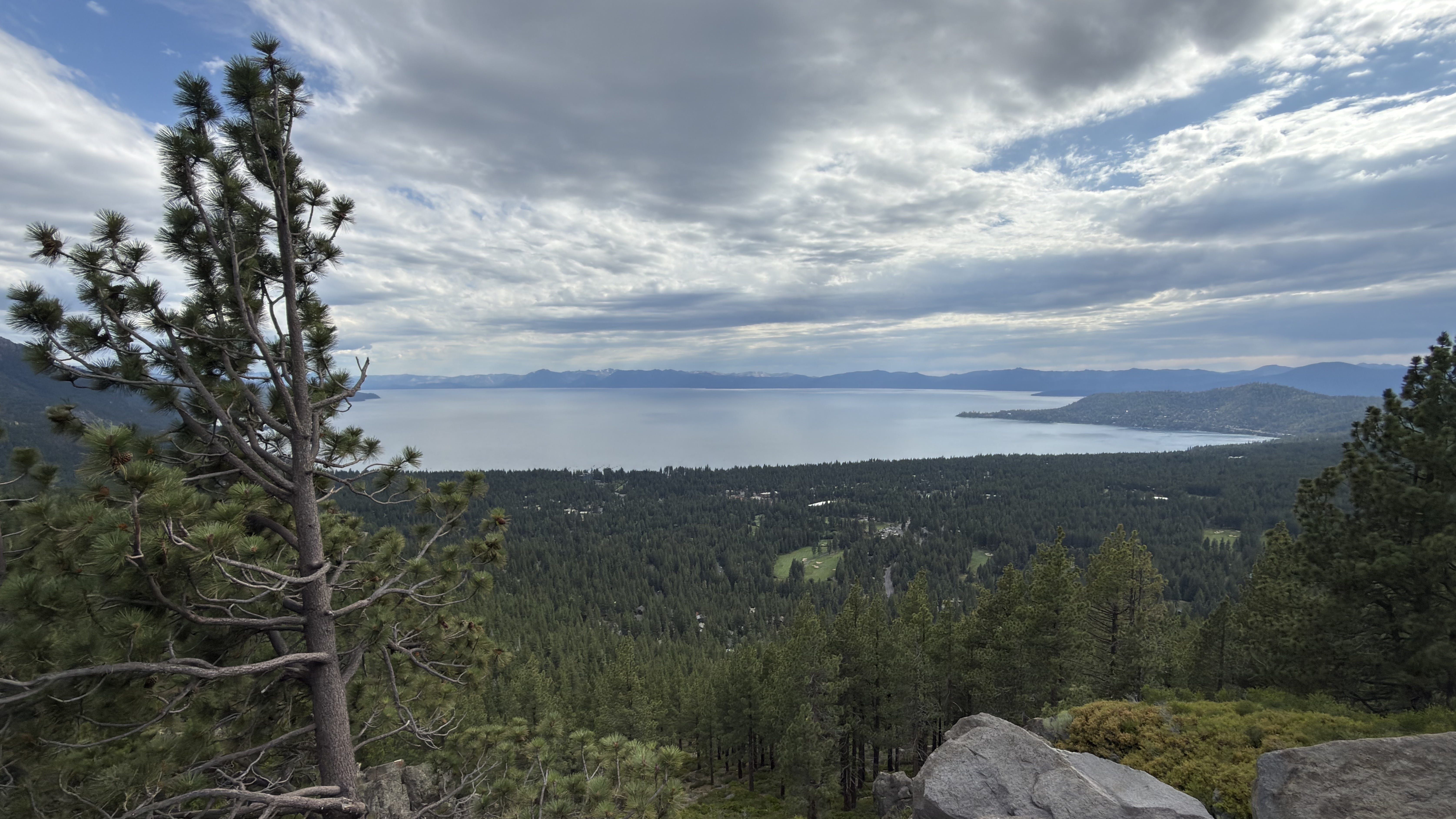
Heading south along the range’s eastern flank we passed through the bucolic alpine meadows of Hope Valley and later, to our right, drove by the eastern entrance to Yosemite National Park, cast our gaze left to Mono Lake in the Owens Valley, and then reached Mammoth Lakes, the ski-town nested below the 11,053-foot (3,369-meter) volcano-created Mammoth Mountain.
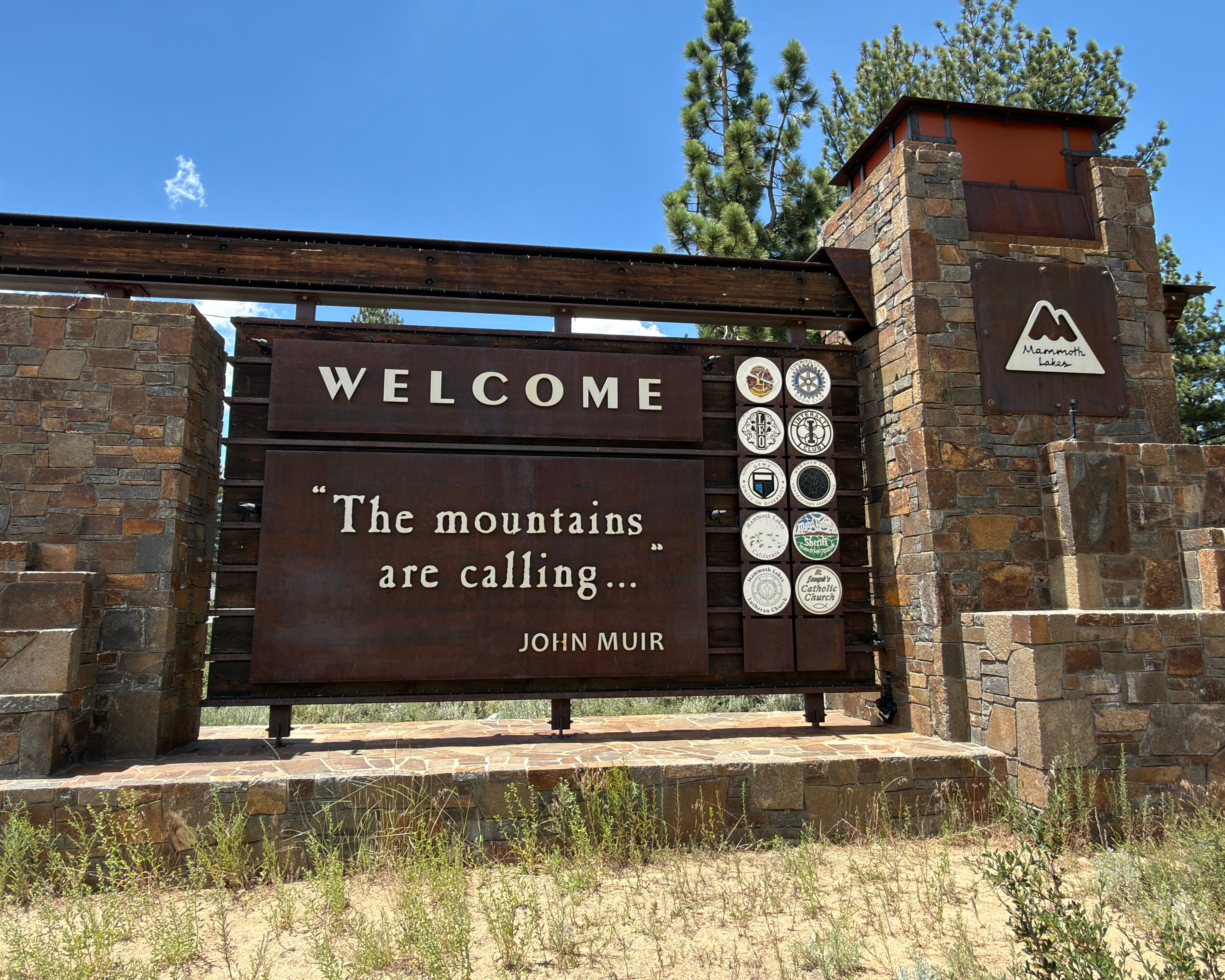
As we entered the town, John Muir greeted us – put more precisely – one of his famous aphorisms did – declaring on a stone gateway: “The mountains are calling.” That the town’s leadership offered this greeting struck me as a kind of proselytism for a high-elevation nature spirituality.
Many interpreters understand Muir in just such a way.
Scottish-born, Muir emigrated as a boy to a Wisconsin forest, which he helped to clear, and as a young man, he wandered his way to California, arriving in 1868. He fell in love with these mountains so deeply that he thought they deserved a more aesthetically evocative name than original Spanish mapmakers who borrowed the Sierra Nevada moniker, meaning snowy mountains, from mountains in their homeland. Muir, watching how light poured through their passes and off their snowfields, searching for terminology he thought worthy of them, labeled them The Range of Light.
Muir went on to co-found the Sierra Club in 1892 and become its first president. His passion for the preservation of nature became the guiding philosophy for, but not always the practice of, America’s national park system. This philosophy also became the model for many national parks around the world.5
My father was a Sierra Club member and what has become an endangered political hominid – a Republican environmentalist. He had also been a soldier in WWII, about whom I earlier wrote in Antifascism & Memorial Day. After the war he became a geologist, I surmise, in part because he found solace from the horrors of war in little-peopled wild places.
My brothers and I benefited from that impulse, as he took us to the West’s deserts and mountains, and sometimes, brought the family to Sierra Club wilderness trips. An early, fond memory was of a ‘wilderness threshold’ trip to Yosemite’s Cathedral Lakes and the spire above them. After reaching the spire’s summit in 1869, Muir wrote: “No feature ... seems more wonderful than the Cathedral itself, a temple displaying Nature’s best masonry and sermons in stones.... This I might say is the first time I have been at church in California.... In our best of times everything turns into religion, all the world seems a church and the mountains altars.”
Indeed, Muir often depicted California’s plants and animals as kin and its mountains as sacred temples. During his first summer in the Sierra, he wrote that when there, “we feel ourselves part of wild Nature, kin to everything.”
Although I had wonder-filled wildlands experiences, including during Sierra Club trips, it would be a long time before I knew anything about Muir.
On one of those early outings, probably in the early 1960s, we met Norman Clyde. My hazy recollection is that he had camped on the shore of one of the small lakes below the Minarets. We pitched tents on the opposite shore but ended up sitting around a small campfire one evening while he told stories, which sadly, I do not remember. My father said he was a legend.
So he was.
Born in Philadelphia in 1885, Clyde made roughly 130 first Sierra Nevada ascents. In 1928 he was the first to climb the tallest of the Minarets, a 12,281-foot (3,743-meter) spire that now bears his name — each Minaret now bears the name of the first person known to climb it. Clyde was also a schoolteacher who read the classics, and a longtime Sierra Club member who led wilderness trips. He lived simply in the Owens Valley, where on a clear day he could see the Minarets and the Ritter Range. In 1972 he died in Big Pine, California, within sight of the Clyde Minaret.
Like John Muir, Clyde fell for these mountains. So have I, although given nature’s indifference and sometimes violence toward our kind, I know such affection is not reciprocal.
Not incidentally, despite his romanticism, Muir knew this as well, which he revealed in Cedar Keys, one of the most amusing and important essays in American environmental letters. I have long assigned it to my students and recommend it heartily.
Given my fondness for these mountains, soon after I connected with Beth, I took her to them. During an early trip to the Eastern Sierra, we drove past the Mammoth Ski resort to the Devils Postpile National Monument, at 7,560 feet (2,304 m), which was then the common trailhead to Thousand Island Lake. Then we hiked over 15 miles (24 km) up to this meadow-surrounded alpine lake at 9,833 feet (2,997 m), which sits directly beneath Mt. Banner. After a lazy recovery day, we set out to climb Banner.
Our route swung around to the right of the mountain’s cliff face until we were behind the mountain, and then we continued up a pitch to Lake Catherine, a stunningly beautiful, round, deep blue lake. At 11,040 feet (3,365 m), it was treeless and surrounded by black rocks, except at the lake’s opposite end from our approach, where a glaciered snowfield spilled into it. Circumventing the rocky bank on the lake’s left side, we reached and began climbing up that snowfield, with Banner to the left and the steeper face of Ritter to the right.
This face was where, in the fall of 1872, during what became the first known ascent of Mt. Ritter, Muir had an uncanny experience. While climbing he came to a dead stop, paralyzed with fear, clinging precariously to the cliff wall. (Years later, when working with California’s Park Service, I participated in a hair-raising cliff rescue of a person in this very predicament, so I have a visceral understanding of how terrifying and paralyzing such an experience can be.)
Muir wrote of the experience in terms that suggested a rescue from some kind of mysterious life-force.
When this final danger flashed upon me, I became nerve-shaken for the first time since setting foot on the mountains . . . But this terrible eclipse lasted only a moment, when life blazed forth again with preternatural clearness. I seemed suddenly to become possessed of a new sense. The other self, bygone experiences, Instinct, or Guardian Angel,—call it what you will,—came forward and assumed control. Then my trembling muscles became firm again, every rift and flaw in the rock was seen as through a microscope, and my limbs moved with a positiveness and precision with which I seemed to have nothing at all to do.6
Muir’s account, in which he seems to imply that the universe took over and flowed through him, reminds me of an experience many expert surfers report, that “time slows down in the tube,” and it also resembles what athletes and some scientists have described as a Zen-like flow state.7
When taking our own path up to the saddle, a ridge that at the top of this snowfield bridges Ritter and Banner, Beth and I did not know this story. Nor did we know that all the way from the Thousand Island Lake to the saddle, we had taken, essentially, the same route Muir had 154 years earlier.
What we knew was that we were ill-equipped to climb Ritter. Although the mountain’s face from the saddle is not highly technical (a Class 3 & 4 challenge in climber’s terminology), a fall from it would likely lead to death. It certainly would have for Muir, who was climbing solo. We had only ice axes, both to assist our ascent of the snowfield and to brake our butt-sliding descent down a steep snow chute—a quicker and more amusing return to Thousand Island Lake. Instead, from the saddle, we turned left and scrambled up to Banner’s 12,936-foot (3,943 m) summit, which was only a Class 2 climb. It was not, however, far below Ritter’s apex, which reached 13,143 feet (4,006 m) above sea level.
The scramble to Banner’s summit was not arduous but the wind was fierce. After reaching the summit, we lowered ourselves to avoid becoming wind-sailors to the lake below, and crawled to the edge of the mountain’s eastern precipice.
The payoff was a view of the many lakes below and a panoramic view of the surrounding mountains, the Owens Valley to the east, and beyond that, the White Mountains.
That view remains seared in my mind.
I later learned that the White Mountains are the refuge of the Bristlecone Pines, the oldest trees on Earth, one of which scientists have concluded is 4,850 years old. Several others are nearly as elderly. A dendrologist dated a specimen at 5,062 years old, but that finding remains unconfirmed (for the story, see Pinus longaeva).
Our Sierran experiences sealed the fate of the three children who would later join Beth and me in our life-journey. A few years after moving to Wisconsin, we brought them to experience Thousand Island Lake and the region to which it belongs. Way up the steep switchback path to the lake, this time, via the June Lake trailhead, our then ten-year-old daughter Kelsey exclaimed, “You know, some families actually relax on their vacations!” After acknowledging sardonically that indeed, “It sucks to be you,” we persevered to the lake.
Despite her complaint, like a duck imprinting on and following a parent, the mountains imprinted on her, and indeed, on all of our offspring, who themselves became lovers of nature, mountains, and alpine adventures.
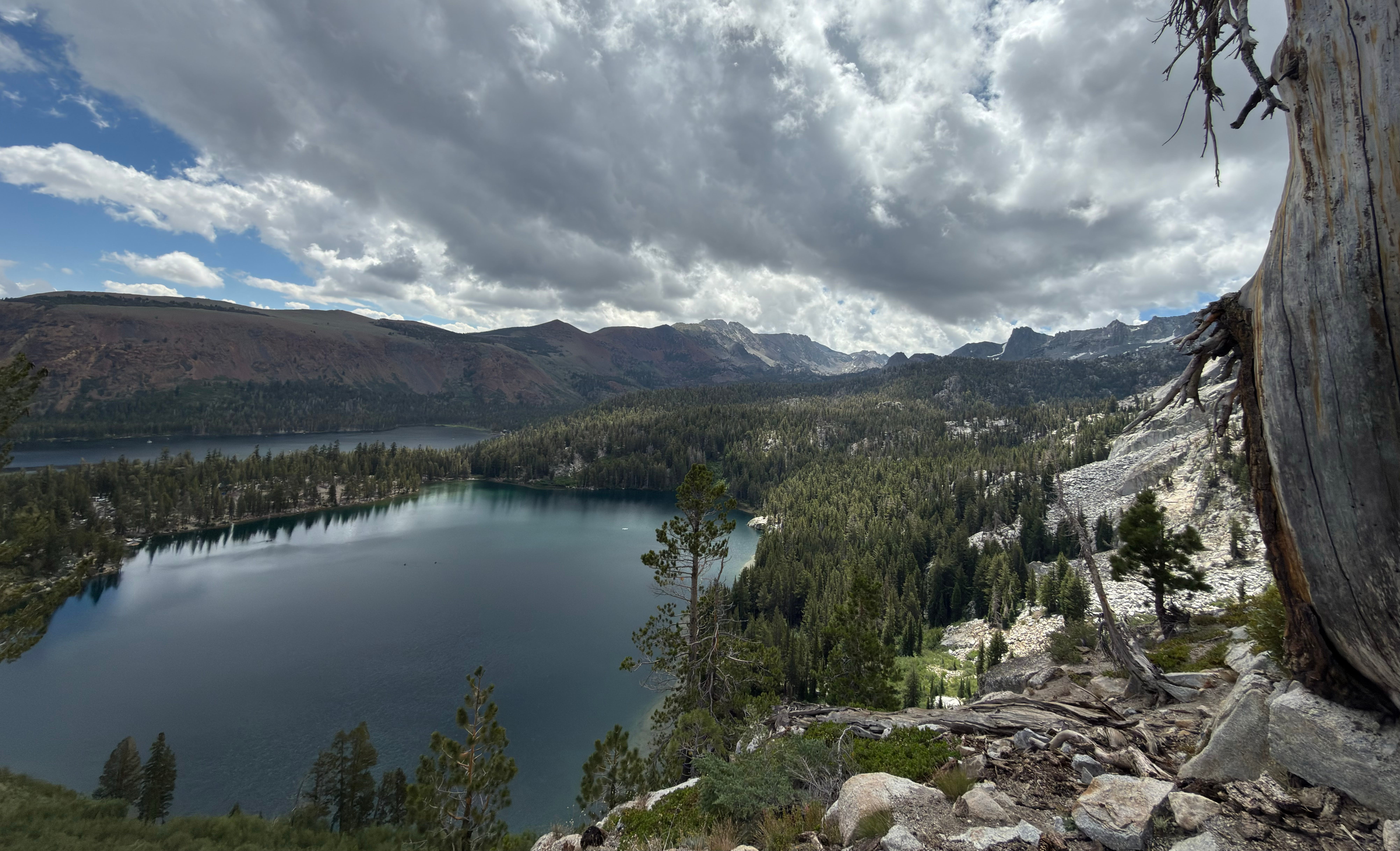
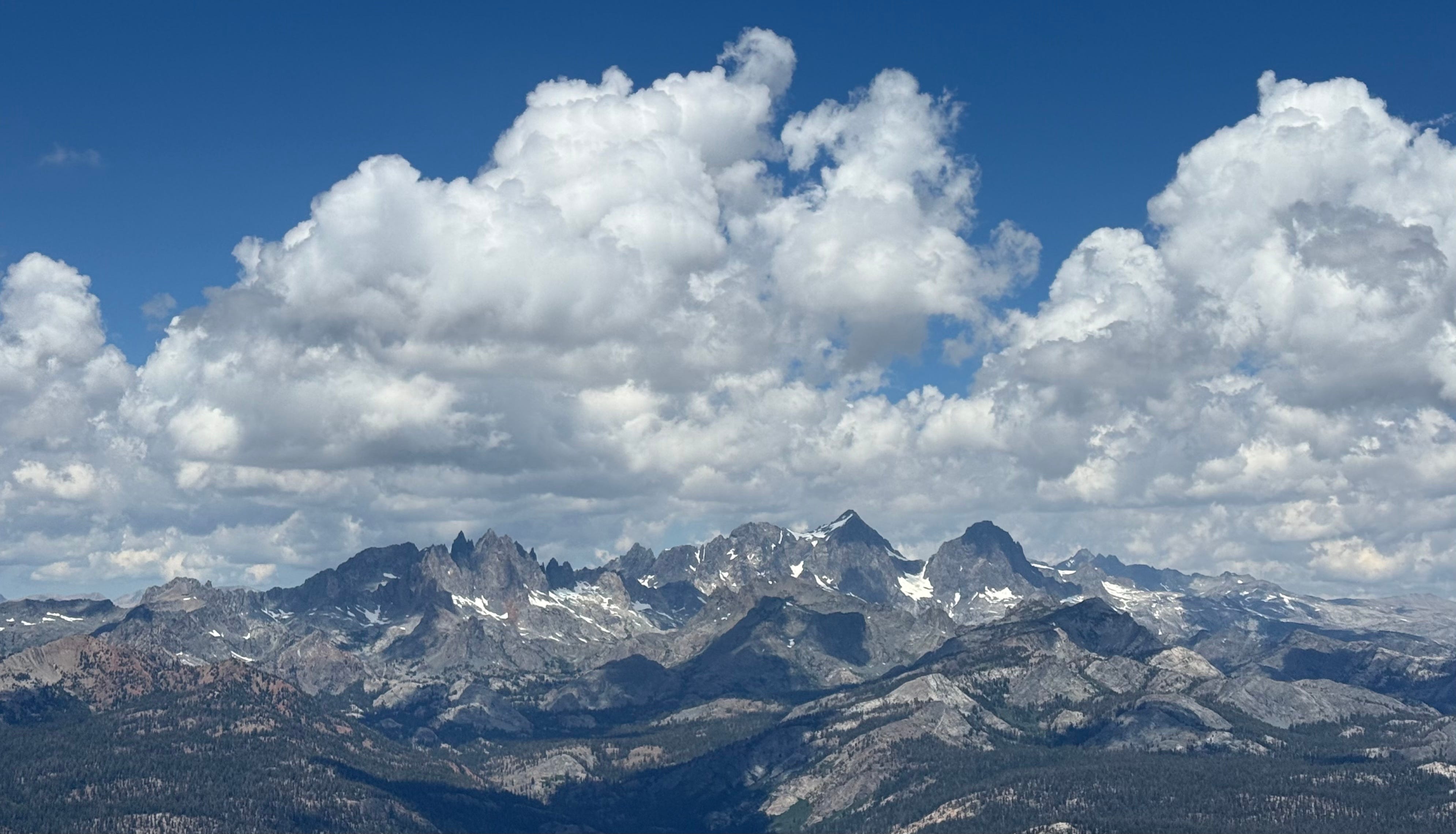
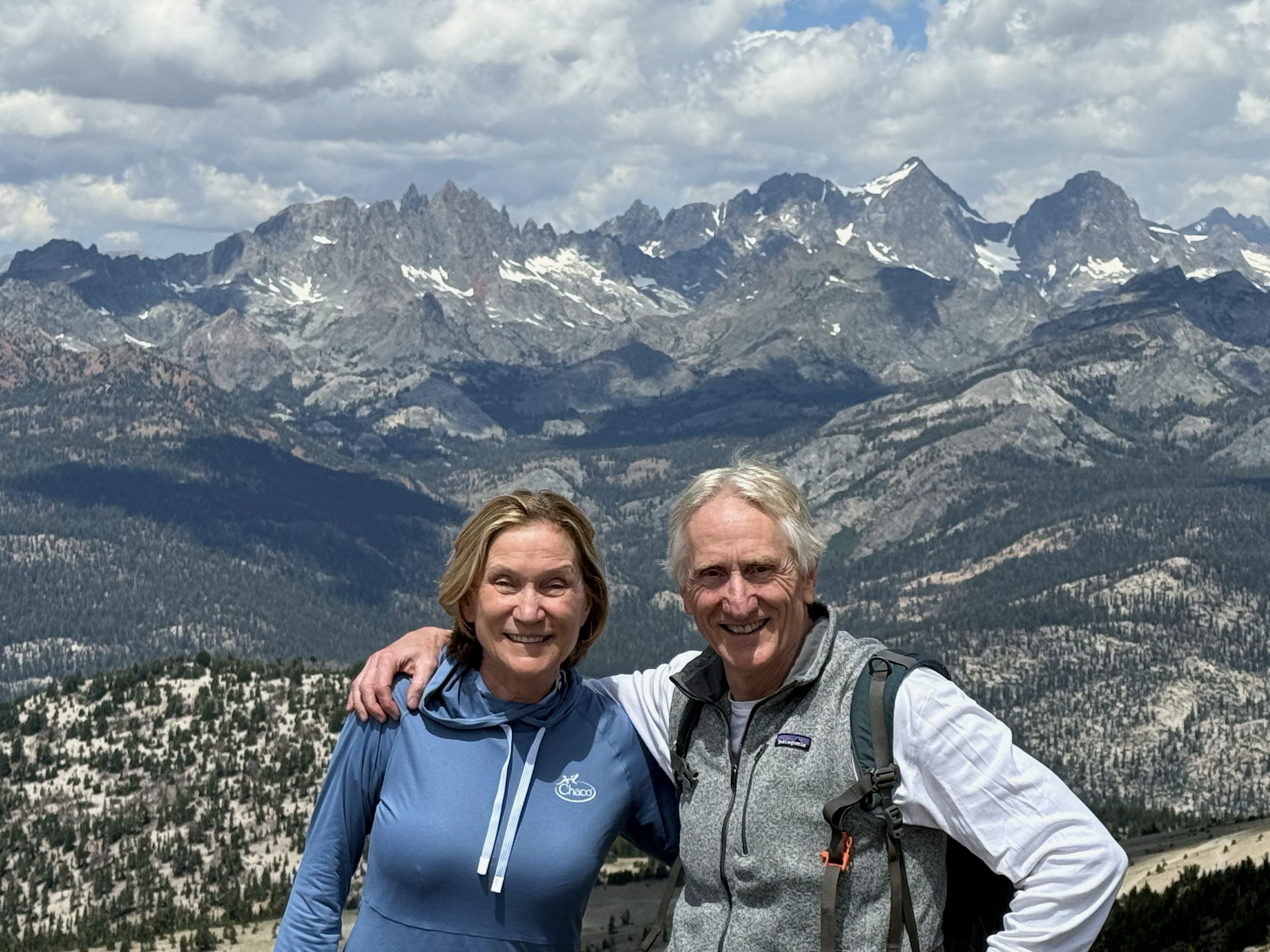
Perhaps it was similar imprinting that led us to return to these mountains. On our recent visit, however, road repair blocked the road to the Postpile trailhead, so to gain a view of the high country, we started further away and hiked past Lake George and up the Mammoth Crest. Finally, from a distance (and as depicted in this essay’s initial picture) Banner and Ritter and the Minarets appeared.
The next day began crystal clear. Although Beth and I, as avid hikers, felt like cheaters, we took a gondola to the top of Mammoth Mountain. Stepping out onto its 11,053-foot (3,369 m) summit, we absorbed the dramatic panorama, including a significantly closer view of Banner, Ritter, and the Minarets than we had seen the previous day.
After reveling in the scenery for a while, we descended the way we came, all the more determined to return, fates permitting, with our mountaineering offspring. Next time, we hope to hike the John Muir Trail, and then his ‘Pathless Way,’ as one of his biographers put it, to the summit of Mt. Ritter.
Homecoming
As we drove out of Mammoth Lakes, a sign in the same style as the one that greeted us expressed an expectation that we would soon return. It also provided a reason for this confidence, again quoting Muir, “Going to the mountains is going home.”
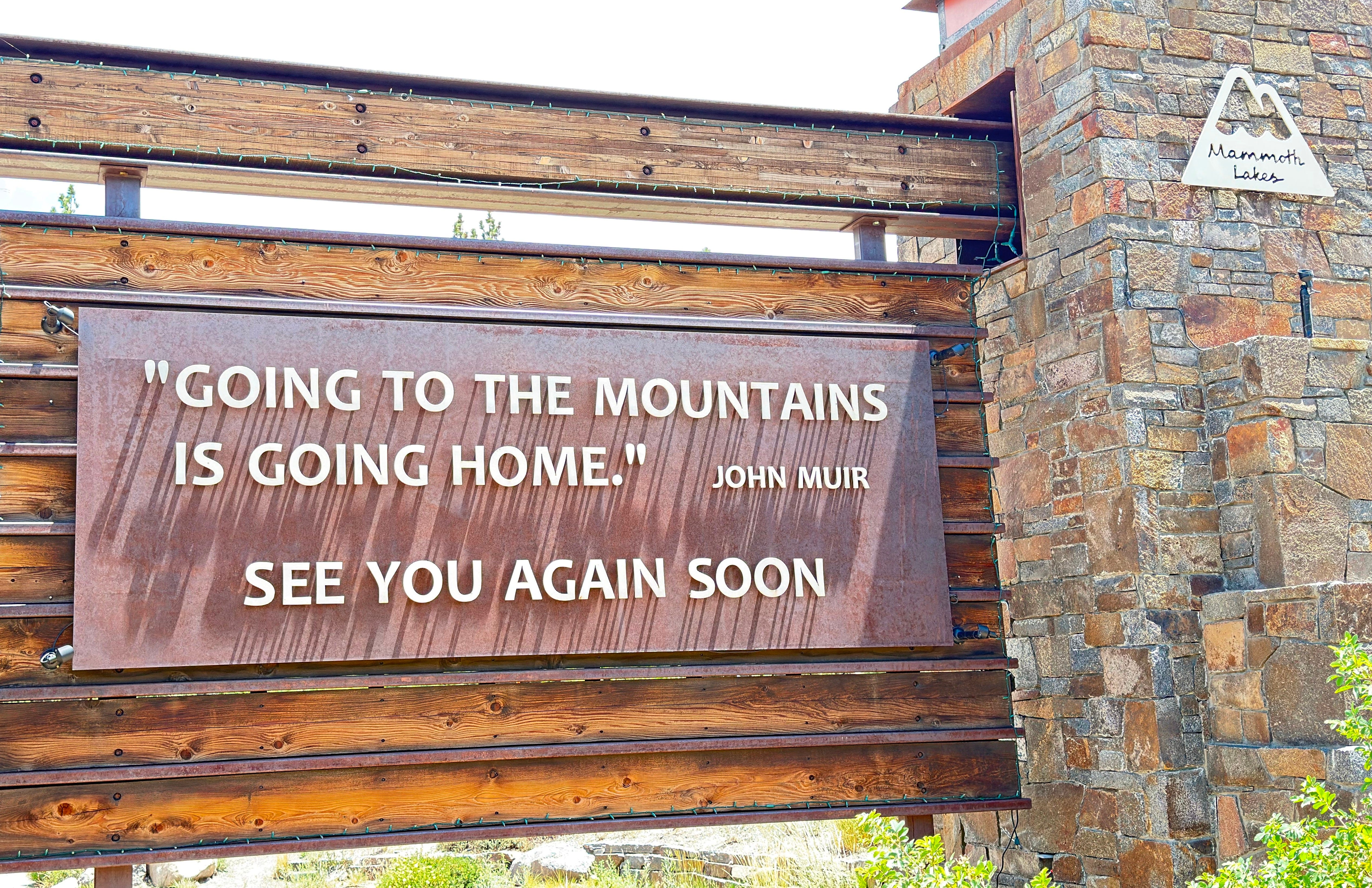
The words named something I have spent much of my career studying—what I long ago labeled ‘spiritualities of belonging and connection to nature’ and, in a subsequently published book, Dark Green Religion. (I summarized its analytic framework in an earlier Substack post, Dark Green Religion ~ A brief Introduction.)8
I think I was able to recognize in others such feelings of belonging to nature because I share them. And I am far from alone.
While still in the mountains and before writing these words, I posted on social media a couple of the photographs that I am sharing here. Several California friends who feel a connection to these mountains responded, expressing their own affection for this region and its wonders. One sent an artistic rendition of Banner, Ritter, and the Minarets, confessing that these are her favorite mountains. Knowing her, I suspect she would also consider them sacred.
The experiences I have recalled here show how nature can bring connection, contentment, joy, and purpose—and, not uncommonly, a belief that the natural world is sacred and worthy of reverent care.
There is, of course, more to say about perceptions of the sacred in nature and the contested history of protected-area conservation. That is for another day. But in my initial Substack essays, I want to provide more personal background than I typically do in academic writing—in this case, why I understand the widespread impulse to perceive Earth’s living systems as something to which we belong, owe obligations, and sometimes even consider sacred.
~ ~ ~
New here? For background, check out my inaugural post, Who I Am and what I intend with my Substack. Would you like an alert to future essays? Then . . .
1. The slogan originated during California’s 1849 gold rush and it has been used subsequently to reflect a determination to overcome all obstacles to get to a specified destination.
2. See the report from the Critical Ecosystem Partnership Fund.
3. The classification is from G.E. Griffith, J.M. Omernik, and colleagues, Ecoregions of California (U.S. Geological Survey Open-File Report 2016-1021; https://www.epa.gov/eco-research/ecoregions-california). I learned about such classifications when studying Bioregionalism, which emerged as a scientific and philosophical approach to biocultural conservation, with strong activist dimensions. If interested in this history, see Bron Taylor, “Bioregionalism: An Ethics of Loyalty to Place,” Landscape Journal 19(1&2): 50-72, 2000.
4. Jordan Fisher Smith’s writings include Nature Noir: A Park Ranger’s Patrol in the Sierra. Houghton Mifflin, 2005, and Engineering Eden: the true story of a violent death, a trial, and the fight over controlling nature, Crown Books, 2016.
5. My favorite biographies of John Muir, which also illuminate the early history of the Sierra Club, are Michael P. Cohen’s The Pathless Way: John Muir and American Wilderness. Madison: University of Wisconsin Press, 1984, and The History of the Sierra Club (1892-70). Sierra Club Books, 1988; and Donald Worster’s definitive study, A Passion for Nature: The Life of John Muir. Oxford University Press, 2008.
6. The account appears in The Mountains of California. This book is included in the best collection of Muir’s writings, with a very helpful timeline and commentary from the historian and editor of the collection. See Muir, John. 1997. Nature writings: the story of my boyhood and youth, my first summer in the Sierra, the mountains of California, Stickeen, selected essays, ed. William Cronon. New York, Library of America.
7. On Zen states regarding actionless action, in which it appears the universe is flowing through one without an individual acting, see Eugene Herrigel, Zen in the Art of Archery, Vintage Books, 1989. And for the classic study of such flow states, see Mihaly Csikszentmihalyi, Flow: The Psychology of Optimal Experience. Harper & Row, 1990.
8. The first time I used the phrase ‘spiritualities of belonging and connection to nature’ was in this two-part study: “Earth and Nature-Based Spirituality (Part One): From Deep Ecology to Radical Environmentalism,” Religion 31(2): 175-193, April 2001, and “Earth and Nature-Based Spirituality (Part Two): From Earth First! and Bioregionalism to Scientific Paganism and the New Age,” Religion 31(3): 225-245, July 2001.
No posts
Comments
Nothing yet. Say the first thing.
Sign in to join the conversation.