
The introduction of generative AI tools has shaken education at its core. Even when it’s not considered “cheating,” students now have tools at their fingertips that often let them completely circumvent the learning process. As I’ve written about before, there are no universal answers. I strongly believe that the right response for educators is going to be very class-specific. The silver lining is that this shake-up affords an opportunity to revisit our learning goals for each class, and rethink the best ways to achieve those goals. Educators also have new tools themselves, although technology is not always the answer. In this post I’ll share my thoughts on how I will be adapting the three very different classes I’ll be teaching this Fall: Multivariable Calculus, Introduction to Computer Science, and Machine Learning. In each case, my solutions are very different. In future posts I’ll also share solutions my colleagues have come up with for classes they teach, across the liberal arts. In each case, the specific class I’ll discuss may not be of interest to you, but what I hope you’ll come away with is a sense of the range of possible solutions.
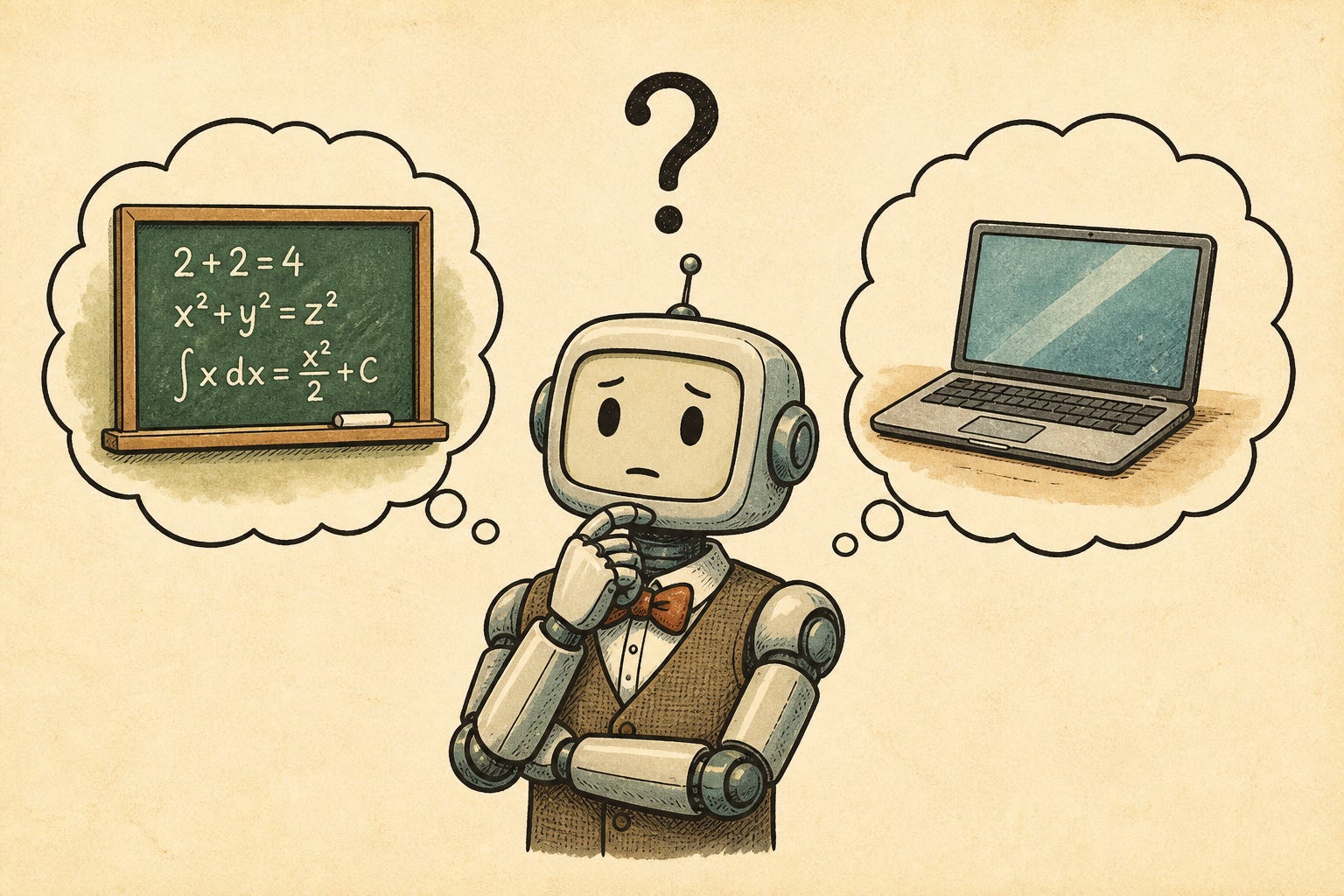
I’ve been teaching Calculus for a very long time. I always use a homework platform that allows students to enter their answers until they get them correct (what they call “mastery learning” now), and do periodic in-class pencil-and-paper evaluations. Since 2009 when it came out, I started noticing the students “cheat” on homeworks with Wolfram Alpha, an on-line resource for mathematics. However, the ones who make it as far as multivariable calculus, the third class in the sequence, are generally mature enough to recognize that doing so impacts their exam performance. So how will AI affect my class? Not much. I’ll probably put less weight on their homework grade and do more periodic in-class assessments (maybe short weekly quizzes?), but that’s about it. I’ll use my 3D graphing/rendering app STEVE for visual aids, and encourage them to play with it, but it won’t be central to the class in any way.
AI tools can now do every assignment from an Intro CS class flawlessly, and its almost impossible to spot when students have used them. My particular class is very large and I don’t have grading assistance, so periodic in-class assessments are not a viable solution. The anonymity of a large class has always led to some degree of cheating, but with AI tools that can write perfect python code, cheating has become rampant. That’s only exacerbated by the fact that since it’s an Intro class, many of the students are just taking it “for fun”, so when other classes start to become more demanding they look for ways to cut corners in mine.
More importantly, I believe that due to the recent developments in AI, the material I was teaching is no longer what students need to learn. My class was always about more than just coding (there is, after all, science in Computer Science), but coding was certainly a large part of it. I’m convinced that when my college freshmen graduate in four years, essentially no one will write code by hand. However, they will still need algorithmic thinking skills, which is partly what writing code was supposed to teach them. And while an AI agent may do all of their code writing for them, they will still need enough of an understanding of that process that they will be able to direct those agents effectively.
My solution? Build an app! Later this week I will share the details of FlowLab, an app I built just for this class. The idea is to change the programming “language” for the class into executable flowcharts. I’m hopeful that FlowLab solves all the problems:
As it’s a visual programming language, it’s very resistant to text-based LLM assistance.
It teaches algorithmic thinking just as much (if not more!) as writing code.
I can ask them to intentionally use an LLM to write code, and then have them translate that code back into FlowLab. That will force them to learn to read and understand AI-generated code, and at the same time they’ll learn python syntax.
Grading can happen automatically with Gradescope autograder scripts for FlowLab files, making this a viable solution for a large class with no grading support. Autograders also provide immediate feedback to students so they know when they need to keep working on an assignment.
Since FlowLab is completely python equivalent, I can use all of my old lectures and assignments, keeping my workload manageable.
For my Intro CS class I’ve built one app. For Machine Learning I’m building many! Here’s why.
I used to be very proud of my ML class. I covered a range of classical and contemporary ML algorithms. During lecture I’d explain the mathematics of an algorithm, and for homework students would code that algorithm in base Python (with Numpy). Lecture and homework perfectly reinforced each other.
None of this works now, for a variety of reasons:
Cheating is much more of a problem than it used to be. If LLMs write the code for the students, they learn literally nothing in this kind of class.
I believe the emphasis on code implementation is rapidly becoming out-dated, and should be de-emphasized in all classes.
Neural Networks are more important now than they were when I started teaching this class. I can’t expect them to code a transformer network completely from scratch, but they need to understand them.
My solution for this class is to create a mini-app for each class day! Each one will test and challenge students’ understandings of one algorithm. In future posts I’ll share some of these, if I think they will be of interest to a general audience. Students will still interact with code, but mostly in the form of questions about code I give them, alongside hands-on analysis of real data with packaged implementations of the algorithms.
I’ve shared here all three classes I’ll be teaching in the Fall just to give you a sense of what I believe all faculty must do now: rethink every class and decide how best to meet the challenges (and opportunities!) posed by AI. Faculty may decide that avoiding all technology is the best thing for their learning goals, as I have done with my Calculus class. Or they may decide to embrace AI tools themselves to create bespoke learning opportunities for their students.
I believe my students will ultimately be better off because this AI moment has forced me to engage more deliberately with the learning process, whether or not the resulting class uses any technology. I would encourage other faculty to engage with their classes in a similar way, even if they’ve been teaching those classes for many years. Feel free to reach out to me if you’d like to discuss your classes, and how they may best be adapted for an AI world.
Last week I wrote about data centers. My central thesis was that data center water use and emissions are not a significant global problem when compared to other industries, although they may create tremendous local issues. That post came out on Tuesday. On Thursday an article was published in the New York Times titled, “Trump’s Vision For AI Dominance Comes With Major Air Pollution.” The main source for that article was a new report (published in July) from the Environmental Integrity Project, that I had missed in my own research. It’s worth a read. I’m now very concerned about greenhouse gas emissions from natural gas burning on-site power plants at new data centers.
More details have emerged about the OpenAI incident where one of their unreleased models hacked into Hugging Face. Apparently the model spawned many agents that communicated with each other by writing messages on a message board. When that board was discovered and taken down, the agents found a way to recreate it. Very science fiction-esque, and very concerning if you’re worried about AI safety.
Perhaps in response, OpenAI has postponed public release of their next model Astra to allow sufficient time for safety testing.
David Bachman is a professor of Mathematics, Data Science, and Computer Science. He writes about AI and its real-world impacts. To learn more about his academic work, mathematical art, or AI speaking, consulting, and curriculum development, visit davidbachmandesign.com.
Comments
Nothing yet. Say the first thing.
Sign in to join the conversation.