
I’m very pleased to announce that a small group of us will be hosting a “Hot Topics Workshop” at the Institute for Computational and Experimental Mathematics (ICERM) in Providence, RI, on “AI-assisted coding for Mathematical Exploration.” The workshop will take place December 11-13, 2026. Applications to attend will open soon. I’ll announce more details here as we finalize things. Here’s the image that will go on the workshop poster:
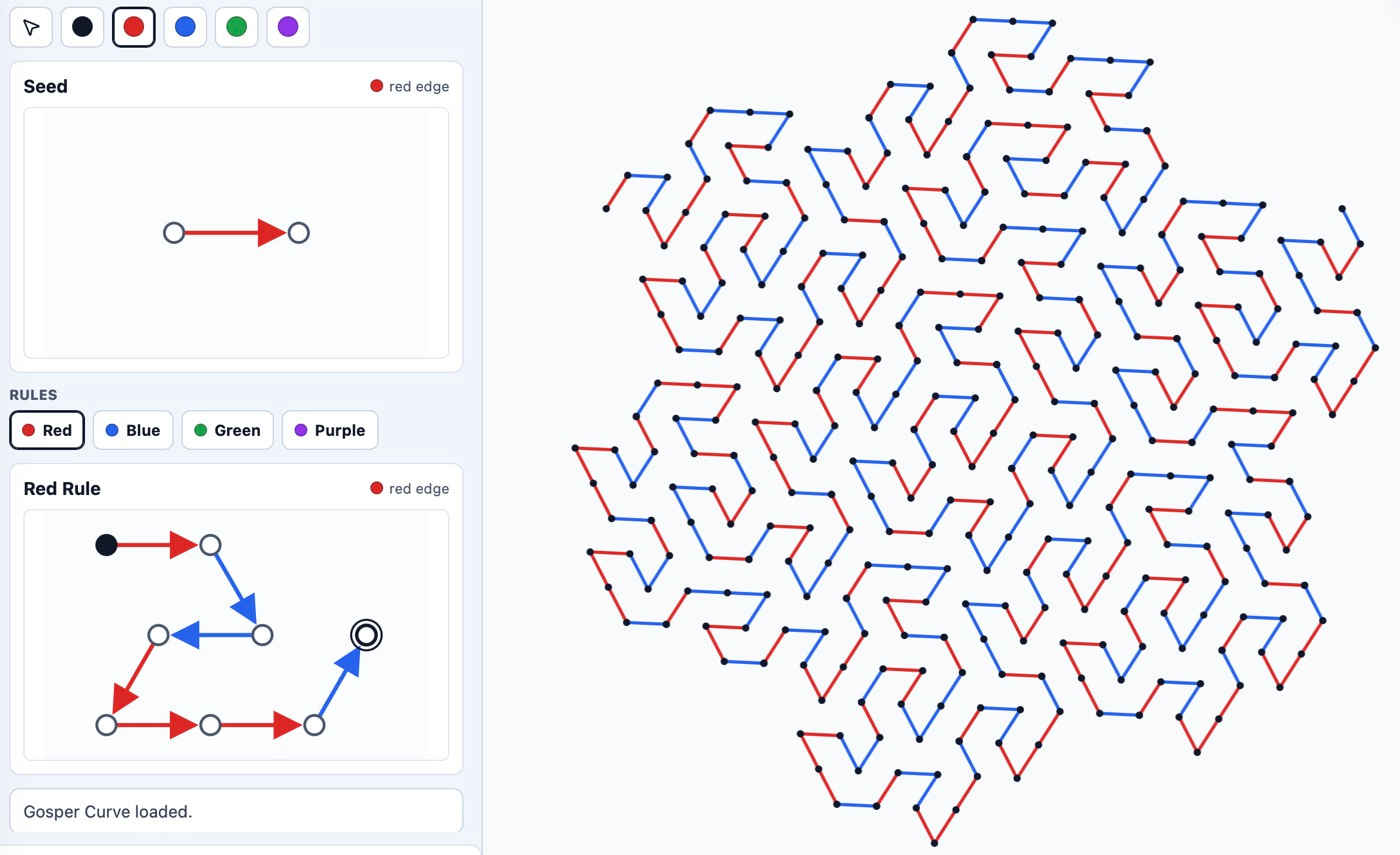
This image is a screenshot of my Geometric L-Systems app, built primarily with GPT 5.5. This app perfectly exemplifies the topic of the ICERM workshop: I created it with AI-assistance so that I (and anyone else!) could explore a mathematical idea. The best part is, you don’t need to know any mathematics to understand it!
For the remainder of this post I’ll explain the app and the idea behind it. To begin, I have to tell you what a Lindenmayer system (“L-system”) is. It’s really a fairly simple idea: you start with a string of letters (the “seed”), and then successively apply substitution rules. Here’s an example. Let’s start with the seed “AB”. We’ll apply two substitution rules: (1) replace any “A” with “AB”, and (2) replace any “B” with “BA”. Here we go:
Seed: A B
After first substitutions: AB BA
After second substitutions: AB BA BA AB
After we’ve done this a few times, we can then draw a picture by reinterpreting each letter as a drawing instruction like “draw a line”, “turn right 45 degrees”, etc. The final picture will depend heavily on all of the choices: seed, substitution rules, and how you interpret letters as instructions. The variety of the pictures you can make with L-systems is astounding; it’s well worth checking out their Wikipedia page to get a sense of this. For example, you can create many fractals that you may have heard of such as a Cantor set, Sierpinski triangle, and Koch snowflake, as well as a wide variety of botanical tree-like forms.
As powerful as they are, though, L-systems have one major flaw: they’re hard to play with. So my goal with the new app was to convert them to a completely visual system that captures as many of the same ideas as possible. Instead of a string of letters to act as the seed, you just draw some colored arrows. Instead of substitution rules, you draw a new set of arrows to replace each color: one set to replace any red arrow, one set to replace blue arrows, etc. You can set the iteration level, and the result instantly appears on the canvas. You can then dynamically adjust the seed or the substitution rules, and see how the result changes in real time.
Many of the same fractals that you can make with traditional L-systems can be made with Geometric L-systems. I’ve included seven with the app under the “Examples” menu, like the Gosper curve shown in the ICERM poster image above. Click here for a little tour of some of the others:
I don’t know of anyone who has defined a system like this. It’s not at all clear to me that anything that can be made with a Geometric L-system can be made with a traditional one, or vice versa. If anyone reading this knows answers to these questions, feel free to reach out or leave a comment here.
In the meantime, have fun! Here’s the link again to play with Geometric L-systems.
David Bachman is a professor of Mathematics, Data Science, and Computer Science. He writes about AI and its real-world impacts. To learn more about his academic work, mathematical art, or AI speaking, consulting, and curriculum development, visit davidbachmandesign.com.
Comments
Nothing yet. Say the first thing.
Sign in to join the conversation.