
Thanks for being here! Every horse lover deserves access to the accurate, practical, and FREE information about equine care on proequinegrooms.com.
A few notes to dispel a common myth about horses and sweat. Notably, foamy sweat is not indicative of an overworked horse. The foam on your sweaty horse results from the ingredients of your horse’s perspiration, specifically latherin.
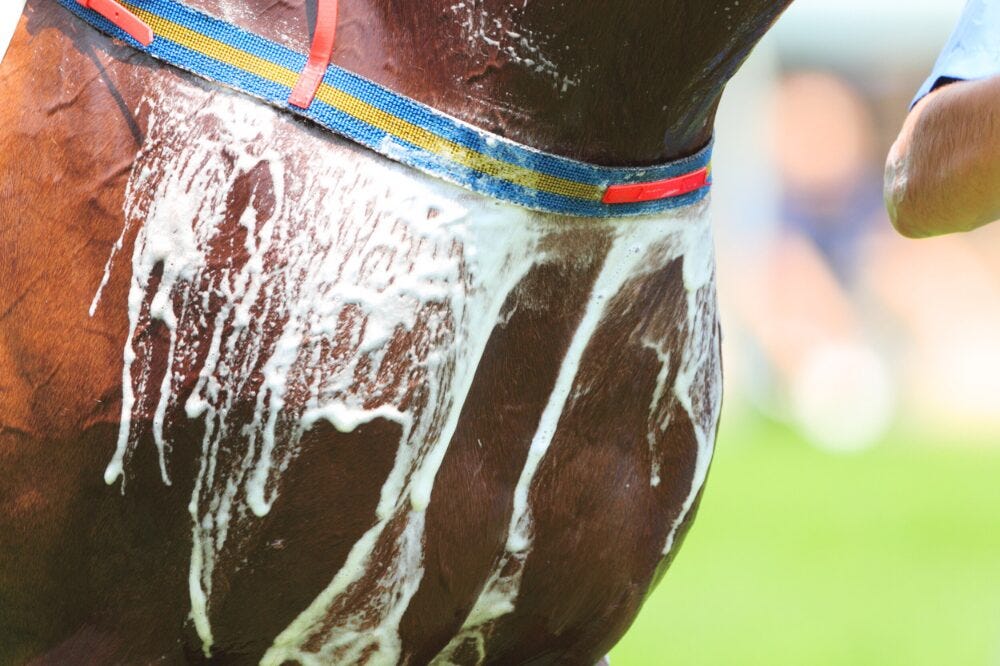
Latherin is the reason that equines foam up while sweating. And contrary to popular belief, it’s not bad!
Getting technical: Latherin is a protein that’s also a non-glycosylated surfactant. 37% of latherin is hydrophobic.
Translated: Latherin is a protein that acts like a detergent. It’s slippery, and 37% of latherin contains ingredients that repel water.
Latherin is also found in your horse’s saliva, and saliva may be the original source of latherin. Latherin in the saliva helps them chew and digest dry forage. Somewhere along the line, equines decided that latherin is also a great idea to put into perspiration.
The theory is that latherin became a part of horse sweat to facilitate evaporative cooling with a hairy coat. This cooling works best in hot weather, but not so well in humid weather.
There are several research projects involving latherin, and it’s promising that one day, there will be more treatments for horses with sweating disorders like anhidrosis.
Not many mammals perspire. Aside from humans, some primates, bovids (cows and relatives), and equines sweat all over their bodies.
As flight animals with large muscle masses, they can produce astounding amounts of heat and need a way to cool effectively and rapidly. Their hair coat prevents easy evaporative cooling. Enter latherin – a fancy protein that makes perspiration easier to evaporate.
Read more about the genetic components of latherin here.
The answer to this is a resounding NO, and science has the data to demonstrate this. Part of the allergen profile included latherin, which is cool! Curly-haired breeds have these allergens.
Respiratory allergens constituted the most abundant proteins in horse hair extracts, such as the lipocalin Equ c 1 variants, lipocalin Equ c 2, and latherin Equ c 4, followed by the protein family of secretoglobins.
Another study examined a wide range of animals, including those beyond equines, dogs, and cats, to identify specific allergens. In horses, they found that latherin is a major allergen.
Equ c 4, a member of the latherin family is the second major horse allergen but its importance still needs to be determined
Read more about these allergens here.
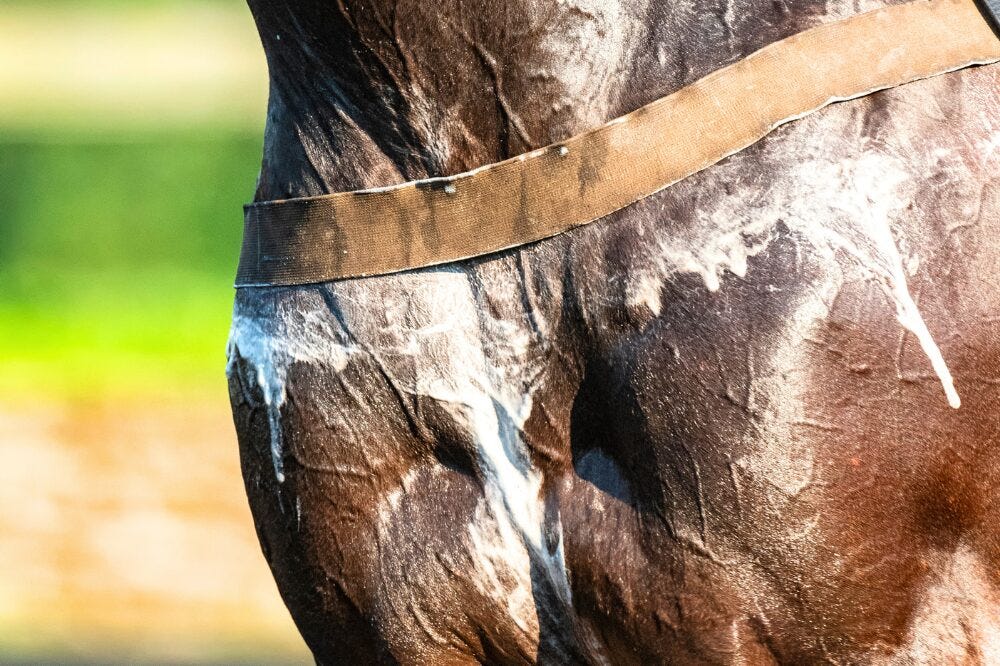
By now, we all know that zebra stripes are said to help deter flies, and some clever researchers now believe that zebra stripes also boost evaporative cooling in addition to the latherin boosting evaporation.
Movement of sweat away from the skin is accelerated by the recently discovered surfactant equid protein latherin, a vital component of cooling in racehorses. Latherin decreases the surface tension of the sweat, facilitating evaporative cooling at the hair tips. We suggest that the abrupt temperature difference between the stripes causes chaotic air movement above the hair surface, thus enhancing evaporative heat dissipation.
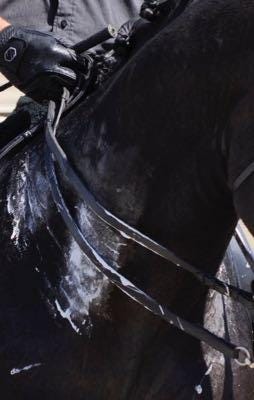
Foam doesn’t mean the horse is overworked. It means sweat and friction are going on.
Your equine buddy cools when the moisture evaporates. However, the hair coat, even in warm weather, serves as a physical barrier, trapping perspiration.
So, latherin acts to “slickify” the sweat so that evaporative cooling is adequate.
The white foam is produced when the soapy properties of this protein are rubbed. Just as your sponge will foam up as you start to wash the dishes, the same is true for your partner. Reins, butt cheeks, and girths will foam up the sweat. You will tend to notice it more where there is friction involved.
Some horses get super soapy and foamy, others do not. Foamy horses are not necessarily overworked. It’s actually an excellent sign – and you know that when you see lather, your horse’s own cooling system is working.
For horses that don’t get foamy, there’s no reason to panic. Perhaps they don’t have a lot of friction, or produce much latherin.
However, if your horse doesn’t perspire at all, or only partially sweats, you may have a horse with anhidrosis or partial anhidrosis. This is an entirely different scenario that needs careful management and veterinary care.
Let’s dispel some unfortunately popular myths about horse sweat, namely, that a foamy horse is overworked.
A horse is overworked.
The horse is dehydrated.
A horse is overheating.
There is latherin in the sweat, and that moisture has friction applied to it. That’s all.
Could a foamy horse be overworked, overheated, or dehydrated? Certainly, but the presence of foam is not PROOF of this, it’s only a coincidence.
Also, a horse WITHOUT foam can be overworked, overheated, or dehydrated. The absence of foam is not PROOF that they are OK.
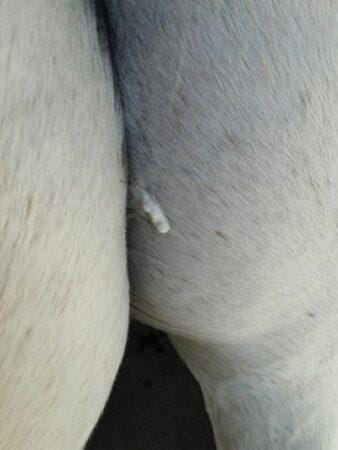
A teeny, tiny patch of latherin-induced foam.
You have many options for grooming the foam away.
You can easily rinse sweat and latherin with water, and no shampoo is needed. In hot months, this is the fasted way to groom your equine buddy after a ride.
For those who get a bit dirty and sweaty, the hose is great. You may find that latherin brings up dirt missed during grooming. Or, use a no-rinse shampoo to help lift the moisture and dirt if the weather doesn’t allow for a bath or rinse.
You can also sponge or wipe latherin and sweat away if you want to spot treat any areas without getting more wet.
A cactus cloth does wonders to remove crusty and dried perspiration after your horse exercises, and the sweat dries. A quick buffing with a wadded-up cactus cloth takes all of the dull away.
Sweat scraper are an option, too!
Remove latherin and sweat from your tack after riding. And saddle pads, too. Your typical tack cleaning routine should be plenty.
For wet leather, you could wipe away surface moisture before cleaning with your saddle soap of choice.
The most important step is to condition the leather. Wet leather can break the protein bonds deep in the leather that give it structure and flexibility. Over time, those broken bonds create cracks and weak points in the tack. Using conditioners helps keep the bonds strong and, therefore, the leather safer.
There’s more to explore at proequinegrooms.com, where every article is written (by a human!) to make quality horse care accessible to all.
I will never gate keep content behind a paywall, and I encourage you to visit the companies that support this educational endeavor.
Wahl Clipper - Code LIV for savings
HandOn Gloves and Grooming Tools - Code PEG for savings
GG-Equine Health Care Products - Code 15PROEQUINE
No posts
Comments
Nothing yet. Say the first thing.
Sign in to join the conversation.