
The main lesson I’ve learned about hiring and growing a team from 0 to 10+ is that you need to think further ahead than you realize. Or at least further ahead than I did.
The path forward seemed obvious to me so I didn’t explore alternatives. I’d simply hire a few PMs and PDs, they’d all report to me, and worry about hierarchy and managers later.
This was not unreasonable. If anything, the idea of managing ~4-6 direct reports is rather normal.
The problem was I ignored the broader context, specifically how broad my role was as a Product leader in those early days.
For the sake of simplicity, I’m going to think about my role as consisting of 3 basic categories.
Execution – doing research, building solutions, measuring impact, etc.
Management – coaching, hiring, professional development, etc.
Leadership – establishing a vision, strategic planning, creating goals, etc.
I’ve shifted the amount of time I spend in each category as my team and the company have grown. e.g. once I hired the first member of my team, I had to spend more time on management.
Here is the lesson I learned about why it matters to think ahead. How you hire and structure the team, even when it is quite small, will significantly influence where you are able to spend your time going forward.
One approach is going to trap you in a “player coach” situation and the other approach is going to allow you to lead.
This is easiest to convey with a fake chart.
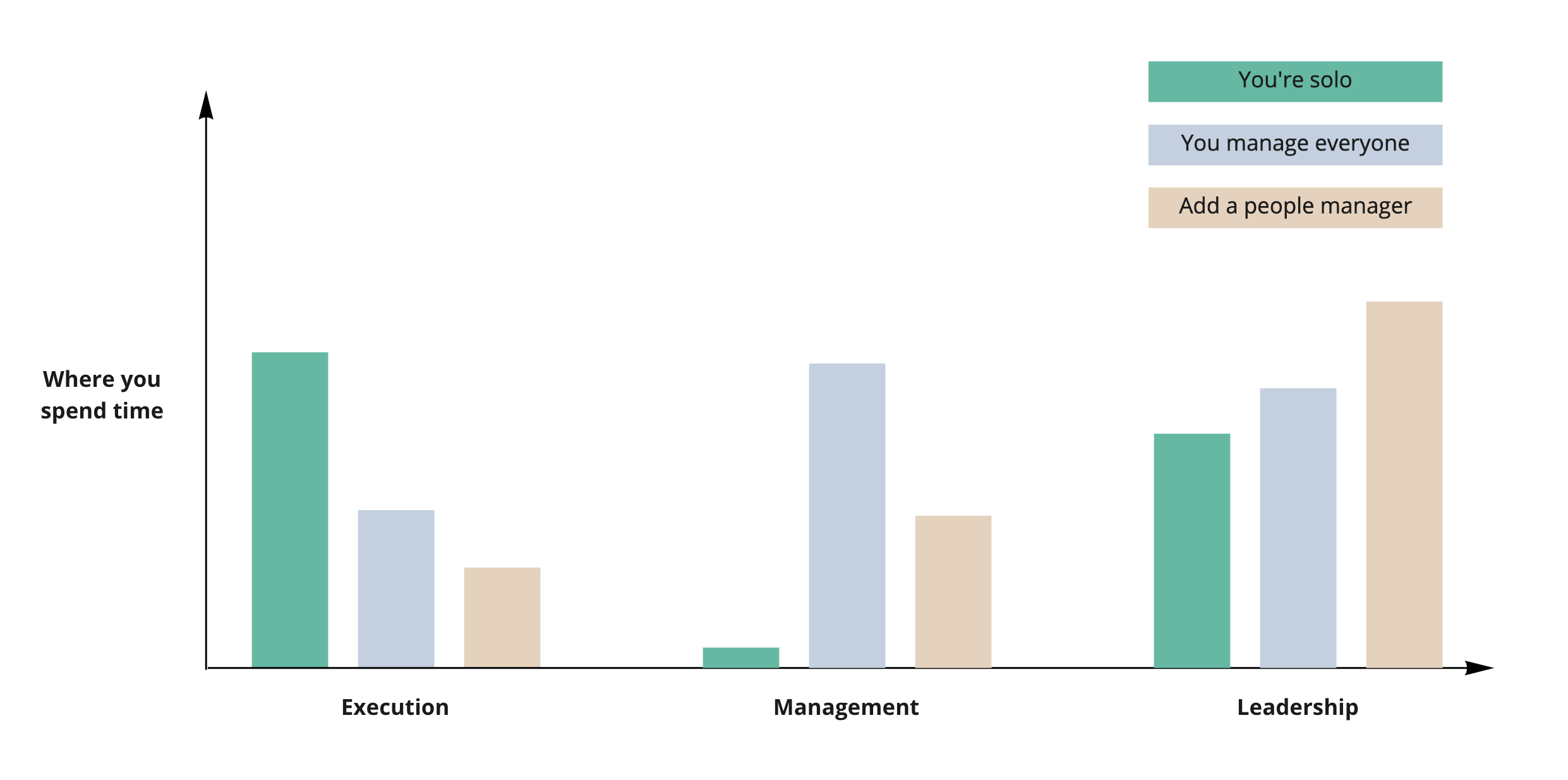
This is pretty straightforward when you’re solo (green bars). You do all the execution so it is the majority of your time. You have no direct reports so management duties are low. You’re also handling the leadership duties in the company.
The other two cases are the more interesting ones. Imagine your team consists of 3 PMs. There are two ways to set up the reporting structure.
The blue bars illustrate how you might spend your time if you manage everyone on the team. The tan bar show what happens when you add a people manager to the team.
The blue bar is how you get stuck in the “player coach” operating model for longer than you should. This becomes an increasingly daunting proposition every time the team grows. You’re spread across every category. You remain close to the execution details because you manage the people doing that work, you have a lot of people to manage, and, oh yeah, that leadership stuff too.
On the other hand, by introducing a manager in your team hierarchy early on you’re able to further distance yourself from the execution details, you lessen your own direct management responsibilities, and you’re able to spend the majority of your time on leadership tasks.
This is huge. You need to remember that as your team is growing so is the rest of the company. And as the company grows so does the value of Product leadership. If you’re not able to make it your top priority then either you have to work a ton or accept that you’re spread thin and drop some priorities.
Here is the advice I’d give myself if I found myself in this situation again:
The first hire in any of my teams should have the skills and interests to manage others. They’ll be expected to manage the next hire and do IC work.
Be transparent about this in my interview process to attract the right candidates and be able to discuss the growth potential for the role.
Accept the goofiness that comes with such a linear chain of command (1 IC, 1 Manager, 1 VP) on a small team. It’s temporary and it will feel natural as soon as the team grows further.
Another benefit – it is less disruptive to have managers in place from the jump rather than having to hire over existing team members.
And yes, this does mean the manager will also operate in a “player coach” capacity until the team is large enough for them to solely focus on managing. However, they will be only spread across two categories rather than all three so it is more viable. There is some amount of juggling and context switching that is unavoidable in the very early days.
Lastly, if you’re wondering… yes, thankfully, I have two great people managing the Product Management and Product Design functions now.
Drop a comment below. I’ll respond to all of them.
– JH ✌️
PS – all of the early User Interviews team members were and have been incredible. This is not a commentary on their performance or contributions (which are too numerous to list). It is simply a reflection on how I inadvertently spread myself too thin for a period of time.
No posts
Comments
Nothing yet. Say the first thing.
Sign in to join the conversation.