
Happy Thursday, designers!
Last week I walked out of the SCAMPER session with seven directions. Not seven polished concepts — seven directions, which is the right output for that stage. The Substitute, the Combine, the Reverse. All technically viable. And it’s tempting to dive into each of them and build.
The one I kept returning to was the Reverse: instead of helping designers get work out into the world, help them get it gracefully back — a visibility toggle that lets you archive without deleting. P03 had been afraid of her old folder since Issue 21. That direction addressed exactly that fear. I knew it was probably the right concept. I also knew I was probably biased — it was the most emotionally interesting direction to me, which is exactly the kind of reasoning you shouldn’t trust at the filter stage. Myself, I always fell anxious adding a project into my portfolio, even if I worked on it only a few months ago.
Why did I use SCAMPER framework? It’s not the most popular one, is it?
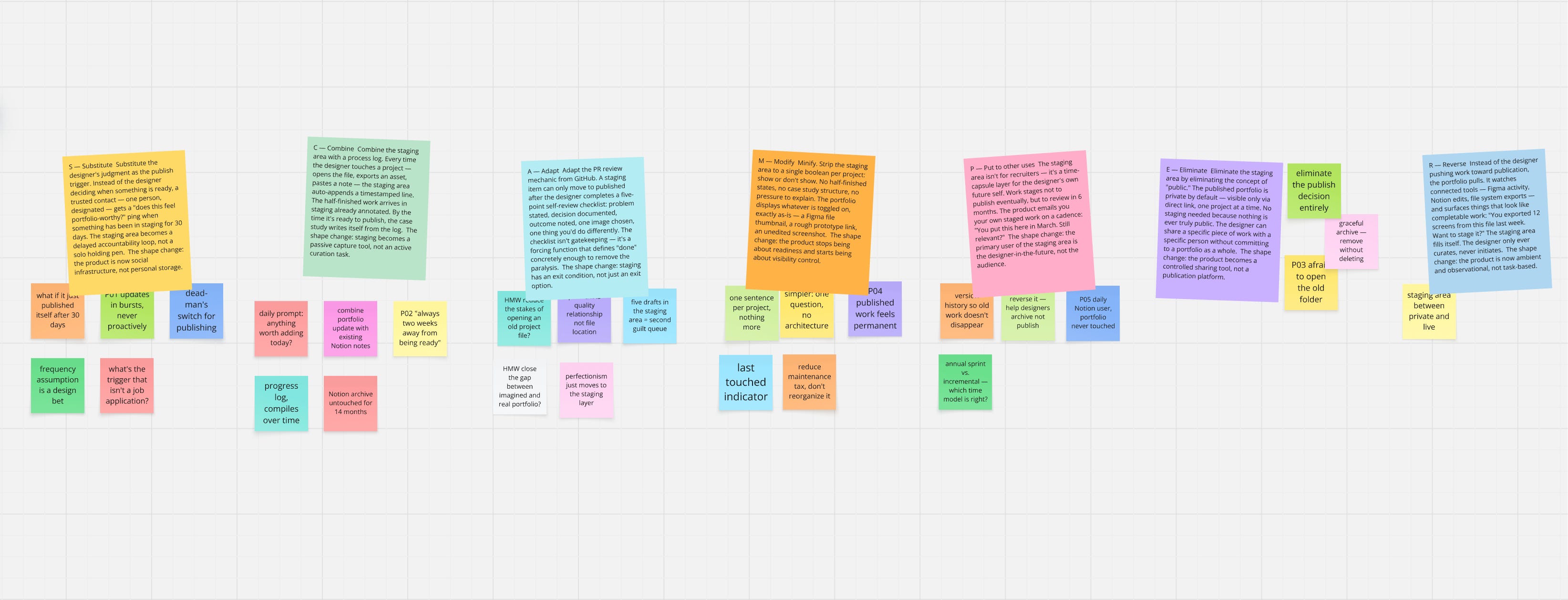
The problem with “help designers show their portfolio” is that it looks like a friction problem, so unconstrained brainstorming produces seven variations of a better publish flow. SCAMPER framework broke that frame. The Reverse direction only existed because the lens required thinking backwards — it’s too counterintuitive to reach voluntarily. The Eliminate direction only appeared because the lens forced the question: what if there’s no decision at all? Free brainstorming would have iterated on the same idea seven times and called it ideation.
The other thing SCAMPER did: it guaranteed conceptual diversity. You can only cluster directions that are actually different from each other. The filter step this issue is built on only works because the seven directions came from seven genuinely different product logics — not seven features. That’s the structural gift SCAMPER gives you. Most solo ideation produces the illusion of options. SCAMPER produces the real thing.
The gap between “I have SCAMPER output” and “I’m building in Figma” is where most solo designers lose the thread. You pick the concept that feels best — which is usually the concept you thought of first, dressed up in SCAMPER vocabulary — and you start designing. The ideas you generated with all that structured effort get left on the board. The filter step is what this issue is about.
The first mistake I made with SCAMPER output was going straight to evaluation. I’d look at seven directions and try to decide which one was best — which is impossible, because the directions aren’t commensurable. You can’t weigh a Reverse direction against a Combine direction without first understanding what each one is actually proposing at a product logic level.
The clustering step fixes that. Before you evaluate, you name the families.
What you’re doing: Asking Claude to read across all seven SCAMPER directions and group them into 2–4 thematic clusters — not by which SCAMPER lens generated them, but by the underlying product logic they share.
Tool chain: Cowork → clustering prompt → copy output into FigJam → build one sticky column per cluster.
The prompt (adjust it, based on how you are doing the exercise):
“Here are the 7 directions from a SCAMPER pass on this concept: [paste your concept in one sentence]. The 7 directions are selected on the board. [Or paste all 7 SCAMPER directions, labelled by lens]. Group them into 2–4 thematic clusters — give each cluster a name and one sentence explaining what underlying product logic the directions in that cluster share. Then flag: (1) which directions sit in more than one cluster, (2) which direction stands furthest outside all the others, and (3) which cluster addresses the user’s core fear most directly, given this context: [paste your HMW and one sentence about your primary research participant].”
What the output looked like for the portfolio study:
Claude identified three clusters.
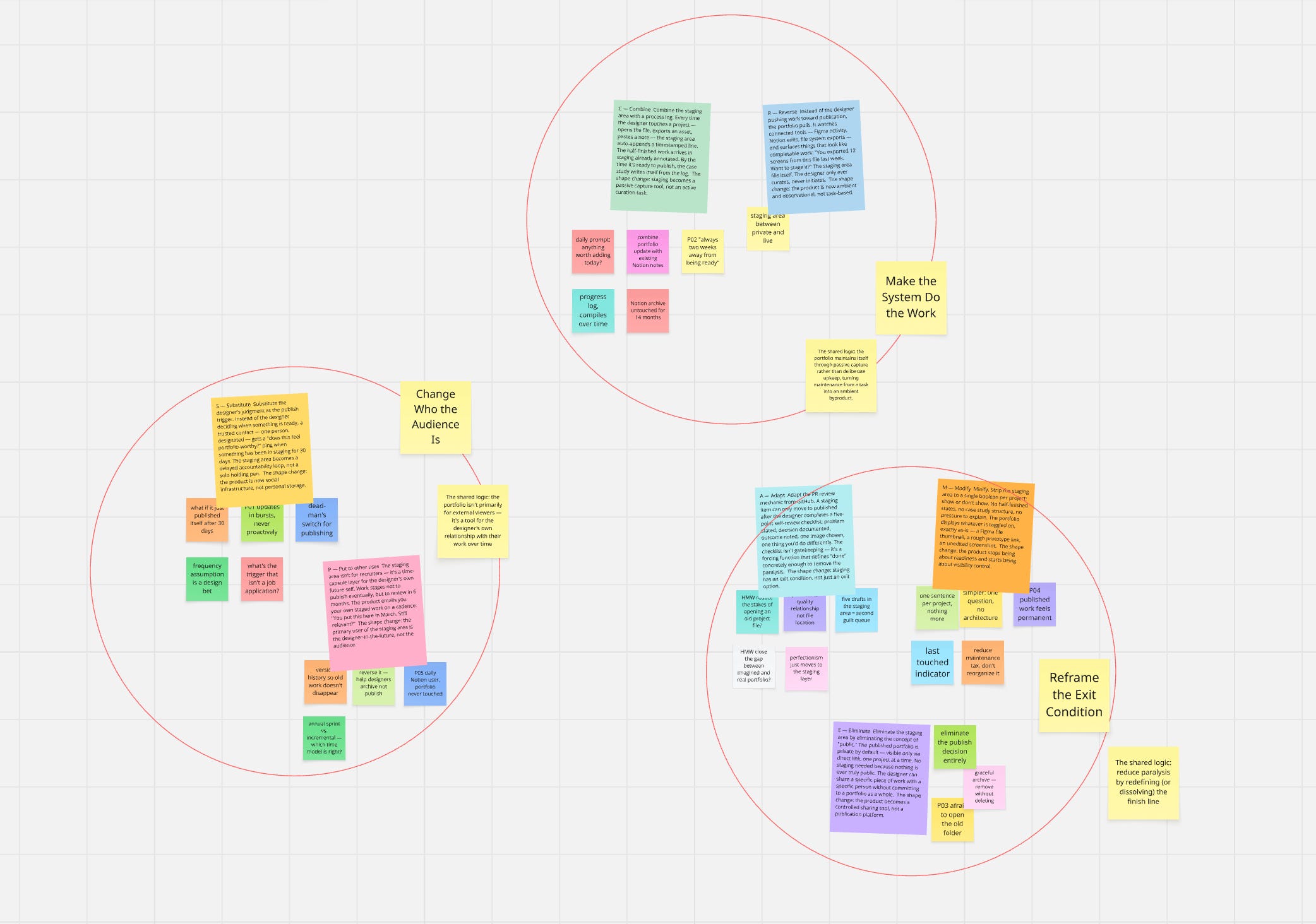
Cluster 1 — “Reframe the Exit Condition” (Adapt, Modify, Eliminate). These three directions all attack the same root problem: what does “done enough to share” actually mean? Adapt replaces vague readiness with a concrete checklist. Modify collapses readiness into a binary toggle. Eliminate dissolves the threshold entirely by making everything private-by-default. Shared logic: reduce paralysis by redefining — or destroying — the finish line.
Comments
Nothing yet. Say the first thing.
Sign in to join the conversation.