
Welcome to TBC 26 FM, the post-apocalyptic radio station broadcasting from the wasteland of late modern America. James McGrath — the Religion Prof himself — was the right guest for the apocalyptic-themed Theology Beer Camp preview, because he wrote Theology and Science Fiction, he loves some Battlestar Galactica, and he spent a full year of sabbatical thinking about nothing but the New Testament’s best apocalyptic preacher. We got the post-apocalyptic factions workshopped (James thinks the sorting needs a Hunger Games battle), then we went where the actual apocalypse lives: what John the Baptist was actually preaching in Second Temple Judaism, why apocalyptic literature always gets the end wrong and why that is a feature rather than a bug, why American Christians reading Revelation as horror instead of hope says everything about which side of the ledger we are on, what AI actually is under the hood and what it does to the way we read scripture, how James teaches a course called The Bible and Misinformation by fooling his own students on day one with AI-generated footage of himself announcing the discovery of the Ark of the Covenant, and — the part that will stay with me — what he says to the person whose evangelical faith is collapsing and who wrote me terrified. James’s answer: that thing you thought was faith was actually doubt. Come for the Andor riff. Stay for the pastoral turn.
Highlights from the conversation
The post-apocalyptic factions, workshopped live. Tripp lays out the four Theology Beer Camp factions and the spiritual orientations underneath them — the Sand Walkers (Dune, the desert mothers and fathers, treasuring and preserving the tradition’s practices), the Fleet (Battlestar, the pilgrims committed to a direction even without knowing the destination), the Remnant (Stranger Things and Fallout, the stewards of memory asking what is worth preserving and who will do it), and the Witnesses (Fury Road, the prophetic zeal that says what does it cost to tell the truth in public and I’m willing to pay it). James’s only note: you cannot sort people peacefully into apocalyptic factions. There has to be a battle. He can make more cardboard swords if needed.
Apocalyptic literature always gets the end wrong — and that is fine. James’s reframe of the genre. The eschatological charts that still name Gorbachev should be a warning that the approach needs rethinking, not the date. The real problem is not that people expect the end. It is that comfortable people who benefit enormously from empire read Revelation as horror instead of hope — and never notice they are on the side that laments the fall of Babylon, not the side that rejoices. Apocalyptic gives hope to people living lives of resistance. The moment it becomes the property of people who want to build crosses rather than bear them, church history shows exactly how fast it goes south.
What John the Baptist was actually preaching. From the year James spent thinking about nothing else. John looked at a people who had been waiting on Jeremiah’s seventy years and Daniel’s seventy weeks of years and whose deadlines had come and gone, and named the problem differently: not that God was unwilling, but that we have not had our act together, and this is one last chance. And his ethical teaching in Luke is the same insight applied downward — the tax collector who cannot dismantle the extractive system he works inside can still refuse to collect more than he is owed. John disentangled himself from injustice as fully as a human can, and then realized that staying disentangled makes no difference. Engaging society means getting your hands dirty. In the meantime, in the sphere you actually control: do what is right. Do not use the system as your excuse.
What AI actually is, in a nutshell. James on the technology, from someone who has been writing about it since before ChatGPT. They took the system that learned to play chess by deducing the rules from a very large dataset, and fed it text. It learned to play the game of human language. Which is why it seems to think. There is no mechanism whatsoever safeguarding factual content — factuality is woven into speech patterns often enough to create the impression, until you push it to the edges. His actual worry is not Terminator. It is that people are already trusting it for medical answers and spiritual guidance, and that because it is trained on what is most frequent online, its theological output drags you backward toward the oldest and most patriarchal readings rather than forward. On the flip side: undermind.ai finding scholarship in Indonesian that James can now actually engage is a genuine expansion of who counts as a conversation partner in the body of Christ.
The Bible and Misinformation. James’s newly retitled course. Day one he shows students a mix of clips — real NBC footage about Noah’s Ark in Turkey, actual excerpts from the Gospel of Philip that sound fake and are not, and AI-generated news footage of James himself announcing the discovery of the Ark of the Covenant — and asks them to sort real from fabricated. The debrief: I didn’t do as well as I thought I would. James: that is a win for day one. Students then fact-check chatbot output on questions like did God have a wife? and discover the citations are real pages, topically relevant, and do not support the claims attached to them. One student, unprompted: by the time I fact-check all this, I could have just written it myself. His line on why the Bible is the right training ground: there was weird stuff online about the Bible before there was weird stuff online about anything else. We had a head start.
“That thing you thought was faith was actually doubt.” The pastoral turn, and the heart of Beyond Deconstruction. Tripp reads an email from someone whose evangelical world is collapsing and who is terrified. James’s answer uses the house-renovation analogy from the book: sometimes rot can be repaired if you catch it early, and sometimes the structure has to come down. But the diagnostic is the sharp part — if you have spent years closing yourself off from every argument and perspective that might bring the house down, you already knew on some level that it could not withstand scrutiny. That is not faith. That is doubt with better branding. Faith is the courage to believe God is big enough that your questions will not bring God down with the structure. Evangelicals know the biblical language about testing the spirits better than anyone — they just never turn the spotlight inward. And the kindergarten-level version of the faith is fine as a starting point. The problem is being told to stay there forever, in a tradition whose own scriptures are full of language about maturity and putting away childish things.
About our guest
Dr. James F. McGrath is the Clarence L. Goodwin Chair in New Testament Language and Literature at Butler University in Indianapolis, where he also chairs the Department of Philosophy and Religious Studies. He trained at the University of Cambridge, the University of London (BD), and Durham University (PhD, under James D. G. Dunn). He blogs as Religion Prof on Patheos and was Patheos’s featured writer in June 2026.
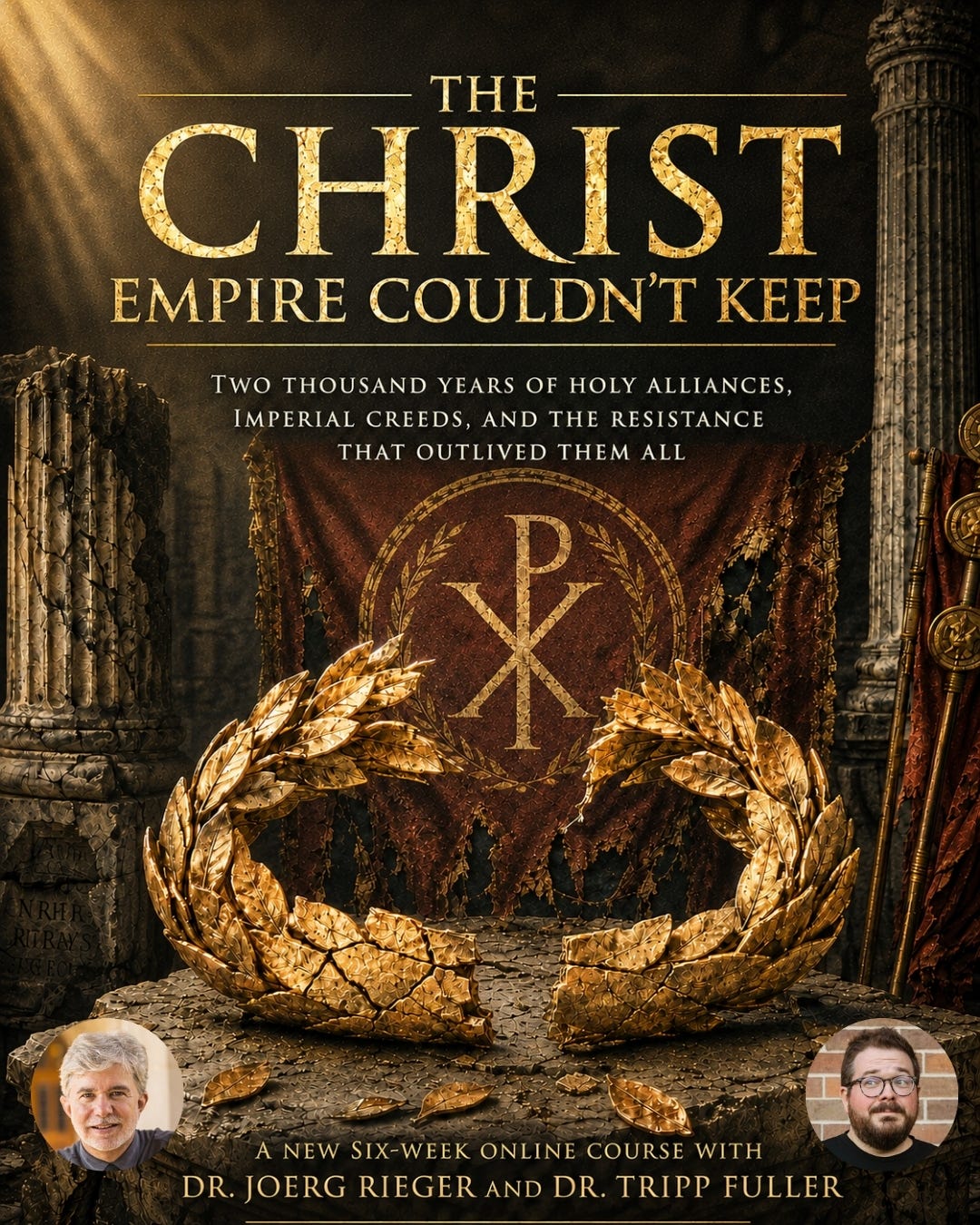
Ever notice how Christian nationalism gets talked about like it’s some bizarre new glitch in the faith? It isn’t — it’s a 2,000-year-old arrangement wearing new clothes, and once you see how the pattern works, you can also spot the Christ who keeps slipping free of it. Join theologian Joerg Rieger and Tripp Fuller for The Christ Empire Couldn’t Keep, a free six-week online class tracing the holy alliances, imperial creeds, and stubborn resistance that have shaped Christianity from Paul to the present. You’ll get six lectures from Joerg, six live Q&As, weekly readings from his book Christ and Empire, and a community of fellow troublemakers thinking it through together.
It’s free to join, every session is recorded, and it kicks off Thursday, August 27. Grab your spot at HomebrewedClasses.com.
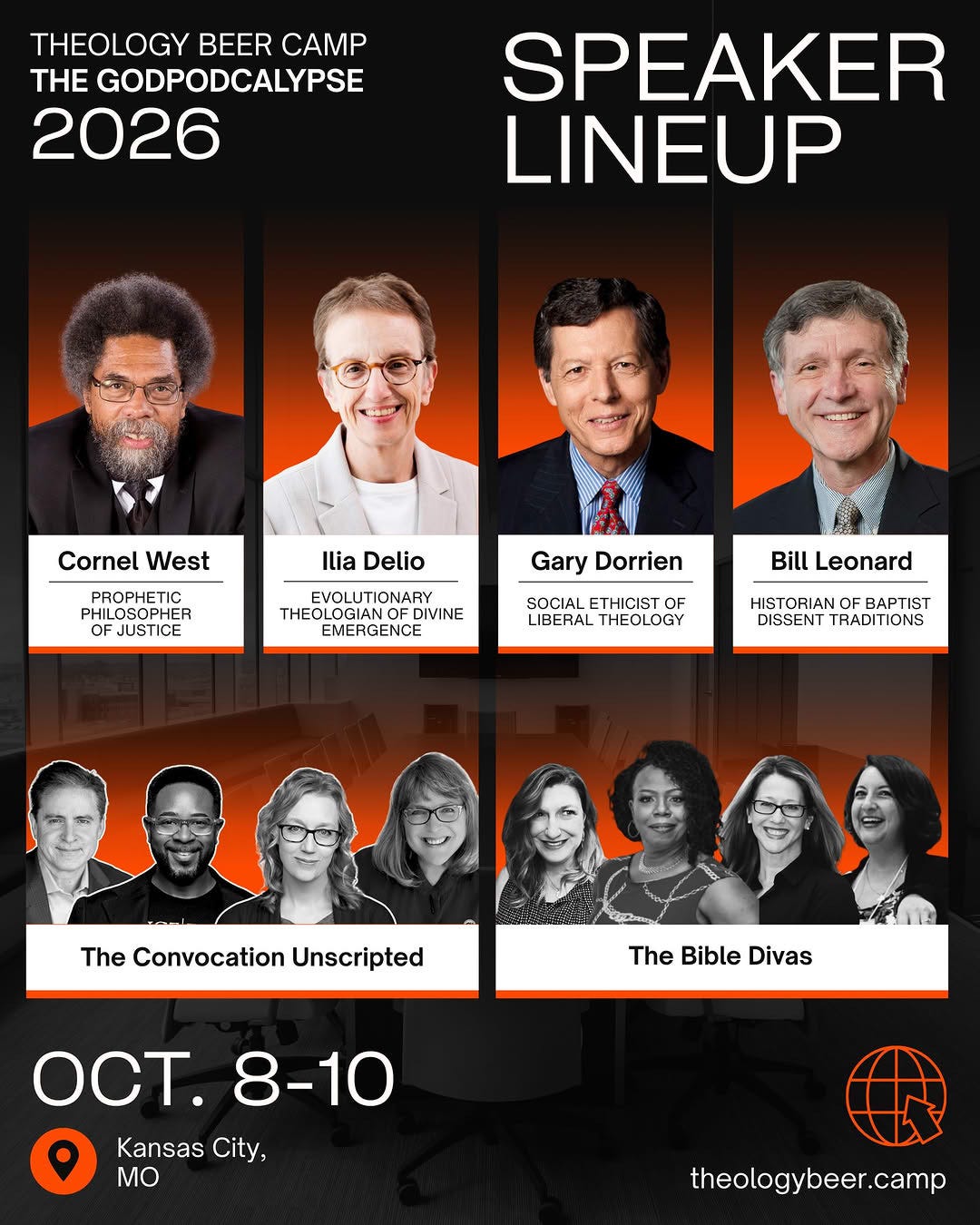
THEOLOGY BEER CAMP
October 8-10, 2026 - Kansas City, MO
Theology Beer Camp is a unique three-day conference that brings together of theology nerds and craft beer for a blend of intellectual engagement, community building, and fun. Organized by Homebrewed Christianity, this event features a lineup of well-known podcasters, scholars, and theology enthusiasts who come together to “nerd out” on theological topics while enjoying loads of fun activities.
We’re excited to share details about our Pre-Event experience. Think of it like a theological pre-game.
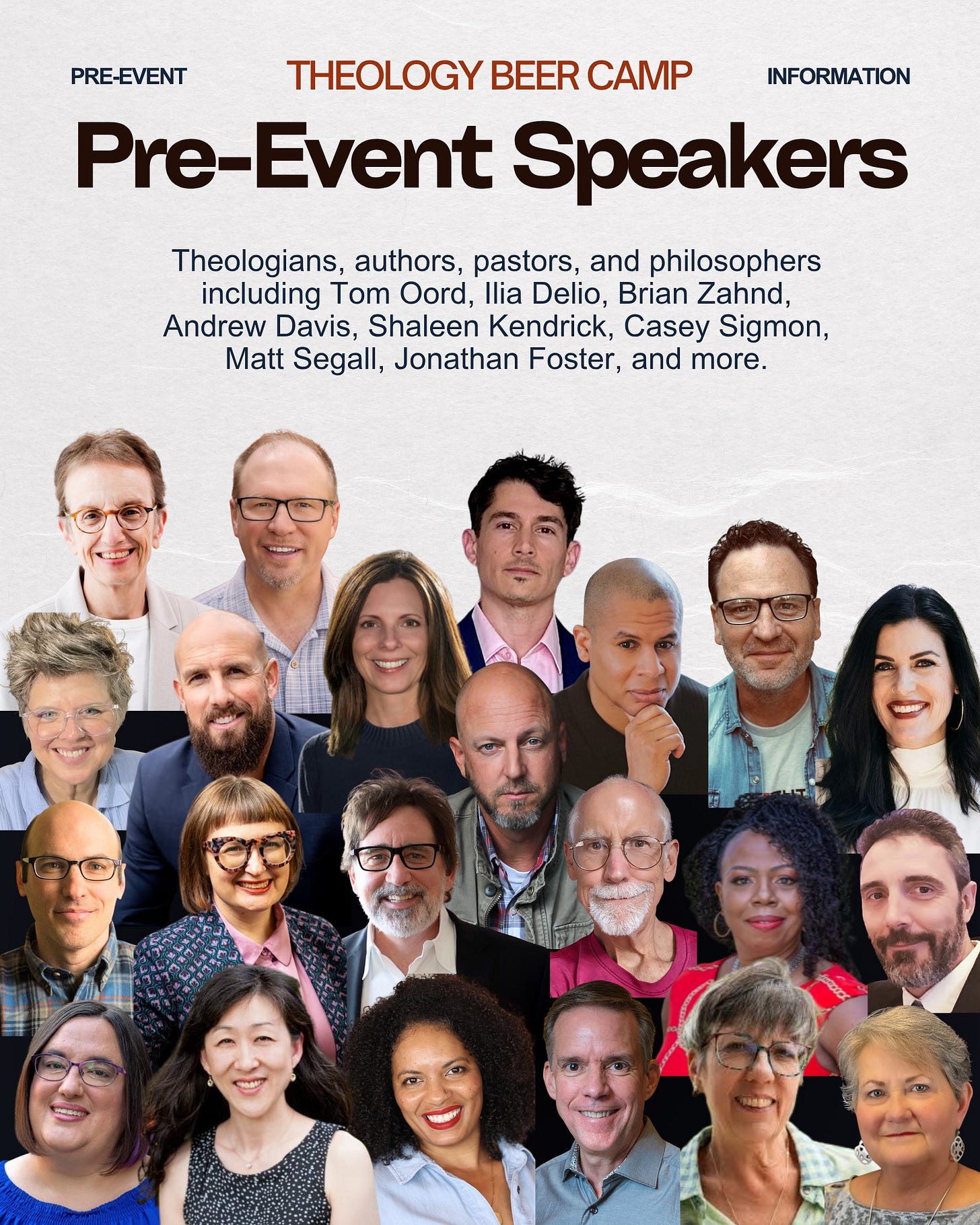
Led by Thomas Jay Oord and Jonathan Foster, we’re bringing you a fantastic lineup of scholars, authors, pastors, and practitioners. This workshop-style gathering is a focused deep dive into Open and Relational Theology before the main event begins.
Think of it as:
A relational head start on Beer Camp
A chance to explore ideas in greater depth
An opportunity to meet people and start building connections before the larger gathering begins
Topics include:
God and an evolving universe
Open and relational approaches to ministry
Theology centered on love and relationship
Process thought and contemporary spirituality
Faith, creativity, freedom, and the future
The Pre-Event takes place on October 8 from 9am–4pm and is available as an add-on registration.
Available for iOS and Android
Comments
Nothing yet. Say the first thing.
Sign in to join the conversation.