
This conversation keeps going for about another hour, and the second half is the part where we stop behaving. Dan’s theory of punk’s irreducible amateurism as a kind of human dignity. The psychology of music project he’s building — endorphins, synchronicity, mosh pits at fifteen, and what it has to do with what mainline worship gave up. Byung-Chul Han’s hell of the same, and Dan cutting my doom with whole milk. Robert Eggers. The Refused frontman walking backstage before “New Noise” to tell my thirteen-year-old do you want to know why I do this? And my ongoing public campaign to get Five Iron Frenzy to play Theology Beer Camp.
Click the button below to become a paid member of the Process This Substack to get the full extended conversation, plus every episode ad-free, bonus content, and the classes. It’s how the podcast keeps running, and it’s where the good stuff lives.
Dan Koch just finished a seven-and-a-half-year process and came out the other side a fully licensed clinical psychologist. So I did what any friend would do — took over his podcast, gave him a week off from prepping, and made him answer every question I have been saving. He did zero prep on purpose. What we got is the conversation you have with someone you have known long enough to skip the throat-clearing: what existential therapy actually gave him clinically, why he moved from the big abstract questions toward attention and embodiment, why he thinks Byung-Chul Han is right but needs to be cut with whole milk, and then two hours on music, which is where both of us actually live. Dan was in an emo band for ten years and a commercial composer for ten more before any of the psychology happened, and he is currently building something on the psychology of music. Somewhere in there we get to the mosh pit as endorphin technology, the irreducible amateurism of punk as a kind of human dignity, why the Refused frontman walked backstage before “New Noise” to tell my thirteen-year-old do you want to know why I do this, and my ongoing public campaign to get Five Iron Frenzy to play Theology Beer Camp. This is the full Substack version. Bring your record collection.
Highlights from the conversation
Becoming a cognitive-existential therapist. Dan’s honest account of how the shift happened: he had a window before licensure study, wanted something that would serve both the podcast and his clinical gaps, and went deep into the existential tradition — Yalom, and then Emmy van Deurzen’s clinical workbook. What surprised him was the hit rate. Nine times out of ten, when he brought an existential concept to a client, they wanted to go there. His account of what keeps him in it: existentialism is hyper-focused on human experience at the individual level, and it shares with cognitive therapy a commitment to dealing with reality as we actually find it and to ridding us of self-deception. His words for that: a cold drink of water.
Permission structures, at the tap room and in the room. Why You Have Permission got its name, and why the question of who gets to go deep with whom keeps coming back. Tripp’s story about the church dad who wanted to meet at the tap room, went straight to the real thing, and then admitted he would not have that conversation with any of his actual friends — but would have it with clergy. Dan’s version out in the world: he now tells people up front that he is an existential psychologist and this could get weird, offers outs at two or three volleys, and works with the feedback he has gotten over the years that he can be a lot and can miss the true interest level of the person across from him.
From ultimate things to attention and the body. The trajectory Dan names in his own thinking: bigger, more abstract questions toward the specific, concrete, and embodied. He has ADHD; at least one of his sons likely does too. The lens he is working with now is attention and bandwidth — what he actually has energy for, how to not spin his wheels, how parenting complicates it. And the honest theological discomfort in the move, coming from a background where the body was quietly downgraded: it can feel like trading the ultimate things of God for the penultimate things of the body. Tripp’s parallel from Whitehead: the whole metaphysics comes out of taking seriously how a moment happens — how the past floods in and how your orientation toward it changes what is consciously available for the future. A philosophy of organic attention.
Han is right, but he needs to be cut with whole milk. Tripp lays out Han’s hell of the same: the self is formed in encounter with the negativity of the other — friction, mystery, distance, the uncontrollable — and we have engineered that away. Algorithmic mediation, self-sorting, purity gatekeeping, over-affirmation in formation, the atrophy of time from scent time into frantic point-time, big data replacing living memory. Dan’s pushback is the spine of the hour: he probably agrees with the critique but wants to suck the catastrophizing out of it. Humans are extraordinarily adaptable, and existentialism is useful precisely because it shows how arbitrary any given time and place turns out to be. Anytime he hears the death of X, he hears the death of this particular way we have done X — and notes that if you asked someone 3,000 years ago what they feared would be lost forever, most of their list we would call good riddance. His sharpest line: you cannot eliminate friction, you can only displace it, and a lot of the frictionless moves people are making right now are generating enormous friction on a longer timescale.
The dark magic of rock and roll. The music half, which is really about formation. Dan on punk’s irreducible kernel of amateurism — that it is not really punk if the band already knows how to play, that this is what opens it psychologically to a much bigger pool of people, and that he would almost connect it to the dignity of all persons. His developing project on the psychology of music: endorphins plus synchronicity, mosh pits at fifteen, the same evolutionary machinery Tripp has been teaching in the religion-before-belief material. And the scarcity point — that his generation’s experience of music happened under conditions of scarcity that are phenomenologically distinct from his six-year-old’s, which is neither simply better nor simply worse. Plus Tripp’s story from Glasgow: Elgin at thirteen, backstage behind the drum kit, and Dennis Lyxzén walking over before “New Noise” to say do you want to know why I do this? Watch this.
The fun stuff, on the record. Dan would replace the drummer of Against Me! on the White Crosses tour, with Lars Ulrich at Metallica’s 1991 Moscow show as runner-up. His closer walkout song is Rage Against the Machine — “Testify” or “Sleeping Now in the Fire,” both from The Battle of Los Angeles. The living filmmaker he could talk to for ninety minutes with no prep is Robert Eggers, no hesitation, for the cultural anthropology and linguistics under every film. And the pitch to Five Iron Frenzy for Beer Camp, which Dan supplied on the spot: the conversations before and after the show will be the most interesting listener interactions you have had in thirty years as a band.
Dr. Dan Koch is a newly licensed clinical psychologist based in Bellingham, Washington, specializing in religious change and deconstruction, working from a cognitive-existential orientation. Before psychology, he spent a decade in an emo band and a decade as a commercial composer. He hosts Religion on the Mind (formerly You Have Permission), the podcast on psychology and religion, and Pretty Good Vibrations, his music podcast. Support and bonus content at patreon.com/dankoch. He is currently developing a pilot on the psychology of music and music therapy, and has an in-process telehealth licensure covering 42 states.
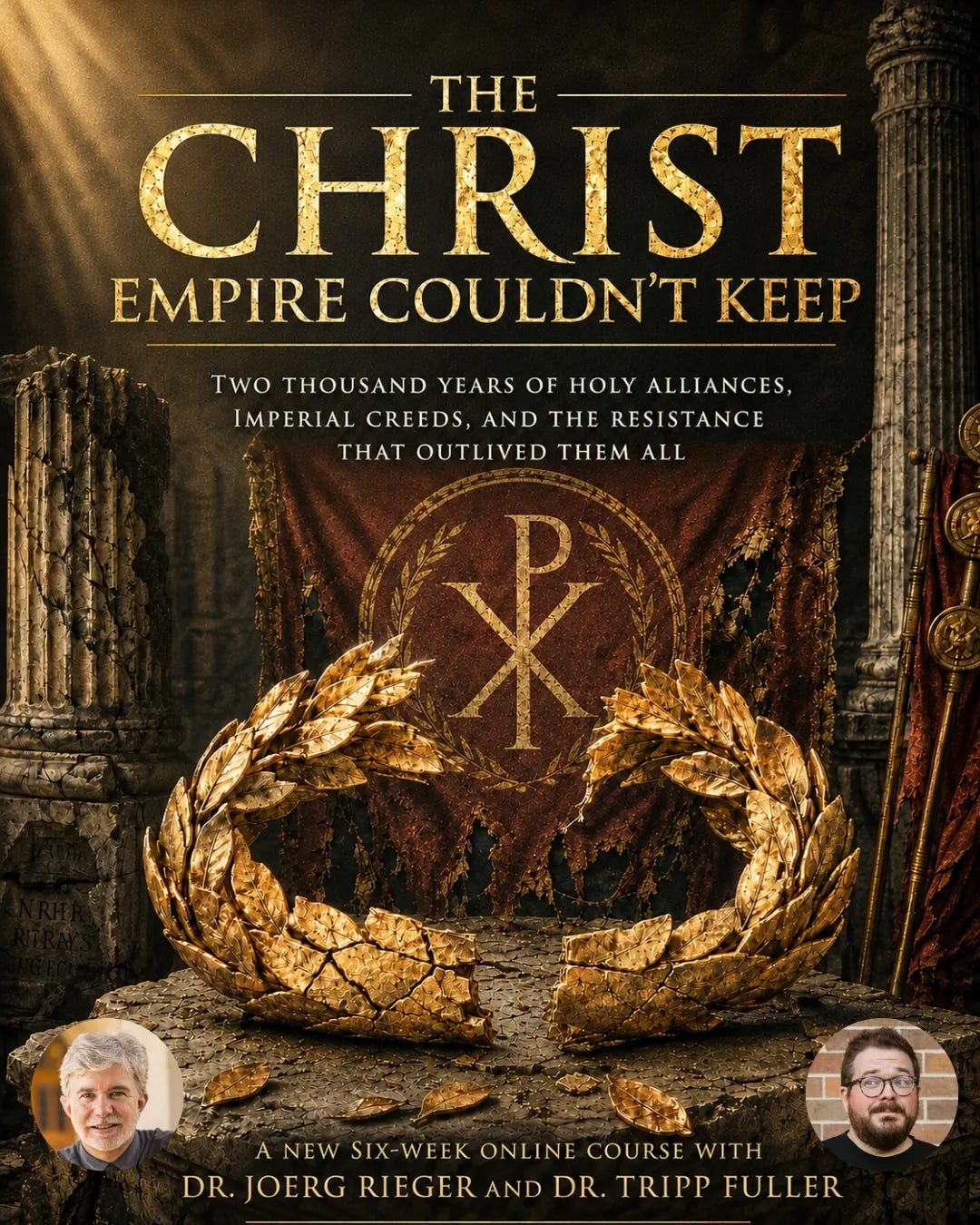
Ever notice how Christian nationalism gets talked about like it’s some bizarre new glitch in the faith? It isn’t — it’s a 2,000-year-old arrangement wearing new clothes, and once you see how the pattern works, you can also spot the Christ who keeps slipping free of it. Join theologian Joerg Rieger and Tripp Fuller for The Christ Empire Couldn’t Keep, a free six-week online class tracing the holy alliances, imperial creeds, and stubborn resistance that have shaped Christianity from Paul to the present. You’ll get six lectures from Joerg, six live Q&As, weekly readings from his book Christ and Empire, and a community of fellow troublemakers thinking it through together.
It’s free to join, every session is recorded, and it kicks off Thursday, August 27. Grab your spot at HomebrewedClasses.com.

Theology Beer Camp is less than 2 months away and if you’re not coming to Kansas City, I get it. Flights are expensive, the world is ending, your dog has opinions about being boarded.
And get this – the online experience has been upgraded!
We built a whole live podcast stage this year, which means you now get TWO live feeds to bounce between all weekend. Hop between the Main Stage with all our keynoters and the live God-pod stage, which surprisingly offers nonstop podcast excitement. Watch one, watch the other, get FOMO about both simultaneously. It’s a very spiritual experience.
Oh, and it’s all recorded and available for replay, along with the recordings from the three stages.
30 scholars. 30 God-pods. October 8-10. (One month before the election, which we did not plan and are choosing to interpret as prophecy.)
What you’ll need to supply yourself: the beer, the snacks, and a plausible reason for why you’re crying (or shouting) at a podcast recording on a Saturday morning. Everything else is handled.
Sorry we cannot livestream you a hug from a stranger in a Battlestar Galactica shirt, but we’ll see you on the frequency,
Tripp
P.S. The in-person ticket may get you Kansas City, but the online ticket gets you the same great content and your sweatpants. We’ll let you do the math.

Available for iOS and Android
Comments
Nothing yet. Say the first thing.
Sign in to join the conversation.