
These are the fundamental economic principles on which every business operates. It has just one equation and one graph.
In a society that recognizes ownership, deters theft, and maintains a free market, people only agree to trade if both parties benefit. For example, a hungry person with a lot of clothing might trade some for food from somebody who has a lot of food but worn out clothing. Both parties receive something they value more than what they gave. Both are better off by trading.
Economists quantify this mutual benefit as Surplus.
By increasing satisfaction and decreasing want, both participants are wealthier (See my other essay on What Wealth Is). Consequently, voluntary trade increases the total wealth in the world.
Each participant must have some surplus to agree to trade. However, the surplus is not necessarily shared equally by both participants. One might gain more than the other. How much depends on the position and effectiveness of negotiating.
Money is a token used to facilitate trade. Selling is the exchange of a good or service for money. Buying is the exchange of money for a good or service. Money allows for complex webs of trade, such as a clothes maker selling to a tool maker, who sells to a farmer, who then buys from the clothes maker.
Working a job is the selling of labor.
The concepts of supply and demand are only meaningful in the context of Price. The relationship is expressed directionally by this equation:
Price = Demand / SupplyIn a free market, high demand increases price. This is why Super Bowl tickets are more expensive than local youth sports tickets. High supply decreases price. This is why bottled water is less expensive than luxury handbags.
A wage is the price of labor. Rent is the price of occupying property.
If one of these three variables changes, the others adjust in response. The scale of this adjustment depends on the Elasticity of the supply and demand.
Elastic Demand: Demand for concert tickets is elastic because they are a luxury. If the price increases or supply decreases, demand drops significantly.
Inelastic Demand: Demand for insulin is inelastic because it is a life-saving necessity. If supply decreases, the price increases sharply because consumers cannot stop buying it.
Elastic Supply: The supply of bottled water is elastic because production can increase quickly. If price or demand increases, suppliers can easily provide more.
Inelastic Supply: The supply of beachfront property is inelastic because the amount of land is fixed. If demand increases, the price increases because more land cannot be created.
Here’s the graph. It’s simpler than it looks.
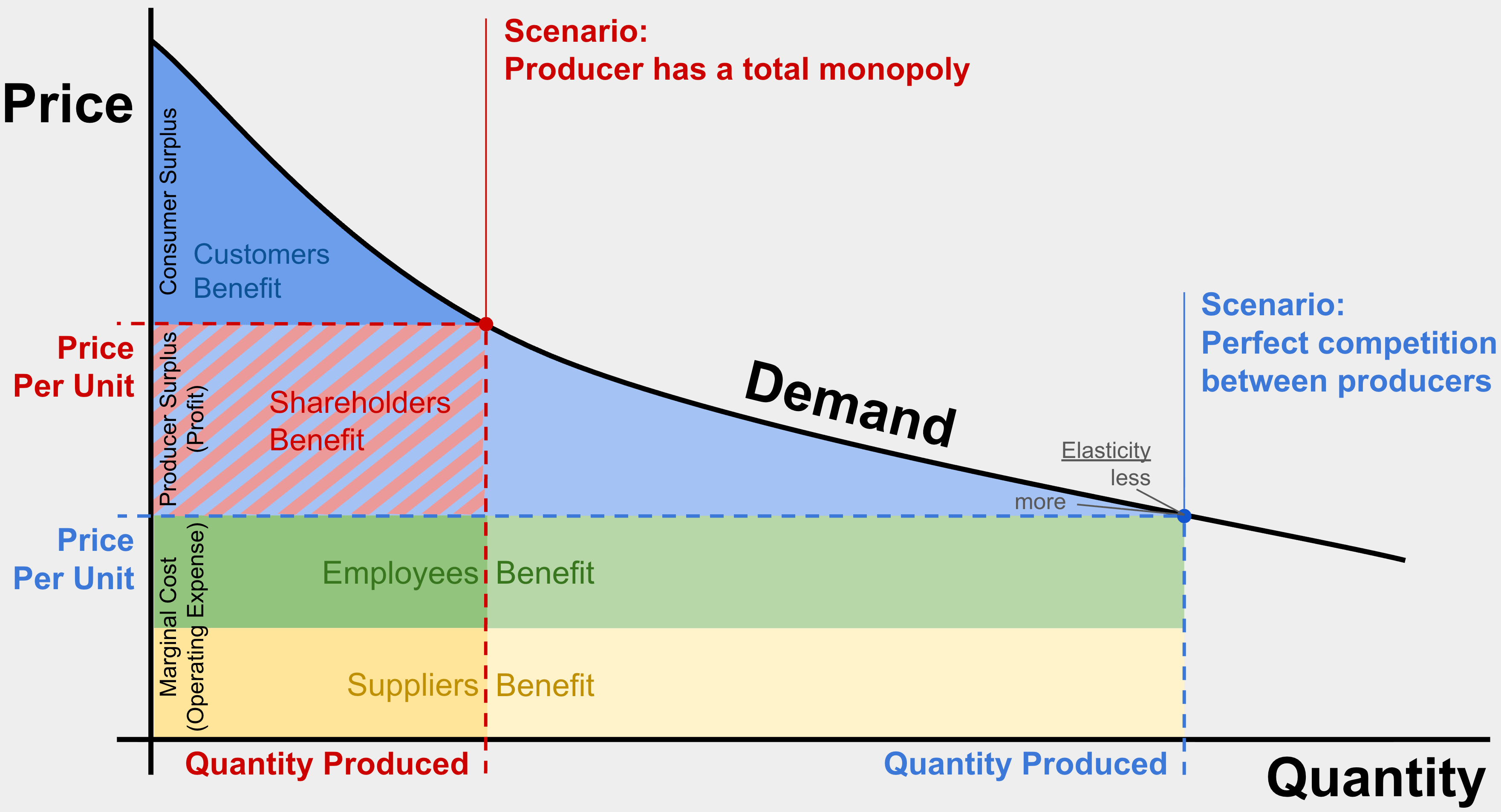
The thick black lines show what economists call a Demand Curve. It represents the relationship between a price for a product or service and the quantity of units traded (sold/bought). Unintuitively, quantity varies along the horizontal (x) axis and price varied along the vertical (y) axis. That’s how Alfred Marshall’s 1890 textbook drew it, and it stuck.
The chart can also be conceptualized as a histogram across all potential customers in the order of their level of desire for the product or service.
The demand curve shows how many units buyers will buy at a given price. When the price is high, the quantity traded is low; when the price is low, the quantity traded is high. That’s why when a store has a sale, more people come in to shop.
When trade occurs at a specific price and a corresponding quantity of units, the Revenue (represented by the area of the dashed rectangles) is distributed as follows:
Suppliers Benefit: This portion covers the cost of materials and external services.
Employees Benefit: This portion represents wages paid for labor. Together, suppliers and employee benefits comprise the Marginal Cost per unit and Operating Expense for the total number of units sold. In economics, the word Margin means per-unit
Shareholders Benefit: Also known as Producer Surplus per unit or Profit across all units sold, this is the remaining value that goes to shareholders.
Customers Benefit: This is the Consumer Surplus, representing the value consumers receive above the price they paid.
The purpose of most companies is to make a profit.
Total profit = Profit per unit * Number of units soldConsider 4 prices.
Very low - The company cannot cover operating expenses and goes out of business.
Very high - The company sells very few units.
Low - The company sells a lot of units but makes very little profit from each one.
Optimal - The price causes a number of units to be sold where the profit per unit times the number of units sold is maximized.
For any particular product or service, different customers have different levels of desire for it. Some would be willing to pay more than the company’s price, but they don’t have to. The amount a consumer would have been willing to pay above the actual price is the consumer surplus, which benefits the customers.
The diagram shows two extreme market scenarios: Perfect Competition and Total Monopoly.
Perfect Competition: When companies compete, they have to lower their prices. Under perfect competition, customers will buy from whichever company offers the lowest price. All companies will sell at a price that equals their marginal cost. There will be no economic profit. That means no surplus will go to the stockholders. There is no Shareholders Benefit (Profit). All of the surplus above operating expenses goes to the Customers Benefit. All competing companies will produce as much as anybody will buy at a price equal to the cost of production.
Total Monopoly: When a company has a total monopoly, it can set any price it wants. A smart company will set a price to maximize its total profit. That maximizes the Shareholders Benefit. This results in a higher price and a lower Quantity Produced compared to a competitive market. While this maximizes profit, it provides less total benefit to employees, suppliers, and customers.
When a pharmaceutical company has a patent, it has a government-granted monopoly. The company can charge a price that maximizes its profit. When the patent expires, generic competitors enter, prices drop, and the medicine becomes available to more patient-consumers.
Investment is required to start and grow a company. This capital is often raised by selling stock to investors. A company’s valuation sets the price investors are willing to pay for stock. It is based on the expectation of future profit. The ability to earn monopoly profits provides the incentive necessary for founders and investors to take risks and create jobs.
Monopoly is not binary. Every company has a monopoly to some extent and competition to some extent. As Peter Thiel describes in Zero to One, the more narrowly you define a market, the more a company looks like a monopoly.
For example, SiriusXM has a total monopoly over the narrowly-defined market for “satellite radio”. The company could charge a high price to consumers with a strong desire for satellite radio. But SiriusXM has strong competition in the broadly-defined market of audio content providers. Most consumers looking for audio content could get essentially the same content over the terrestrial internet at a competitive price from Spotify, YouTube, Apple, Amazon, and others.
Various things can help a company grow its monopoly position. Most fall into these categories.
Intellectual property, proprietary data, or trade secret know-how
Regulatory barriers to competition such as standards and licensing requirements
Control of critical inputs, infrastructure, or distribution channels
Mergers with competitors or exclusive agreements with other key partners
Vertical integration or bundling of related products and services
Being the first mover in the market while also having either a network effect or a high switching cost (“stickiness”).
Strengthening a monopoly allows a company to change its price point up and to the left on the demand curve, thereby maximizing the red profit rectangle.
Another way to increase the profit rectangle is to increase demand. This pushes the demand curve itself up and to the right, allowing for higher pricing and profit.
Various things can help a company increase demand. Most fall into these categories.
Innovate to improve the product or service
Open new distribution channels, locations, or product placement
Brand marketing and advertising
Have network effects
Most people want some kind of government that requires money to run. Governments get money by taxing. Taxing takes a portion of the economic surplus of trade. Because taxes reduce the surplus, some trades that would have been worthwhile will not occur. Thus, taxes reduce the total amount of trade and its benefits.
There are various kinds of taxes. Four can be imagined in the diagram.
Sales Tax: A portion of the marginal cost and producer surplus.
Value Added Tax (VAT): A portion of the producer surplus and employees benefit.
Corporate Tax: A portion of the producer surplus (profit).
Income Tax: A portion of the employees benefit (wages).
These basic principles of economics are helpful to understand in many contexts.
Starting and running a company
Investing in companies
Comparing economic systems such as capitalism and socialism
Determining desirable rates of different kinds of taxes
Considering government interventions in pricing and profits such as minimum wages, rent control, antitrust regulations, and drug pricing controls
We would do well, individually and collectively, by minding these fundamental principles of economics.
No posts
Comments
Nothing yet. Say the first thing.
Sign in to join the conversation.