
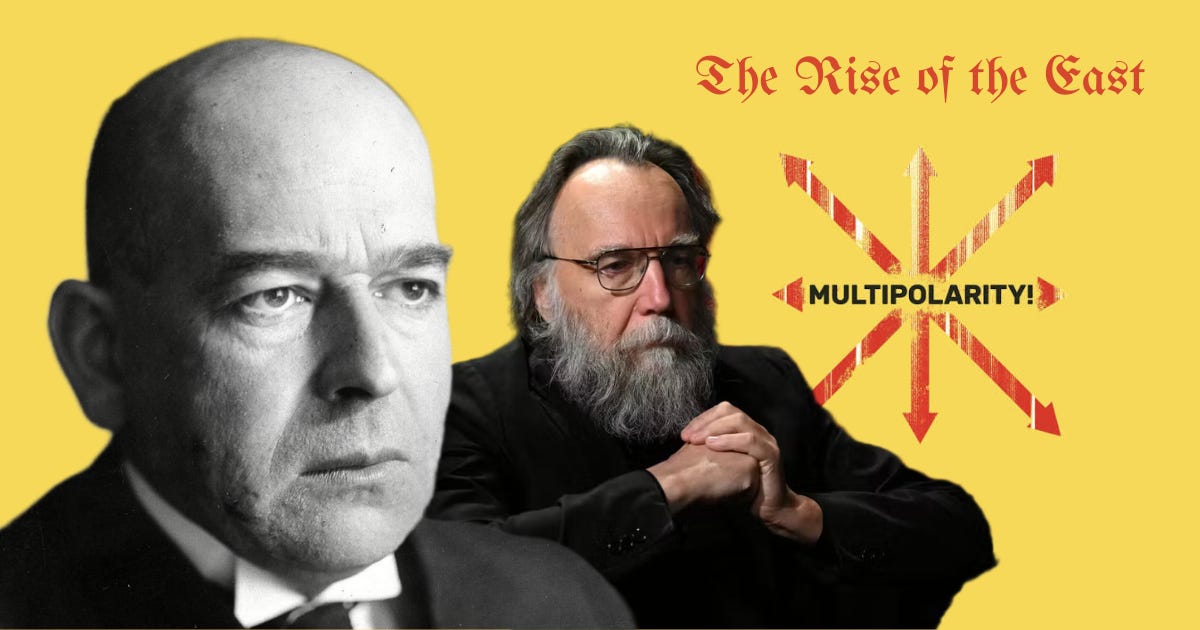
This is probably the worst time I could have written this article as it seems that most of the Dugin hype, then hate and controversy has died down. However, I actually wanted to read and understand the book/man (I have only read Theory of a Multipolar World1, and this is what I will rely on for this article.) whom I will be discussing.
Regardless, Dugin is a highly interesting political philosopher to the world and for good reason. His primary strength is that his philosophy finds its foundations in a wide as well as deep selection of sources. Yet, a fundamental concept which informs his worldview most strongly: the multipolar world and civilization as political actor is explicitly borrowed from Samuel Huntington2 who took his framework from Oswald Spengler!
"Russianism is the promise of a future culture as the evening glows faint in the West." Decline of the West (p 192. Volume II) - Oswald Spengler
I think that if you only vaguely know about one of these authors then this may come as a surprise. It certainly did to me when this connection was explicitly mentioned as Dugin describes the genealogy of his ideas in this book. Fundamentally this heritage of ideas makes Dugin a unique political philosopher. It also makes him one of the most clairvoyant and free of illusions within academic political philosophy —especially at his foundations.
Where Dugin takes a misstep, in my opinion, is in his conclusions and applications of his theory: the taking of Eurasia as a civilizational entity and understanding its coming into being as just, inevitable or even possible.
Perhaps he has revised his ideas since the publication of this book. I’m not here to be a Dugin scholar, but more so to point out that his ideas do deserve more credit —especially at the framework level because he has essentially synthesized some of the best political philosophers for a contemporary theory that could be highly useful to anyone seeking to understand geopolitics in a realistic way (and not an idealistic or fantastical one.)
A civilization is a collective community [obshchnost’], united by belonging to the same spiritual, historical, cultural, mental, and symbolic traditions (most often religious in its roots, though not necessarily realized in terms of a concrete religion), the members of which sense intimacy toward one another, regardless of national, class, political, or ideological belonging.
p 24 TMW - Alexander Dugin
Another political philosopher, highly influenced by Spengler, Francis Parker Yockey described the civilization in a very similar way.3
The key premise of TMW is that the main geopolitical actor is the civilization. Where the civilization is defined as an “ethno-cultural” entity —one could also say a “bio-spiritual” entity.
Since Plato’s Politics, the political unit has been considered an organic entity.4 This idea is intuitively quite sensible: a political unit is nothing but an organization of power among men (organic beings) therefore, naturally as cells organize into a body, men organize into a political unit.
But where do we draw the lines between one body and the next, how do we know which political body an individual belongs to? The complexity of this issue led to a denial of the more fundamental reality of politics as organic rather than synthetic. The Westphalian and modern Constructivist politics give primacy to law and arbitrary notions of nation/countryhood.
While having the advantage of being a more clear theory regarding who exists and who does not within the political arena, it makes serious errors when analyzing underlying realities. For example, the synthetic idea of the nation would view Germany and Belgium to be equally legitimate and real states —or equally fake depending on one’s perspective. The key difference however is that there is such a thing as a German person when speaking anthropologically where there is no Belgian person.
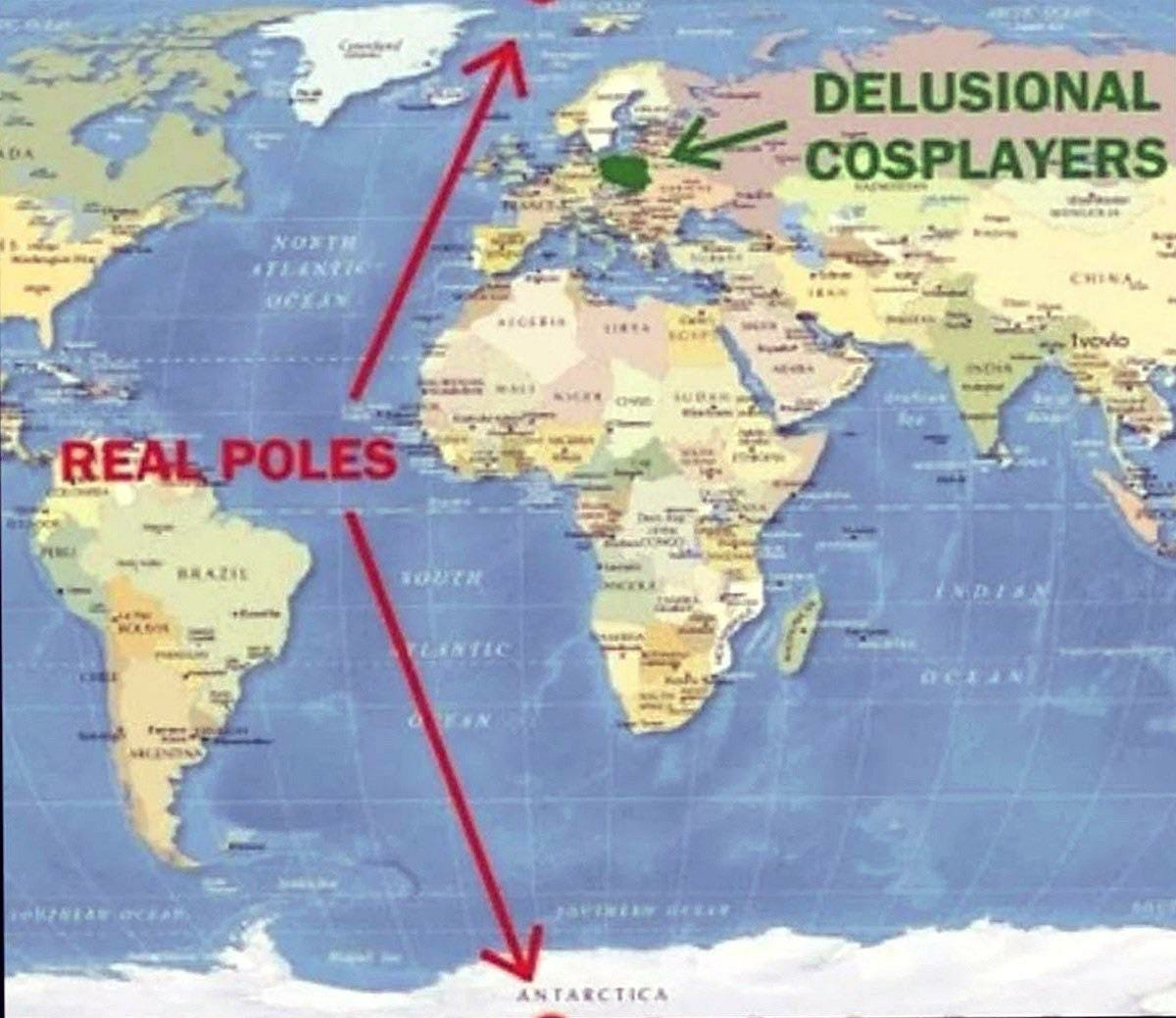
That is an overdone example, here is another one. A constructionist could not parse expansionism or separatism in India. This is because a nation is as its borders and laws so define.5 Therefore, a patchwork of ethnicity, cultures, histories and ambitions become a unified idea and legal concept of India. While India exists, it is not at all the nation whose borders exist cleanly in east Asia. India exists in many countries in the west while also not existing in certain diasporas within its own borders.
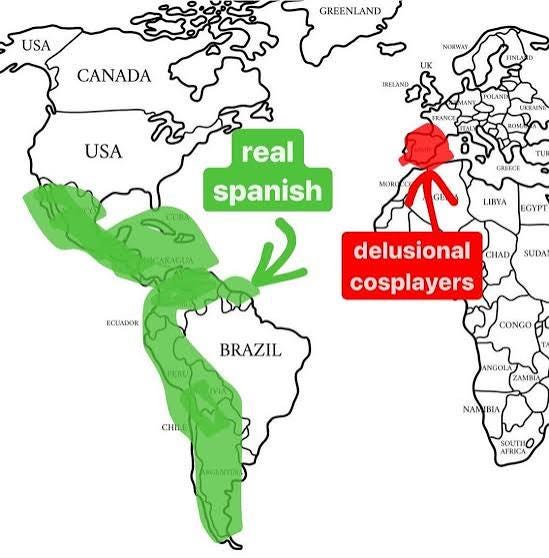
Yugoslavia never existed despite having borders on a map while the West still exists despite having no borders.
Here’s my broad point: political entities are real and not whimsical concepts in the abstract realm. The brilliance of the civilizational concept as expanded and defined by Spengler is it gives structure to this reality beyond treaties and laws. He explains that through a process of ethno-genesis, where a people is created via genetics, culture and myth-making, a reality is created where a group of people becomes a tribe at a civilizational scale. Civilizations have dreams, ambitions, trauma and go through cycles as they age. They are not a permanent idea or set of concepts.

This is a superior way of understanding geopolitics because it unmasks nations as dynamic, ambitious and vulnerable. Realist theory ironically gives birth to the constructivist which is unreal. The international anarchy and rule by force in realism are still principles essential to civilizational geopolitics.
In a way that synthetic politics would struggle to describe, we understand that China can either expand as a power or destroy itself or perhaps we understand that China barely exists as things stand. Whereas the synthetic politics insists that Britain exists as far as it claims to and in as much as it can enforce its will, the organic politics understands that the British soul is on its last legs with scarcely any territory to call its own.
Here is a list of the civilizations which Dugin considers to be “poles” in TMW6
• Western civilization
• Orthodox (Eurasian) civilization
• Islamic civilization
• Hindu civilization
• Chinese (Confucian) civilization
• Japanese civilization (potential)
• Latin-American civilization
• Buddhist civilization
• African civilization
Notice anything wrong? One of these civilizations is quite different from the others, mainly in that it does not exist. Orthodox (Eurasian) civilization is as much of a hypothetical as Japanese civilization. Orthodox Civilization certainly exists and is wherever you find Russians and Orthodox majorities: essentially the present Russian borders and some of the caucuses as well as diaspora.
There isn’t really a justification to extend this civilization into Europe or beyond the present Russian borders in the east. In fact, I would think that the borderland or frontier between Orthodox civilization and Chinese is within Russia’s formal borders in the east due to Chinese soft influence and migrant workers. In the west, Orthodox civilization essentially ends at Russian borders —barring Kaliningrad, which is naturally included.
There are also more complexities to this list, but Dugin is very aware of them and discusses them. It is just this Eurasian concept which finds itself so beloved to Dugin while also being the most strange part of his otherwise highly insightful and accurate political philosophy.
Spengler believed in Orthodox civilization himself —as shown in the quote at the start of the article— and in fact predicted that to them would go the twenty-first century. This prediction was made around seventy years prior to said century and yet it was well reasoned. Was he right, I’m not too confident to call it yet. However, according to the bio-spiritual understanding of civilization which I have discussed in this article, I simply cannot see a basis for the existence of Eurasia.
Regardless, I am glad that Dugin is a somewhat popular political philosopher who retains and advances the tradition of analyzing geo-politics through civilizational actors.
Civilization as actor in politics is an important idea with a long tradition. Comprehending it and applying it can lead to a superior understanding of the underlying realities in geopolitics instead of idealism and wishful thinking.
I respect Alexander Dugin for continuing the tradition of exploring a political philosophy with civilization as primary actor. I think there is much to be learned from studying his politics and their applications.
However, I think that Dugin is wrong about the existence of Eurasian civilization and as a result of his placing much emphasis on this entity within his politics, his work becomes confused and controversial.
Nonetheless I redouble that people should study politics through the lens of civilization as actor and consider the multipolar world which we are entering into. We should also remember the solid foundations of such ideas in the works of Oswald Spengler.
Note: This article contains overgeneralization and simplifications. I assume the reader has a cursory knowledge of politics and the subjects discussed. If you want me to explain something in better detail please ask.
Thanks for reading.
Theory of a Multipolar World (2021) Dugin, Alexander
p 60 Imperium (1948) Yockey, Francis Parker
https://en.wikipedia.org/wiki/Constructivism_(international_relations) sorry I don’t have a better source for this. You can read this contemporary paper if you really care https://www.jstor.org/stable/27282409 —which is on a specific form of constructivism
No posts
Comments
Nothing yet. Say the first thing.
Sign in to join the conversation.