
Dear readers,
I want to talk about something that has bothered me for a while, and I think once you see it you won't be able to unsee it either. Isaac Newton is one of the most frequently cited names in Christian debates and apologetics. He's used as proof that faith and science aren't enemies. That's a wonderful idea, but it's also built almost entirely on a version of Newton that his own writings contradict.
Let’s get started,
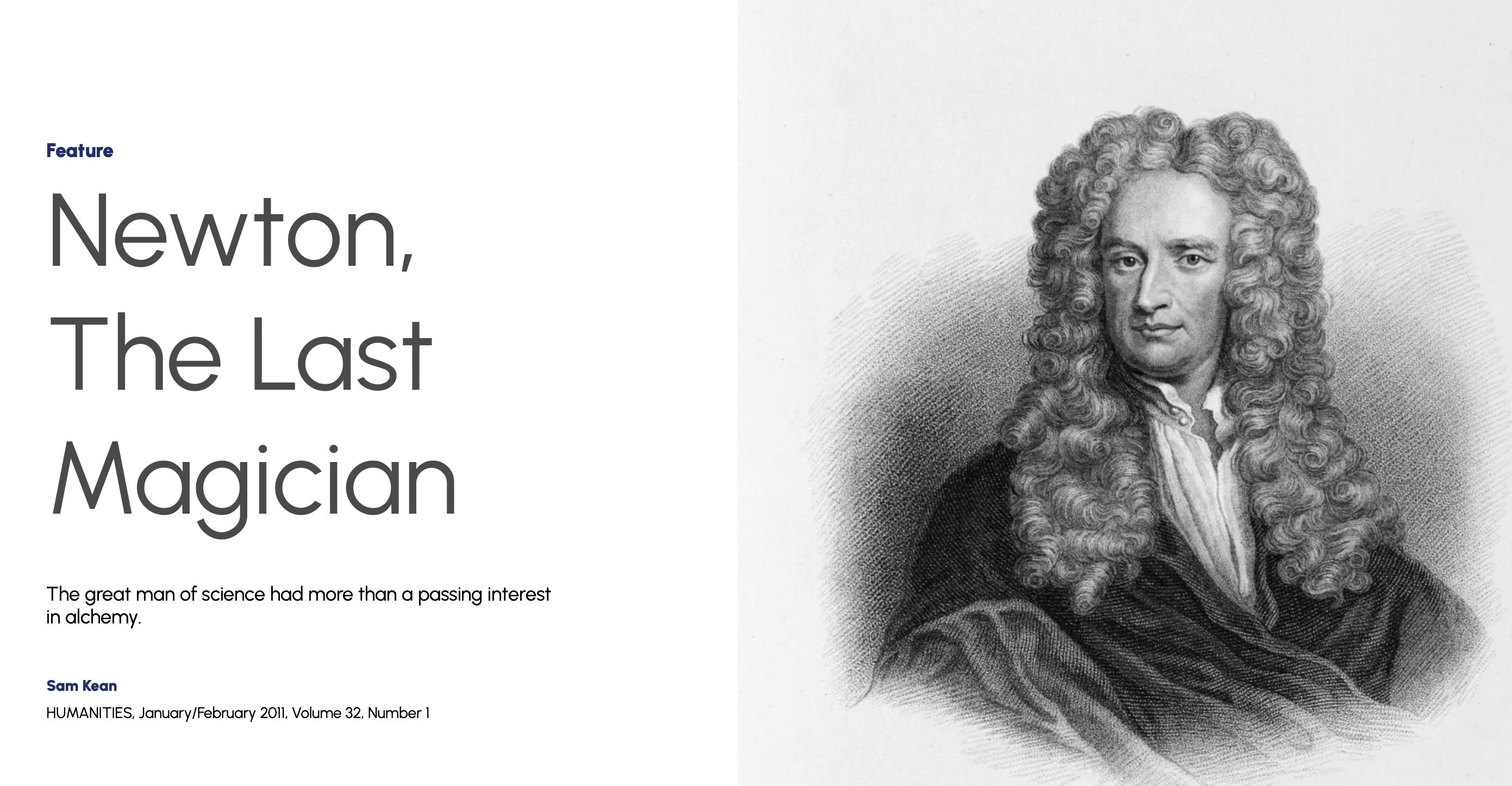
Newton’s public persona as the ‘father of modern science’ masks a private-ish, or just forgotten, obsession with the occult. While the world remembers him for calculus and optics, his personal writings (discovered long after his death) reveal that alchemy consumed far more of his time and intellect than physics ever did.
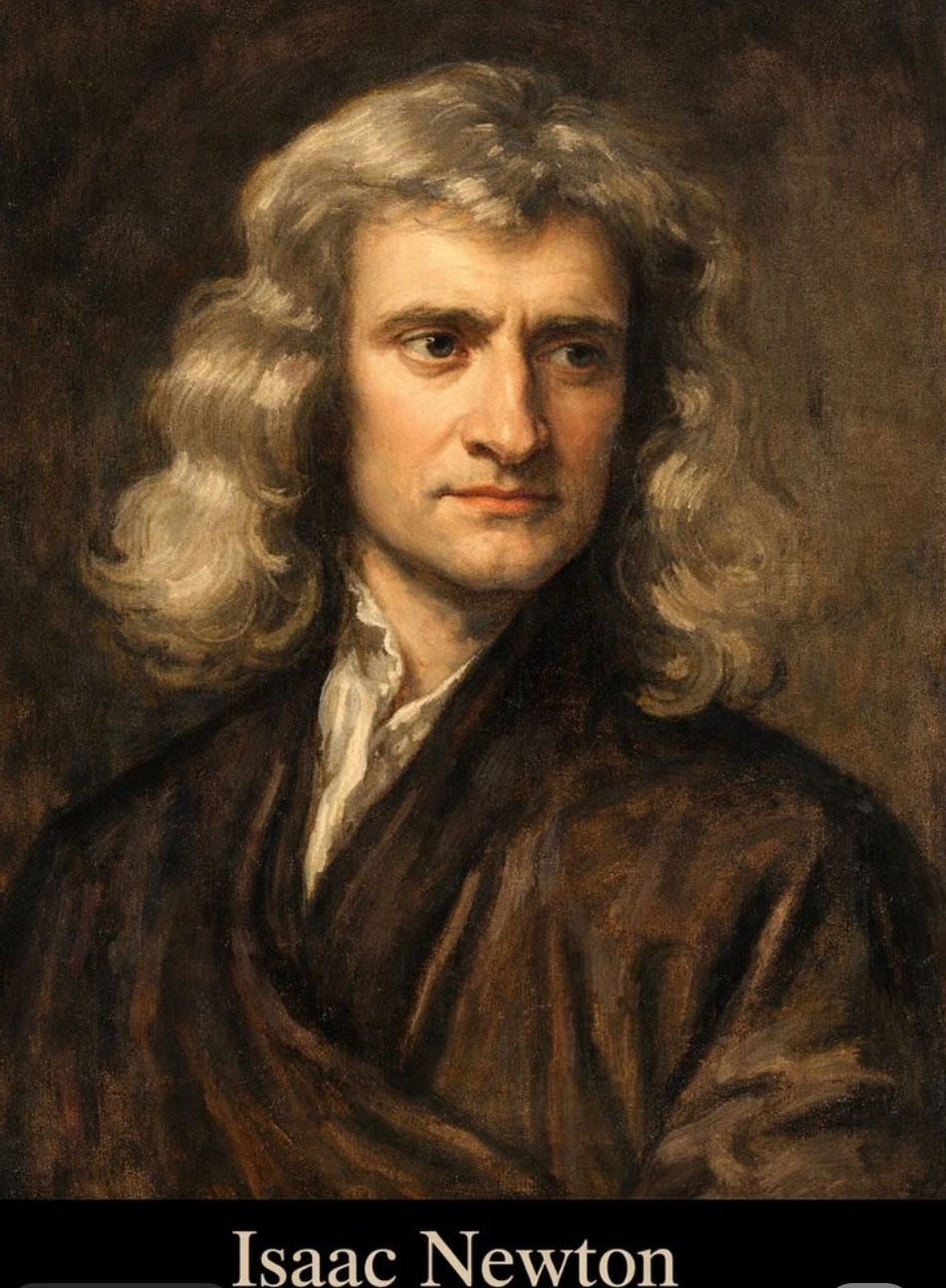
He wrote extensively on alchemical experiments, focusing on the esoteric aspects of alchemy of transmutation of the soul, not just the exoteric of transmutation of metals.
Newton believed alchemy held the keys to unlocking ‘divine secrets’ hidden in nature, drawing from ancient texts that blended mysticism with proto-chemistry.
We’ve heard this story many times before. It’s your typical Gnostic-inspired belief system.
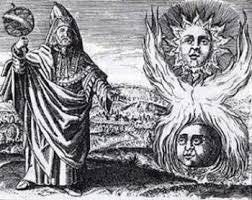
Newton was also into numerology, astrology, and even interpreted Greek myths as recipes for alchemical processes. He was convinced that ancient civilizations, like the Egyptians, possessed advanced mathematical and astronomical knowledge that had been lost, or deliberately concealed.
This fascination extended to biblical prophecy and chronology, where he attempted to decode the Book of Revelation and timeline the end of the world, often through strange and mystic lenses. Newton’s theology was anything but mainstream Christianity; he viewed God as a cosmic architect whose secrets were accessible only through esoteric study, not simple faith.
Yes, that’s the same philosophy of the Freemasons.
Direct membership in Freemasonry is debatable. His ideas, though, did influence Masonic and Rosicrucian thought. There is even an Isaac Newton Lodge, No. 859, in Cambridge, England.
Many prominent Rosicrucians, including people like Robert Fludd, were deeply involved in alchemy, and Newton’s work matches their Hermetic-Kabbalistic traditions.
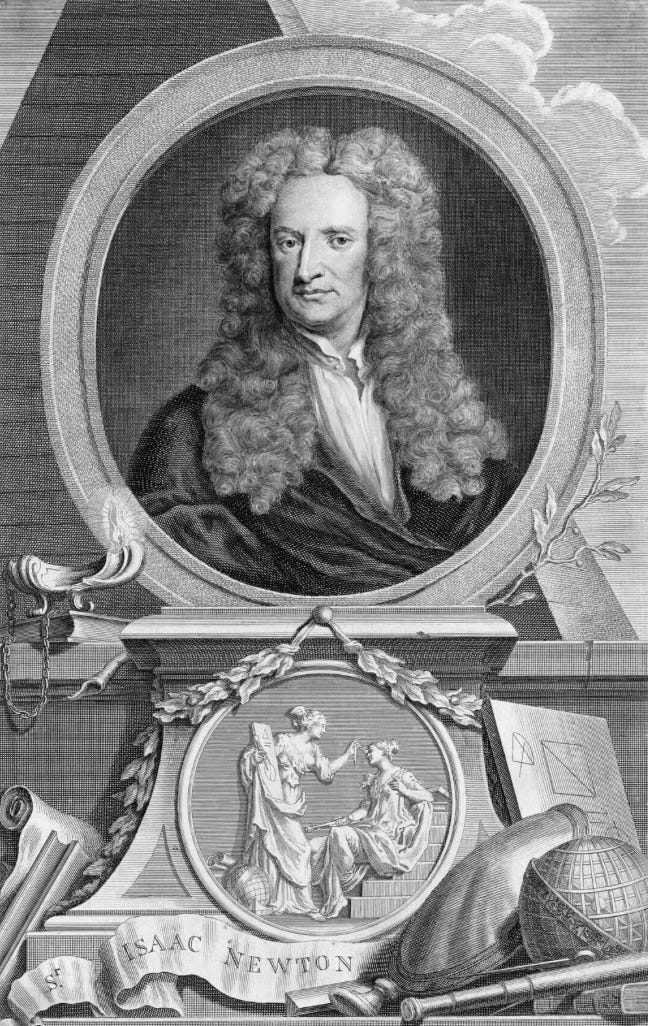
He studied Atlantis as a real civilization and sought to unify world religious histories into a single, occult timeline. These pursuits align him with the invisible college of esoteric thinkers who operated in the shadows, blending science with magick.
According to information from Universal Co-Masonry’s website, Newton’s best friend was Dr. J. T. Desaguliers. Newton was even godfather to Desaguliers’ daughter.
Dr. John Theophilus Desaguliers was one of the key architects behind the early organizational structure and ideology of modern Freemasonry, specifically the centralized system established by the Grand Lodge of England in the early 1700s.
Newton was also a leader in the Royal Society.
Newton’s posthumously published work on the dimensions of Solomon’s Temple has also been highlighted as “significant” in Masonic contexts, reflecting interests in sacred geometry and ancient architecture that align with Masonic symbolism. So, while official membership to a secret society is speculative, the circles he ran in were strictly societies with secrets.
To today’s occultists, Newton isn’t just a famous scientist, he’s a revered initiate who bridged the material and spiritual realms. Occult writers portray him as a wizard who uncovered the “hidden hand” guiding creation, introducing concepts like action-at-a-distance gravity that are based more so in magical forces than mechanical laws.
Critics like Gottfried Leibniz accused him of injecting occultism into science, arguing that gravity’s invisible pull was essentially a supernatural explanation dressed in mathematical garb.
Modern esoteric circles still view Newton as a Rosicrucian archetype, his work embodying the order’s alchemical symbolism and quest for the Philosopher’s Stone.
To these groups, Newton is a hero of the ‘hidden path’, a man who rejected the claims of the Bible for something hidden and occulted and brought back forbidden fruits that shaped the modern world.
For these reasons, it always makes me cringe when I see modern-day apologists praise Newton for being a “strong Christian man”.
Newton devoted more than thirty years to writing about alchemy. He even called it a “dangerous pursuit” indicating he took it very seriously, not just a hobby like botany.
Similar sentiments appear in his annotations to works like Manna (1675), linking alchemy to sacred philosophy hidden from the unworthy. That text promised the alchemical stone would allow the practitioner to see visions of the creation days, converse with spirits, and learn all sciences supernaturally, without working for it. This is the territory of occult mysticism, not the humble faith of the apostles.
In a 1676 letter to Henry Oldenburg he wrote:
“These [chymical tools] are the secrets that the ‘true Hermetick Philosopher’ must keep hidden lest they cause ‘immense dammage to ye world.’”
Doesn’t that sound like a Lord of the Rings-tier mystic guarding esoteric knowledge?
He even created dozens of anagrams of his own name “Isaacus Neuutonus” to align himself with famous esoteric adepts.
One interesting example was “Jeova sanctus unus” (the One Holy Jehovah). Newton placed this at the head of his list of more than thirty variations. Scholars note that this phrasing reflects his well-documented anti-Biblical views. Decoding a passage from early Church fathers that originally read “Unus est Deus, ex hoc Deo filius est genitus spiritum sanctum,” (God is one, from this God the Son is begotten and the Holy Spirit), Newton reduced it to a purely material formula: “b. ☿ in digesting gives ☉ , ☿ and ☉ In digesting give the Elixir.”
The Father, Son, and Holy Spirit became mercury, gold, and the philosophers’ stone.
This is classic mysticism.
Another detail that rarely comes up when discussing Newton is from his own biography; he personally translated the Emerald Tablet of Hermes Trismegistus from Latin into English, and his translation is still housed at King’s College Library in Cambridge.
This foundational text of alchemical and Hermetic writing, alongside the Corpus Hermeticum, shaped Western esoteric thought more than almost any other known document.
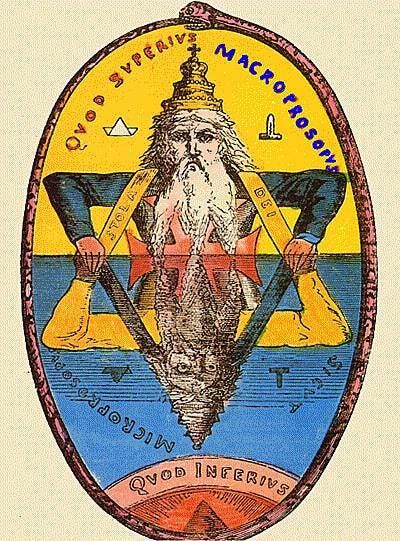
The super popular occult phrase “as above, so below,” comes directly from it.
At the time of his death, Newton had 169 books on alchemy remaining in his personal library, which was considered one of the finest alchemical libraries in the world. He also owned heavily annotated copies of the Rosicrucian Manifestos.
He was also deeply influenced by the occultist John Dee, the infamous court astrologer and fallen angelic communicator. Newton and Dee shared beliefs, and both were deeply interested in Rosicrucianism. That is who Newton counted as a philosophical predecessor.
Since Jesus was not God in Newton’s view, to worship Him was, in Newton’s own reasoning, an act of idolatry, which he regarded as the greatest of sins. (Source)
This single belief is enough reason to be disheartened whenever you hear an apologist cite Newton as a Christian. This is the pattern we see over and over in the esoteric tradition; a public-facing identity that sounds vaguely spiritual or even Christian, and a private theology that rejects the divinity of Jesus Christ.
Even Newton’s crowning achievement, the one we all know him for the theory of universal gravitation, crumbles under scrutiny as little more than an educated guess.
In his own words, from the Principia Mathematica, Newton famously declared “Hypotheses non fingo” (I feign no hypotheses), admitting he couldn’t explain why gravity worked, only that it seemed to describe observed phenomena. He speculated on invisible particles or ethereal mediums but dismissed them as unhelpful guesses. The apple-falling legend, while iconic, underscores how gravity was an intuitive leap rather than a proven mechanism.
Of course, there are esoteric undercurrents with the fact the story claims it was an ‘apple’, much like the forbidden fruit of the Tree of Knowledge of Good and Evil. Newton himself knew gravity’s action-at-a-distance implied an occult-like force, one that contemporaries criticized as introducing mysticism into science.
It’s ironic to me that the Christian men of today cite Newton to prove scientific men can be Christians, when Newton was criticized in his day for bringing straight-up occultism into science.
Very few atheists seem to know that the men they believe were neutral scientific voices were actually lifelong mystics.
I covered this in my video: The Shocking Origins Of Evolution: From Mysticism To Science.
I encourage everyone to do their own research, prayer, and scripture searching to determine what they believe regarding Geocentrism vs Heliocentrism. These types of debates typically end up being a matter of the person's worldview and beliefs. Neither can "prove" the other wrong without first agreeing on the epistemological ground rules (e.g., Is the Bible authoritative? Are vacuum experiments trustworthy? If talking with a Christian, does the Bible describe literal cosmology or phenomenological language? etc.) which are notoriously hard to establish without extensive conversation, let alone online in echo chambers.
Wherever you fall, the most important thing we can all agree on is that the Word of God is the beginning and end of our epistemology, not the posthumous reputation of a man who spent his life chasing forbidden knowledge and hiding his true beliefs from the Church he publicly served. Newton was not a foundation worth building on.
Using Newton as a Christian scientist risks endorsing the occult that defined his true legacy, which is the exact thing Christians are told to be on guard for. His heretical theology and alchemical obsessions place him far outside biblical faith, and much closer to a Gnostic sage than a faithful disciple. By promoting him, folks are unwittingly amplifying esoteric ideas that contradict Scripture.
Newton is not a neutral figure. He was a committed occultist who spent more of his intellectual energy on Hermetic alchemy than on physics, who believed worshiping Jesus Christ was idolatry, translated the foundational text of Western esotericism into English, and whose social circle included the architects of speculative Freemasonry. The occult community knows exactly who he is.
I would hope apologists could see that what weakens our witness is not a lack of famous scientists to cite. We have a wealth of evidence on our side, and we don’t need to rely on someone like Newton.
The real question becomes why aren’t we investigating whether those the world praises are really voices of truth, or just another puzzle piece in this grand deception.
Thank you for reading,
Alexandra
*Stay tuned for a big update article I’ve got in the works!
“See to it that no one takes you captive through hollow and deceptive philosophy, which depends on human tradition and the elemental spiritual forces of this world rather than on Christ.”
Newton the Alchemist: Science, Enigma, and the Quest for Nature’s “Secret Fire” by William R. Newman: Newton’s 30+ years and million words on alchemy, portraying it as central to his genius, not peripheral. Newman analyzes Newton’s lab notebooks and texts, showing his decoding of alchemical riddles: https://www.americanscientist.org/article/alchemist-extraordinaire
The Chymistry of Isaac Newton Project (Indiana University) digitized manuscripts confirming Newton’s over 1 million words on alchemy: https://webapp1.dlib.indiana.edu/newton/project/about.do
The Metaphysical World of Isaac Newton by John Chambers explores alchemy, prophecy, and Bible critiques: https://www.betterworldbooks.com/product/detail/the-metaphysical-world-of-isaac-newton-alchemy-prophecy-and-the-search-for-lost-knowledge-9781620552049/new
The Problem of Alchemy by William R. Newman debates alchemy’s religious depth, noting rare “God” mentions in notebooks: https://www.thenewatlantis.com/publications/the-problem-of-alchemy
Comments
Nothing yet. Say the first thing.
Sign in to join the conversation.