

I’m on vacation for the rest of the summer, reminding myself what it means to rest and recharge before I jump into my next big endeavor. (This week I was in beautiful Minneapolis, where I spent three sun-soaked days catching up with close friends.) So, I’ll be sharing thoughts here a bit more haphazardly than usual.
For your full “economics of crime” fix, I strongly recommend listening to the Fighting Crime podcast that my Arnold Ventures team launched in partnership with Indio Media. The latest episode digs into the evidence that exposure to air pollution increases violent crime, in real time. The featured study is one of my favorites in the entire public safety space, and makes a terrific conversation starter at even the least academic of cocktail parties.
I’m enjoying Cate Hall’s You Can Just Do Things, about cultivating a sense of personal agency. This book will break you out of whatever rut you’re in this summer/year/season of life. I’ve been recommending it to friends who are feeling stuck, and I’ve found it motivating even though I’ve already decided to make a big leap.
“States want to bring Medicaid behind bars. Federal changes make that harder”— An update on the implementation of Medicaid reentry waivers in states across the US. Based on previous evidence that expanding access to mental health care reduces crime and recidivism, I’m interested to see if these waivers reduce violence within prisons, and reoffending after release.
“Who Pays for San Francisco?” — An exploration of how private money is coming in alongside public dollars to provide government services. I appreciate my friend Rob Reich’s warning that philanthropies are less accountable to the public than government is, but I also see an important role for philanthropic dollars in the public safety space, among others. It’s interesting to see how this is playing out in San Francisco, which was struggling for a while (especially on the crime and disorder front) and is now on a much better trajectory — in part because the investment of private dollars made timely, high-impact investments possible.
I talked with Jonathan Wroblewski for his terrific Sentencing Matters substack. An excerpt:
Jonathan: Can you talk a little bit more about what you call the risky investments?
Jennifer: John Arnold talks a lot about a two-by-two matrix of funding opportunities. On one axis, you’ve got impact, low or high impact, and on the other axis, you’ve got probability of success, low or high probability of success. In the first quadrant, you’ve got low probability of low impact. Nobody wants to fund that. The opposite quadrant — high probability, high impact — everyone wants to fund those things. But those are unicorns; they don’t come along very often. And so that leaves two quadrants left that philanthropies can go after. One is the high probability, low impact. Because there is a tendency to want to rack up quick wins, there’s an overabundance of philanthropic dollars going to the high probability, low-impact stuff.
Where there’s an undersupply of investment is the low probability, high impact ideas; the moonshots. John was always encouraging us to try to look for the moonshots. It can be really hard to tell up front which those are. So, we have been trying lots of stuff with a failing-fast mentality. One of the projects we’ve been developing over the last couple of years is looking at the effects of GLP-1s on substance use disorder and ultimately time in jail. There’s lots of anecdotal evidence that GLP-1s seem to have this impact; they reduce cravings for drugs and alcohol, but we don’t have the rigorous evidence yet. There are some ongoing clinical trials, but the question of the impact on the ground is quite different. There are lots of reasons this might not work. But if it does, it would be a game-changer in the public safety space. Finding projects like that has been really fun and rewarding.
You can read the full interview here:
I also talked with Kurt Nelson for the Behavioral Grooves podcast. We discuss a wide range of topics, exploring how economists think about crime, and what the evidence says about what works best to change behavior.
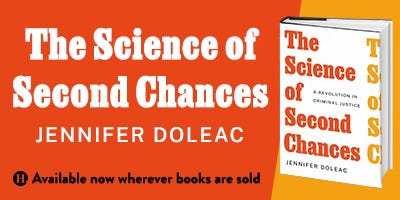
Finally, I joined the American Bar Association’s JustPod to talk about The Science of Second Chances and what economics has to say about how to improve our criminal justice system.
Want more? You can find my book at your favorite bookseller:
No posts
Comments
Nothing yet. Say the first thing.
Sign in to join the conversation.