
A giant electromagnetic railgun on the Moon that flings payloads into space for pennies per kilogram — built by robots, paid for in satoshis, and kickstarted by Starship.
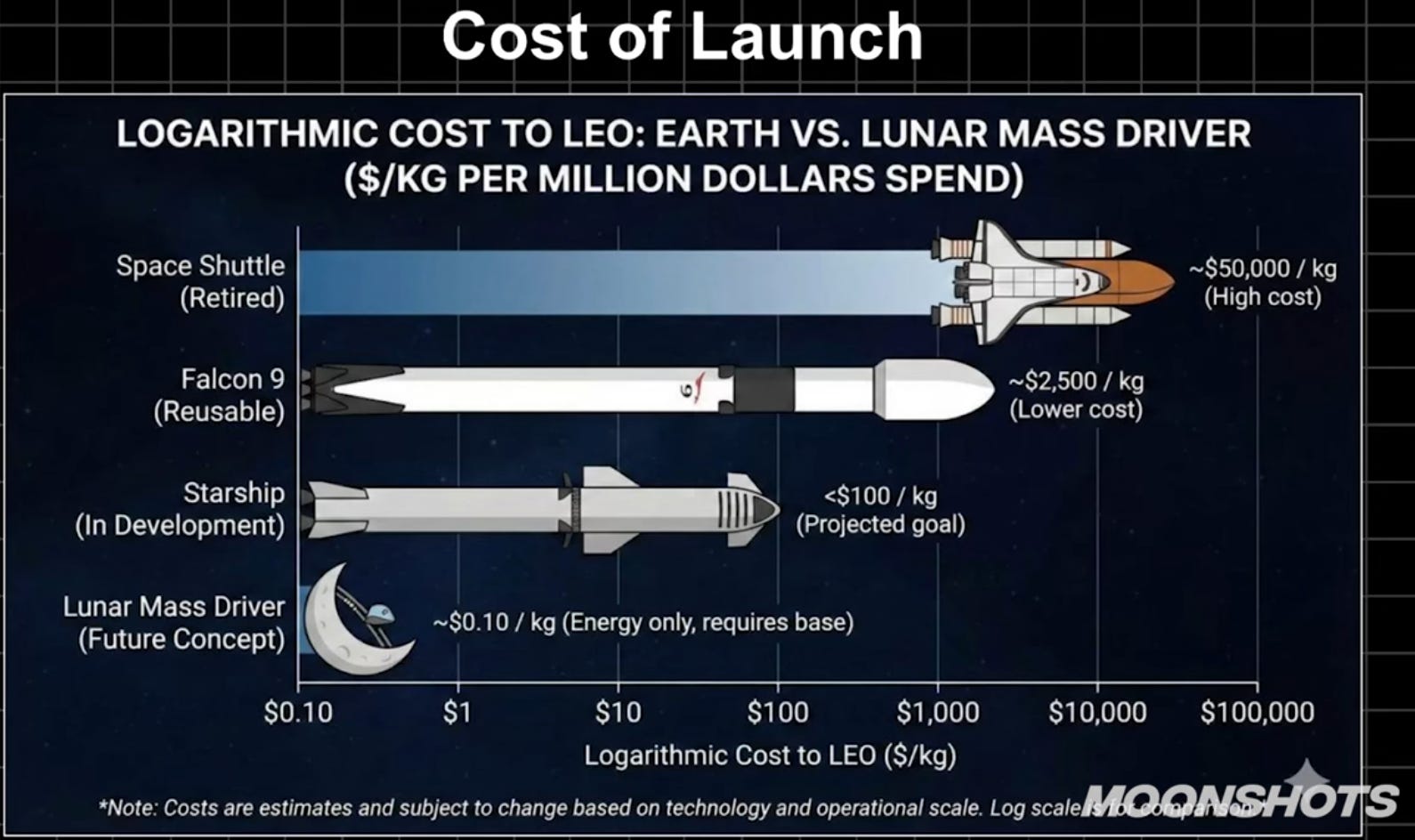
Right now, getting one kilogram to low Earth orbit costs $2,000–$10,000 even with Falcon 9, and Starship is shooting for ~$200/kg when fully reusable. That’s revolutionary… but still expensive compared to what physics allows if you stop fighting Earth’s gravity and atmosphere.
The Moon has 1/6th the gravity and no air. Escape velocity drops from 11.2 km/s on Earth to roughly 2.4 km/s on the Moon. An electromagnetic mass driver (basically a very long coilgun/railgun) can accelerate payloads to that speed using solar power and lunar aluminum as reaction mass. Once built, operating cost could fall below $100/kg — and potentially far lower.
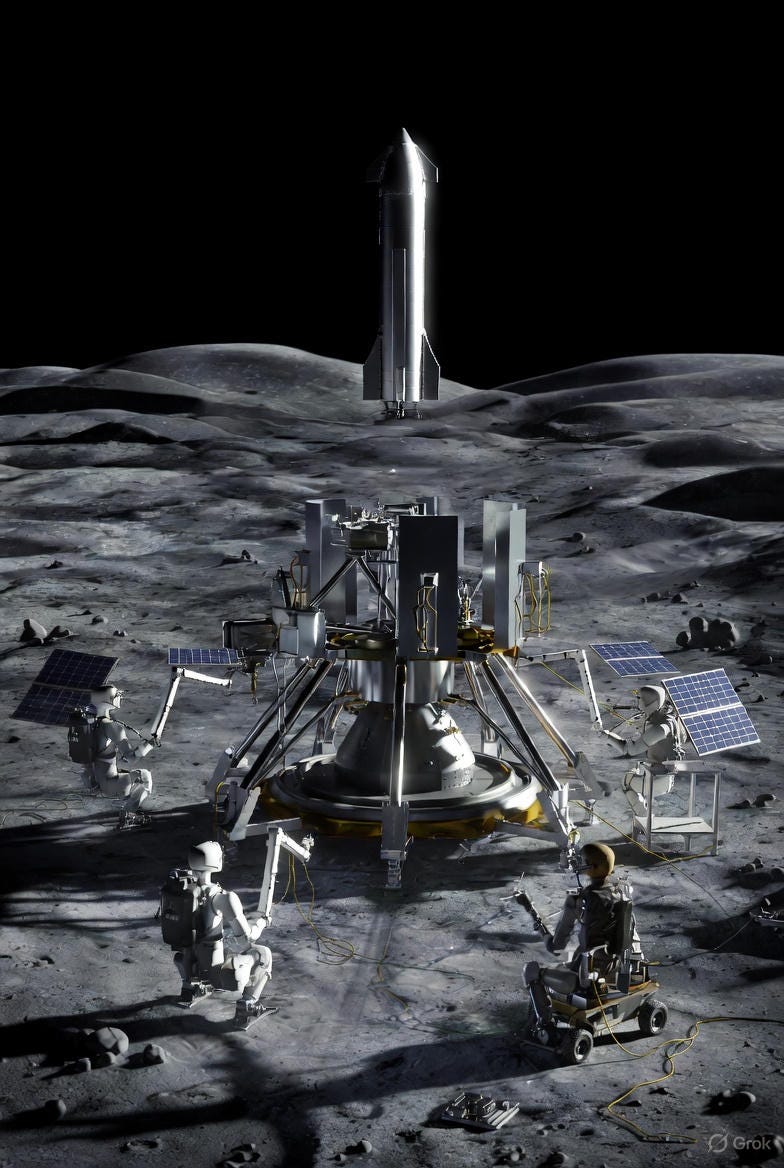
Starship hauls robots, tools, and seed hardware to the lunar surface (2027–2030 timeframe under current Artemis/CLS plans).
AI-guided robotic swarms mine regolith, sinter bricks, 3D-print metal parts, and lay down kilometers of superconducting track.
Humans mostly stay home or in orbit; the heavy lifting is done by machines that never get tired or need air.
2027–2028: First uncrewed Starship lunar landings (NASA + SpaceX).
2029–2031: Robotic site prep, power, and small-scale manufacturing demos (think GITAI, Astrobotic, ispace, and others already under contract).
2032–2034: First 500-meter to 1 km mass driver capable of tossing 10–100 kg test packages into lunar orbit or escape trajectories.
That’s the realistic, non-hype version. Five to ten years from today for something that actually works.
Here’s where it gets spicy.
Imagine every robot and 3D printer has its own Lightning wallet. Need 200 kg of sintered regolith blocks delivered to the track site? The construction AI opens a channel, pays 300 satoshis per ton, and the mining bot delivers — instantly, autonomously, with zero trusted third parties.
Crowdfunding happens the same way: anyone on Earth zaps sats to a public Lightning address or Nostr-based fundraiser. Donors get real-time video and telemetry in return. No VC decks, no government grants, no banks — just a global, permissionless bounty board in space.
We already have the pieces:
Blockstream has beamed Bitcoin transactions via satellite for years.
Companies like ZBD and Breez run production Lightning nodes that can handle autonomous micropayment flows.
Open-source projects like LNBits let you spin up thousands of wallets programmatically.
Sats become the native currency of the lunar economy before the first human ever lives there permanently.
Once the first mass driver is online, the cost of moving mass around the inner solar system collapses. Ores mined on the Moon get shot to LEO construction yards. Water cracked from lunar poles gets flung to Mars transfer orbits. Suddenly, building orbital habitats, solar-power satellites, or giant telescopes becomes an engineering problem, not a financial one.
Starship gets us to the Moon cheaply. AI robots do the hard work. Bitcoin Lightning turns millions of small contributions (and millions of tiny robot-to-robot payments) into the fuel that makes it all happen.
We’re not waiting for permission from governments or billionaires anymore. We’re waiting for code, steel, and electricity under the lunar sun.
Phase 1 prototype by 2032? Entirely doable if we start treating space like open-source hardware and Bitcoin like oxygen.
Who’s ready to open a Lightning channel to the Moon?
No posts
Comments
Nothing yet. Say the first thing.
Sign in to join the conversation.