
Magnifica Humanitas: An AI Governance Reading of Pope Leo XIV’s Encyclical
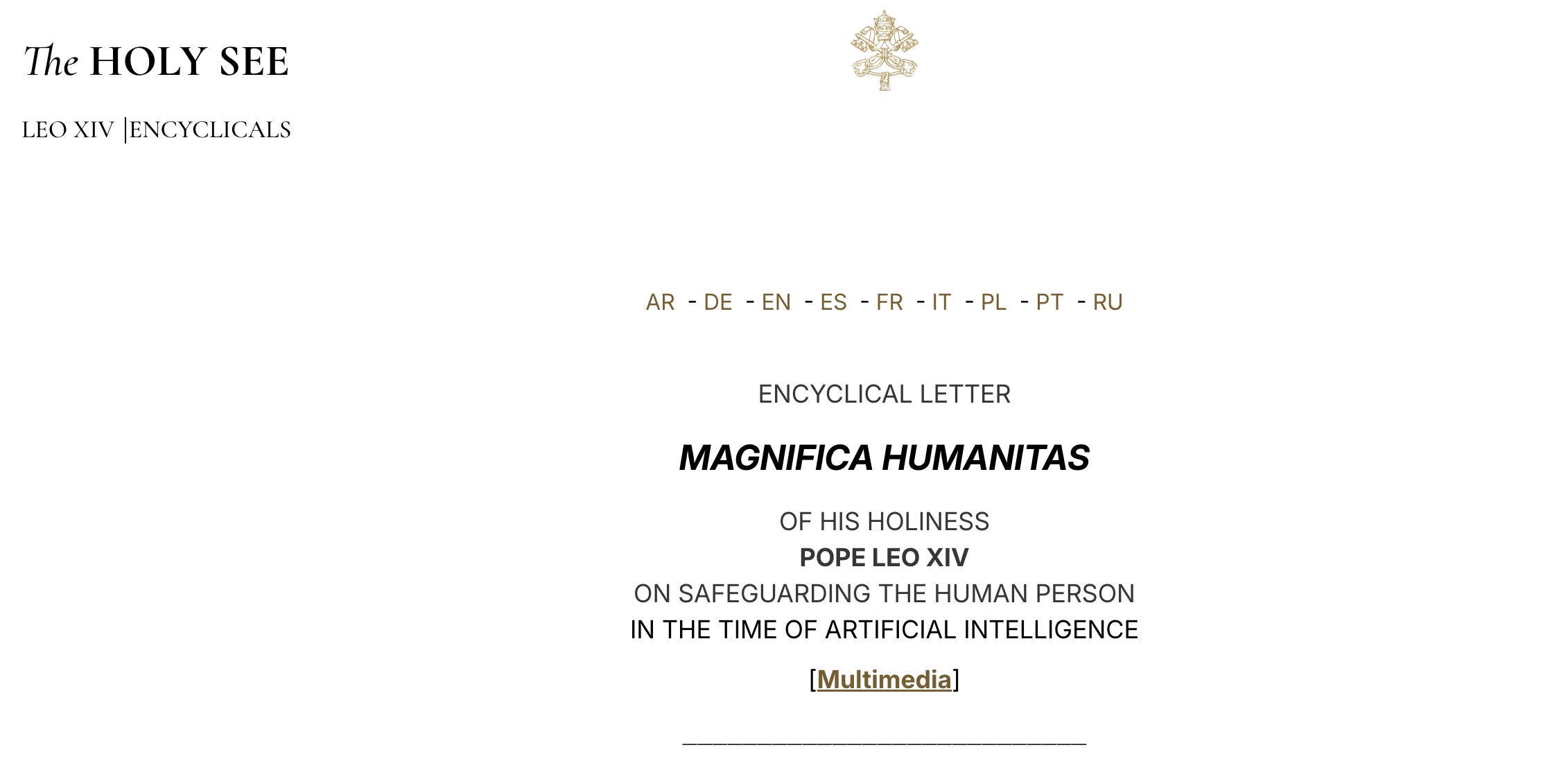
Pope Leo XIV published his first encyclical, Magnifica Humanitas (”On Safeguarding the Human Person in the Time of Artificial Intelligence”), on May 15, 2026 the 135th anniversary of Rerum Novarum, Leo XIII’s 1891 encyclical on labor rights.
Reading it as someone who spends their day in Data Privacy and AI governance the parallels are hard to ignore. That’s what makes it interesting. It doesn’t replace GDPR, the EU-AI Act, or NIST. But it does something valuable: it sharpens the moral vocabulary around the same problems.
Dignity.
Power.
Accountability.
Human agency.
Those aren’t abstract themes here. They are the center of gravity. The convergence is real. And in some places, it’s sharper than the language we tend to use in compliance work.
This is a work of Catholic theology, not a regulatory framework.
Its core concepts - dignity, subsidiarity, solidarity, and the common good are grounded in imago Dei, the belief that human beings are made in the image of God. Dignity, in this framing, is not granted by law or institutions. It precedes them.
That distinction matters. The encyclical has no enforcement mechanism, no penalty structure, and no legal authority outside the Church. So it should not be cited as if it were a compliance source.
Cite it instead as what it is: an ethical and philosophical framework that happens to converge with many of the same principles embedded in modern privacy and AI governance. A values argument, not a legal one.
Several themes map almost one-to-one with familiar AI governance controls:
Dignity as non-instrumentalizable personhood maps cleanly to privacy by design and purpose limitation.
The idea that technology is never neutral supports treating AI impact assessment as a values decision, not just a technical approval.
Subsidiarity, especially as applied to institutions and platforms, looks a lot like vendor accountability, audit rights, and recourse.
Data as a shared good connects naturally to portability, anti-concentration concerns, and vendor selection discipline.
The insistence that AI is not morally neutral by design reinforces why model documentation and bias testing need to happen early, not after deployment.
Accountability for opaque decisions lands squarely in the territory of named owners for automated decision-making.
Explainability and contest-ability map directly to due process in high-stakes automated decisions.
It gives you language for the human stakes behind the controls.
The document is also more expansive than most AI governance standards.
It explicitly names supply chain labor issues such as data labeling, content moderation, and rare-earth extraction as due-diligence concerns. Most vendor risk programs barely scratch that surface.
It also offers a compact workforce transition checklist that is easy to appreciate: worker protections tied to automation rollouts, accessible retraining, and work quality treated as a real corporate metric.
And its human-in-the-loop language is unusually strong. Written for autonomous weapons, it still translates well to high-stakes AI systems more broadly: traceable responsibility, no speed-override of judgment, full auditability, and no irreversible decisions without effective human control.
That is not just a theological point. It is a governance one.
The cleanest way to cite Magnifica Humanitas is as a values-first companion to the legal and technical sources you already use.
A simple mapping works well:
Dignity → data subject rights.
Subsidiarity → vendor accountability.
Common good → societal impact assessment.
Contest-ability → procedural fairness in automated decisions.
Use it to deepen the argument, not to replace the argument.
For privacy and AI governance leaders, it offers a second language for ideas we already know matter.
One-sentence takeaway: For privacy and AI governance leaders, Magnifica Humanitas is effectively a call for human-centered AI transparent, accountable, rights-preserving, and governed in ways that protect individuals from surveillance, manipulation, discrimination, and excessive concentration of digital power.
Comments
Nothing yet. Say the first thing.
Sign in to join the conversation.