
Let’s start with a question you’re probably familiar with: what do you want to be when you grow up?
Every year in my elementary school, students would participate in a writing competition. At the end of our short fiction stories, we would need to write an “About the Author” section, which included a description of what we wanted to be when we grow up. And year after year, my answers would change - astronaut, singer, writer, scientist, and so on.
It wasn’t until the summer after sixth grade that something really clicked. I attended a website design camp where I used Wix, a no-code platform, to design a website with a friend. It was simple - essentially a collage of nature photos - but it was the first time I became inspired by technology. I saw that I could use it as a form of creative expression and as a way to share joy with others. That was my first real itch to explore tech and entrepreneurship.
As the years went on and I began high school, I seized every opportunity I could to pursue extracurriculars related to my interdisciplinary intellectual interests - computer science, physics, debate, and community service teaching STEM to younger kids and girls. I loved anything centered around logical problem-solving and sharing my learnings with others. I applied to college as a CS major, while also highlighting my interdisciplinary and community-oriented side.
I entered college in fall 2020 - right at the peak of the pandemic. Our entire freshman year was remote, over Zoom. I saw it as the perfect opportunity to try everything, since I was anyway at home.
I joined a number of clubs that matched my interests or were considered the “best” ones to join. While I enjoyed my activities, I was often joining out of a fear that I might regret missing opportunities so closely aligned with my interests. In reality, despite being involved in a multitude of leadership roles, I was missing out - on immersive learning and building close relationships with any single community.
At the same time, I had this nagging feeling that I was dabbling in so many areas, and while being interdisciplinary was a big part of who I was, I didn’t know how to choose what to do in my career.
In winter quarter of my sophomore year, when campus became in-person again, I found a course called Designing Your Life. It promised to teach students how to design their career and life path using principles of design thinking. It had incredible reviews - over 4.5 out of 5 - and was nearly full, so I grabbed a spot.
I was skeptical at first. I didn’t think of myself as a “designer.” I’d never been great at arts and crafts or hands-on hardware work. I thought of myself as more of a critical thinker focused on science, computing, and argumentation. Thus, seeing that the course was offered by the Design School, which also taught classes on app design and robotics, I expected a shift in perspective.
And that was exactly what I got.
Going into the class, I had a “problem”: How do I think about my career and what I want to do in life?
Designers love problems, and design problems are everywhere. Take Apple and the iPod. Before the iPod, if you wanted to listen to thousands of songs on the go, you’d need a stack of CDs. The iPod was a design solution to that problem. There could have been other solutions, like a better portable CD player, but we can all agree the iPod was far more convenient.
This is different from an engineering problem. Engineering problems are often well-defined and objective, with an optimal solution - like battery efficiency or manufacturing constraints for the iPod itself.
When you have a desired outcome - whether it’s building a laptop or designing a meaningful life - design thinking is the right approach. You brainstorm, improvise, and build your way forward.
Importantly, before jumping into problem-solving, designers must embrace the core principle of reframing dysfunctional beliefs. For example, while many people believe their degree determines their career, about 75% of college graduates work in careers unrelated to their major. Similarly, despite the commonly advanced belief that individuals each have one true passion and must discover it early, in reality, passion often comes after trying various activities. Reframing opens up more possibilities by questioning default assumptions.
The design thinking process has five parts: Empathize, Define, Ideate, Prototype, and Test.
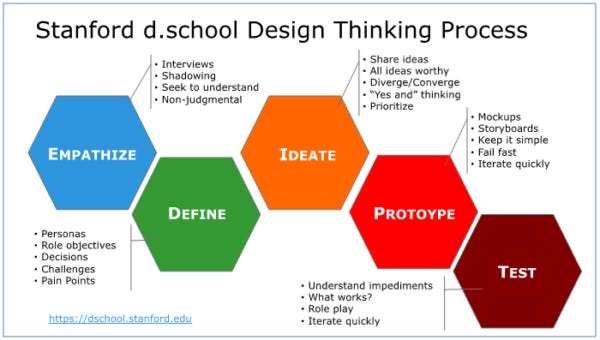
Designers must deeply understand their users. If you’re designing an ad for Macy’s, you need to know who you’re targeting - budget shoppers or luxury buyers, men or women. Those decisions shape everything - from where you will place your ad, to the Macy’s products you will feature, to the color and font.
When designing your career, you are the user. If you don’t understand yourself, you’re vulnerable to living someone else’s life—copying narratives from Instagram, LinkedIn, or Twitter. To help with this, we use Views and Clues.
One of our first assignments was writing our lifeview and workview, about 250 words each. Your lifeview reflects your beliefs about meaning and values. Your workview reflects how you see the purpose of work in your life.
From mine, I noticed that I wanted my work to be impactful, intellectually stimulating, and financially sustainable. I also noticed I was energized more by purpose and belonging than by public recognition.
Once you have these views, you can look for clashes. For example, if you value environmental sustainability but work for a firm funding fossil fuel expansion, that mismatch can erode your sense of integrity. Not everything has to align perfectly, and you can make tradeoffs depending on your circumstances - such as prioritizing financial rewards over whether your occupation aligns with your deepest interests - but you will know that you made an informed decision for yourself.
Clues are real-time signals from your daily life. Two important ones are engagement and energy.
Engagement is how focused and present you feel. Energy is whether an activity leaves you energized or drained. Something like competitive debate can be engaging but also require your energy.
A useful practice is tracking activities over a week and noting engagement, flow, and energy. You can then adjust your schedule - putting energizing tasks earlier in the day, for example.
Another tool is AEIOU, which stands for Activities, Environments, Interactions, Objects, and Users. I used this lens to reflect on group projects and realized that my peers and I did not dislike group projects; many of us thrived in small, focused discussions but felt drained by abstract meetings or endless follow ups.
Reflecting on my views and clues helped me rediscover how much I cared about community and impact. That insight led me to join Women in Computer Science and become a teaching assistant for intro CS courses for the next three years.
Next comes defining the problem. Often, we focus on the wrong one.
One professor shared how he struggled in marine biology labs and assumed the problem was improving his grades. The real question should have been whether marine biology was the right career at all.
There are also gravity problems - things outside your control - and anchor problems, where we confuse the problem with our first imagined solution. Letting go of anchors opens up more realistic and creative paths forward.
Once the problem is defined, it’s time to ideate. Feeling “stuck” is normal. Designers don’t get instant answers; they generate many ideas.
A key principle is separating divergent and convergent thinking. First, generate ideas without judgment. Then, narrow them down.
Mind mapping helps here. Starting with something like “being outdoors” can lead to unexpected but viable ideas.
I also learned that there isn’t one perfect life path; rather, there are multiple great ones.
One exercise we did was the Odyssey Plan: three five-year life plans. One realistic, one backup, and one unconstrained by money or time. Treating them as equally valid prevents premature commitment.
Prototyping means testing ideas with low stakes. Careers feel rigid, but you can prototype them through life design interviews and prototype experiences, such as conversations, clubs, classes, and internships.
I used to feel awkward about networking, but in this course, I came to see that it’s just asking for directions. People want to help, just as a college senior would for a freshman asking for directions to the nearest dining hall. Moreover, networking isn’t something you do - a network is something you join and co-create.
Finally, testing means reflection. Not all failures are the same: some are mistakes, some are weaknesses, and some are growth opportunities.
Having a small support team helps: supporters, players, and intimates. And remember the difference between advice and counsel - counsel helps you decide.
Now that we’ve gone through the design cycle for career decisions, we can see how design thinking can also be powerful within your career.
One of my prototype experiences was working with an AI startup as a product management consultant through Stanford’s EE205: Product Management for Electrical Engineers and Computer Scientists. The startup was called Typeface.ai, which helps marketing teams at large companies like Coca-Cola create content faster. Marketers can upload brand assets and use generative AI, similar to ChatGPT, to automatically generate text and visuals like blog posts and ads.
My task, as part of a group of five, was to identify a new product opportunity for Typeface, develop a minimum viable product, and get executive feedback - all within ten weeks.
We started by interviewing over 40 people: Typeface’s sales team, marketers using the product, and potential customers. We visited their office and used the product ourselves.
We learned that marketers felt overwhelmed. Typeface was powerful, but users didn’t know which features to use or how to prompt the AI. Our initial problem statement was: How do we make Typeface easier to learn and use?
But leadership challenged us to think bigger. We realized we were anchored on improving the existing product. So we reframed the question around marketers’ broader day-to-day challenges.
We expanded our interviews beyond AI users and discovered that content generation wasn’t the real problem. The hard part was deciding which ad or blog post would perform best. Small changes can make huge differences, and testing at scale is expensive.
This led to a new problem statement: How do we help marketers determine which generated ad will perform best?
We brainstormed many ideas, such as performance scoring and historical data analysis, until then one teammate had a seemingly wild suggestion: What if we simulated a brand’s followers and tested ads on them?
It sounded unrealistic, but it opened an exciting direction. The next day, we found related Stanford research on Generative Agents. I tracked down the researcher and introduced myself - she was happy to chat, and it turned out that she had already built a prototype simulating consumer behavior at a hackathon. It felt like a stroke of luck, but in reality, when you keep putting yourself out there, asking questions, and reaching out again and again, your surface area for luck increases. What looks like luck from the outside is often the result of repeated curiosity and willingness to engage.
From there, we prototyped. We took real Facebook ads from companies like Joann’s Fabrics and asked ChatGPT to adopt personas, like a middle-aged woman shopping on Black Friday, and predict which ad they’d click.
We tested dozens of variations: prompt specificity, persona count, question format. Even with a rough prototype, the model proved capable in identifying top-performing ads.
This experience was deeply fulfilling - not just because of the outcome, but because it showed how design thinking compounds. The project itself was a prototype experience I chose using design thinking, and within it, we applied the same process again. Very meta, but very powerful.
Figuring things out, whether it’s your next career step or a product idea, is a process - and like most processes, what matters is iterating, staying curious, and reframing when something isn’t working.
Most importantly: have a bias toward action and don’t be afraid to ask for help. Design thinking taught me that we don’t have to figure everything out alone. We can build our way forward, experiment, and collaborate even if we never thought of ourselves as designers.
If you do, you won’t just set yourself up for a successful career, you’ll be working towards a well-designed life that’s full of growth, adventure, resilience, and meaning.
Comments
Nothing yet. Say the first thing.
Sign in to join the conversation.