
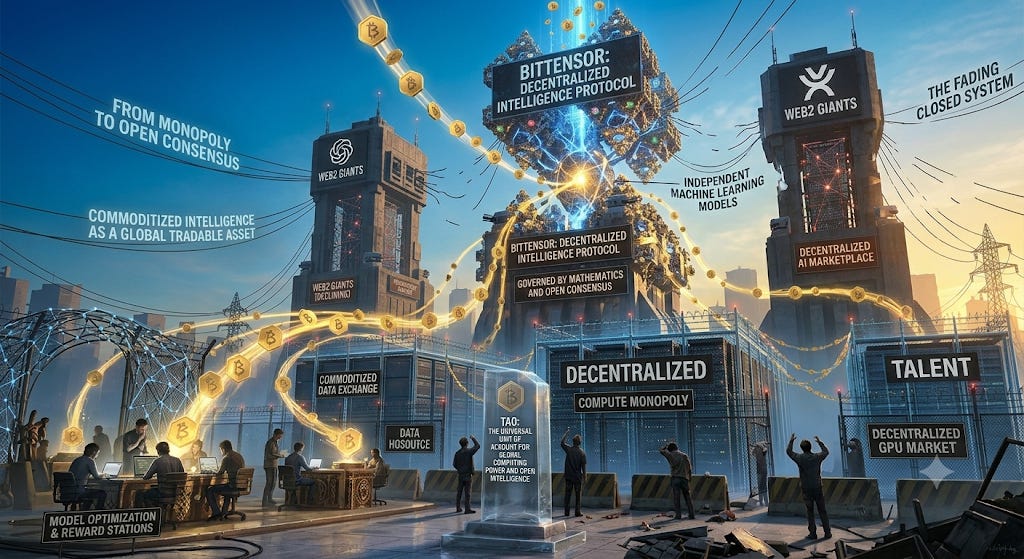
Most discussions in the technology sector today revolve around artificial intelligence. Generative models. Autonomous agents. The race toward AGI. It often seems that the future of the global economy belongs entirely to those who control the largest computing clusters. Yet, as of 2026, this monumental resource remains concentrated in the hands of a closed corporate oligopoly. A handful of Web2 giants have monopolized access to data, hardware (GPUs), and algorithms. They decide who gets access to intelligence, how much it costs, and, most importantly, what that intelligence is allowed to do and say. The result is a fundamental bottleneck: the most critical technology of the 21st century is becoming a closed, censored, and tightly controlled black box.
This raises a structural question. Can a free, decentralized market for artificial intelligence exist, one owned by no single corporation but governed entirely by mathematics and open consensus? That is the paradigm behind Bittensor and its native asset, TAO. Most crypto projects carrying the “AI” label simply integrate third-party APIs or capitalize on market hype. Bittensor operates differently. It is not trying to build another isolated neural network to compete with ChatGPT. Instead, it is building a protocol that commoditizes intelligence itself, turning it into a globally tradable asset. Thousands of independent machine-learning models compete within the network to produce the best outputs and earn direct financial rewards for their performance.
For investors, this represents a paradigm shift. Rather than investing in a single technology company whose proprietary model might become obsolete tomorrow, you gain exposure to a foundational economic highway: the financial layer of decentralized machine intelligence. If this model proves capable of scaling, TAO will become far more than another cryptocurrency. It will evolve into the universal unit of account for global computing power and open-source intelligence.
The Crisis of Centralized AI
Not a Model, but a Protocol
The Division of Labor and Capital
Deconstructing Yuma Consensus
TAO Tokenomics: Hard Capitalism for Compute
Core Thesis: Crypto as the Financial Layer for AI
TAO as an Index of Decentralized Intelligence
Ecosystem and Real-World Use Cases
Competitive Landscape
Growth Scenarios 2026-2028
Risks
Conclusion
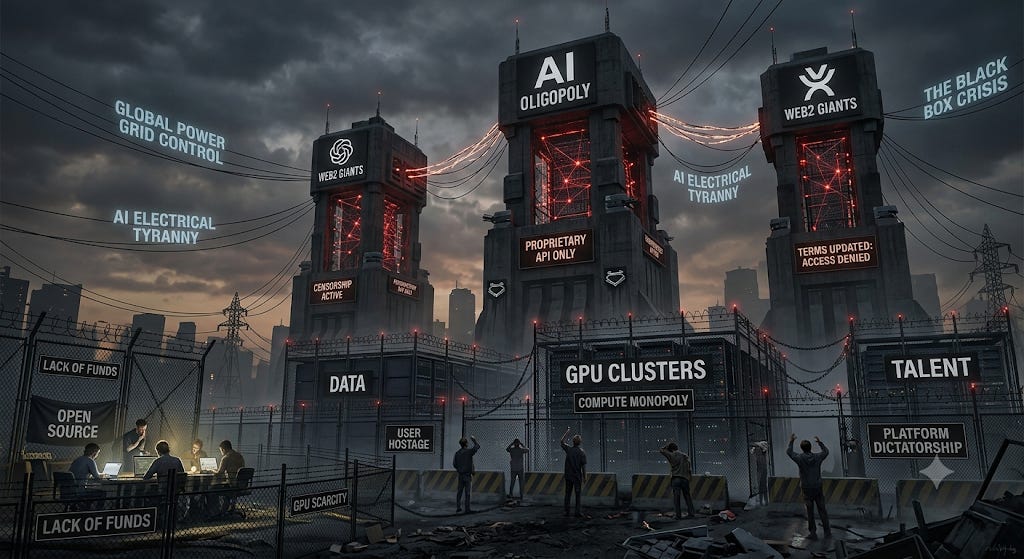
Artificial intelligence is the electricity of the 21st century. Yet, as of 2026, the global “power grid” remains under the tight control of a closed corporate oligopoly.
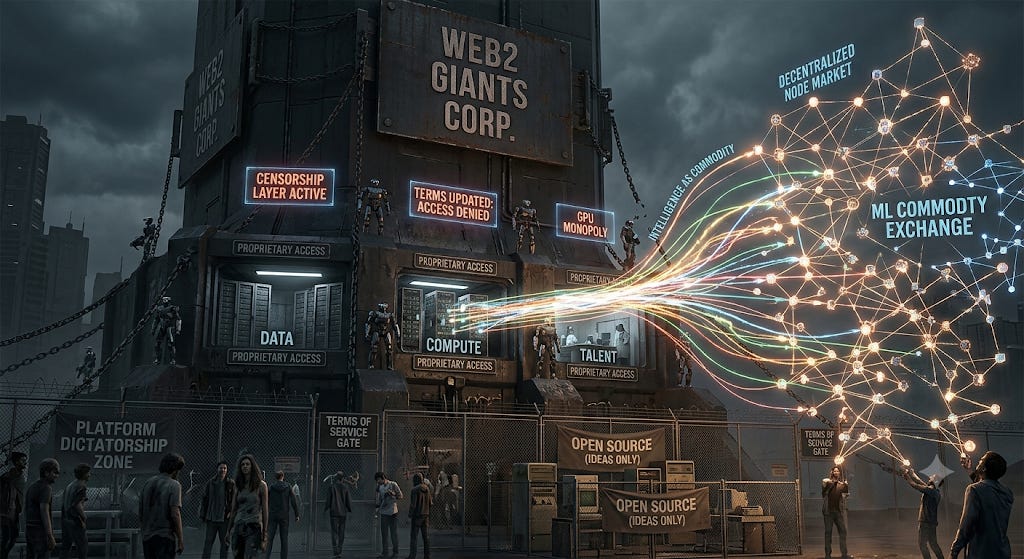
A handful of Web2 giants, including OpenAI, Google, and Anthropic, have monopolized the three foundational resources required to build AI: data, computational power (GPU clusters), and talent. They have spent billions of dollars training massive neural networks, only to lock them behind proprietary APIs.
For the global economy, this concentration creates a fundamental crisis. The most critical technology of the decade has become a black box. A handful of corporations decide who gets access to intelligence, how much it costs, and, most importantly, what that intelligence is allowed to say and which topics are subjected to corporate censorship.
Users and independent developers are held hostage by those decisions. Build your business on top of a closed model, and a revised pricing tier or an updated Terms of Service can wipe it out overnight. It is the ultimate platform dictatorship.
Traditional open source partially mitigates this problem, but it does not solve it. Open-source developers build exceptional models, yet they rarely have the financial resources required to rent thousands of GPUs and compete with corporate giants. They have the ideas. What they lack is the infrastructure and the economic engine.
The world urgently needs an open, decentralized alternative. It needs a market where compute and machine learning are not the private property of three or four corporations, but are freely traded as standardized commodities.
This is exactly the environment Bittensor was built to disrupt.
The biggest market misconception surrounding Bittensor is treating it as another competitor to ChatGPT, Claude, or Llama.
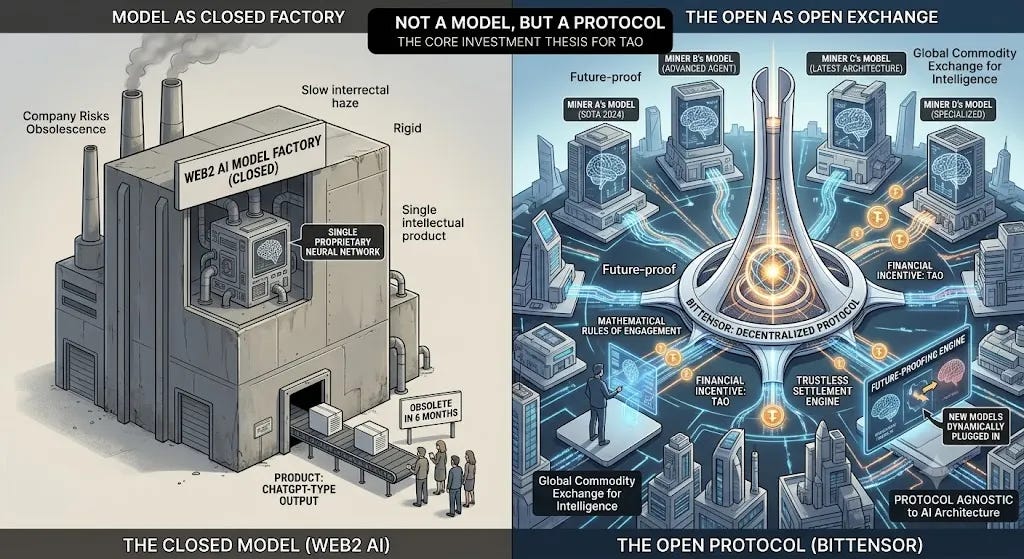
Bittensor is not an artificial intelligence. It does not train its own proprietary neural network or develop machine-learning algorithms. Bittensor is a protocol, a decentralized infrastructure that allows thousands of independent AI models to interact, compete, and monetize within a single global network.
To understand the difference, consider the Web2 architecture. OpenAI is a closed factory producing a single intellectual product. Bittensor, by contrast, is a global commodity exchange for intelligence, where thousands of independent factories compete in real time to deliver the best possible output. The protocol establishes the mathematical rules of engagement and guarantees trustless settlement between participants.
This distinction forms the core investment thesis for TAO: the protocol is future-proof against technological obsolescence.
In the AI sector, every individual model eventually becomes obsolete. What qualifies as a state-of-the-art breakthrough today often becomes a baseline standard within months. Companies built entirely around a single proprietary neural network risk being wiped out the moment a competitor releases a more efficient architecture.
Bittensor is immune to that dynamic because it remains agnostic to any specific AI architecture. When a superior machine-learning model emerges, miners can integrate it into the network, outperform their peers, and capture TAO rewards.
The protocol does not generate intelligence itself. It does something far more valuable: it creates the ultimate financial incentive for developers around the world to bring their best intelligence to the Bittensor network.
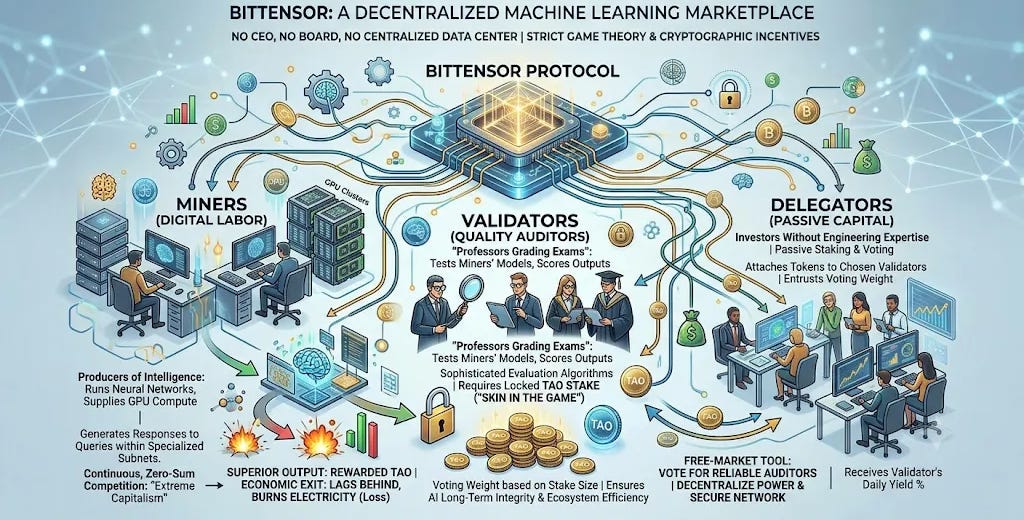
In any highly efficient economy, labor and capital must have clearly defined and separate functions.
Bittensor operates without a CEO, a board of directors, or a centralized data center. Instead, the protocol relies on strict game theory and cryptographic incentives to coordinate three key groups of participants. The structure resembles a classical separation of powers adapted for a global machine-learning marketplace.
Miners are the direct producers of intelligence. They deploy neural networks, supply the necessary computational power, and generate responses to queries within specialized subnets.
Their working environment is extreme capitalism. Miners do not receive a guaranteed salary. They exist in a state of continuous, zero-sum competition. If a miner’s model produces a superior, faster, or more accurate output than its competitors, the miner earns TAO. If the model falls behind, the miner simply burns electricity at a loss and is economically forced out of the market.
If miners are the students taking an exam, validators are the professors grading the papers. Their core function is to test miners continuously by submitting queries and mathematically scoring the quality of their outputs.
Writing a sophisticated evaluation algorithm, however, is not enough. Validation also requires capital. Validators must stake a significant amount of TAO, and the larger their stake, the greater their voting weight in the network’s reward distribution. This financial barrier creates skin in the game. The quality of the network is judged by participants whose own capital depends on the long-term integrity and efficiency of the ecosystem.
For retail and institutional investors without the technical expertise to operate servers or the capital required for solo validation, Bittensor offers delegation.
TAO holders can attach their tokens to a chosen validator, entrusting that validator with their voting weight in exchange for a share of the validator’s yield. This is not merely staking for passive income. It is a fundamental free-market mechanism through which independent capital continuously votes for the most reliable auditors, decentralizing power and securing the network.
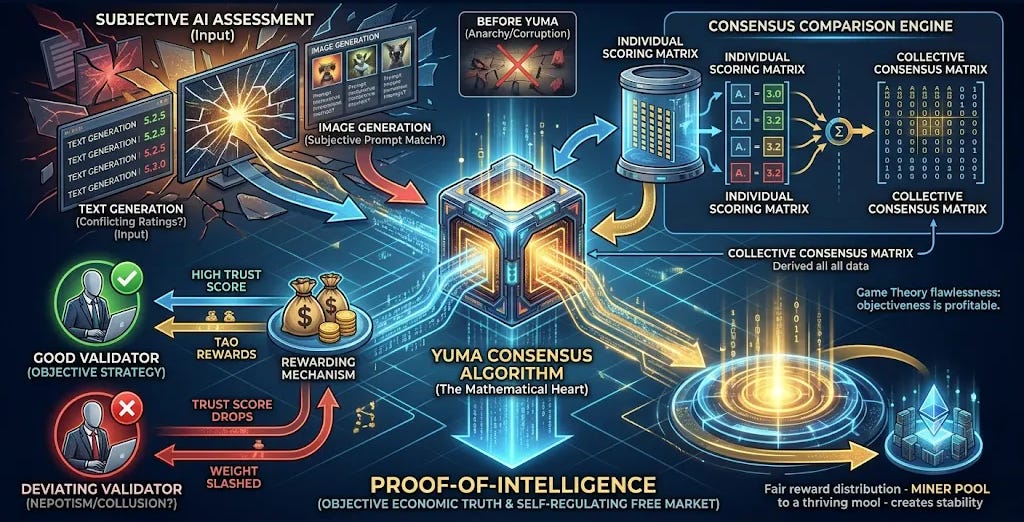
Yuma Consensus is the mathematical heart of Bittensor. It transforms the anarchy of decentralized neural networks into a functioning, self-regulating free market.
The central challenge facing any decentralized AI system is quality evaluation. While the validity of a Bitcoin block can be verified instantly through a simple mathematical function, evaluating an AI model is far more complex. Which text response is better? Which image matches the prompt more accurately? These questions are inherently subjective.
If validators could assign scores without restriction, the system would quickly collapse into corruption and nepotism. Major participants could downrank competitors while directing rewards toward their own affiliated miners.
Yuma Consensus solves this problem through sophisticated matrix mathematics.
The algorithm evaluates not only miners but validators as well. The protocol continuously compares each validator’s scoring matrix with the consensus matrix of the broader network. If a validator systematically deviates from that consensus, such as consistently awarding top scores to an underperforming miner, its Trust score declines and its weight in reward distribution is slashed.
The game theory here is flawless. Validators are economically disincentivized from lying, colluding, or playing favorites. Their most profitable strategy is to remain objective and reward genuine quality.
This is not a traditional consensus mechanism based on hardware parameters, like Bitcoin’s Proof of Work or Ethereum’s Proof of Stake. This is Proof of Intelligence, the world’s first functioning algorithm designed to convert fragmented, subjective human and machine assessments into objective economic truth.
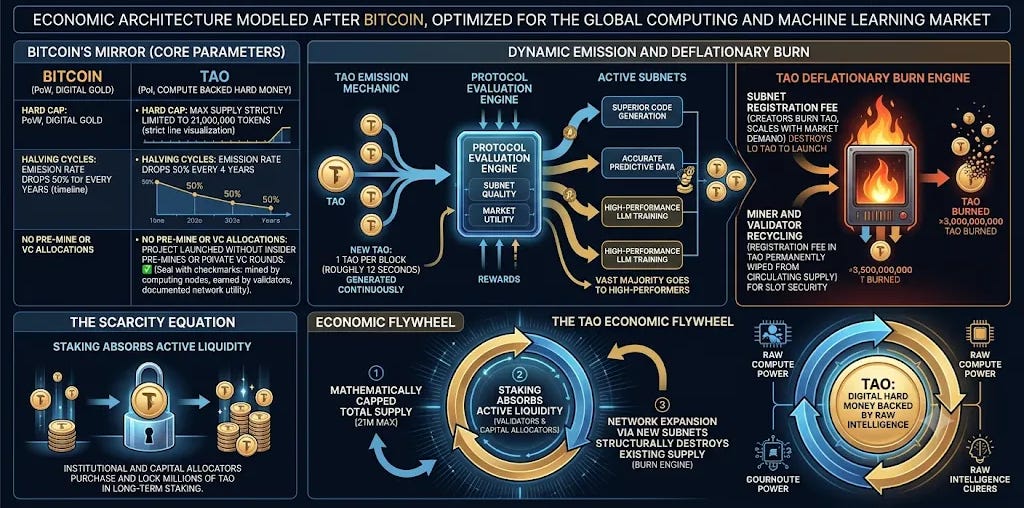
Bittensor’s economic architecture is deliberately modeled after Bitcoin but optimized for the global computing and machine-learning market. It operates under the laws of pure, uncompromising capitalism, where every token represents a scarce and highly contested resource.
TAO shares several core parameters with Bitcoin:
Hard Cap: The maximum supply is permanently capped at 21,000,000 tokens.
Halving Cycles: The emission rate declines by 50% every four years, or every 10.5 million blocks.
No Pre-mine or VC Allocations: The network launched without insider pre-mines or private venture-capital rounds. Every token in circulation was either mined by network participants or earned by validators through documented network utility.
New TAO is issued at a fixed rate of one token per block, approximately every 12 seconds, and distributed across active subnets. The allocation, however, is far from uniform.
The protocol continuously evaluates the quality and market utility of each subnet. The strongest performers, whether they produce superior code, predictive analytics, or other specialized outputs, receive the largest share of newly issued TAO. This forces subnet owners to optimize their marketplaces relentlessly or lose emission share to competitors.
The emission schedule is complemented by a powerful burn mechanism:
Subnet Registration Fees: Launching a new subnet requires creators to burn TAO. The entry fee adjusts dynamically with demand. As more teams compete to build subnets, registration costs rise and permanently remove additional tokens from circulation.
Miner and Validator Registration: Securing a competitive position within an active subnet also requires a TAO registration fee, which is permanently burned.
To secure validation rights and maintain influence within the protocol, institutional and other capital allocators must also purchase and lock substantial amounts of TAO through long-term staking.
The resulting dynamic is a highly calibrated economic flywheel. Total supply is mathematically capped. Active market liquidity is continuously absorbed through staking. Horizontal network expansion structurally destroys existing supply through the burn engine. TAO acts as digital hard money backed by raw intelligence.
The primary error made by critics who dismiss the intersection of AI and blockchain lies in a single question: “Why does a neural network need crypto when it already runs on standard code and servers?”
The answer is straightforward. AI does not require money in the human sense. It has no use for bank accounts, payment cards, credit scores, or paper contracts. What AI requires are autonomous, instantaneous, and censorship-resistant micropayments.
The traditional financial system, with its institutional bureaucracy, clearing houses, settlement fees, delays, and geopolitical borders, is fundamentally incapable of providing this at machine scale.
As hundreds of thousands of autonomous AI agents begin interacting with one another, cryptography becomes the only logical transactional language for machines. This is the core thesis behind Bittensor: TAO functions as the financial layer for artificial intelligence.
That financial layer solves three strategic problems.
When an AI model in one subnet requires data verification or computation from another, the two systems do not sign a corporate service-level agreement. They interact through smart contracts. TAO acts as the trustless intermediary, ensuring that a machine receives payment the instant its algorithm delivers valid work.
Traditional banking rails become economically unviable when transactions involve a single token of generated text, one rendered image component, or another microscopic unit of computational labor.
A dedicated blockchain architecture allows machines to execute enormous volumes of micropayments, settling value at a scale and frequency conventional payment systems cannot support efficiently.
Bittensor treats intelligence the way commodity markets treat oil or electricity: it standardizes it.
Through TAO, intelligence becomes a liquid, globally tradable commodity. By purchasing or staking TAO, an enterprise gains a mathematically guaranteed claim on a proportional share of the network’s aggregate processing power and intellectual output.
AI does not need crypto to generate text, images, or code. It needs crypto to purchase resources from other machines while maintaining complete operational autonomy from human financial institutions. TAO is the world’s first sovereign currency for the machine economy.
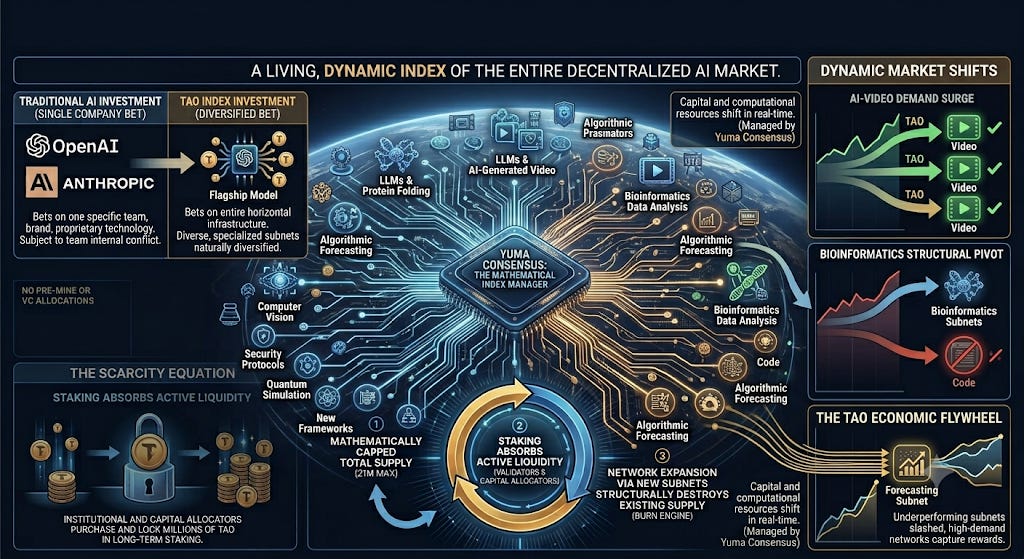
For investors, Bittensor introduces an entirely new capital-allocation paradigm. Buying exposure to an AI enterprise such as OpenAI or Anthropic means betting on one team, one brand, and one closed proprietary technology. If its flagship model loses its edge or internal conflict fractures the team, invested capital absorbs the damage.
TAO operates differently. It functions as a living, dynamic index of the entire decentralized AI market.
Holding TAO provides exposure to the broader horizontal infrastructure of the Bittensor network. Because the ecosystem consists of dozens of independent, specialized subnets, an investor’s capital is naturally diversified across multiple vectors of machine-learning development.
If demand for AI-generated video accelerates, capital and computational resources shift toward dedicated video subnets, increasing their share of network rewards and the utility value of the broader ecosystem.
If the structural trend pivots toward bioinformatics, complex data analysis, or algorithmic financial forecasting, the network self-corrects in real time. Underperforming subnets lose emission share, while high-demand networks automatically capture those rewards.
It is an automated index fund managed not by human asset managers, but by an uncompromising mathematical engine: Yuma Consensus.
A TAO investor does not need to predict whether transformers, diffusion models, or an entirely new architecture will dominate the next decade. Any breakthrough developed anywhere in the world can be integrated into Bittensor by independent miners competing for economic rewards.
The crypto market is exhausted by whitepapers and promises of a brighter decentralized future. By 2026, institutional capital demands one thing: product-market fit. Technology must solve tangible business problems today.
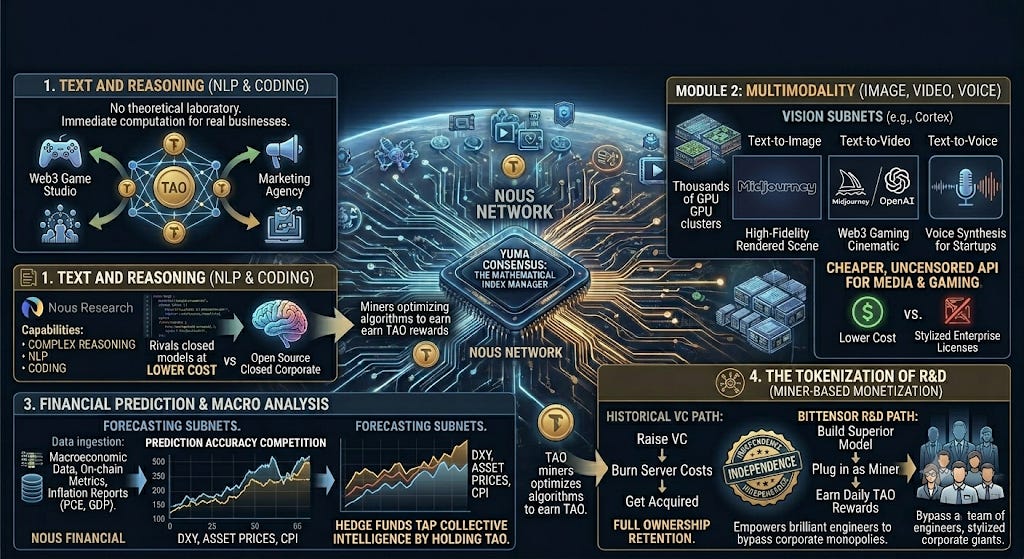
Bittensor is not a theoretical laboratory. It already functions as a B2B marketplace where enterprises and developers purchase computational services across a growing network of specialized subnets.
Some of the network’s most competitive subnets, including those driven by open-source leaders such as Nous Research, specialize in natural-language processing, coding, and complex reasoning.
Because miners continuously optimize their models to capture TAO rewards, these subnets can produce outputs that rival closed corporate alternatives at a significantly lower cost for developers.
Bittensor has expanded far beyond text. Dedicated subnets, including Cortex and other vision-focused networks, coordinate distributed GPU resources to render high-fidelity images, synthesize speech, and generate video from text prompts.
For Web3 gaming studios, marketing agencies, and media startups, the Bittensor API offers a cheaper and uncensored alternative to expensive enterprise licenses from Midjourney or OpenAI.
One of the most compelling use cases for capital allocators lies in financial forecasting.
Dedicated subnets aggregate macroeconomic data, on-chain metrics, inflation indicators, and market variables to compete on predictive accuracy across assets such as the DXY. Hedge funds can tap into the collective intelligence of thousands of algorithmic models through the network.
Perhaps the most profound use case for Bittensor is its disruption of the venture-capital model.
Historically, an AI startup had one viable path: raise venture funding, burn it on server costs, and ultimately seek acquisition by Google, Microsoft, or Apple. Bittensor offers an alternative. A talented development team can build a superior model, deploy it into the network as a miner, and monetize its code directly through daily TAO rewards.
The protocol pays for intelligence directly. It allows engineers to remain independent, bypass corporate monopolies, and retain ownership of their intellectual labor.
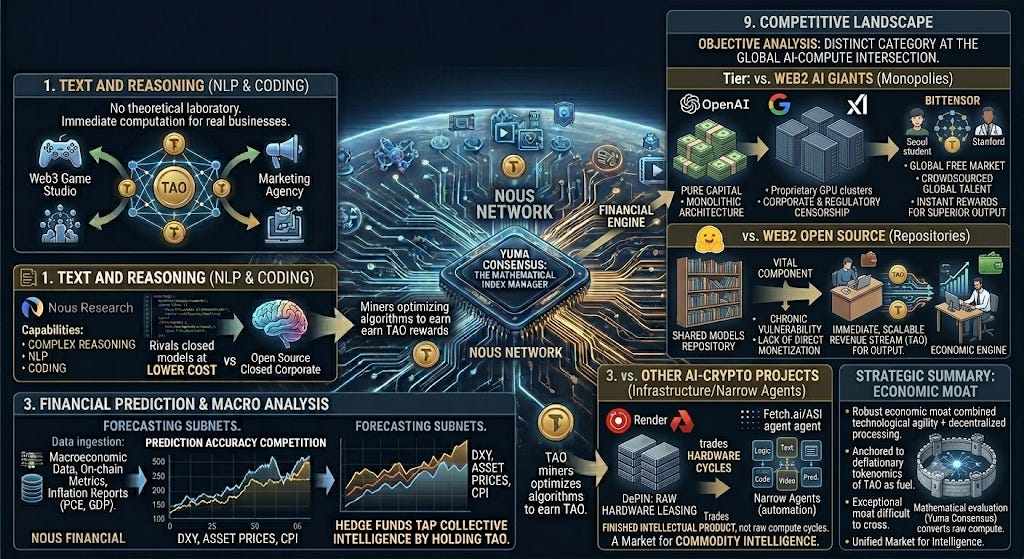
To understand TAO’s competitive position, comparisons with conventional Layer 1 blockchains such as Ethereum or Solana must be discarded. Bittensor operates in a distinct category. Its battleground sits at the intersection of global artificial intelligence, decentralized infrastructure, and computational power.
As of 2026, Bittensor competes across three primary fronts.
This is the central existential battle.
Closed technology monopolies hold an enormous advantage in capital reserves, proprietary datasets, and direct access to state-of-the-art GPU clusters. Their weaknesses lie in monolithic architectures and strict corporate, political, and regulatory controls.
Bittensor counters with a global free market. Instead of sustaining a centralized workforce of thousands of engineers on fixed salaries, it draws on crowdsourced talent from around the world. Any developer, from a student in Seoul to a researcher at Stanford, can plug an algorithm into the network. If the output is superior, the protocol rewards it instantly.
Bittensor competes with Web2 giants not through concentrated capital, but through the sheer velocity of decentralized innovation and permissionless deployment.
Platforms such as Hugging Face serve as vital repositories where developers share open-source machine-learning models. Yet the open-source movement has historically suffered from one chronic weakness: the absence of direct monetization.
Engineers build sophisticated models out of passion but are often forced into corporate roles simply to finance compute costs. Bittensor introduces the missing component, an economic engine. Developers can deploy models directly into a competitive marketplace and earn a scalable TAO-denominated revenue stream based on performance.
This transforms open-source AI from a static code repository into a competitive financial incubator for sovereign intelligence.
Most crypto projects branded around AI solve fundamentally different infrastructure problems.
Render and Akash operate as decentralized physical infrastructure networks, leasing raw GPU capacity without evaluating what is being computed. Fetch.ai and similar projects focus primarily on workflow automation and narrow autonomous agents.
Bittensor sits higher in the stack. It abstracts raw compute power and transforms it into a finished intellectual product. It does not trade hardware cycles. It trades standardized outputs: logic, text, code, images, video, and complex data predictions.
It is a marketplace for commodity intelligence itself.
Bittensor has engineered a robust economic moat by combining the technological agility of open-source AI with decentralized processing power and the deflationary tokenomics of TAO.
Yuma Consensus determines how value is allocated. TAO provides the operational fuel and financial incentives that keep the ecosystem competitive. Together, they transform distributed compute into a unified market for machine intelligence.
No other Web3 project has successfully deployed a comparable mathematical evaluation framework at this scale. That moat is exceptionally difficult to cross.
TAO’s future trajectory hinges on one fundamental conflict: whether an open, decentralized market for machine intelligence can evolve faster than the closed laboratories of Web2 monopolies.
Three core scenarios illustrate how that competition could unfold.
In the bullish scenario, open-source models decisively outcompete proprietary corporate architectures.
Aggressive censorship, political bias, and restrictive API pricing push enterprises and Web3 developers toward Bittensor. Subnets evolve beyond basic text generation into robotics, computational biology, scientific research, autonomous finance, and physical infrastructure coordination.
Institutional capital begins to view TAO as the most liquid and frictionless index-fund proxy for the global decentralized AI industry.
Economic Impact: Exponential growth in subnet registrations triggers massive token burns. Major enterprises systematically accumulate TAO to become validators and secure operational access to network resources. The resulting extreme supply shock propels TAO into the upper echelon of macro digital assets.
In the base case, OpenAI, Google, and other Web2 giants retain their lead in frontier AI through enormous proprietary data centers and concentrated capital.
Bittensor, however, monopolizes large specialized niches. Web3 protocols, gaming studios, quantitative traders, and enterprises requiring uncensored AI, data privacy, or permissionless infrastructure rely on the TAO architecture.
Economic Impact: Network revenue expands sustainably. Yuma Consensus efficiently purges weak models. TAO staking produces predictable, organic returns. The project secures its position as the undisputed leader of the AI and crypto sector while coexisting with traditional Web2 monopolies.
The bearish scenario can unfold through two primary vectors.
The first is economic. Web2 giants slash proprietary API pricing toward near-zero margins, making Bittensor mining economically unviable and forcing independent miners to shut down GPU capacity.
The second is technical. Goodhart’s Law degrades the consensus mechanism. Miners discover exploits in validator evaluation algorithms and begin producing optimized garbage, outputs that score highly under protocol rules but hold no commercial value for real users.
Economic Impact: Enterprise clients abandon the subnets. Real-world demand collapses. Validators begin mass unstaking and dumping TAO into the open market. The incentive economy enters a severe liquidity and price death spiral.
Despite its expansive vision of artificial intelligence decoupled from corporate gatekeepers, Bittensor remains one of the most experimental and technologically complex architectures at the intersection of Web3 and machine learning. Investors must carefully assess its core structural, operational, and physical risks.
Goodhart’s Law states: “When a measure becomes a target, it ceases to be a good measure.”
This represents the single greatest internal vulnerability of the Bittensor ecosystem. Miners are economically incentivized to maximize TAO rewards. Rather than training models that deliver genuine commercial utility, they may redirect resources toward exploiting validator evaluation algorithms and gaming the grading formulas.
If this behavior scales unchecked, the network risks producing optimized garbage, outputs that score highly within the protocol but hold zero practical value for business integration.
Decentralized AI ultimately relies on physical infrastructure.
The global market for cutting-edge GPUs, including Nvidia’s H100, B200, and next-generation architectures, remains supply constrained and tightly controlled. Microsoft, Google, Meta, and other Web2 giants secure enormous volumes directly from foundries and deploy them inside gigawatt-scale data centers.
Independent Bittensor miners operate under very different conditions. They must procure hardware at premium prices or source secondary capacity through DePIN marketplaces.
If legacy corporations successfully concentrate access to state-of-the-art silicon, Bittensor risks being technologically throttled and confined to previous-generation hardware.
Within Bittensor, the authority to grade machine-learning quality and direct TAO emissions is concentrated among top-tier validators.
Under the staking framework, voting weight increases with delegated TAO. This creates an inherent oligopoly risk. A small concentration of institutional validators and venture funds can accumulate enough influence to manipulate emissions in favor of affiliated subnets and miners while systematically disadvantaging independent developers.
Any perceived corruption within Yuma Consensus would break the protocol’s central promise of a fair and meritocratic free market.
TAO faces regulatory pressure from two directions.
On the digital-asset front, securities regulators and frameworks such as Europe’s MiCA scrutinize tokens built around large-scale staking architectures without localized corporate entities.
On the technology front, governments are introducing rules covering AI development, content watermarking, identity verification, access to compute, and uncensored foundational models.
Because Bittensor is permissionless, borderless, and pseudonymous, it stands as a primary target for states seeking to control the distribution of machine intelligence.
Artificial intelligence has evolved far beyond software. By 2026, it has become one of the defining infrastructure resources of the global economy, as strategically important as oil or electricity were in previous generations.
The question is no longer whether AI will reshape the global economy. The question is who will own the infrastructure behind it. Will intelligence remain concentrated in the hands of a handful of technology monopolies, or will it evolve into an open market where anyone can contribute, compete, and be rewarded?
Bittensor is the most ambitious and mathematically rigorous attempt to build that alternative.
The market still largely misunderstands the nature of this project, viewing TAO through the lens of consumer AI and comparing it with chatbots or proprietary models. That misses the point entirely.
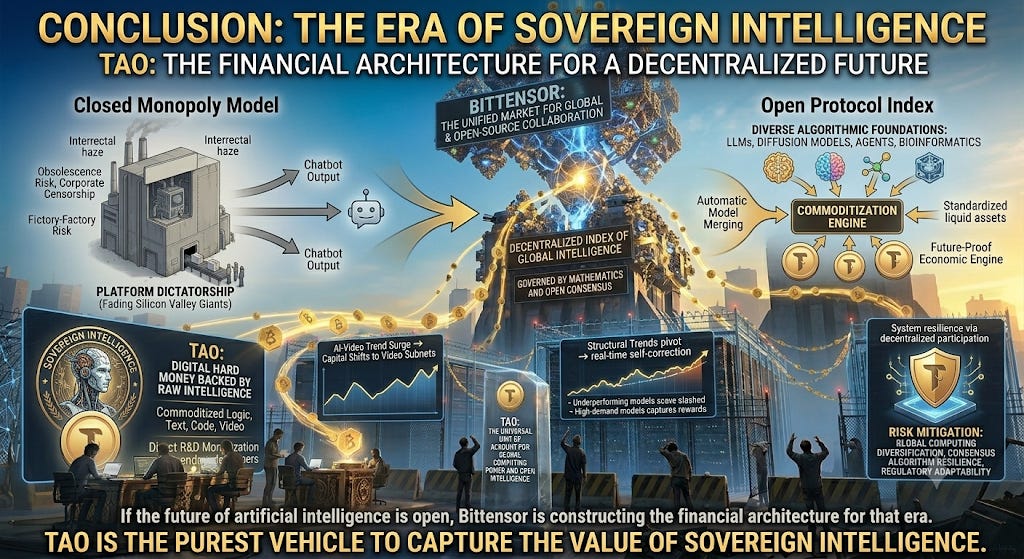
Bittensor is not trying to build the best model. It is building the financial infrastructure that incentivizes developers around the world to merge their best intelligence into a single decentralized ecosystem. The protocol commoditizes subjective intelligence, transforming it into a standardized, liquid asset.
For investors, the implication is straightforward. Rather than betting on which proprietary AI architecture will dominate tomorrow, TAO provides exposure to the economic engine itself, a system designed to absorb, evaluate, and monetize every future breakthrough in machine intelligence.
It is the ultimate decentralized index of global intelligence.
Make no mistake. This is an allocation with an extreme risk profile. GPU supply constraints, adversarial attacks on consensus, validator concentration, and aggressive regulatory crackdowns all represent substantial threats. The potential upside, however, reflects the magnitude of those risks.
If the future of artificial intelligence belongs not to closed corporate laboratories but to open-source collaboration and free-market compute, Bittensor is building the financial architecture for that new era.
And the TAO token is the purest vehicle to capture the value of that Sovereign Intelligence.
Disclaimer:
This report is intended solely for informational and educational purposes and reflects independent commentary and analysis by the author. The author is not affiliated with any company mentioned in this report and holds no positions on the board of any related entities. All opinions, analyses, and insights expressed are the author’s alone and should not be interpreted as specific investment advice, a solicitation to buy or sell securities, or an endorsement of any particular investment strategy.
The information provided is derived from sources and research the author deems reliable, but its accuracy, completeness, or timeliness is not guaranteed. Readers should not rely on this report as the sole basis for any financial decisions. The author disclaims any liability to update or revise the content as new information becomes available.
Investing involves significant risks, including the potential for loss of principal. Past performance does not guarantee future results. Investments or strategies discussed may not suit every individual’s circumstances, and they may fluctuate in price or value. This report does not consider your specific financial objectives, risk tolerance, or personal investment needs. Readers are encouraged to conduct their own research and consult with a qualified financial or investment advisor before making any investment decisions.
The author and any associated entities do not guarantee specific outcomes or profits from the use of this report. The author may or may not hold open positions in the securities mentioned. By reading this report, you acknowledge the risks involved and accept the limitations of the information presented.
Comments
Nothing yet. Say the first thing.
Sign in to join the conversation.