
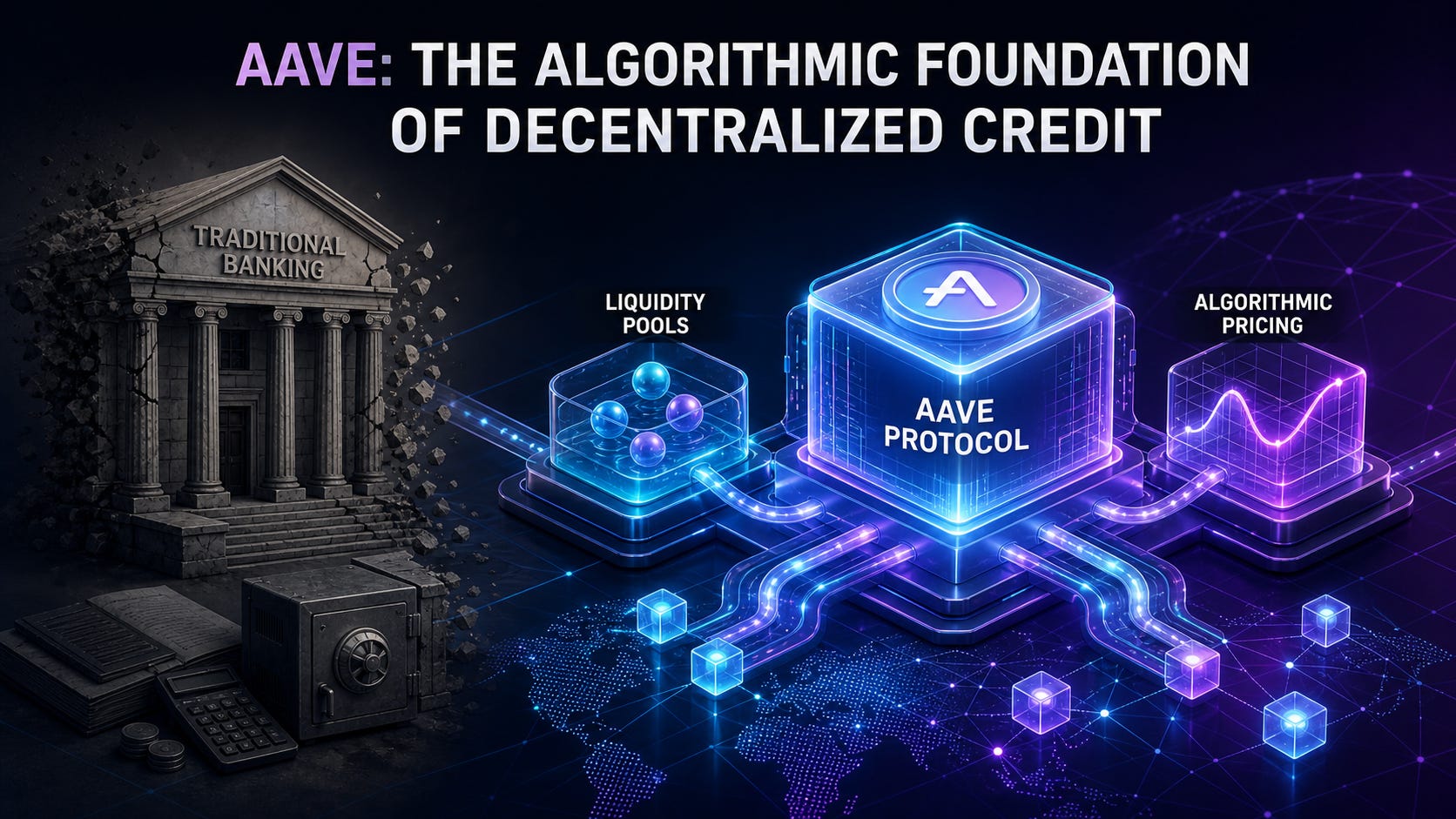
In a world where market inefficiencies are traded algorithmically and capital management requires millisecond precision, the legacy banking architecture looks like a manual calculator. Credit risk in TradFi is managed opaquely, reacts to events post factum, and often relies on fractional reserve banking, which inevitably leads to hidden bad debts. The system privatizes profits and socializes losses.
Aave fundamentally shifts this paradigm. The biggest mistake is to view it simply as just another DeFi application for speculative leverage. As of 2026, Aave functions as a decentralized settlement layer for the global credit market. The protocol entirely commoditizes liquidity. It does not attempt to match a specific lender with a specific borrower; instead, it creates a global architecture of shared pools where the rules of the game are determined exclusively by mathematics.
For investors and capital architects, this represents a fundamental shift. By tokenizing both debt obligations and deposits, Aave engineers the risk-free rate of the Internet itself. By betting on this protocol, you are not investing in another financial company, but in an open macroeconomic infrastructure - an algorithmic foundation that determines the true cost of money and risk for the entire decentralized economy.
The Crisis of Centralized Lending
Not a Bank, but a Protocol
The Division of Capital and Risk
Deconstructing Capital Efficiency (V3, Flash Loans & V4)
AAVE Tokenomics: Hard Capitalism for Liquidity
Core Thesis: Engineering the Internet’s Risk-Free Rate
Aave as an Index of Decentralized Credit
Ecosystem, RWA, and Real-World Use Cases
Competitive Landscape
Growth Scenarios 2026-2028
Systemic Risks
Conclusion
The traditional financial system (TradFi) functions as a black box built on information asymmetry. Banks employ fractional reserve banking, lending out significantly more capital than they actually hold in deposits. Credit risk management happens behind closed doors, balance sheets are published with a quarterly lag, and bad debts are often masked through complex derivative instruments. When the system inevitably overstretches, as it did in 2008, the rule of “privatizing profits and socializing losses” triggers - taxpayers bail out institutions that took on excessive risk.
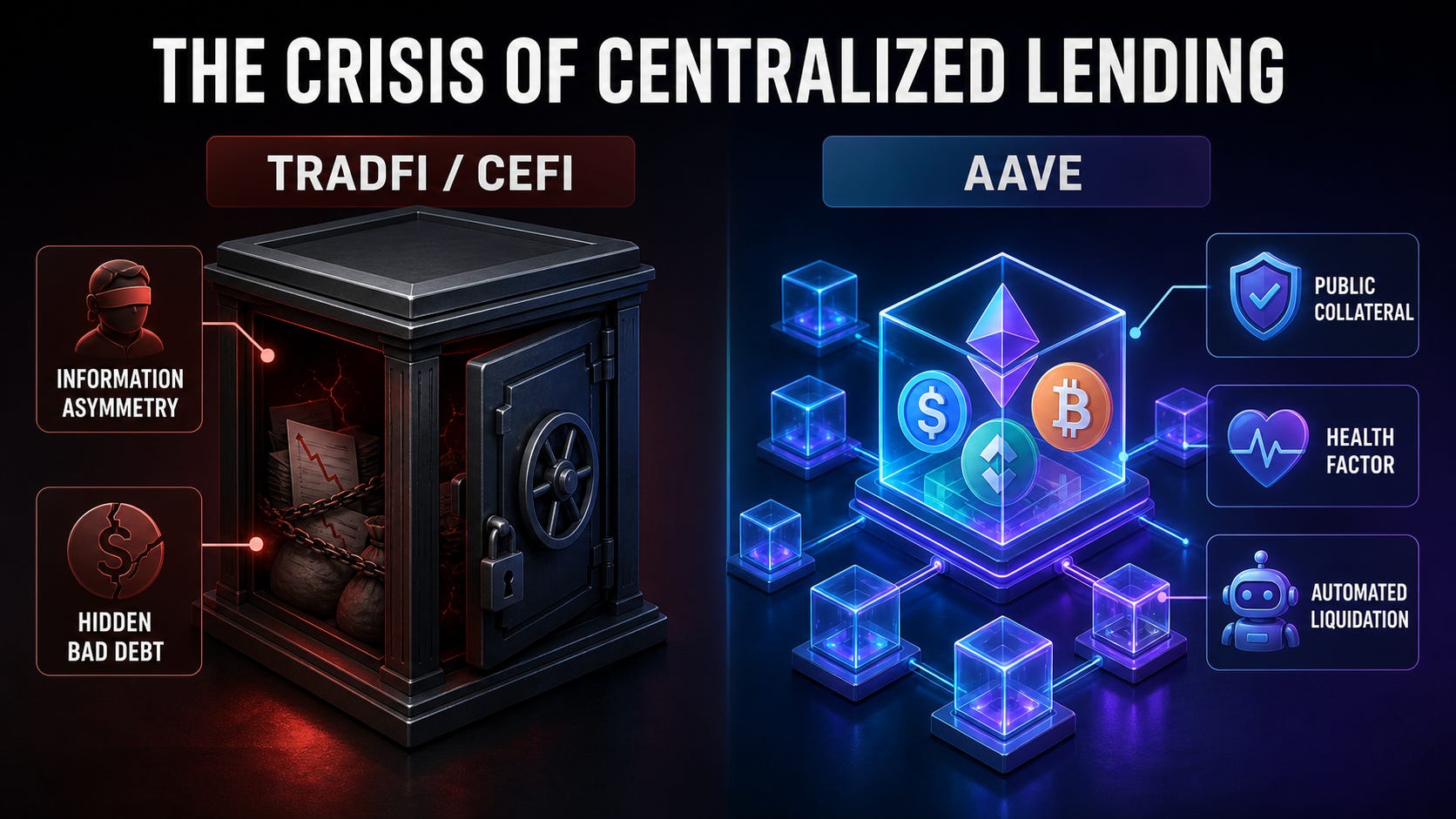
The crypto industry initially attempted to replicate this model by creating the Centralized Finance (CeFi) sector. However, 2022 provided a brutal lesson on what happens when traditional opacity is combined with the hyper-volatility of digital assets. Platforms like Celsius, BlockFi, and Voyager promised retail investors stable “DeFi yields.” In reality, they functioned as unregulated hedge funds. They took user deposits and engaged in rehypothecation - secretly pledging the same collateral for multiple loans, investing in high-risk directional positions. When the market collapsed, it turned out that users were not bank clients, but unsecured creditors of bankrupt funds.
Aave was created to dismantle this architecture of trust. The protocol replaces the promise of “trust us” with the cryptographic imperative “verify the code.”
Aave proves that the global credit market does not need intermediary banks. It only needs ruthless, deterministic code that applies rules equally to all participants, removing human corruption from the risk assessment process.
The biggest conceptual misconception regarding Aave is attempting to apply traditional peer-to-peer (P2P) lending logic to it. In a classic P2P world, the platform is merely a bulletin board: a lender with capital must find a borrower with matching requests for amount, duration, and interest rate. This creates immense friction, time delays, and liquidity fragmentation. Aave does not do matchmaking. Aave is a Peer-to-Pool architecture.
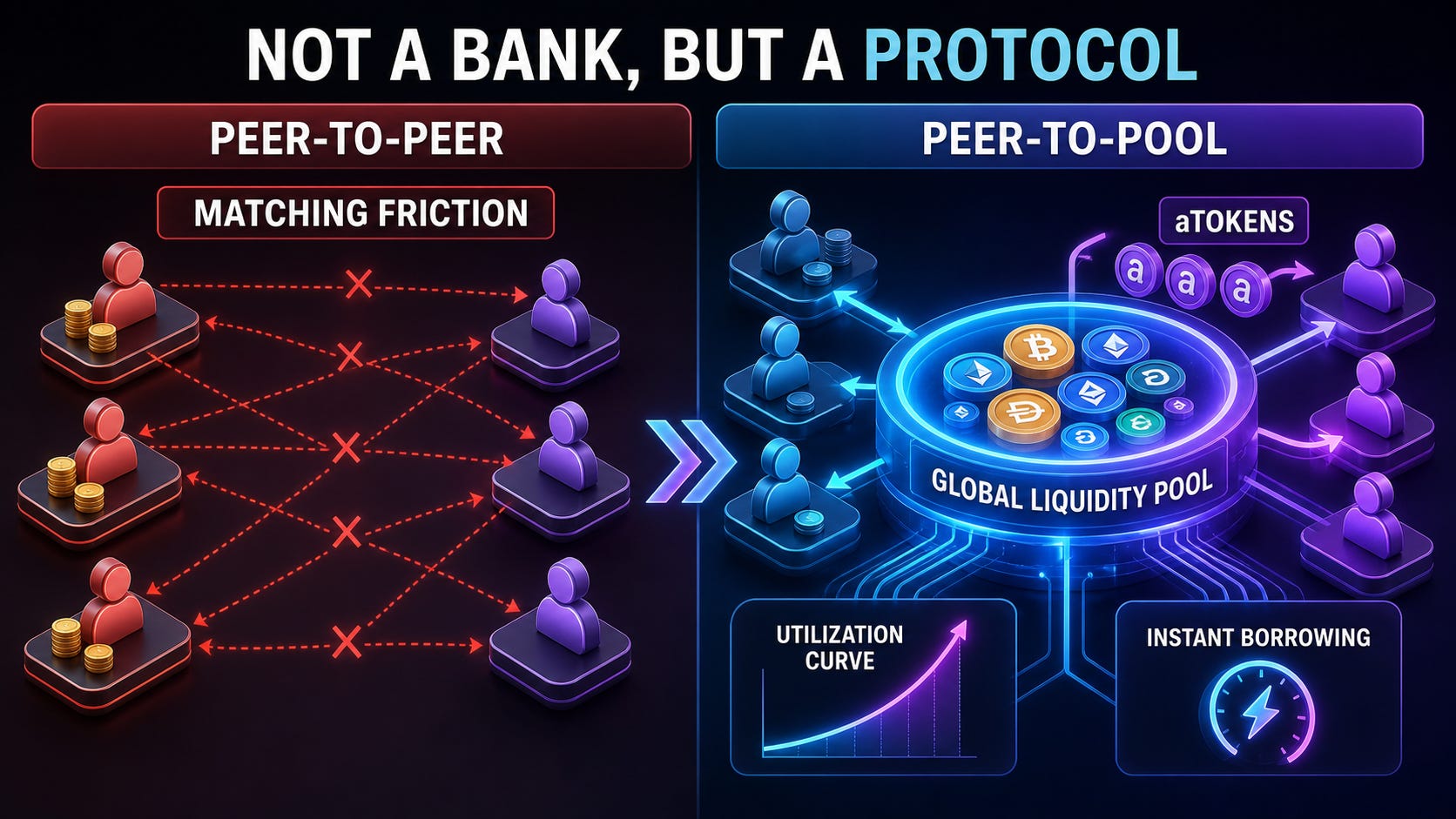
Instead of signing bilateral contracts, capital providers deposit their assets into a single, global smart contract - a liquidity pool. In that same millisecond, the protocol mints and sends them aTokens (e.g., aUSDC instead of the deposited USDC). An aToken is not just a deposit receipt. It is a yield-bearing cryptographic derivative whose balance algorithmically grows in your wallet block by block, reflecting earned interest. Furthermore, this token is fully liquid: you can transfer it, sell it, or use it as collateral in other DeFi protocols while your initial capital continues to generate yield in Aave.
Borrowers sit on the other side of the pool. They do not have to wait for a credit committee’s approval or search for a counterparty. If there is available liquidity in the pool, and the borrower has provided sufficient over-collateralization in another asset (e.g., locking ETH to borrow stablecoins), they can withdraw the funds instantly. This mechanism guarantees constant on-demand liquidity.
But how is the cost of this money determined if there is no board of directors or central bank to set a discount rate? Aave relies on a rigid mathematical function - the Utilization Curve.
The interest rate is algorithmically recalculated based on the current ratio of borrowed capital to the total liquidity in the pool:
If demand is low and money is sitting idle, the algorithm lowers rates, incentivizing traders to take out loans.
If demand skyrockets and the pool nears depletion, the curve hits a “kink point.” Borrowing rates exponentially spike upwards (sometimes to double or triple-digit APYs). This creates an instant market self-regulation mechanism: high rates financially force borrowers to repay debts, and new investors to aggressively deposit their capital for the outsized yields. The system autonomously protects itself from liquidity shortages.
Aave is not a bank because it takes on no balance sheet risks, does not pocket the deposit-lending spread as pure company profit, and makes no discretionary management decisions. It is a neutral infrastructure protocol - a global vending machine for liquidity that balances market supply and demand with millisecond and mathematical precision.
In any highly efficient economy, the functions of providing capital and managing risk must be clearly separated. A traditional bank concentrates all these functions within a single institution: it attracts deposits, issues loans, and independently tries to manage default risk. This creates a massive conflict of interest and a centralized point of failure.
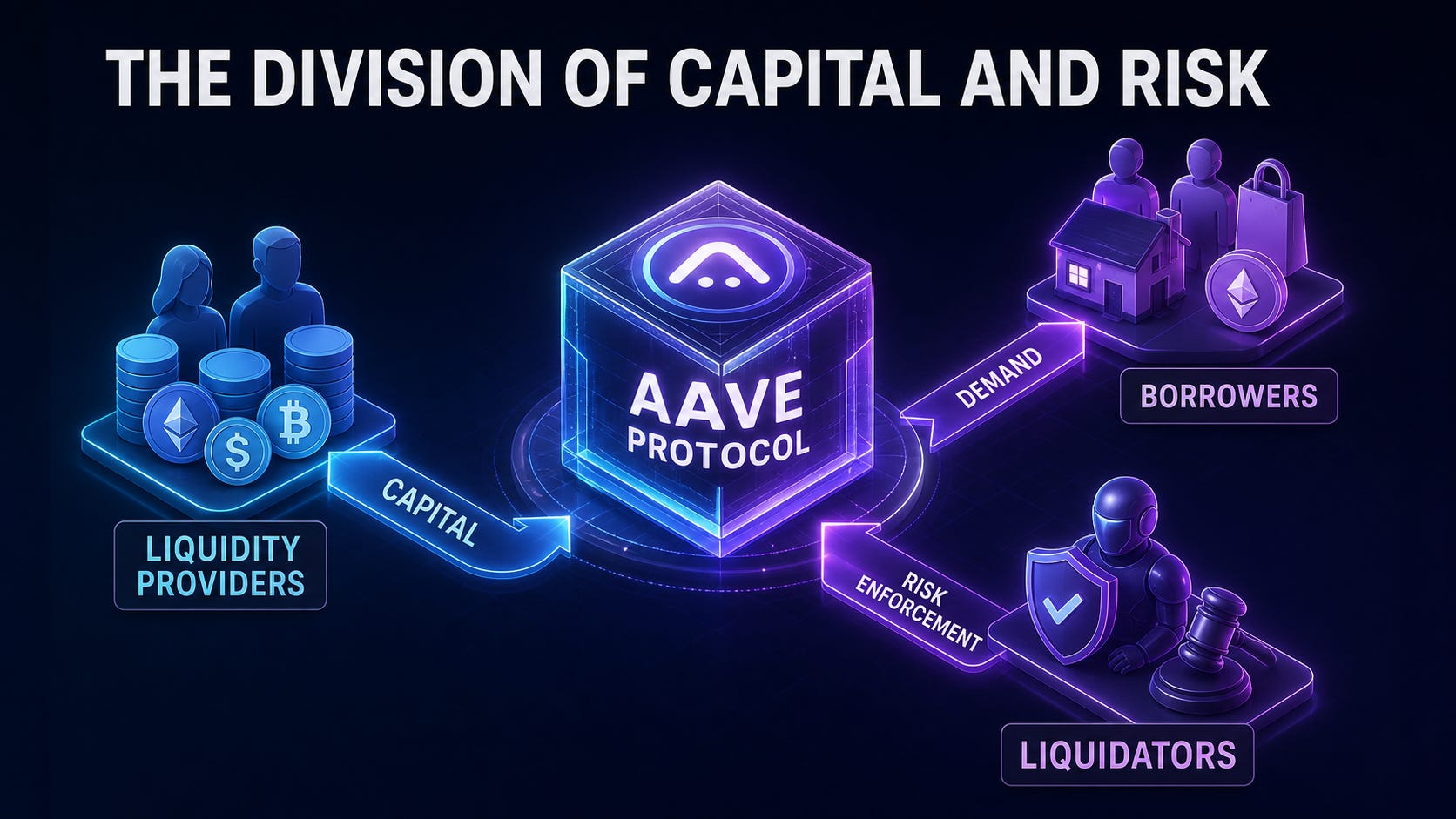
Aave deconstructs this model. The protocol does not employ risk managers and has no proprietary capital. Instead, it relies on ruthless game theory, coordinating three distinct groups of participants through purely financial incentives. This structure resembles a classic separation of powers, adapted for an automated capital market.
Liquidity Providers (Passive Capital): The foundation of the protocol. Investors seeking predictable, algorithmic yield without taking on directional market risk. They supply the “raw material” - stablecoins, ETH, or other crypto assets. They assume smart contract risk but are completely insulated from the need to assess the creditworthiness of those taking the money.
Borrowers (Active Capital): Traders, hedge funds, and DAOs who generate demand. They deposit excess collateral to access liquidity without having to sell their spot assets (avoiding taxable events or losing potential upside from asset appreciation). Borrowers use the acquired capital for margin trading, shorting volatile tokens, arbitrage, or operational funding. They pay a floating interest rate, which becomes the revenue for liquidity providers.
Liquidators (Economic Snipers): The most critical yet often invisible element of the system, replacing traditional collection agencies and lawsuits. These are not humans, but high-frequency trading bots. Their sole purpose is to monitor the blockchain 24/7 in search of borrowers whose Health Factor has dropped below 1.0 (meaning their collateral value no longer safely covers the debt).
When that moment arrives, liquidators do not need permission. A bot instantly initiates a transaction, paying off the borrower’s debt to the protocol, and in return, takes the borrower’s collateral at a discount (Liquidation Penalty), typically ranging from 5% to 10%. This discount represents guaranteed arbitrage profit for the liquidator.
This architecture creates a perfect, self-regulating mechanism. Liquidators do not work for Aave; they are driven exclusively by their own greed. Yet their ruthless pursuit of profit is precisely the mechanism that purges toxic debt from the protocol, ensuring that liquidity providers can always withdraw their funds and that the system remains solvent even during a 30%-per-hour market crash.
The fundamental problem with any over-collateralized lending system is capital lock-up. If you have to lock up $1,500 in assets to borrow $1,000, capital becomes inefficient. In previous versions of the protocol (V1 and V2), this limitation was rigid, making DeFi less attractive for large-scale institutional strategies compared to traditional prime brokers.
Aave V3 completely rewrote these rules, introducing an architecture that maximizes capital efficiency to levels unavailable in traditional finance, while maintaining mathematically verified security. This was achieved by deconstructing risk at the micro-level and introducing unique smart contract primitives.
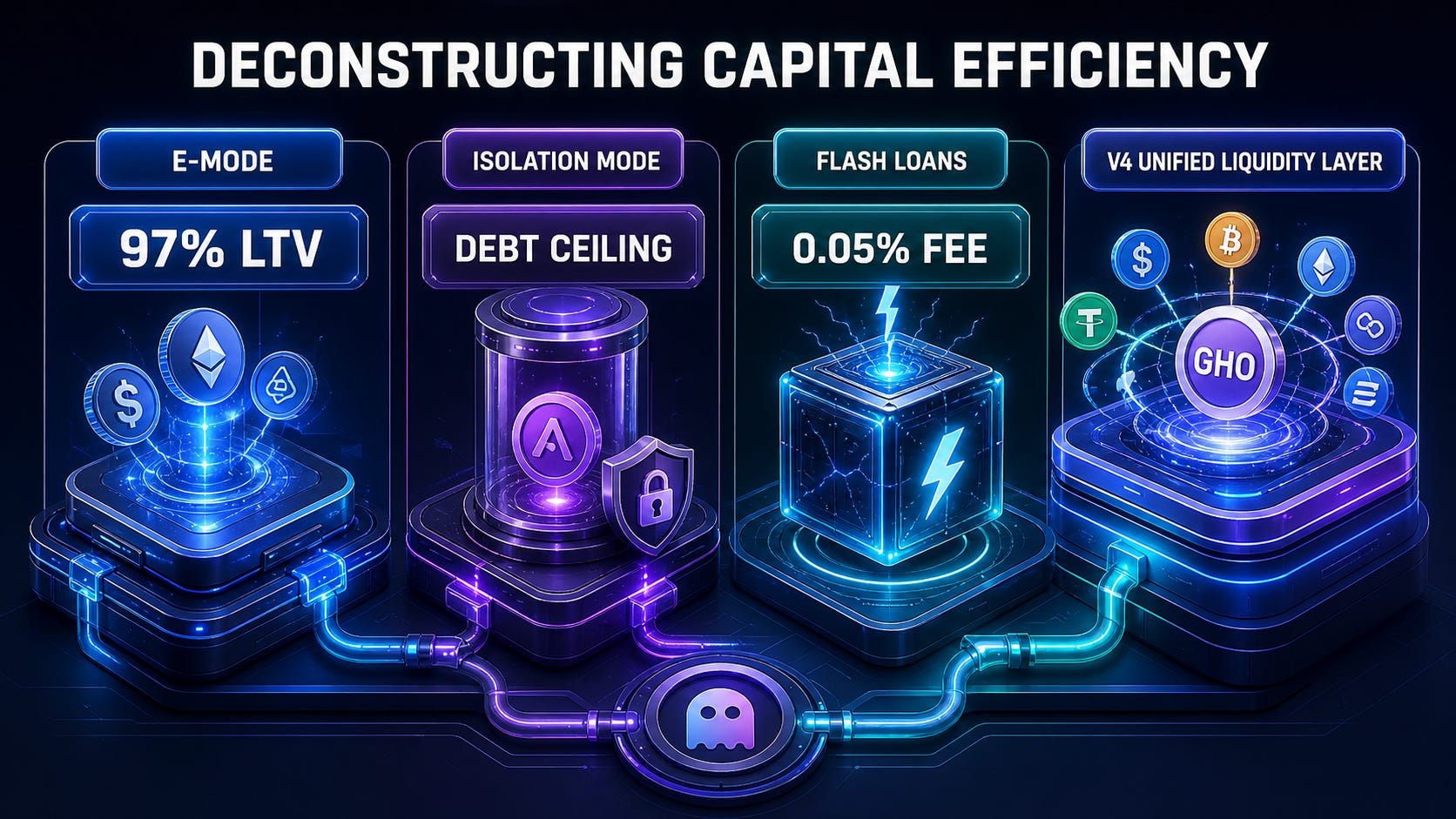
The E-Mode (High Efficiency Mode) mechanism allows users to obtain extremely high leverage (up to 97%) if the collateral and the borrowed asset have a strict price correlation.
The simplest example is stablecoins. If a user locks USDC to borrow USDT, the risk of price divergence between these assets is minimal (both are pegged to $1). E-Mode allows the protocol to lower the over-collateralization requirements for this specific pair. The same applies to liquid staking derivatives (e.g., locking wstETH to borrow ETH). This creates a paradise for institutional capital and quant funds, which use E-Mode to build multi-layered yield farming loops with minimal liquidation risk.
Aave V3 solved this through Isolation Mode. When a new asset is listed, it is isolated from core liquidity. Users can supply it as collateral, but with strict limitations: they can only borrow specific stablecoins (e.g., USDC or USDT), and the total debt volume is capped by a specific Debt Ceiling. This ensures that in the event of a sudden crash (rug pull) of that specific token, the “bad debt” is contained and does not lead to cascading insolvency across the entire protocol.
Perhaps Aave’s most revolutionary innovation is the concept of the Flash Loan. This is a financial instrument that simply cannot exist in the TradFi world. It allows any user to borrow millions (or hundreds of millions) of dollars without any collateral whatsoever.
The rule of a flash loan is simple: you must return the entire borrowed amount plus a fee (0.05%) within the exact same transaction block.
If your smart contract executes an arbitrage operation (e.g., buying an asset cheaper on Uniswap and selling it higher on Curve) and successfully returns the funds at the end of the transaction - the operation is approved. If the strategy fails or the profit is insufficient to repay the debt, the transaction simply reverts. The blockchain erases it as if it never existed, and the Aave protocol loses nothing.
Flash loans democratized access to institutional capital. A trader no longer needs millions of dollars in personal funds to exploit market inefficiencies. They only need flawless code. This turns Aave into a global provider of “instant liquidity” for arbitrage, debt refinancing, and closing margin positions, creating a hyper-efficient and constantly self-correcting DeFi market.
While the V3 architecture became the gold standard of DeFi, the protocol has already initiated a transition to the Aave V4 paradigm. The core innovation of the new version is the Unified Liquidity Layer, which completely abstracts asset management. Furthermore, V4 introduces “fuzzy” interest rates. Instead of harsh spikes in capital cost at the “kink point,” the algorithm now dynamically smooths the rate curve, making borrowing costs more predictable for institutional players. GHO becomes a native asset across all pools, definitively transforming Aave from a simple credit market into a fully sovereign economy.
In the Web3 space, most native tokens are often criticized as “useless governance tokens” that have no real tie to the protocol’s economy. AAVE is fundamentally different. In this ecosystem, the governance token serves simultaneously as the capital of last resort and a global insurance fund. Aave’s economic model is built on the principle that risk has an exact price, and those who make decisions put their own capital on the line.
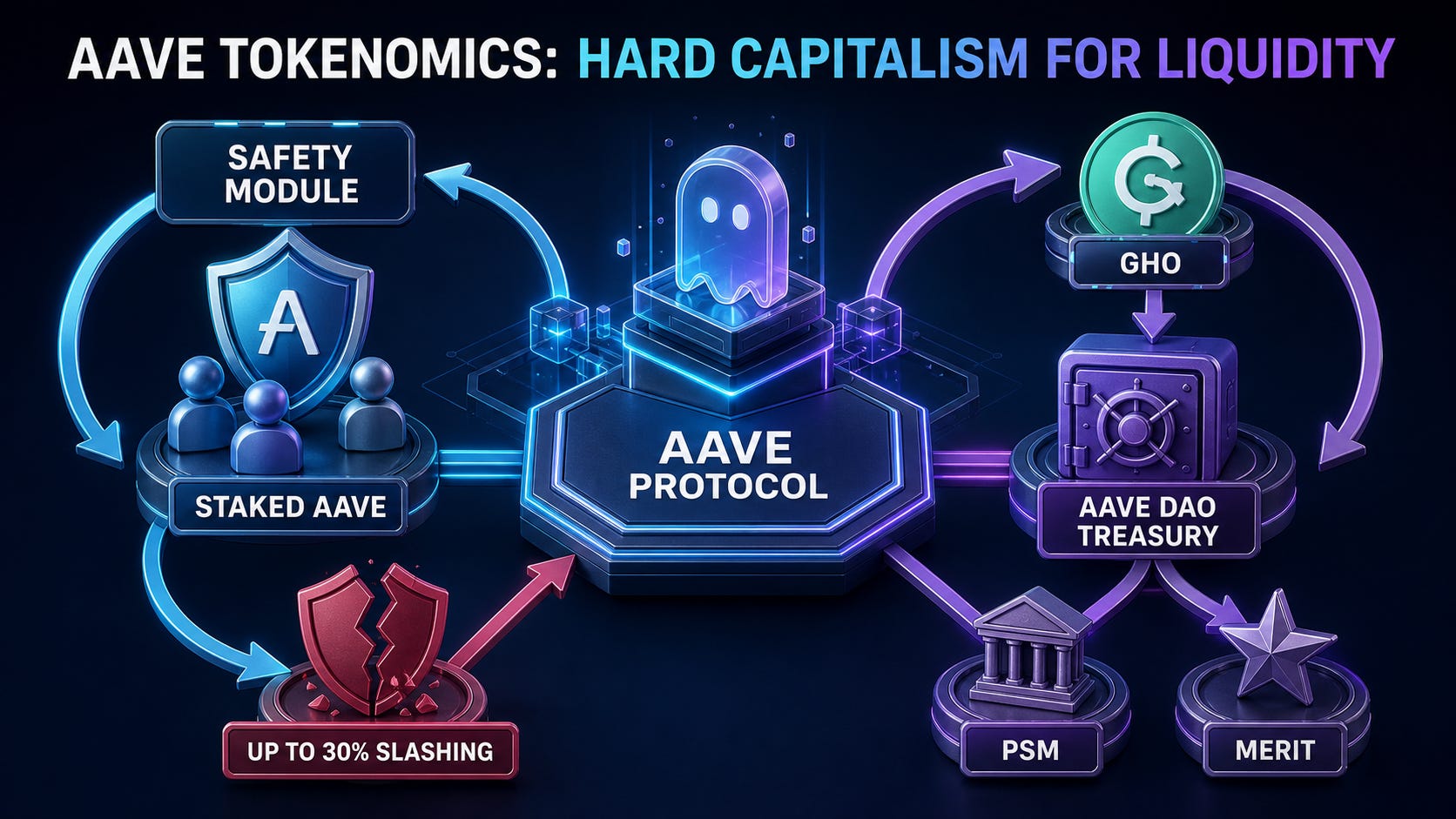
Aave’s security architecture relies on a smart contract known as the Safety Module. AAVE token holders can lock (stake) their assets in this module, for which the protocol pays them a constant algorithmic yield generated from ecosystem fees.
However, this is not just “free money” for staking. It is an insurance premium. AAVE stakers assume extreme tail risk.
If a catastrophic failure occurs in the system - such as an oracle exploit, a critical bug in a new asset’s smart contract, or an unprecedented market crash during which liquidator bots fail to sell collateral due to Ethereum network congestion - toxic, bad debt is created (a Shortfall Event). At this moment, the protocol automatically initiates a slashing mechanism. Up to 30% of all locked AAVE tokens in the Safety Module are instantly confiscated, sold on the open market, and the resulting funds are used to recapitalize the protocol and cover liquidity providers’ losses.
This mechanism creates flawless game theory: The exact same people voting to add new riskier tokens as collateral or to raise borrow limits are the exact same people whose capital will be burned if their decision leads to a collapse. This forces the Aave DAO to act extremely conservatively and professionally, as a misjudgment in risk assessment is directly punished by the loss of their own millions of dollars.
For a long time, Aave functioned exclusively as an intermediary - users supplied other people’s assets (USDC, DAI, ETH), and the protocol took a microscopic fee for managing these pools. With the launch of its native stablecoin, GHO, the ecosystem evolved. Aave ceased to be just a capital market; it became an issuance center.
GHO differs from traditional stablecoins (like USDC), which are backed by fiat in a bank. GHO is minted algorithmically. Any user who has provided over-collateralization to the Aave protocol can borrow GHO. In other words, the stablecoin is created directly against a basket of the best cryptocurrency assets in the market.
The economic genius of GHO for AAVE tokenomics lies in revenue distribution: When a user borrows USDC, they pay interest to another user (the USDC supplier). But when a user mints GHO, they borrow money “out of thin air” (algorithmically from the protocol). Therefore, 100% of interest payments on GHO loans go directly to the Aave DAO Treasury.
This creates a massive, continuous revenue stream for the protocol. Importantly, the Aave DAO is constantly refining how it manages this capital. In its early stages, the protocol used a static Discount Model for stakers, but this sometimes caused GHO to deviate from its $1 peg. Thus, the architecture was updated: the DAO implemented a Peg Stability Module (PSM) and the innovative Aave Merit program.
Merit is a system of dynamic algorithmic incentives (an airdrop program) that surgically rewards users for behavior beneficial to the ecosystem (e.g., maintaining GHO liquidity on decentralized exchanges) and disincentivizes “toxic” borrowers. This completes the loop of hard capitalism: the protocol generates profit from GHO -> Merit redirects this profit to the system’s most loyal participants -> the stablecoin’s liquidity and peg become bulletproof.
In the traditional financial world, the concept of a “risk-free rate” is the center of gravity for all macroeconomics. Usually, this role is fulfilled by the yield on government Treasury bonds (e.g., US Treasuries). This figure is the foundation from which everything else is calculated: the cost of corporate loans, derivative pricing, startup valuations, and mortgage rates.
But in the TradFi system, this critical base rate is not market-driven. It is set by a small group of people (such as the US Federal Reserve’s FOMC) in closed meetings, relying on macroeconomic data that typically lags by several months. It is a manual, discretionary, and deeply politicized management of the economy.
The decentralized economy (Web3), which operates 24/7 without geographic borders, requires its own native base rate. The core thesis of investing in Aave boils down to one fact: as of 2026, Aave has de facto become the algorithmic Central Bank of the Internet.
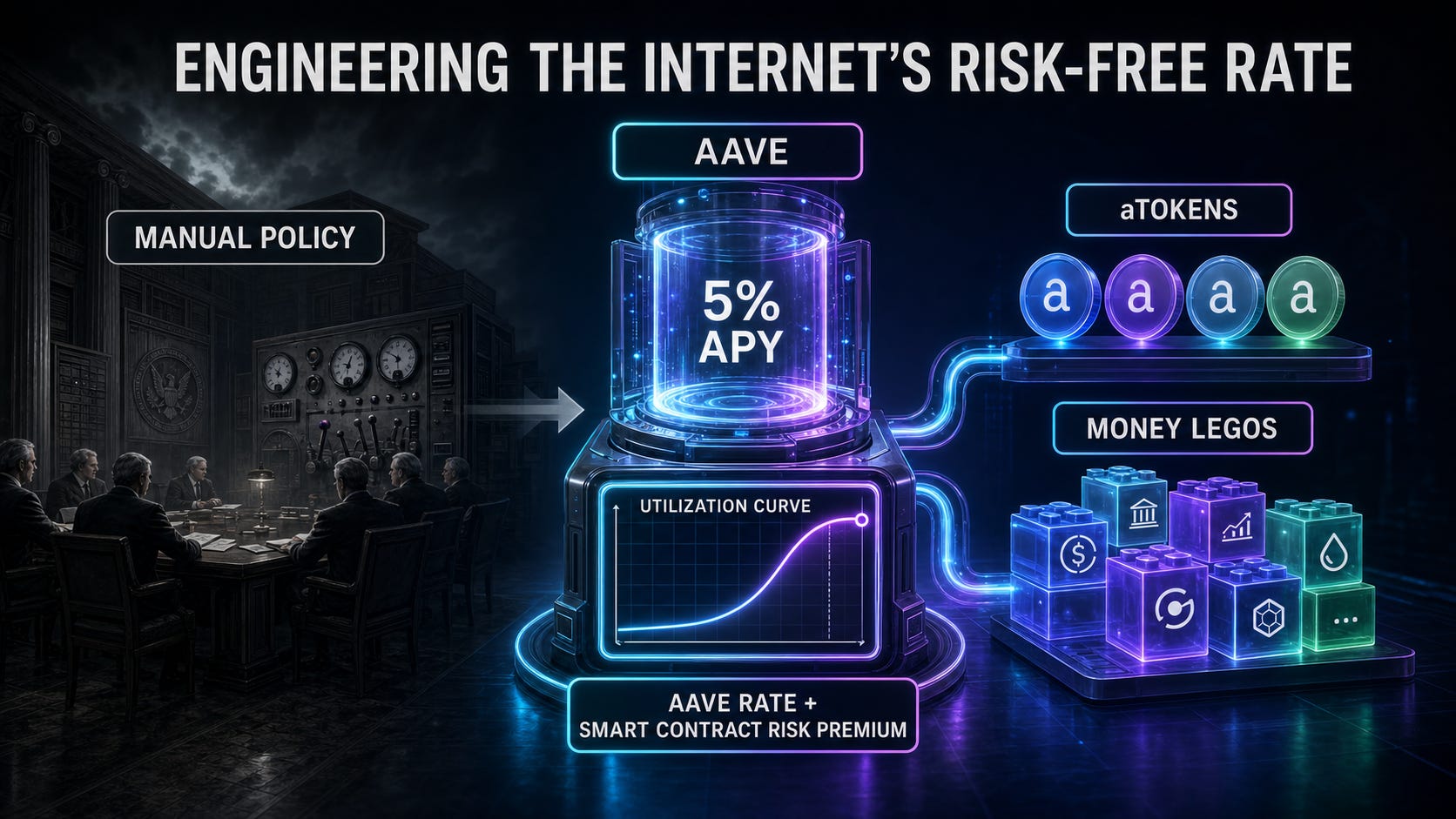
Thanks to billions of dollars in uninterrupted liquidity (TVL) and years of surviving extreme volatility without a single systemic default (the Lindy Effect), Aave has established a gold standard of trust.
This trust turns the Aave interest rate into a global benchmark for determining the opportunity cost of capital. If Aave’s smart contracts offer a 5% APY on USDC deposits, that 5% automatically becomes the “risk-free rate” for the entire decentralized finance space.
Why? Because no rational institutional or retail investor will deploy capital into a new, less-proven protocol (even if it offers an attractive yield farming strategy) unless it offers a yield equal to “Aave’s Rate + Smart Contract Risk Premium.” Thus, Aave’s algorithms tacitly dictate risk pricing and the cost of capital for thousands of other protocols.
Unlike the Fed, Aave has no inflation targets or political pressure. Aave’s “monetary policy” is updated with every new network block (every 12 seconds on Ethereum), driven solely by a mathematical Utilization Curve.
This is the purest manifestation of a free capital market:
If there is panic in the market and traders are heavily shorting assets, demand for stablecoins surges. The rate algorithmically spikes to 15-20% instantly, attracting capital from all over the world to stabilize the system.
When the market calms and loans are repaid, the rate gently drops to an equilibrium of 3-4%.
The true power of this base rate lies in its architectural composability. Because deposits in Aave are tokenized as aTokens (which automatically reinvest interest), these aTokens themselves become fundamental building blocks (Money Legos) for other applications.
Today, you can find treasury management protocols, automated market makers (AMMs), and derivative exchanges that hold their reserves not in standard stablecoins, but in aUSDC. Their logic is simple: why hold “dead” capital when you can hold an asset that defaults to generating the Internet’s base interest rate?
When you invest in Aave, you are not just buying a lending application. You are investing in a base macroeconomic primitive. Aave has transformed yield into a standardized, permissionless, and highly liquid commodity, becoming the center of gravity around which the rest of the on-chain economy revolves.
In traditional finance, an investor looking to bet on the growth of the credit market buys bank stocks, bond ETFs, or indexes through complex financial instruments. The problem with this approach is that you are buying not just market access, but all the bureaucratic “baggage” - expensive offices, bloated risk management teams, compliance costs, and worst of all, the risk of management incompetence. When you buy bank stock, you rely on the assumption that its credit committee won’t issue a billion-dollar unsecured loan to the next fraudulent hedge fund.
Investing in the Aave protocol (via the AAVE token) offers a radically different paradigm. It is not a bet on a company or a management team. The AAVE token functions as the purest, most liquid index of the entire decentralized credit market.
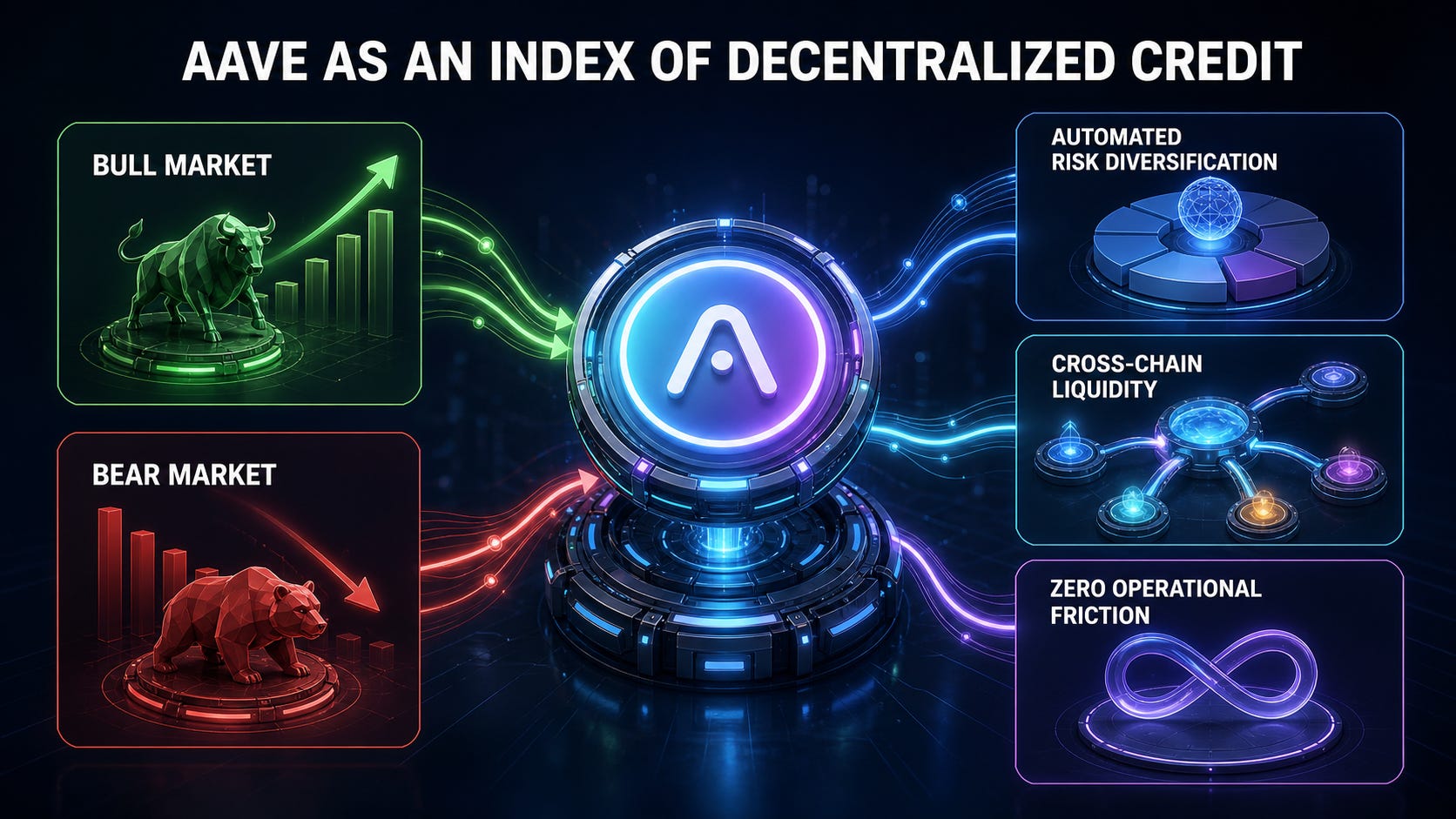
By holding AAVE, an investor gains macro-exposure to global capital demand. Aave does not depend on the success of one specific asset. It is an agnostic infrastructure that adapts to any market trend:
Bull Market: When the market rises, traders aggressively seek leverage. They deposit their BTC and ETH as collateral to borrow stablecoins and buy even more assets. Loan demand skyrockets, interest rates rise, the protocol generates millions in fees, and yields for liquidity providers reach double digits. This is a classic “reflexivity” cycle from which Aave earns colossal revenue.
Bear Market: When the market falls, traders borrow volatile assets (e.g., ETH or altcoins) to “short” them (sell now, buy back cheaper later). Simultaneously, fleeing from risk, capital massively migrates to safe stablecoin pools in Aave, seeking stable “risk-free” yield. Even amidst a bloody market slaughter, Aave continues to earn fees on liquidations (Liquidation Penalties) and arbitrage.
Thus, Aave acts as a financial weather vane: the protocol captures value from whichever direction market volatility flows.
Most DeFi protocols are limited to a single blockchain (Layer 1). Aave transcended these boundaries long ago, becoming chain-agnostic. By deploying across dozens of networks (Ethereum, Arbitrum, Optimism, Polygon, Avalanche, Base, and others), Aave is no longer just an app on Ethereum. It is a web of liquidity spanning all of Web3.
Thanks to the V3 Portals architecture, Aave’s liquidity can flow seamlessly between different blockchains.
For the investor, this means the AAVE token captures the economic activity of the entire multi-chain economy. You don’t have to guess which specific Layer 2 will win the tech race this year. Wherever users and capital end up, Aave will already be there as their base banking layer.
While a traditional bank with billions in assets spends millions of dollars on salaries and infrastructure maintenance, Aave manages tens of billions of dollars (Total Value Locked, TVL) as an autonomous smart contract. The protocol scales from $1 billion to $100 billion without the need to hire a single new employee.
The AAVE token capitalizes on this perfect unit economics. It is a bet that clean code always beats human bureaucracy in the efficiency of capital allocation.
As of 2026, institutional capital demands only one thing: undeniable Product-Market Fit. The Aave ecosystem has successfully crossed this threshold. It is no longer exclusively a playground for crypto-speculators seeking high leverage. Today, it is a massive B2B highway solving concrete business problems and bridging the gap between traditional assets and on-chain liquidity.
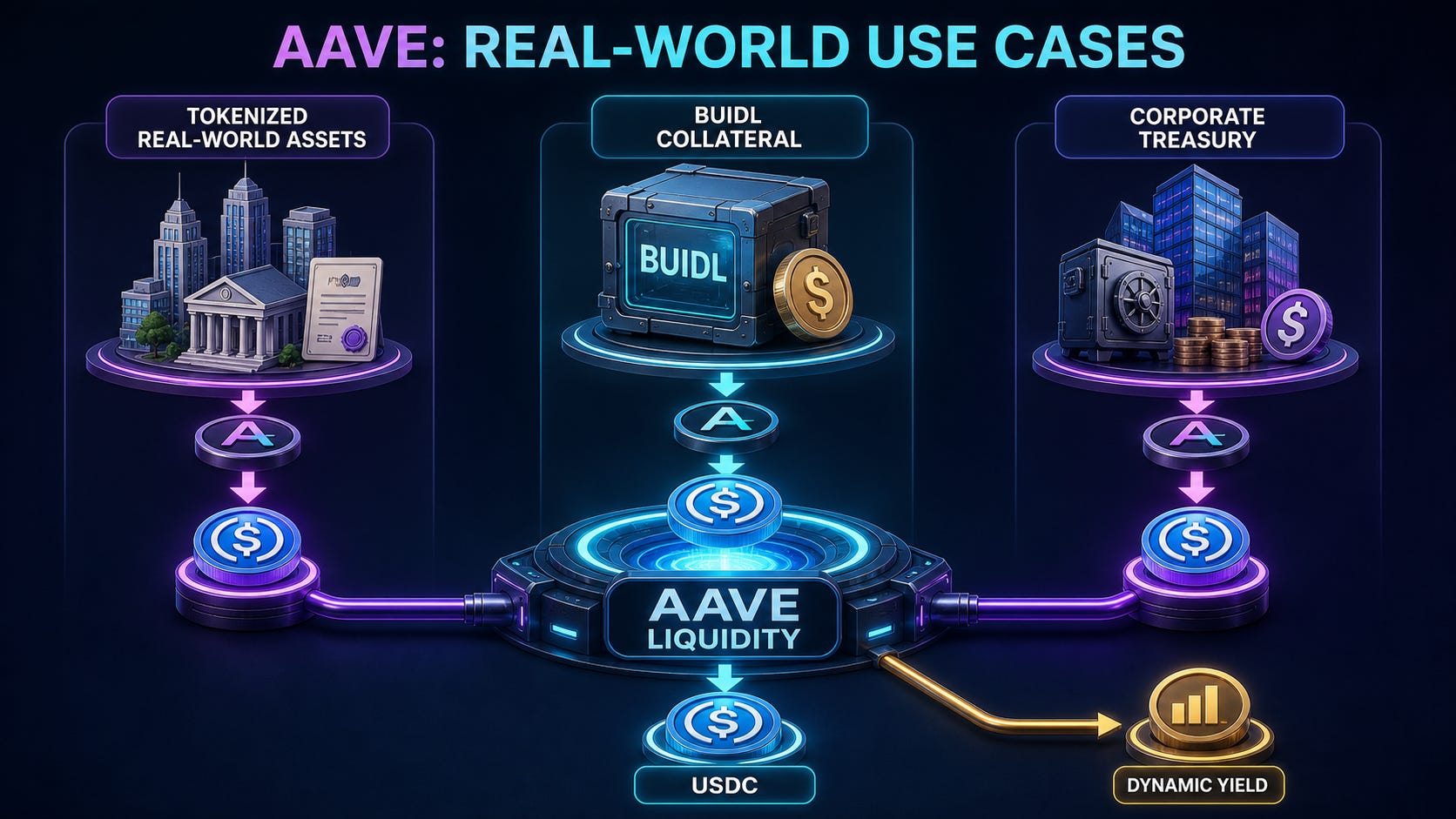
Aave’s greatest breakthrough in the institutional sector is shattering the barrier between physical and digital capital. Previously, borrowers could only use crypto assets (ETH, WBTC) as collateral. Today, the protocol integrates RWAs.
Through partnerships with protocols like Centrifuge and the integration of tokenized funds, traditional businesses can obtain algorithmic liquidity against real-world assets. A company has a portfolio of corporate bonds or real estate. Instead of going to a traditional bank for a working capital loan (a process that takes months of bureaucracy), the company tokenizes these assets, places them in a specific Aave pool, and instantly receives a USDC loan. This transforms illiquid real-world assets into a source of instant algorithmic capital.
Compliance has always been considered the main barrier to Wall Street entering DeFi. Initially, the industry tried to solve this by creating isolated KYC pools (like the early Aave Arc experiment). However, the true institutional breakthrough occurred thanks to the integration of tokenized assets at the base layer.
Today, Aave allows the use of tokenized US Treasury bills (T-Bills), such as BlackRock’s BUIDL fund, as premium collateral. This creates perfect synergy: a traditional fund holds fixed-yield US government bonds, tokenizes them, and deposits them into Aave. Against this incredibly secure collateral, the fund instantly borrows stablecoins (e.g., USDC), which it uses for operational activities or high-yield DeFi strategies. Institutions no longer need to build “walled gardens”; they utilize Aave’s general liquidity while relying on the highest TradFi collateral standard.
Historically, corporations held their idle cash reserves in bank accounts with zero or meager yields. Web3 companies, DAOs, and modern neobanks changed this paradigm, making Aave their base treasury instrument.
Dynamic Yield without Liquidity Loss: Instead of holding “dead” capital, corporations deposit tens of millions of dollars into Aave’s stablecoin pools. The capital generates a continuous floating yield (e.g., 4-6% APY) while remaining 100% liquid. A company can withdraw funds to pay salaries or operational expenses at any second, without the early withdrawal penalties typical of traditional term deposits.
Backend for Fintech: Many modern fintech apps that promise retail users a “high APY on balances” do not actually have their own banking infrastructure. They simply integrate Aave’s API on their backend. When a user tops up their balance in the app, the funds are automatically routed into Aave’s smart contracts. The protocol does all the heavy financial lifting, and the startup simply takes a cut of the spread.
Aave is no longer just a tool for margin trading tokens. It has evolved into a base settlement layer for the global economy, offering TradFi players a speed, transparency, and efficiency that no classic bank can compete with.
The battle is for the title of fundamental settlement layer for the entire global credit market. Aave defends its capital against three completely different categories of opponents, each attempting to attack its economic moat.
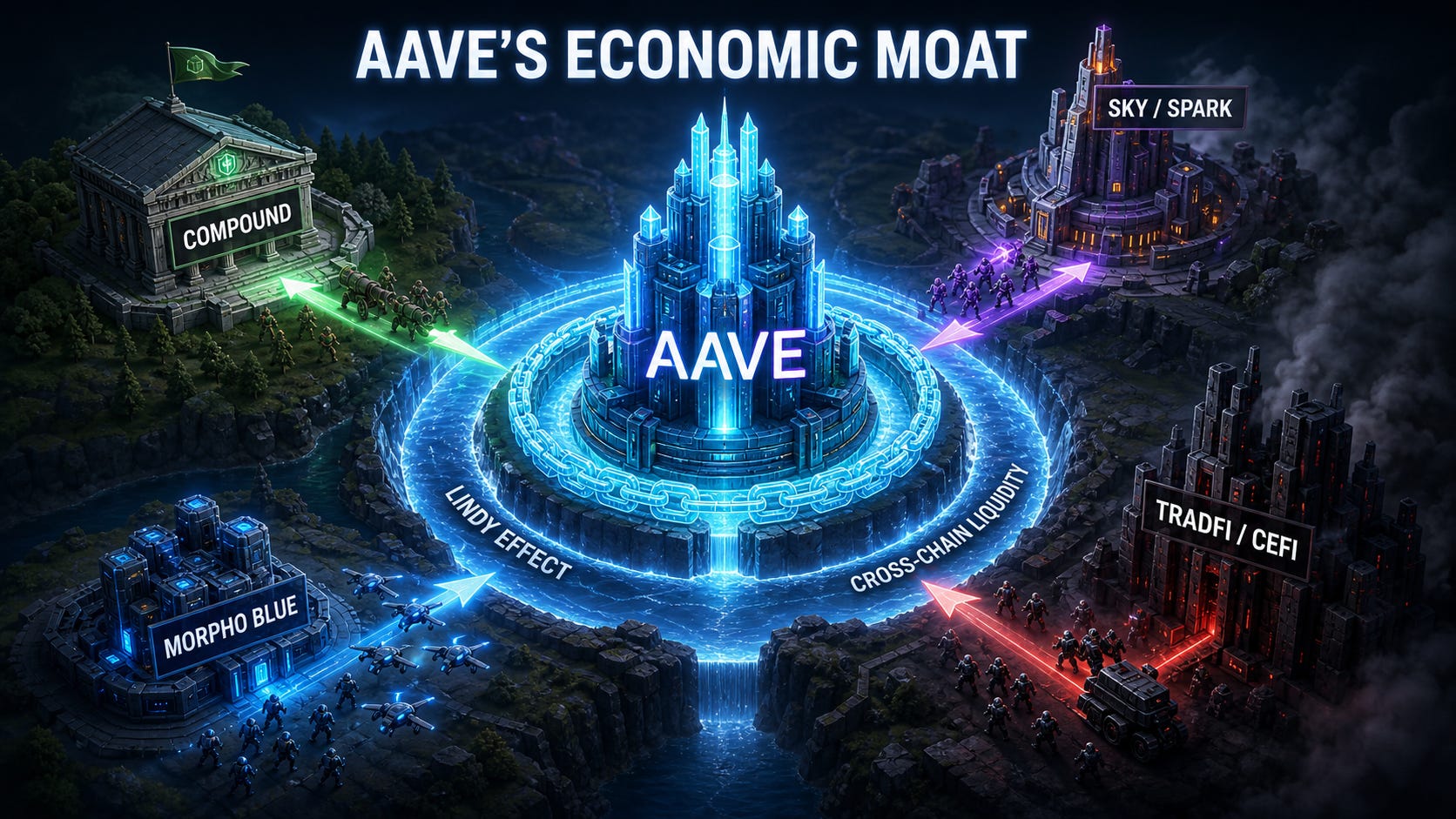
Compound Finance pioneered the concept of liquidity pools and was the catalyst for “DeFi Summer” in 2020. Historically, it was the primary direct competitor. Today, however, this battle looks like a contest between an aggressive tech monopolist and a conservative traditional bank.
Innovation Dynamics: While Compound chose a path of slow, hyper-conservative development, focusing on a narrow set of assets, Aave acted like an aggressive venture startup. The protocol sequentially introduced Flash Loans, E-Mode, and isolated debt markets in V3, and has now transitioned to the Aave V4 paradigm featuring a Unified Liquidity Layer. While competitors are trying to optimize old models, Aave is completely rewriting the rules of capital efficiency.
Cross-Chain Presence: Compound remained too focused on the Ethereum base layer. Aave, on the other hand, deployed its architecture on every meaningful Layer 2 (Arbitrum, Optimism, Base) and alternative networks (Avalanche, Polygon). As a result, Aave became the absolute monopolist in cross-chain liquidity, leaving Compound fighting for a continuously shrinking market share.
For a long time, Aave and MakerDAO (which recently evolved into the Sky ecosystem with USDS/SKY tokens) existed on parallel planes. Maker was the Central Bank that minted the DAI stablecoin against collateral (CDP - Collateralized Debt Position). Aave was a commercial bank (Peer-to-Pool) where users borrowed existing assets. But their business models collided:
Maker launched its own lending protocol, Spark, directly attacking Aave’s market share by offering cheaper loans via proprietary emission.
Aave responded by issuing GHO - its own algorithmic stablecoin - becoming a direct competitor to Maker in money creation.
Aave’s Advantage: While the Maker/Sky ecosystem remains deeply tethered to the Ethereum ecosystem, Aave wins through its multi-chain agnosticism and a vastly wider variety of assets available for collateral. Aave offers the market a flexibility that Maker’s monolithic structure cannot provide.
The greatest architectural threat to Aave today comes not from old giants, but from a new generation of modular protocols like Morpho.
Attack Vector: Aave is governed by a DAO that centrally determines risk parameters for the entire platform. Morpho Blue offers permissionless market creation, where anyone can create their own credit pair with any risk parameters, removing the DAO from the pricing process. This makes such protocols more efficient for specific, niche institutional strategies.
Aave’s Defense (The Lindy Effect): While smart contract code is easy to fork, trust is impossible to copy. Aave possesses the Lindy Effect - the protocol has survived the most brutal market crashes, liquidation spirals, and oracle attacks, keeping user funds secure. In the corporate world, they say: “Nobody ever got fired for buying IBM.” In DeFi in 2026, it goes: “No fund risk manager gets fired for depositing treasury funds into Aave.” Institutional capital chooses Aave’s battle-tested security over the marginal efficiency gains of new platforms.
Despite internal Web3 rivalries, Aave’s main opponent remains traditional credit infrastructure.
Compared to Celsius, BlockFi, or traditional banks, Aave’s competitive moat lies in zero counterparty risk. Clients no longer need to analyze bank balance sheets for hidden holes caused by management’s bad investments. The blockchain provides cryptographic proof of solvency every single millisecond.
The future trajectory of Aave depends on one fundamental conflict: whether open-market decentralized infrastructure can become a legitimate backend for traditional global capital before regulators or infrastructure vulnerabilities halt its growth.
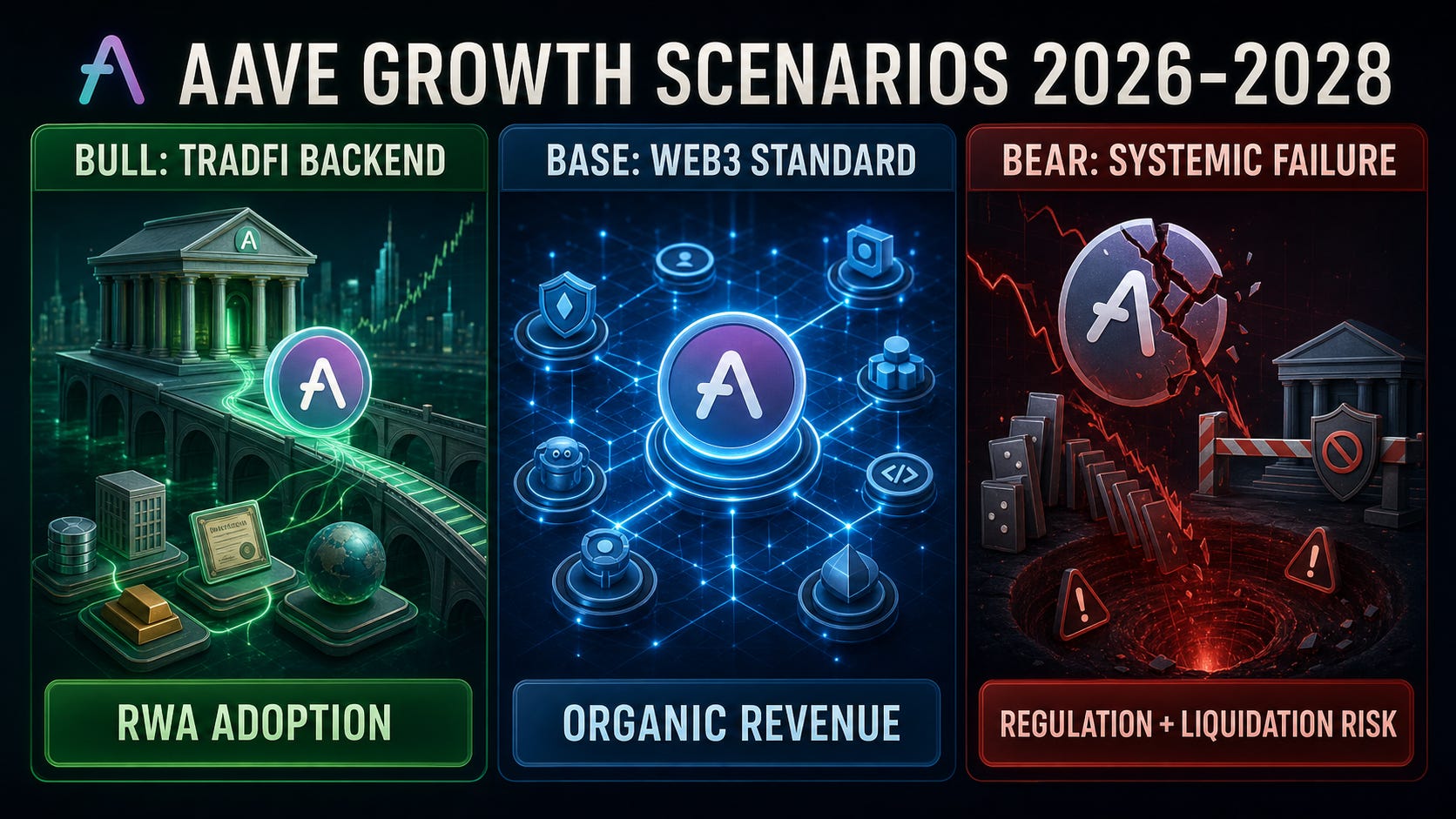
Between 2026 and 2028, we project three primary vectors for ecosystem development:
In the bullish scenario, Aave definitively breaks out of the crypto-native “sandbox” and becomes the base settlement layer for global finance. The tokenization of real-world assets (RWA) - corporate bonds, US Treasury bills, real estate - becomes the standard for the traditional market. Traditional banks and neobanks realize that maintaining their proprietary credit infrastructure is economically unviable, and begin using Aave smart contracts as their backend.
Economic Impact: The GHO stablecoin captures a significant share of the decentralized money market. Protocol fees grow exponentially due to an influx of hundreds of billions of dollars of “real” capital (TVL). The DAO Treasury begins aggressively buying AAVE tokens off the open market. For institutional investors on Wall Street, the AAVE token becomes a macroeconomic dividend asset representing the “Internet’s interest rate.”
In the base-case scenario, traditional financial giants remain cautious due to regulatory uncertainty, and a massive capital influx from TradFi does not occur. However, Aave maintains and cements its absolute monopoly within the crypto economy. The protocol continues its aggressive expansion into new Layer 2 and Layer 3 networks. Modular competitors (like Morpho Blue) capture niche markets for high-frequency traders, but 90% of retail capital and DAO treasuries remain in Aave’s safe, time-tested pools.
Economic Impact: The network generates stable, organic revenue. The Safety Module works flawlessly, purging toxic assets. AAVE stakers receive predictable yields (APR). The protocol cements its status as a conservative Web3 “blue chip,” growing synchronously with total cryptocurrency market capitalization, coexisting with traditional banks rather than destroying them.
The bearish scenario could unfold via two vectors: infrastructural or political. The technical risk involves cascading liquidations: a sudden, unprecedented flash crash in the market causes Ethereum network congestion. Liquidator bots cannot execute transactions, causing borrower collateral to depreciate faster than it can be sold. Hundreds of millions of dollars in “bad debt” are created. The political risk arises if the SEC (USA) or MiCA (EU) classify Aave smart contracts as unlicensed brokers and force the closure of all public front-ends, demanding strict KYC for every liquidity provider.
Economic Impact: A technical collapse triggers the Safety Module - 30% of staked AAVE tokens are confiscated and sold for pennies to recapitalize the system. This destroys investor trust (loss of the Lindy Effect). A regulatory attack triggers a massive capital flight (bank run) as anonymous users withdraw their funds. The protocol’s TVL plummets by 80%, liquidity fragments, and the price of AAVE enters a death spiral due to a lack of organic fees.
Despite its mathematical elegance and multi-year history of surviving extreme market conditions, Aave functions in one of the most hostile, highly competitive, and unpredictable environments in the world - on public blockchains. Investors viewing this asset as a macroeconomic credit index must clearly understand its structural vulnerabilities. Aave has no central bank to print money for a bailout; a mistake here is permanent.
Here are four key systemic risk vectors threatening the protocol:
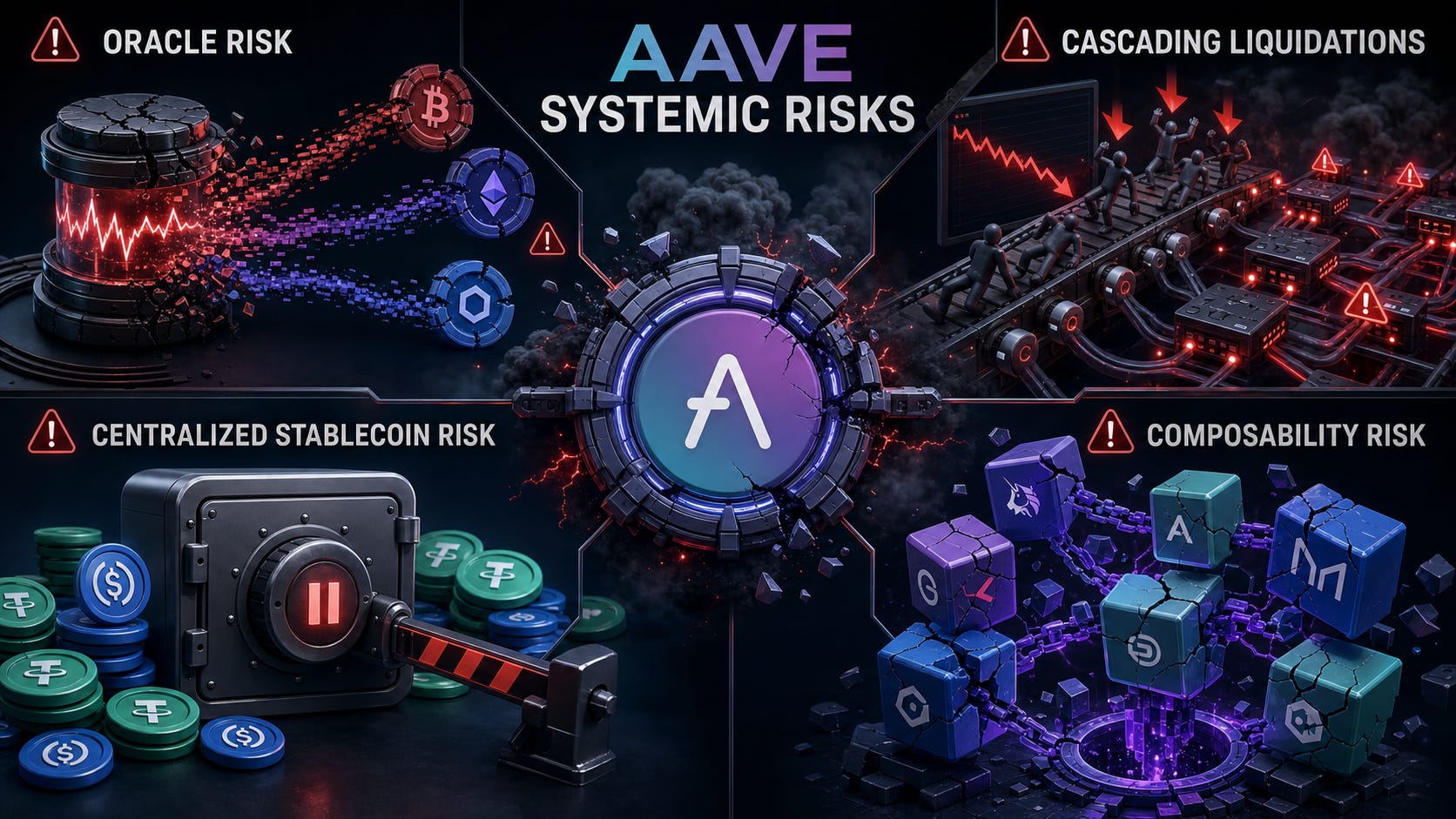
Blockchains are algorithmically isolated - Aave smart contracts have no access to the outside world and do not know the real price of Ethereum or USDC. To assess collateral value, the protocol relies entirely on decentralized oracle networks (predominantly Chainlink). This creates a single point of failure. If an oracle data feed is compromised, or if the price of a low-liquidity asset is severely manipulated in the market, the protocol receives false data.
Consequence: Healthy positions could be unfairly liquidated, causing massive losses for users. Worst case scenario: a malicious actor could artificially inflate the price of a “junk” token via an oracle, deposit it into Aave, and instantly borrow (effectively steal) millions of dollars of real liquidity, leaving the protocol with worthless collateral.
Aave’s design is based on the assumption that independent liquidator bots are always ready to instantly buy up risky debt. But this game theory can break down during an extreme Black Swan event. When the market crashes 50% in a matter of minutes, two things happen:
Hundreds of positions become insolvent simultaneously.
The base blockchain (e.g., Ethereum) faces unprecedented congestion, and gas fees spike to thousands of dollars per transaction.
Consequence: Liquidator bots physically cannot execute transactions, or it becomes economically unviable for them to do so due to high gas costs. During this time, the value of the collateral continues to plummet and eventually falls below the loan amount itself. Toxic, unbacked debt is created. If the volume of this debt exceeds the size of the insurance fund (Safety Module), the protocol becomes insolvent.
The protocol constantly integrates new types of collateral to remain competitive: liquid staking tokens (LSTs), liquid restaking tokens (LRTs), and tokenized real-world assets (RWAs). Although the core Aave V3 code has been verified by hundreds of audits, the DeFi ecosystem operates on the principle of “money legos,” and the overall security of the system is only as strong as its weakest link.
Consequence: If a hidden vulnerability exists in the smart contract of one of the newly accepted assets (for example, a hacker finds a way to print an infinite amount of a derivative token), an attacker could legitimately deposit this “empty” asset into Aave and drain the protocol’s stablecoin pools.
The greatest irony of decentralized lending is that the majority of liquidity in Aave is denominated in centralized stablecoins (USDC from Circle and USDT from Tether). These companies have the ability, at the smart contract level, to blacklist addresses and freeze funds by order of regulators or law enforcement.
Consequence: If US or European regulators decide to classify Aave as an unlicensed shadow banking entity and order Circle to freeze USDC within Aave smart contracts, the lion’s share of the system’s capital would be instantly paralyzed. No decentralization of code can save the system if its base money is controlled by traditional corporations.
The global financial system is on the verge of its deepest structural transformation since the emergence of the first commercial banks. Credit - the basic unit of any economic growth - is ceasing to be a closed monopoly held by institutions that rely on opaque fractional reserve banking, political influence, and inevitable state bailouts. It is becoming a transparent, programmable, and entirely deterministic commodity.
The vast majority of traditional analysts still misunderstand the essence of this protocol, classifying it as just another margin casino for speculators. They are missing the bigger picture: Aave is not competing with other apps; it is building the base settlement layer for a new Internet of Value. By reducing risk management to algorithmic utilization curves and instant liquidations, Aave has de facto become a decentralized Central Bank, generating the risk-free rate for the entire Web3 economy.
For investors and capital architects, this distills down to one fundamental truth: you no longer need to place bets on individual banking institutions or hope for the competence of their CEOs. By allocating capital to the AAVE token, you are investing in the credit highway itself. You are buying a stake in a system that automatically balances the global demand for liquidity and allows you to earn fees for acting as the insurance guarantor of last resort.
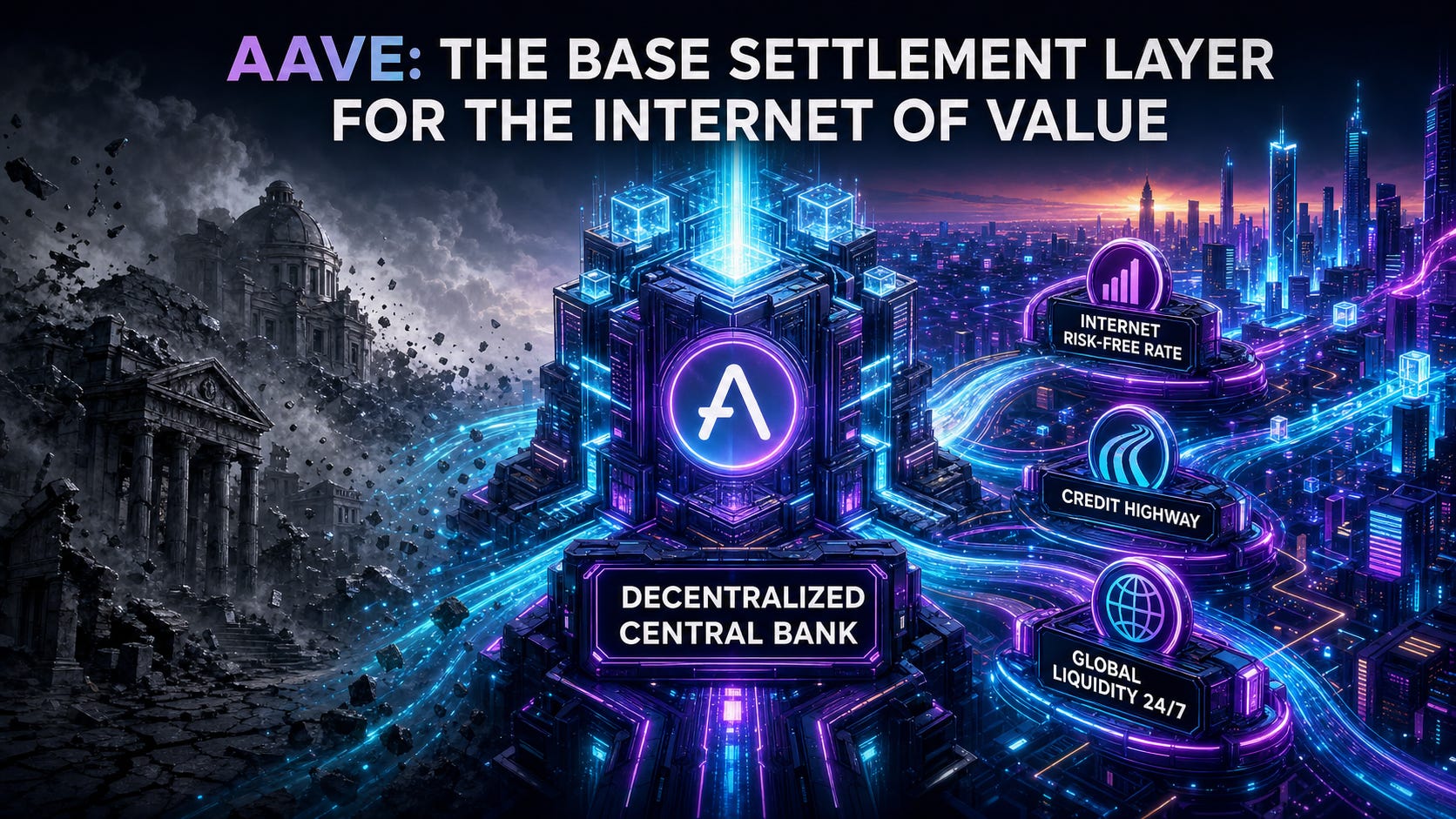
However, the potential upside perfectly reflects the magnitude of these risks. If the future of capital is to be determined not behind closed doors on Wall Street, but by open-source code and global liquidity revolving 24/7, Aave has already finished building the foundation for this new era. The money of the future does not need banks - it only needs flawless code execution.
Disclaimer:
This report is intended solely for informational and educational purposes and reflects independent commentary and analysis by the author. The author is not affiliated with any company mentioned in this report and holds no positions on the board of any related entities. All opinions, analyses, and insights expressed are the author’s alone and should not be interpreted as specific investment advice, a solicitation to buy or sell securities, or an endorsement of any particular investment strategy.
The information provided is derived from sources and research the author deems reliable, but its accuracy, completeness, or timeliness is not guaranteed. Readers should not rely on this report as the sole basis for any financial decisions. The author disclaims any liability to update or revise the content as new information becomes available.
Investing involves significant risks, including the potential for loss of principal. Past performance does not guarantee future results. Investments or strategies discussed may not suit every individual’s circumstances, and they may fluctuate in price or value. This report does not consider your specific financial objectives, risk tolerance, or personal investment needs. Readers are encouraged to conduct their own research and consult with a qualified financial or investment advisor before making any investment decisions.
The author and any associated entities do not guarantee specific outcomes or profits from the use of this report. The author may or may not hold open positions in the securities mentioned. By reading this report, you acknowledge the risks involved and accept the limitations of the information presented.
Comments
Nothing yet. Say the first thing.
Sign in to join the conversation.