
Greetings. My research assistant, Chris Robinson, is about to leave AEI to attend law school (everyone boo this man). The Chris-sized hole on AEI’s education team won’t be easy to fill. It’s been fantastic to work with Chris for the last two years—most recently on a report we coauthored and published late last month.
The closure of Hampshire College dominated recent headlines, at least in higher-ed world. Hampshire is engaging in an orderly closure, with defined transfer pathways for students to finish out their degrees at other schools. But it doesn’t always happen that way. Sometimes closures are sudden—and their costs passed on to students and taxpayers. But is there a way to make institutions bear the costs of their closures, rather than the government?
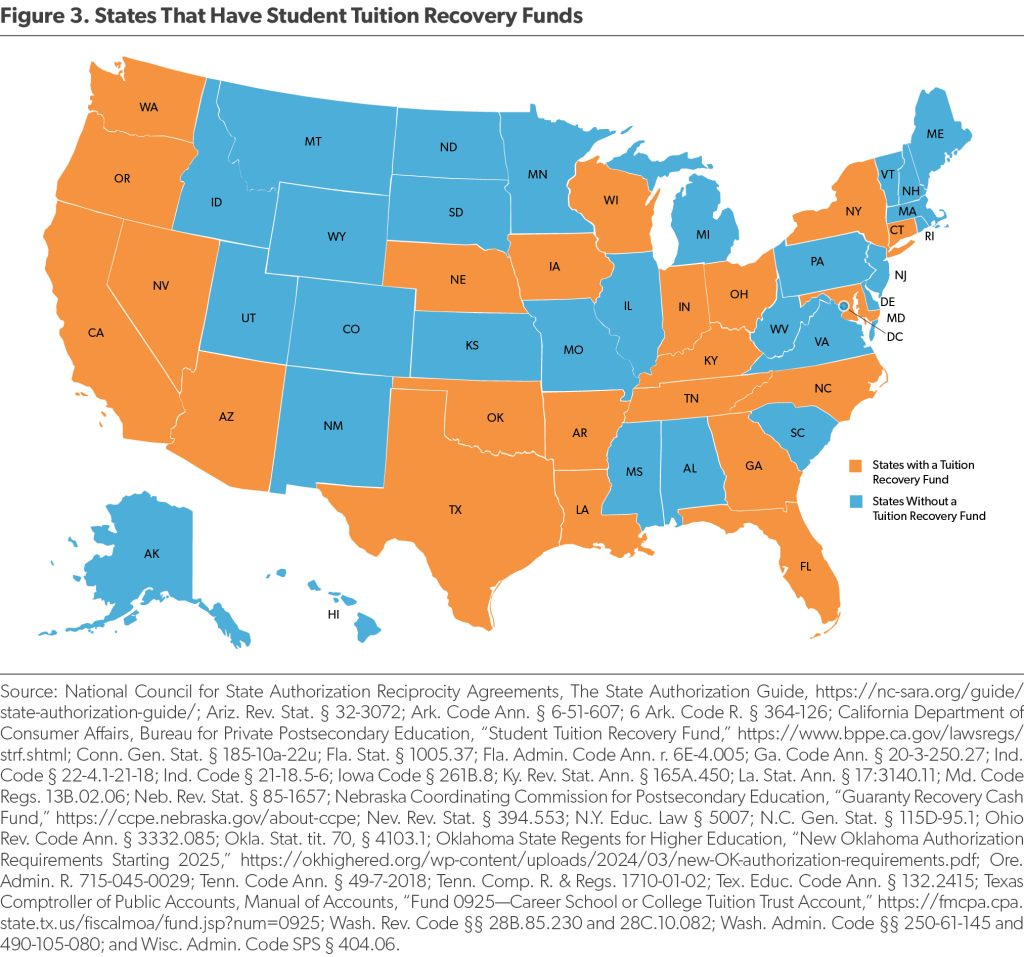
Twenty-two states operate a tuition recovery fund, which is a bit like an FDIC for higher education. Certain colleges (not all are required to participate) pay a small percentage of their tuition revenues into the fund. If one of these colleges closes, its students can submit a claim to get some of their tuition reimbursed. When Silicon Valley University collapsed in 2018, California’s fund paid out nearly $15 million to affected students—an amount funded entirely by past assessments on institutions.
The federal government also operates safety-net programs for students whose colleges closed. Students attending a closed school who cannot transfer their credits and complete elsewhere are eligible for a closed school discharge, which wipes away their federal loans. Borrower defense discharges are available to students whose colleges defrauded them. Technically, the Education Department is supposed to recover the value of those forgiven loans from the college in question. But when an institution shutters and other creditors come knocking, you can imagine how often that money actually gets recovered.
The upshot: taxpayers eat the costs. The government has discharged tens of billions of dollars in loans for borrowers at closed schools. Some of those discharges were justified, while others were more questionable. But the costs fell almost entirely on you and me—not the schools themselves.
A national tuition recovery fund could fix this problem. Chris and I envision it thus:
Each institution would contribute a small amount every year toward a common fund, based on the volume of federal student loans that the institution uses. If the federal government granted closed school or borrower defense discharges, it would first attempt to recover the discharged amounts from the offending institution. If it could not do so, the common fund would pay the US Treasury to cover the discharged amounts. So long as there is a sufficient balance in the common fund to cover [closed school] and [borrower defense] obligations, taxpayers would not need to shoulder the burden of granting these discharges.
This is not a new entitlement program. Closed school and borrower defense discharges already exist; they’re simply funded by taxpayers rather than institutions. Republicans’ One Big Beautiful Bill Act reined in these programs somewhat, to ensure discharges only occur when genuinely warranted. But with college closures on the rise, you can bet that the next several years will see more discharges. A national tuition recovery fund could help the government get ahead of that wave, so taxpayers don’t wind up shouldering the costs again.
Our report offers some lessons from the states on the design of such a national fund. Such a fund must have adequate resources: we calculate that an assessment of $1.50 for every $100 of federal student loans disbursed at private institutions would likely be sufficient to cover expected discharges. Schools displaying exceptionally risky characteristics (such as a high loan default rate) might be charged higher rates, while more responsible schools pay less.
Nonetheless, we do argue that all private institutions should be required to contribute something (public institutions backed by state governments are another matter). Oregon learned this lesson the hard way: its tuition recovery fund covers only nondegree-granting schools, meaning students at the degree-granting Marylhurst University were unprotected when the school shuttered in 2018. No private institution is completely immune from loan discharges due to closure or fraud; the design of a federal tuition recovery fund should acknowledge this.
We’ll certainly see more college closures over the next several years. The government can’t prevent them, nor should it. But we can ensure that students and taxpayers aren’t left holding the bag.
You can read the full report—and our recommendations—here.
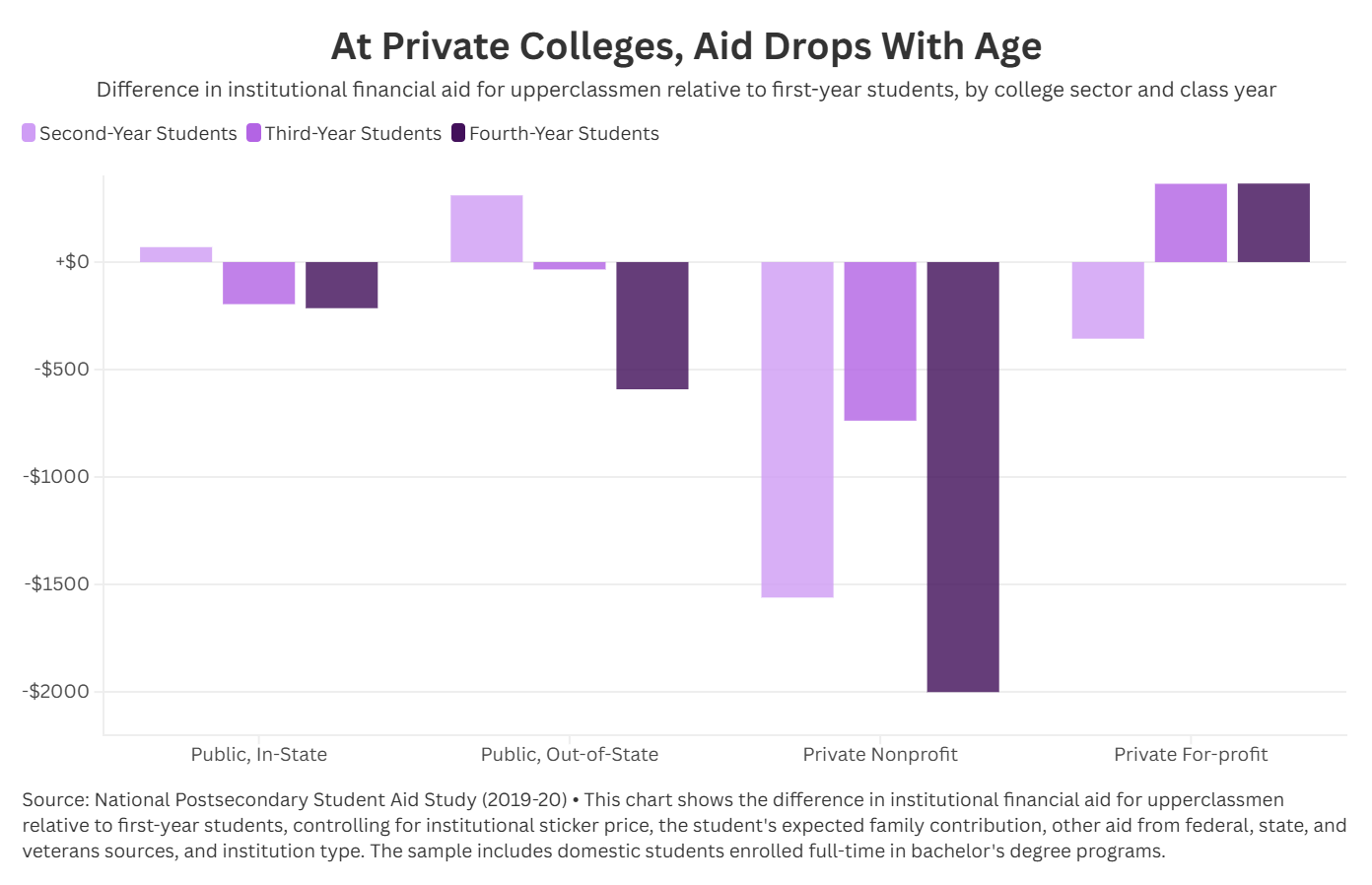
The college financial aid bait-and-switch. Has an internet service provider ever lured you in with a low “introductory” rate, only to jack it up after a year or two? Colleges have learned a thing or two from Verizon and Xfinity. My analysis shows that at private colleges, upperclassmen receive far less institutional financial aid than similarly situated freshmen—meaning students pay higher net prices after their first years. If private colleges provided as much aid to upperclassmen as to freshmen, students would receive $4,300 more in institutional aid during a four-year college career.
Colleges should rebuild public trust with price transparency. The bait-and-switch I highlighted in the previous article is part of the reason that trust in higher education has declined. Nobody knows how much they’re going to pay for college before they apply, since colleges generally don’t reveal aid packages until then. A much-discussed report from Yale University rightly called out these problems in the way financial aid works:
This system has lowered the expense of college for individual students and families, which has not risen as much as the headlines suggest. But it has had a disastrous impact on public trust. By its nature, the system is complicated, unpredictable, secretive, and highly variable. These factors tend to reduce trust rather than increase it.
I argue colleges could rebuild trust my making efforts to communicate net prices to students upfront, before the apply, much as you can compare airfares on Kayak or Expedia before committing to fly with a particular airline.
Do education schools need to worry about new loan limits? For the most part, no—most education schools charge something approaching reasonable for tuition, meaning few of their students borrow above the new federal loan caps implemented as part of the One Big Beautiful Bill Act. However, a handful of wildly expensive education schools—notably Columbia University, New York University, and the University of Southern California—see a much higher share of students borrowing above the new limits. The limits could thus force those colleges to reduce tuition or lose students to other schools—which sounds like a good outcome in my book.
Andrew Gillen offers several recommendations for finding budget savings in the federal higher education programs.
Cosmetology schools’ arguments against accountability for earnings outcomes don’t hold water, argue Rachel Fishman and Ewaoluwa Obatuase.
I interviewed U.S. Undersecretary of Education Nicholas Kent last month on the big announcement that student loans would move to the Treasury Department. Check out the full recording of our conversation here.
I also spent a day or two diving in the Channel Islands after a conference in southern California. Please enjoy the eyes on this harbor seal.

Comments
Nothing yet. Say the first thing.
Sign in to join the conversation.