
Originally published at AEIdeas
Georgetown University recently attained a dubious distinction: it became one of sixteen colleges nationwide with a price tag of more than $100,000 (including tuition, required fees, room, and board). Cue the usual caveats: “Ignore the sticker price” and “Nobody pays the sticker price.” The message is that students shouldn’t be warned off by those hefty prices, because generous financial aid will bring the cost down.
There’s just one problem: Only 36 percent of students at Georgetown receive any financial aid, from the school or the government, per federal data. The remaining 64 percent of Georgetown’s undergraduates pay the published price—all six figures of it.
To be sure, considering financial aid is important. Nationwide, about four in five students at private colleges receive some grant aid, which defrays the sticker price. But that fraction isn’t a constant across the board. Some schools provide aid to every student. But at other institutions, more than half of enrollees pay full freight.
The below chart compares each institution’s published tuition and required fees to the percentage of students at that institution who receive no grant or scholarship aid, among private nonprofit four-year colleges.
(Click here for an interactive version.)
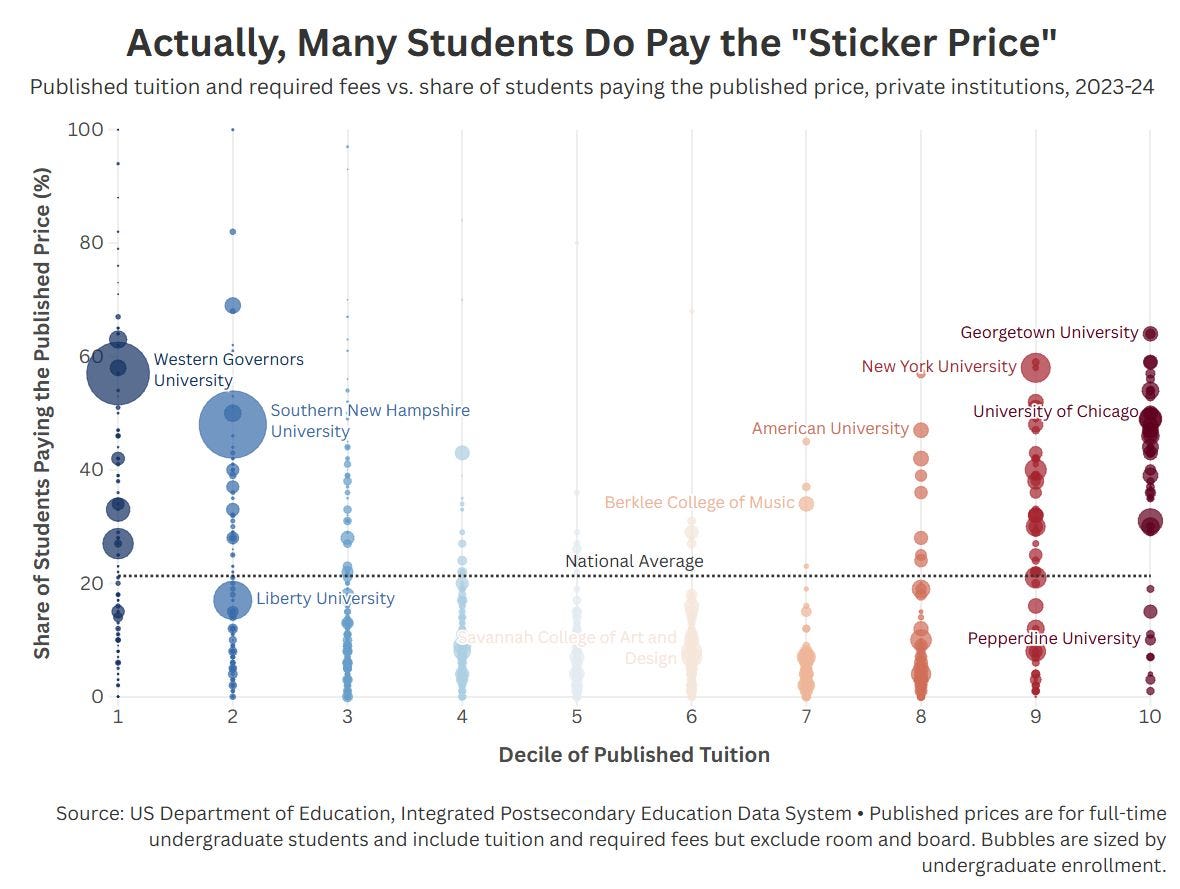
A U-shaped relationship emerges. Some of the cheapest private schools, notably Western Governors University and Southern New Hampshire University, see half or more of their students pay the published price. Financial aid is less necessary because sticker prices are already so low.
As prices rise, some schools defray them by offering more financial aid. Savannah College of Art and Design charges over $40,000, but only 8 percent of students pay that much.
But among the most expensive colleges, the share of students paying the sticker price rockets back up. More than half of students at prestigious schools like Tufts University, New York University, and the University of Chicago receive no financial aid—even as their institutions charge over $60,000 for tuition and fees alone (not even counting room and board). Overall, 42 percent of students attending schools in the priciest decile of institutions paid full freight in the 2023-24 academic year.
This is doubly problematic because higher education lacks price transparency. Usually, students don’t know how much they will have to pay until they are accepted. While some students land a generous financial aid package, others have to pay the full price. Advice to “ignore the sticker price” is thus misguided—depending on the institution, students run the risk of ending up with a bill for the full cost of tuition. This turns the costs of enrolling in college into a throw of the dice.
Students receiving multiple offers of admission can angle for a better financial aid package by playing schools off one another—providing a small semblance of market competition. But this involves a heavy commitment of time, effort, and application fees—so most students don’t bother. When acceptance letters roll in, many students find themselves choosing between a hefty bill and not going to college at all. Such a dynamic neuters price competition between schools and drives up costs even further.
Pricing clarity and transparency is part of the answer. Some schools offer guaranteed free tuition to families who earn below a certain threshold. Whitman College recently announced an interesting new program to set tuition at 10 percent of the family’s adjusted gross income. These initiatives help students understand what they will pay before they even apply—and whether the promise of financial aid can be trusted.
The government should go further. The Education Department should continue efforts to collect and release more detailed data on the net prices that colleges actually charge. The government could also prod colleges to disclose net prices upfront. In any case, “nobody pays the sticker price” is a fiction we can no longer afford to tell aspiring college students. Plenty of families do pay the sticker price—and the risk of doing so is something students and their parents should take seriously.
States are creating their own graduate loan programs in response to federal caps on lending. While the motivation is to preserve access to graduate school, some of these programs risk replicating the same problems that plagued uncapped federal lending—excessive debt, tuition hikes, and low repayment rates. States should think more deeply about what reasonable borrowing for graduate education should look like, rather than trying to replicate the federal program.
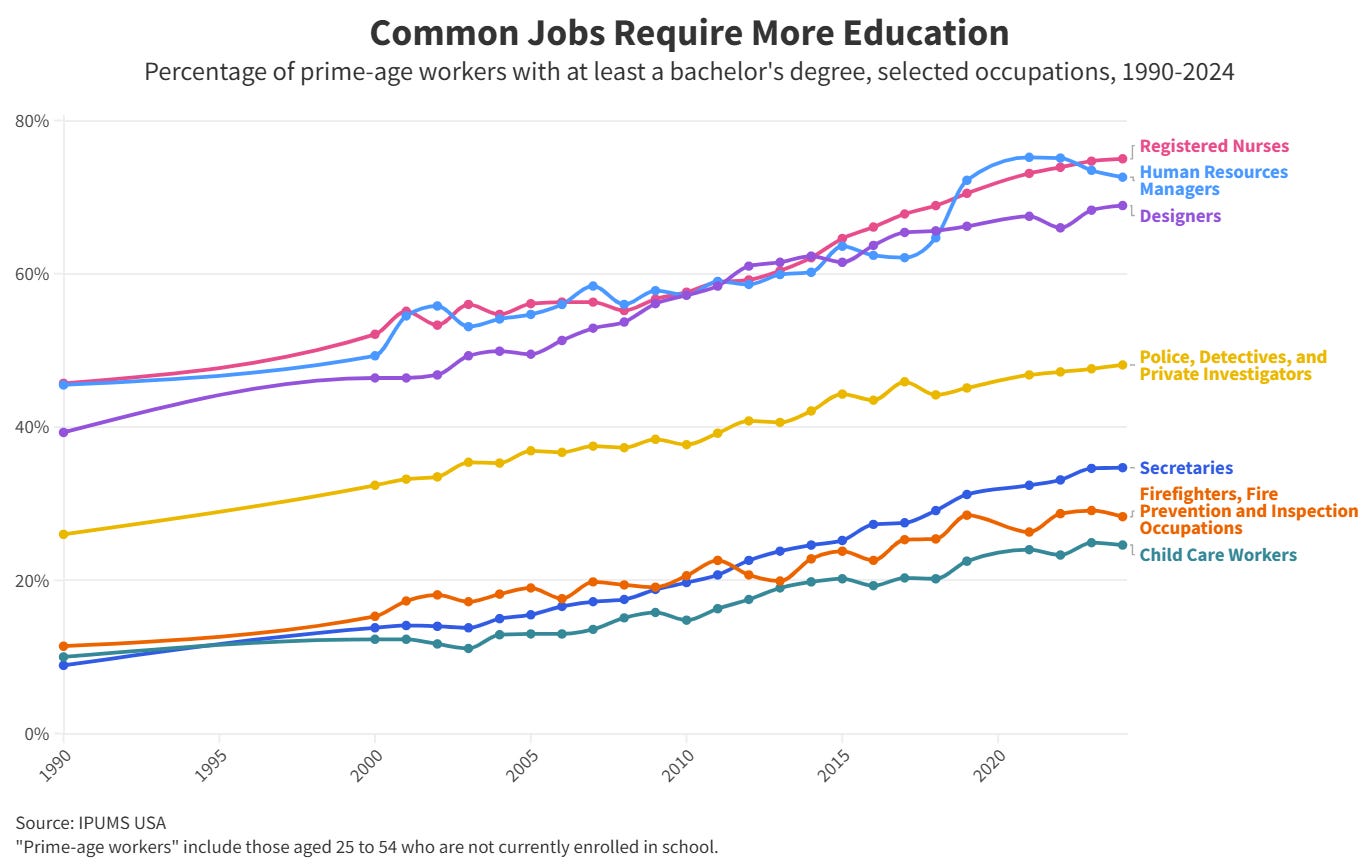
The Justice Department issued a legal opinion that could strike a blow against degree inflation. Common jobs that used to be accessible with only a high school diploma or two-year degree now increasingly require a bachelor’s—which is partially the result of a backwards interpretation of disparate impact law that treats college degree requirements differently from other types of hiring tests. The Justice Department’s opinion tries to remedy this.
Capping student loan interest is a silly idea. A bipartisan proposal would set federal student loan interest rates at 2 percent. This would cost somewhere in the neighborhood of $30 billion and mostly help doctors and lawyers with six-figure debts. Republicans already created a safety-net program, the Repayment Assistance Plan, to prevent runaway interest accumulation. An outright cap on interest rates is expensive overkill.
The final Do No Harm rule is out—and it unfortunately delays accountability for low-performing programs training for “tipped occupations,” write Clare McCann and Kristen Allen.
The Education Department broadened the list of programs qualifying for “professional” loan limits—which is unfortunate but not catastrophic, writes Beth Akers.
Dr. Smug Snidely, the celebrity dean of Paymore U’s school of education, argues that education programs should be classified as “professional”—so teachers can go into more debt.
Medicare funding for medical residencies is heavily skewed towards northeastern states, according to a new Niskanen Center report.
My colleague Tao Tan has launched SOURCE, a first-of-its-kind dataset of private foundations’ giving to colleges and universities.
Washington Post reporter Todd Wallack looks into Sophia Learning, which lets students quickly rack up college credits online—perhaps too quickly?
I’m writing this from an Airbnb near Glacier National Park, where I’ve spent the last few days exploring. Shuttle tickets to the main trailheads sold out around thirty seconds after opening, so I had to park at a lot further down and hike several extra miles. In true economist fashion, I said they should charge more money for tickets and use the revenue to run more shuttles. To which I was told, “Sir, this is a huckleberry pie shop.”

Preston Cooper@PrestonCooper93
Glacier National Park! (I was too slow on the shuttle reservation so I had to park lower down and gain 5,000 feet in a day instead)
1:56 AM · Jul 15, 2026 · 835 Views
1 Repost · 18 Likes
I’ll be speaking at the National Conference of State Legislatures conference in Chicago later this month about college return on investment and the Do No Harm rule. Stop by my session if you’re around!
Comments
Nothing yet. Say the first thing.
Sign in to join the conversation.