
By Brad Isbell
A kind friend in the Orthodox Presbyterian Church has generously provided this unpublished letter of J. Gresham Machen, which sheds light on his concern for and awareness of problems in the old Southern church—the Presbyterian Church in the United States—from which the PCA emerged in 1973. Images of the typewritten letter are here included, but a bit of annotation will be helpful for most of us. The letter shows that even by 1925, Machen saw what was coming in the next hundred years; some of his observations seem almost prophetic. And the letter reveals both the kindly and polemical aspects of his churchly spirit.
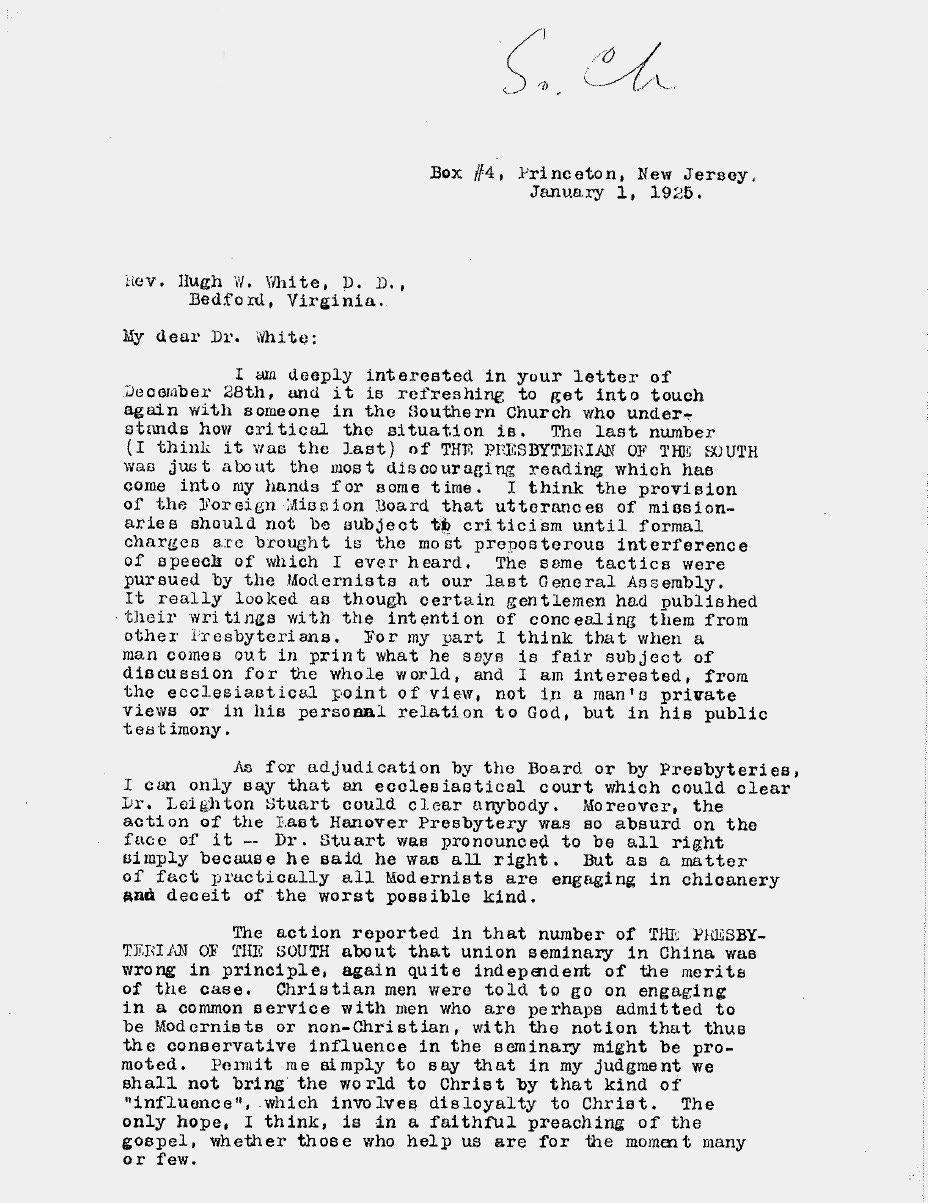
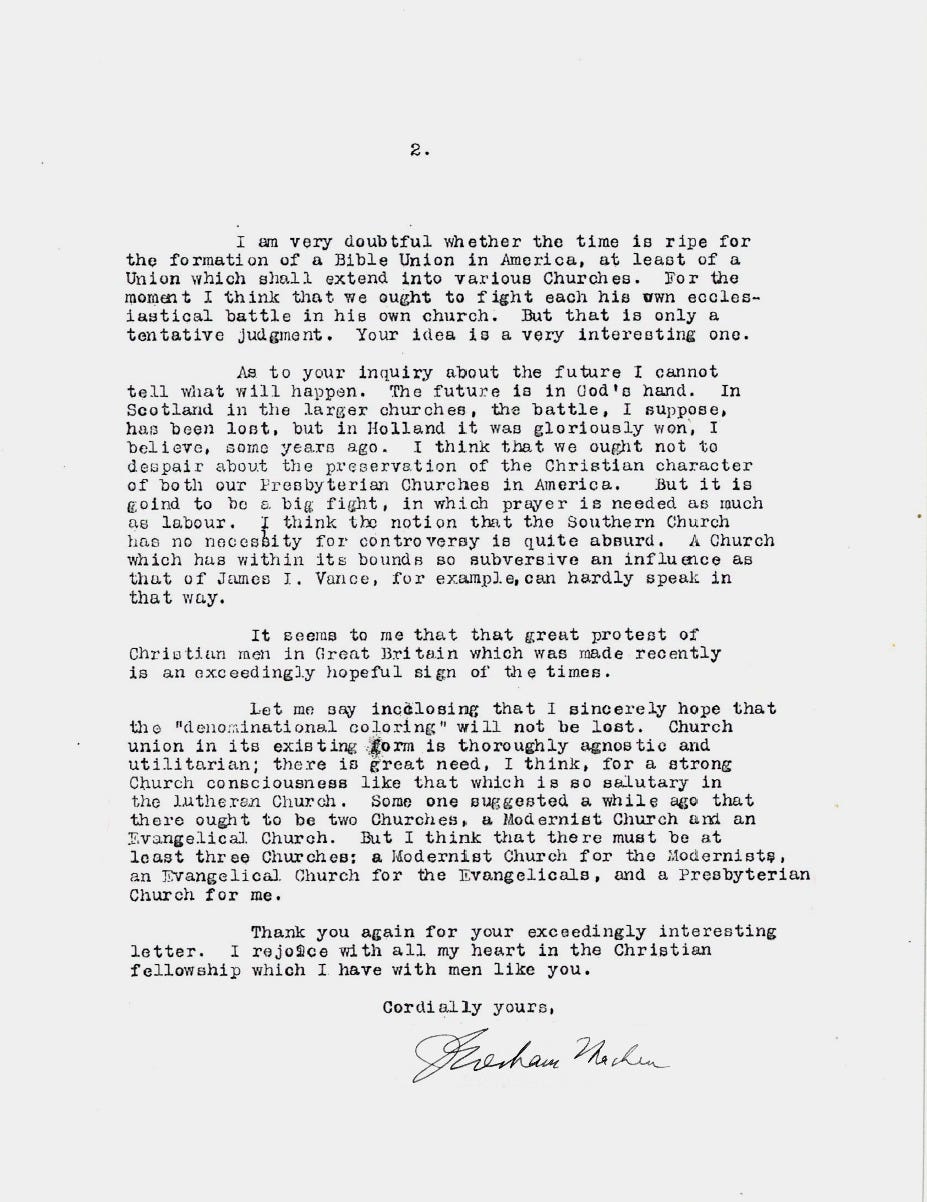
Let’s begin with the “So. Ch.” at the top of the first page, added in Machen’s own hand. This is almost surely filing nomenclature, suggesting that he maintained a file on the “Southern Church,” the PCUS, in which he had been sired. Machen had his hands full with the PCUSA and Princeton, of course, but kept an eye on the PCUS, whose seminaries at least twice tried to tempt him to come home from the North. It’s almost as interesting to ask, “What if Machen had come South in the late 1920s?” as it is to ask, “What if Machen had not boarded the train to North Dakota in December of 1936?”
“January 1, 1925.” - New Year’s Day is significant for students of Machen—he died exactly 12 years later to the day. By 1925, Machen had been involved in ecclesial conflict for only about five years. He was relatively new to the fight; his concerns here reflect those found in his bombshell book of two years earlier, Christianity and Liberalism. He was remarkably consistent right to the end of his life.
Machen’s correspondent, “Rev. Hugh W(att) White, D.D., Bedford, Virginia,” was a conservative pastor and missionary to China in the PCUS who knew what was happening “across the waters.” The problems of reckless ecumenism and liberal unbelief on the mission field (especially in China), discussed with Dr. White,1 were the same issues that plunged Machen into a battle in the Northern church, a battle he would not survive, at least as far as remaining a member of the Princeton faculty and the PCUSA is concerned.
My dear Dr. white:
I am deeply interested in your letter of December 28th (1924), and it is refreshing to get into touch again with someone in the Southern Church who understands how critical the situation is. The last number (I think it was the last) of THE PRESBYTERIAN OF THE SOUTH2 was just about the most discouraging reading which has come into my hands for some time.
This suggests that busy Machen had only occasional communications from the sunny South, but that he knew enough of the situation to see dark clouds ahead—the same clouds on both sides of the Mason-Dixon Line. Things were worse in the North, but not much worse; the decline was more advanced up North, but the decline was evident in the Southern church to those who cared to look. He notes that both denominations (or the agencies thereof) have a recent history of wanting to suppress public criticism3 of the public actions and teachings of boards and figures:
I think the provision of the Foreign Mission Board that utterances of missionaries should not be subject to criticism until formal charges are brought is the most preposterous interference of speech of which I ever heard. The same tactics were pursued by the Modernists at our last General Assembly. It really looked as though certain gentlemen had published their writings with the intention of concealing them from other Presbyterians. For my part I think that when a man comes out in print what he says is fair subject of discussion for the whole world, and I am interested, from the ecclesiastical point of view, not in a man’s private views or in his personal relation to God, but in his public testimony.
Machen pulls no punches in this private communication, naming names. The name of Dr. Leighton Stuart was well known in 1925, but would become much more well known when he was eventually named U.S. ambassador to China (1946-1952). Stuart, whom Machen considered a Modernist (theological liberal), had often inserted himself into Chinese politics even while serving as president of Yenching University (1919-1945). Stuart himself identified as a liberal. In his own memoirs, he said his time as a seminary professor “inevitably led to thought on the issues which may be loosely described as conservative or liberal, orthodox or modernistic. All my training and official connections had been with those of the former type; all of my instinctive sympathies and critical studies led me to the latter.”4
These modernist views actually resulted in an ecclesial trial in a PCUS presbytery, to which Machen now refers with much chagrin and no little heat:
As for adjudication by the Board or by Presbyteries, I can only say that an ecclesiastical court which could clear Dr. Leighton Stuart could clear anybody. Moreover, the action of the last Hanover Presbytery was so absurd on the face of it -- Dr. Stuart was pronounced to be all right simply because he said he was all right. But as a matter of fact practically all Modernists are engaging in chicanery and deceit of the worst possible kind.
Many will know that “union (cooperating, blended) presbyteries” of the PCUSA5 and PCUS smoothed the way for the reunion of the Northern and Southern churches more than five decades later. Much earlier, the pre-Communist mission effort in China (which was massive and well-funded) saw “union seminaries,” which were fertile fields for liberalism and modernism to make inroads, or we should say, plow furrows. Stuart was involved in just such an institution:
The action reported in that number of THE PRESBYTERIAN OF THE SOUTH about that union seminary in China was wrong in principle, again quite independent of the merits of the case. Christian men were told to go on engaging in a common service with men who are perhaps admitted to be Modernists or non-Christian, with the notion that thus the conservative influence in the seminary might be promoted. Permit me simply to say that in my judgment we shall not bring the world to Christ by that kind of”influence,” which involves disloyalty to Christ. The only hope, I think, is in a faithful preaching of the gospel, whether those who help us are for the moment many or few.
Machen then turned to the idea of parachurch, evangelical ecumenism, a topic no less relevant in our own day, where networks and loose affinity groups seem to trump denominations:
I am very doubtful whether the time is ripe for the formation of a Bible Union in America, at least of a Union which shall extend into various Churches. For the moment I think that we ought to fight each issue individually battle in his own church. But that is only a tentative judgment. Your idea is a very interesting one.
Machen was often prescient, but in this case, too optimistic. Note that he was rightly pessimistic about Scotland, wrongly (as we understand) optimistic about the Netherlands, and dead wrong about the future of both larger presbyterian churches in the USA:
As to your inquiry about the future I cannot tell what will happen. The future is in God’s hand. In Scotland in the larger churches, the battle, I suppose, has been lost, but in Holland it was gloriously won, I believe, some years ago. I think that we ought not to despair about the preservation of the Christian character of both our Presbyterian Churches in America. But it is going to be a big fight, in which prayer is needed as much as labour. I think the notion that the Southern Church has no necessity for controversy is quite absurd. A Church which has within its bounds so subversive an influence as that of James I. Vance, for example, can hardly speak in that way.
Again, Machen names names. Vance was one of those “PCUS leaders (who) began introducing Presbyterians—by way of seminaries, training schools, publications, and pulpits—to the ideas of the social gospel and Protestant liberalism.”6 Machen was right that controversy would come to the Southern church, but wrong about which side would prevail. Looking across the Atlantic, it is unclear whether Machen had in mind recent movements among evangelical Anglicans or non-conforming evangelicals, but the rest of the 20th century would not justify his hope:
It seems evident to me that that great protest of Christian men in Great Britain which was made recently is an exceedingly hopeful sign of the times.
Finally, we see Machen’s churchliness on full display, his passion for presbyterianism, and his regard for confessional bodies of other stripes:
Let me say in closing that I sincerely hope that the “denominational coloring” will not be lost. Church union in its existing form is thoroughly agnostic and utilitarian; there is great need, I think, for a strong Church consciousness like that which is so salutary in the Lutheran Church. Someone suggested a while ago that there ought to be two Churches, a Modernist Church and an Evangelical Church. But I think that there must be at least three Churches: a Modernist Church for the Modernists, an Evangelical Church for the Evangelicals, and a Presbyterian Church for me.
What a wonderful paragraph! Machen advocates:
for doctrinal and polity distinctives (“coloring’),
against reckless ecumenism, which kills such distinctives, and
for “strong Church consciousness,” which likely means “church first” (over against political and cultural “isms”) with an emphasis on the spirituality of the church and the ordinary means of grace, with confessional Lutherans as a positive example.
Just as Machen did not quite want to wear the “fundamentalist” label in the 1920s, neither did he want evangelicalism to subsume his beloved presbyterian and Reformed tradition:
But I think that there must be at least three Churches: a Modernist Church for the Modernists, an Evangelical Church for the Evangelicals, and a Presbyterian Church for me.
Machen would give his all in the following 12 years to preserve a presbyterian church and not just for himself, but for God’s glory and the sake of the gospel. Hard days were ahead for him and he knew it. That’s probably why he valued his co-combatants so greatly:
Thank you again for your exceedingly interesting letter. I rejoice with all my heart in the Christian fellowship which I have with men like you.
Machen’s strong fellow feeling for his presbyterian and Reformed brethren is reflected to this day in the ecumenical passion of the Orthodox Presbyterian Church, which he helped found, and the North American Presbyterian and Reformed Council.
Pilgrims need company on their way, and no one of like faith is truly a stranger. We can be thankful for this little letter from a giant of a man and the example it gives.
An interesting biographical side note: White’s daughter, Agnes Mary White Sanford, later became a faith healer, and her books were influential in the 20th-century charismatic movement. She may have come by some of her oddities honestly—her father had already written (1922) a book entitled Demonism Verified and Analyzed.
This issue of the Southern presbyterian newspaper is not available online, so knowing the specifics of Machen’s reference is impossible at the moment.
To be precise (pedantic?), at the time of the union of presbyteries, the northern church was known as the UPCUSA, and became the PCUSA again when the reunion with the PCUS happened in 1983.
No posts
Comments
Nothing yet. Say the first thing.
Sign in to join the conversation.