
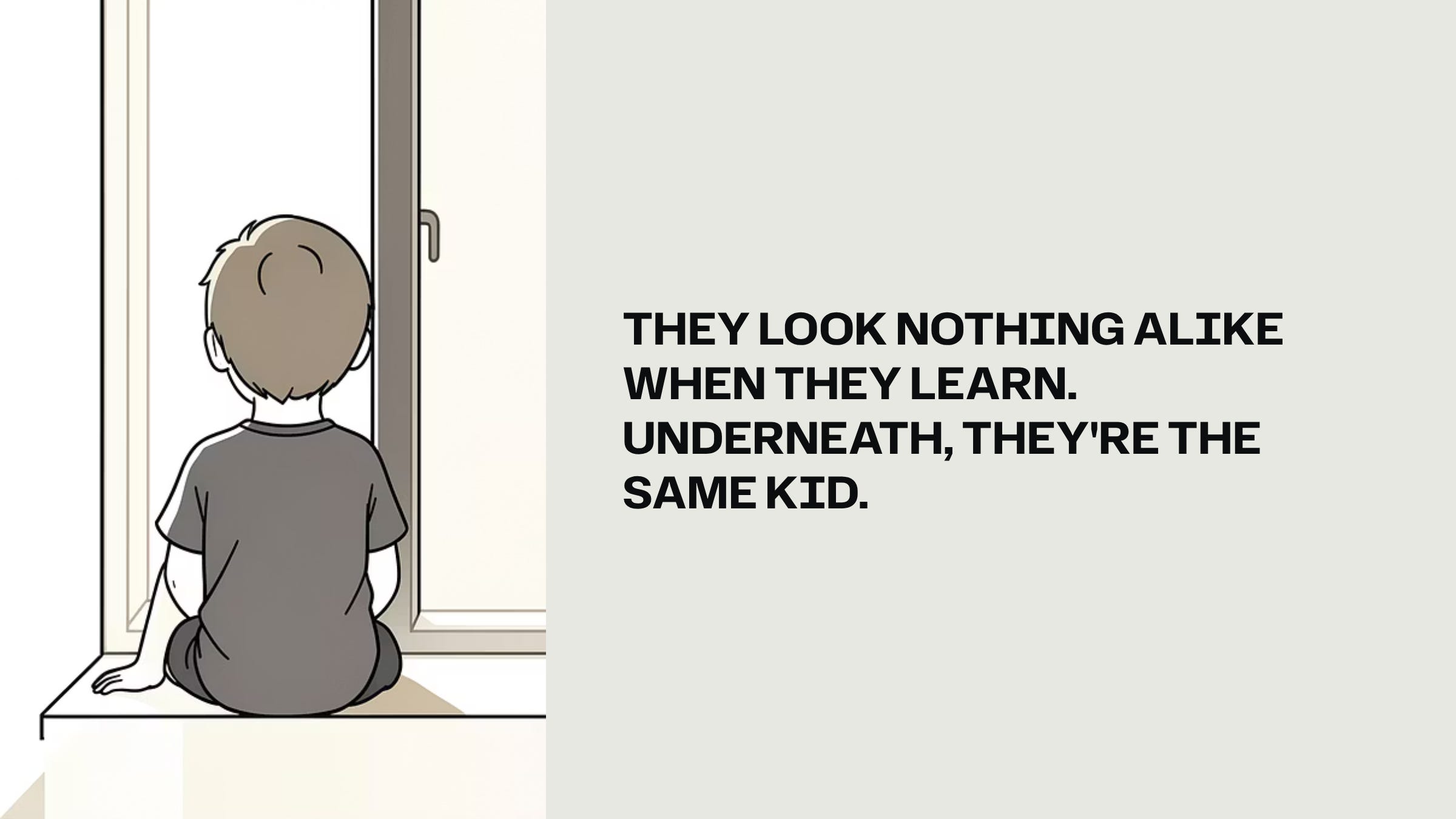
My daughter spent Saturday morning spelling words wrong on purpose.
She knew how to spell them. That was the point.
“Necessary” with two s’s and one c. “Rhythm” with a spare vowel jammed in the middle. She’d write the wrong version, tilt her head at it, pull a face, and go “nope — that’s not it,” then try again.
I asked what she was doing.
“Seeing which wrong one looks the most right,” she said. “Then I know the real one better.”
I didn’t think much of it. Ten-year-olds invent strange games.
Then, an hour later, I was in the car with my son. Fifteen, in the passenger seat, half-arguing himself through a decision out loud. And in the middle of it he stopped and said: “I think I keep deciding before I’ve actually looked.”
He wasn’t upset. He said it the way you’d notice you’d taken a wrong turn — mildly, correctably.
And I realised I’d watched the same thing happen twice in one morning, in two rooms, in two kids who could not look more different while doing it.
So here’s the question I couldn’t shake: what does a ten-year-old misspelling words on purpose have in common with a fifteen-year-old catching himself deciding too fast?
Here’s the trap I keep falling into, and I suspect I’m not alone.
We’ve been handed a script for growth mindset. “I can’t do it yet.” Praise the effort, not the outcome. The brain-is-a-muscle line. Good things, all of them. I’ve written them into this newsletter myself.
But somewhere along the way the script became the thing I was listening for. I’d wait for my kid to say something that sounded like growth mindset — and when they didn’t, I assumed it wasn’t there.
That’s backwards.
In an actual child, growth mindset almost never announces itself. It doesn’t say “I can’t do it yet.” It wears a hundred disguises, and most of them look nothing like the poster in the classroom. It looks like a girl breaking words on purpose. It looks like a boy going quiet and then muttering that he jumped too soon.
The tell was never the words. The tell is what they do with a result.
Watch closely the next time your child gets something wrong. Not what they say — what they do in the next three seconds. Do they treat the wrong answer as a verdict — a final statement about what they are? Or do they treat it as information they can still use?
That’s the whole skill. Everything else is costume.
And once you know that, you stop being reassured by the easy signs and start noticing the real ones. The confident kid who rattles off an answer and won’t budge isn’t necessarily the one with the strongest mindset — sometimes they’re the one who’s decided that changing their mind is a kind of losing. The quiet kid who says “hang on, let me think about that again” might look less sure. They’re often the one doing the actual work.
Once I saw it that way, my daughter and my son stopped looking like two different children.
She was treating her spelling as a draft. A wrong version wasn’t a failure — it was data. Writing “necessary” wrong on purpose was her way of finding the edges of the right one. She was, without any idea she was doing it, running an experiment on herself and keeping the results.
He was doing the exact same thing with a decision. Catching himself committing too early meant he’d stopped treating his first move as the final one. He could revise mid-stream. He could look at his own thinking, decide it wasn’t finished, and edit.
What struck me was how undramatic it was. There was no groan, no “I’m so stupid,” none of the self-punishment we’ve somehow taught kids to perform when they notice a mistake. He just… adjusted. The way you’d re-grip a bag that was slipping. For him, being wrong halfway through wasn’t an event. It was Tuesday.
That’s what my daughter had too, at the table, an hour earlier. She wasn’t embarrassed by the wrong spellings. She was interested in them.
Different rooms. Different ages. Barely the same activity.
Identical move.
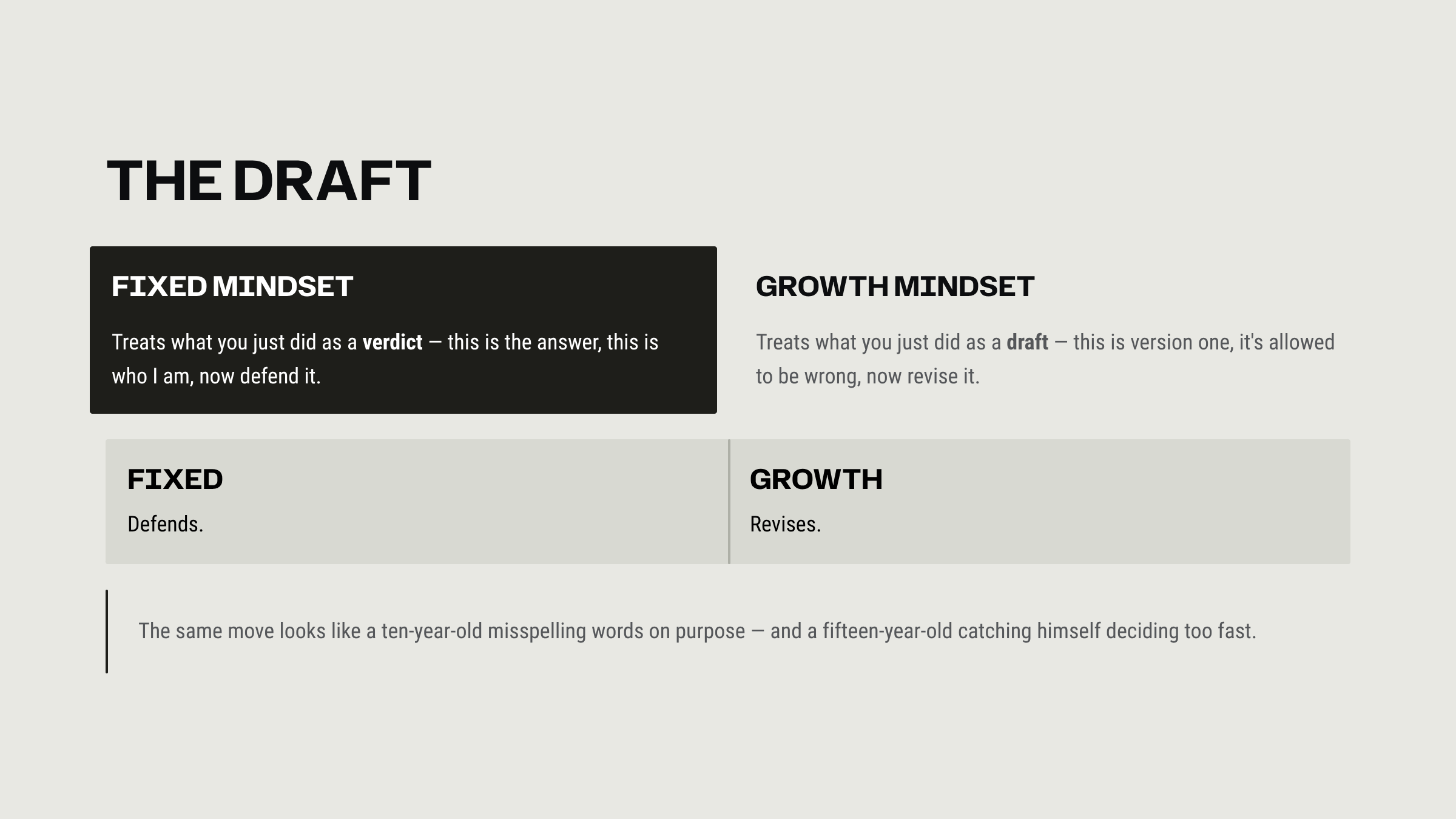
I’ve started calling it The Draft — because that’s the line that separates the two mindsets more cleanly than anything else I’ve found. A fixed mindset treats what you just did as a verdict: this is the answer, this is who I am, and now I defend it. A growth mindset treats what you just did as a draft: this is version one, it’s allowed to be wrong, and now I revise it.
Fixed defends. Growth revises.
That’s it. That’s the muscle. And the reason it’s so easy to miss in your own kid is that revising looks completely different at six than it does at sixteen. At six it’s rebuilding the block tower. At ten it’s misspelling words to learn them. At fifteen it’s saying “I decided before I looked” to nobody in particular in a moving car.
Same shape. Wildly different surface.
Here’s why this matters more than a neat observation about my two kids.
If I’d only had the son, I’d have almost missed it. A teenager second-guessing a decision doesn’t look like a win. It looks like hesitation. It looks like the thing we’re tempted to reassure away — “don’t overthink it, mate, trust your gut.” I might have coached the skill right out of him.
And if I’d only had the daughter, I’d have filed her word game under “cute” and moved on. I’d never have connected it to anything that mattered for who she’s becoming.
It was seeing them side by side that taught me what neither could alone. The same skill, at two ages, so I could finally recognise the shape independent of the surface. One kid gave me the obvious version — the playful, visible, mistake-as-game version that’s easy to love. The other gave me the grown-up version, the one that’s easy to mistake for weakness. Put them together and the pattern jumps out. Pull them apart and you’d swear they had nothing to do with each other.
That’s the trap with a single child. You only ever get one surface. You see your kid’s particular way of revising — or particular way of refusing to — and you assume that’s what the skill is, rather than one of its thousand disguises.
So when you go looking for this in your own child this week, don’t look for the script. Look for the draft. When your eight-year-old rubs out a drawing and starts again instead of insisting it’s fine — that’s it. When your twelve-year-old changes their answer after thinking about it, rather than digging in to look decisive — that’s it, and it’s worth more than the confidence we usually praise. When a small one says “let me try the other way” — that’s the whole thing in four words.
You are not waiting for them to sound like a growth mindset. You are watching for the tiny, unglamorous moment where they treat their own performance as editable.
And here’s the part that connects to everything this newsletter is about. The world these kids are walking into does not hand out answer keys. It won’t tell them when they’ve got it right. It will constantly ask them to make a call, get new information, and change their mind without falling apart — the exact move schools quietly punish, because in a classroom changing your answer looks like you didn’t know it in the first place. The child who can treat their own thinking as a draft isn’t just a better student. They’re the adult who can be wrong on Tuesday and better on Wednesday, for the rest of their life. That capability is built now, in these ordinary moments, or it isn’t built at all.
On Thursday I’ll get specific about the moment itself — the one small thing I now say (and the one thing I’ve had to stop saying) in the three seconds after my kid gets something wrong, so the draft stays open instead of slamming shut into a verdict. It’s smaller than you’d think, and I got it wrong for years.
But before Thursday, one question — and it’s not about your child.
The last time you got something wrong this week — in front of them, at the dinner table, behind the wheel — did you defend it, or did you revise it?
Because whichever one you did, they were watching. And they were taking notes.
No posts
Comments
Nothing yet. Say the first thing.
Sign in to join the conversation.