
A note on context: At a time when so few people are paid a living wage and able to make ends meet, it is unlikely that wages are driving inflation. And yet that relationship sets the foundations for monetary policy, with implications for interest rates, financial stability, and whether inequality deepens or softens.
If wages no longer drive inflation, what does? In this newsletter, we will explore other potential drivers.
While this edition focuses on wealth inequality, future editions will consider other drivers of inflation and market stability, such as market concentration, supply chain shocks from “just-in-time” versus “just in case” business models, past stimulus measures which sought - perhaps imperfectly - to correct for socioeconomic fragility in times of crisis, and other factors.
We hope this content will be useful for central banks, other policy makers, and regulators as they seek to understand and reduce systemic and systematic risks related to socioeconomic inequality. Please do not hesitate to be in touch with any feedback!
By Raphaele Chappe, PhD and Delilah Rothenberg

Two decades ago, Citigroup's Plutonomy Memos introduced the term "plutonomy" to describe economies where wealth and consumption are heavily concentrated among the affluent – a trend observed not only in the U.S. but also in countries like the UK, Canada, and Australia.1
The authors argued that affluent consumers commanded a disproportionately large share of both income and spending. While the report was controversial at the time for seemingly advocating capitalizing on economic inequality by recommending investments in a "plutonomy basket" of luxury stocks, the concept remains relevant today.
The Chair of Rockefeller International recently noted that in the U.S., the bottom 40% by income now account for 20% of all spending while the richest 20% account for 40%.”2 Recent analysis from Moody’s Analytics indicates that households in the top 10% of earners (those earning $250,000 or more annually) now account for nearly half (49.7%) of all consumer spending, a significant increase from three decades ago.3
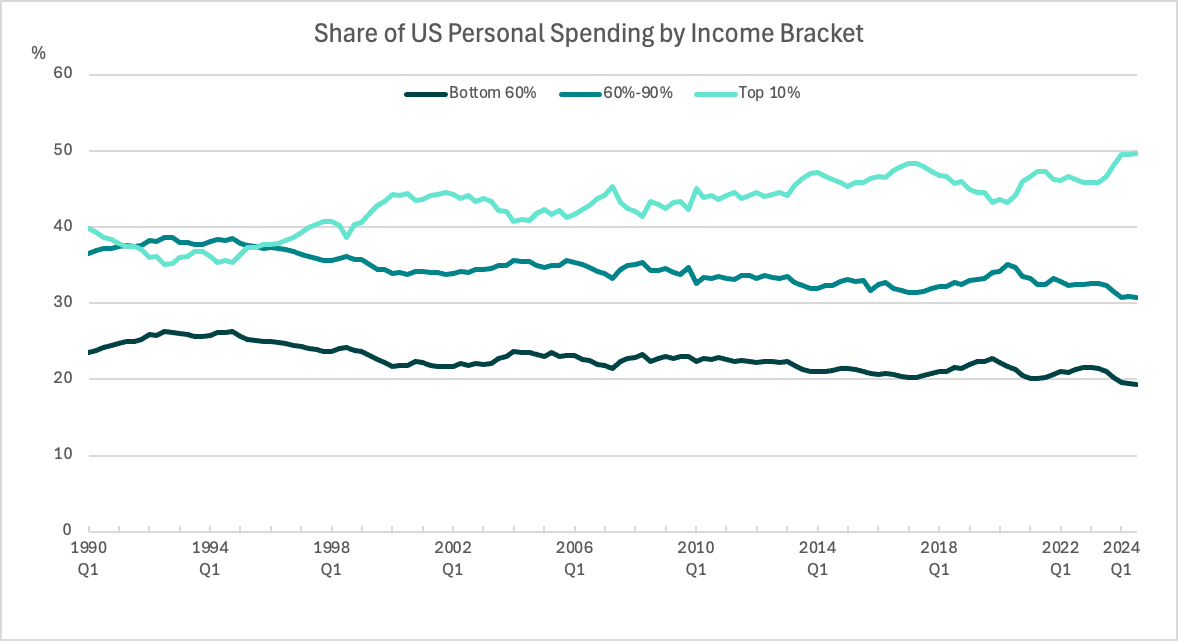
Source: Moody's Analytics
Meanwhile the real median household income was $80,610 in 2023,4 with workers sometimes holding multiple jobs.5 As of May 2022, nearly 6 in 10 U.S. jobs paid less than $25 per hour, and about 20% of jobs paid under $15 per hour.6 A recent report by a human capital management data company and the Living Wage Institute found that only 56% of full-time workers in the U.S. earn a living wage.7
Concentration of spending in wealthier segments of society has direct implications for inflation, market stability, and economic policy – including how interest rates are set, which should concern investors, companies, and policymakers alike. The traditional approach in macroeconomics is that central banks are expected to reduce overheating demand to combat inflation through interest rate adjustments. But are wages the main driver of inflation? In an economy where wealth and spending are increasingly concentrated among the ultra-rich, it may not be accurate to think of wages as a primary driver of inflation, since the vast majority of workers have limited influence on aggregate demand. This may call into question dynamics like a “wage price spiral”8 and the traditional relationship between employment and price stability. It is worth nothing that there are also many other potential drivers of the recent surge in inflation, including market concentration, supply chain disruptions, and energy shocks exacerbated by sanctions against Russia.
A closer look at plutonomic dynamics, particularly how wealthier households spend from their accumulated wealth, can shed light on overlooked effects of asset price inflation in the post-2008 era of persistently low interest rates. The growing reliance on affluent consumers as a driver of economic growth may have consequences that are potentially under-examined. For example, it may exacerbate affordability crises in essential sectors like housing, education, and healthcare.
It may also make the economy more fragile, increasingly susceptible to financial market fluctuations, asset price cycles, and potential debt crises. Over time, fiscal and monetary policy tools may become less effective, limiting governments' ability to stabilize downturns and stimulate broad-based growth.
And, as we are seeing with escalating trade wars and tariff policies, socioeconomic inequality can lead to public discontent and populism, which can trigger unpredictable and drastic policy changes, leading to conditions such as the current market turmoil.
While investors navigate near-term turbulence which arguably can be attributed to a decades-long build-up of socioeconomic inequality, it will be important for investors to also consider in the long-term how they can play a role in evolving markets to build more broad-based and less concentrated wealth across society. This is the focus of the Predistribution Initiative (PDI).
The Wealth Effect
Economists have long recognized that higher-income individuals have a lower marginal propensity to consume than lower-income individuals – meaning that as income increases, the proportion of additional income spent on consumption decreases. This disparity contributes to widening wealth inequality, as higher saving rates enable high-income earners to accumulate wealth more rapidly.
However, in an environment of rising wealth and income inequality, the spending power of the wealthy has remained substantial despite their lower marginal propensity to consume. Increases in perceived wealth – through rising asset values like stocks or homes – can translate into higher spending on goods and services, a phenomenon known as the “wealth effect.”
The Plutonomy Memos argued that as wealth-to-income ratios rise, households may respond by increasing consumption and reducing savings, which they suggested could help explain the persistently low U.S. savings rate.9 On the other hand, other research finds that savings by rich Americans have increased substantially since the 1980s, leading to a material accumulation of financial assets.10 This could suggest that the rich are both earning more and saving more in absolute dollar terms, even if the saving rate decreases under a wealth effect.
Traditional Inflation Models May Underestimate the Impact of the Wealthy
In economies where consumption is driven disproportionately by the wealthy, traditional economic models might underestimate inflationary effects. When measuring inflation, economists often use a "basket" of goods that represents typical consumption patterns – such as the one underlying the Consumer Price Index (CPI) – that may not accurately reflect the spending habits of households that do not fit the average profile. Specifically, the approach may not reflect the spending habits of affluent consumers, whose demand influences distinct sectors.
For example, Forbes’ annual Cost of Living Extremely Well Index (CLEWI), which has been tracking a basket of ultra luxury goods and services, has outpaced inflation as measured by the CPI over four decades – even if it is nowhere near matching the explosive growth in the net worth of the Forbes 400 members.11 Established in 1976, the index tracks the price changes of items like private yachts and jets, fine dining, designer apparel, or tuition at elite private schools and colleges for a (very!) lavish lifestyle.12
Yet the CLEWI serves as more than just a snapshot of elite tastes. It reflects how demand at the top can drive inflation in markets where supply is constrained and demand inelastic. The result is that concentration of spending in high-end services and goods creates inflationary pressure in these segments, even when broader economic inflation remains moderate.
It is crucial, here, to distinguish luxury consumption from necessity consumption. While luxury inflation does not directly impact average households, it can spill over beyond luxury goods to essential sectors like housing, education, and healthcare – areas where the willingness and ability of affluent households to pay more drives up costs for everyone else, affecting the broader population. In the context of a plutonomy, the structural dynamic is that inflation may not appear in headline averages while still intensifying in supply constrained sectors where top-heavy spending exerts disproportionate influence. Let’s consider a few examples.
Sector-Specific Inflation Driven by Wealthy Households
Housing: Affluent buyers, including those purchasing second or third homes – as well as foreign investors making “non-resident” purchases – significantly impact real estate markets, particularly in major metropolitan areas. By competing for high-end and investment properties, these buyers can drive up overall housing demand and property values, making homeownership increasingly out of reach for middle-income households and exacerbating affordability challenges for renters and first-time buyers.
In global cities like New York, London, L.A., etc. non-resident buyers can have a significant impact on condo prices in specific desirable neighborhoods.13 While increasing supply is often seen as a key solution to the problem of housing unaffordability, the intended benefits are undermined when new units are primarily purchased by non-residents. Many of these properties are used as investment assets rather than primary or secondary residences, further reducing supply for local buyers, and often sitting empty.14
In areas where high-income earners concentrate their wealth in real estate, demand for premium properties inflates prices across the broader housing market, creating spillover effects that impact middle- and lower-income residents.15 Developers often respond to this demand by prioritizing luxury units rather than affordable housing. This can lead to supply-demand imbalances, with rising vacancy rates in luxury housing and a persistent shortage of affordable units.16 The growing influence of affluent buyers in real estate markets ultimately raises broader concerns about housing as a financial asset versus housing as a human right, while also fueling populism and social instability as opportunities for home ownership becomes increasingly out of reach for many.
Education: Since 1990, the price of a four-year private college degree has doubled, even accounting for inflation.17 Ivy-Plus colleges (Ivy League, Stanford, MIT, Duke, and Chicago) give significant preferences to wealthier applicants, even adjusting for differences in standardized test scores.18 A 2016 report found that 72% of students at the most selective colleges came from the wealthiest 25% of the population, while only 3% came from the bottom 25%.19
The willingness and ability of wealthier families to pay higher tuition can drive up costs, particularly at elite universities where they bid for limited seats, making higher education less accessible to students from lower-income backgrounds in those institutions. This can in turn also reset price expectations across the higher education market, creating a form of price signaling that reinforces the idea that higher cost equals higher quality. A recent paper has found that increases in U.S. income inequality can explain more than half of the observed rise in average net tuition since 1990.20
Healthcare: Healthcare costs in the U.S. have increased drastically over the past several decades, from 5% of GDP in 1962 to 17% in 2022.21 The growth in costs stems from many factors including an aging population, the introduction of expensive new medical technologies, administrative inefficiencies in the complex U.S. healthcare system, and market consolidation, which reduces competition and enables price increases.22
The intersection of medical need and financial capacity raises important questions about who the system is built to serve, and whether the spending power of wealthy households may be reinforcing a healthcare model that is expensive, fragmented, and increasingly unaffordable for much of the population. We’ll note some disturbing trends in that respect.
First, access to care remains uneven – particularly in rural and underserved areas. Rural hospitals in the U.S. have closed or merged with larger health networks at alarming rates, and access to high-quality healthcare remains a major challenge in rural areas.23 In urban areas, hospital closures often occur in low-income communities with high rates of uninsured or underinsured patients, where healthcare services are less profitable. For instance, in New York City 18 hospitals closed between 2003 and 2016, many in poorer neighborhoods, leading to increased pressure on remaining facilities and longer travel distances for residents seeking care.24 Such developments exacerbate existing health disparities, reducing access to care for vulnerable populations.
Second, the spending power of wealthy households may be amplifying deeper systemic flaws of the healthcare system in the U.S., such as the dominant fee-for-service model, where providers are financially rewarded for delivering more services (volume over actual health outcomes). This can create incentives for health systems to prioritize high-revenue services that cater to affluent demand (e.g. costly specialized treatments, advanced diagnostics) over lower-margin, cost-effective services like primary or preventive care.
While disparities in purchasing power are only just one factor driving healthcare’s unsustainable trajectory (among others which PDI covers, including market concentration, or concentration amongst suppliers of these goods and services), they expose the shortcomings of a model that prioritizes profit over broader population health. Solutions may require systemic reforms, including a shift towards “value-based” care models that align financial incentives with patient health outcomes and hold providers accountable for delivering high-quality, equitable, and cost-effective care.25
Broader Macroeconomic Implications
While concentrated demand among the wealthy can drive sector-specific inflation, particularly in areas where supply is limited and affluent demand is inelastic, it can still suppress broad-based consumption. This is because affluent households have a lower marginal propensity to consume than less affluent households. This creates inflation that is uneven, persistent, and harder to manage through traditional policy tools like interest rate adjustments.
Importantly, this calls into question the notion of a wage-driven “overheating” economy. Wage growth for the bottom half of the income distribution has been modest and often outpaced by inflation itself.26 In fact, it is highly unlikely that people struggling to afford housing, food, or healthcare are those pushing up prices. Many households are often reducing discretionary spending or going into debt just to meet basic needs.27
The traditional Phillips Curve framework assumes that inflation primarily arises from wage-driven demand in an environment of broad-based wage growth. However, in a plutonomy, with consumption dominated by the wealthy – whose spending is less sensitive to wages and more influenced by asset prices, inflation in specific sectors can persist even if wage growth remains weak among most workers.
Overall demand may not respond strongly to changes in employment, and inflation dynamics may be decoupled from employment trends. In this context, inflation becomes less a function of labor market overheating and more a reflection of who is spending and where demand is concentrated. Aggregate demand composition matters.
This potentially limits the effectiveness of fiscal policy, particularly when stimulus (like tax cuts, rebates, or transfers) is filtered through upper-income households. If consumption is top heavy, multiplier effects on the real economy may be weakened, and inequality may deepen without significantly boosting overall demand.
Likewise, the effectiveness of monetary policy transmission mechanisms may also be obstructed. Since the consumption of wealthy households is largely insensitive to interest rates, raising or lowering rates may do little to curb inflation or stimulate additional consumption.28 Specifically, traditional inflation control mechanisms – such as interest rate hikes – may be less effective and even cause more harm than good when inflation is fueled by asset appreciation rather than broad-based wage growth. Additionally, expansionary monetary policy fuels asset price inflation, benefiting wealthier households and amplifying the “wealth effect”.
Recognizing and Addressing Systemic Risks
For investors, the increasing concentration of spending presents systemic risks that go beyond market cycles. The reliance on affluent consumers as the primary engine of demand heightens economic and social fragility, making markets more vulnerable to asset price volatility and liquidity shocks in addition to drastic policy measures in response to populist concerns, such as extreme tariffs (emphasizing “extreme,” as some level of tariffs can be healthy to support domestic economies), which can exacerbate or trigger such shocks.
The current tariff wars may impact plutonomy dynamics through two separate channels. First, it may hurt wealthier households through the impact on asset holdings and global portfolios. We are now seeing, for instance, that the stock market volatility resulting from the Trump administration trade policies is threatening high-income consumer spending as a key U.S. growth driver.29 In capital markets, liquidity risks could rise as concentrated wealth may lead to capital flight or sudden investment withdrawals during downturns. Second, tariffs may also affect middle- and lower-income households through rising consumer prices. The combined effect is that aggregate demand could decline short-term. Ultimately, the overall impact of tariffs on plutonomy dynamics could depend on which channel might be stronger in a relative sense. Aggregate demand might become more top heavy, or less so, depending on which group is most impacted.
In this environment, investors must not only reassess risk exposure in sectors sensitive to plutonomy-driven inflation but also reflect on the role they currently play in shaping economic outcomes. This is not just a question of social responsibility, but of understanding negative feedback loops from investment activity that exacerbate inequality and market fragility. These system-level risks suggest there may be strategic value in shifting toward investment in more balanced, resilient forms of growth.
Institutional, long-term, and diversified investors – including pension funds, insurance companies, sovereign wealth funds, and endowments – are uniquely positioned to influence this trajectory. For instance, supporting thoughtfully structured investments in affordable housing, education, and healthcare (sectors affected by plutonomy-driven inflation) can help mitigate long-term risks while aligning with sustainable growth and return objectives.
It will be important to consider the broader distribution of risk and economic returns among stakeholders in transactions to address the structural imbalances that underpin plutonomy. While companies paying living wages to their employees is a starting point, the distribution of risk and return across workers, community members, small business owners, investors, intermediaries, and lenders and the differentials between these amounts are the ultimate factors that influence plutonomy dynamics. Ultimately, these differentials are heavily influenced by the way that investors allocate, price and structure capital.
Furthermore, when it comes to the role of central banks, as well as other policy makers and regulators, investors can consider what engagement they can undertake to encourage policies and regulations that reduce socioeconomic inequality and support a level investment playing field. A level playing field enables investors to undertake measures to avoid allocating, pricing, and structuring capital in ways that exacerbate socioeconomic inequality and negative economic externalities, thereby supporting long-term financial stability. Since diversified investors’ returns are more than 75% dependent on systemic and systematic market factors, a level playing field helps investors in maintaining strong performance over decades to come, avoiding a scenario of “missing out” if peers were to continue externalizing costs in the short term.30
There is enormous potential for change if enough investors recognize the systemic and systematic risks of inequality and the role that they can play to reduce it. If you would like to stay tuned to PDI’s growing coverage on the systemic and systematic risks of socioeconomic inequality and what investors can do to reduce it, please subscribe to our newsletter here!
References/Sources:
[1]: See the original report in October 2005, followed by a second report in March 2006, and a third report in September 2006.
[2]: Ruchir Sharma in the Financial Times (2024) – The US Economic Boom is a Mirage.
[3]: Wall Street Journal (2025) -- The U.S. Economy Depends More Than Ever on Rich People
[4]: As per the U.S. Census Bureau.
[5]: As of February 2025, 5.4% of workers held multiple jobs, as per FRED Economic data.
[6]: As per the U.S. Bureau of Labor Statistics.
[7]: Dayforce – New Research Reveals Major Disparities in Access to Living Wages in U.S. Workforce
[8]: The wage-price spiral is a mainstream economic theory that describes how rising wages can lead to higher prices, prompting further wage demands and creating a self-reinforcing cycle of inflation. It was widely used to explain inflation during the 1970s and still informs central bank thinking. However, its relevance is becoming increasingly questioned, as wage growth in many advanced economies has been lagging behind prices.
[9]: Citing Federal Reserve research from Maki and Palumbo (2001) -- Disentangling the Wealth Effect: A Cohort Analysis of Household Saving in the 1990s
[10]: Mian, Straub, Sufi (2020) – The Saving Glut of the Rich
[11]: Forbes (2023) – The Price Of The Good Life: Here’s How Much More Expensive It’s Gotten To Live Like A Billionaire
[12]: Included in the index is the cost of things like a night at The Carlyle in a Central Park suite in New York, an Oyster 595 sailing yacht, one year’s tuition, room & board at the Groton School and at Harvard, a tasting menu per person with wine pairing (but excluding tip!) at Le Bernardin, a case of 2008 Krug Vintage Brut champagne, 12 cotton bespoke shirts at Turnbull & Asser, horsebit leather Gucci loafers, season tickets to the Metropolitan Opera, an Ebonized Model D concert-grand piano from Steinway & Sons, a 45 minutes appointment with a psychiatrist in New York’s Upper East Side, and, last but not least the hourly fee for estate planning by a partner at Schlesinger Lazetera & Auchincloss
[13]: See for example Suher (2016) – Is Anybody Home? The Impact and Taxation of Non-Resident Buyers
[14]: See for example Wall Street Journal (2025) – A Sore Spot in L.A.’s Housing Crisis: Foreign-Owned Homes Sitting Empty
[15]: Matlack and Vigdor (2006) – Do Rising Tides Lift All Prices? Income Inequality and Housing Affordability
[16]: See Brownstoner (2023) – NYC Has More Housing Than Ever Before Yet It's Still Not Affordable
[17]: Federal Reserve Bank of Minneapolis (2021) – As the rich get richer, the price of college soars
[18]: A recent study finds that children from families in the top 1% are more than twice as likely to attend an Ivy-Plus college as those from middle-class families with comparable SAT/ACT scores. Chetty, Deming and Friedman (2023) – Diversifying Society’s Leaders? The Determinants and Causal Effects of Admission to Highly Selective Private Colleges
[19]: Jay Kent Cooke Foundation (2016) – True Merit: Ensuring Our Brightest Students Have Access to Our Best Colleges and Universities
[20]: Federal Reserve Bank of Minneapolis (2020) – College Tuition and Income Inequality
[21]: Peter G. Peterson Foundation (2024) – Why Are Americans Paying More for Healthcare? Healthcare spending is heavily concentrated, with the top 5% of patients accounting for over half of total health expenses. High spending often correlates with greater medical needs, such as those of individuals with chronic or complex conditions.
[22]: In addition to hospitals, other subsectors – including pharmaceutical companies, insurers, and medical device manufacturers – play a significant role in driving up costs. Prescription drug prices in the U.S. are among the highest in the world, in part due to limited price regulation and extended patent protections that delay the introduction of generics. Insurance companies, meanwhile, contribute to administrative complexity through opaque billing practices, narrow provider networks, and rising premiums and deductibles that shift more costs onto patients.
[23]: O’Hanlon, Kranz, DeYoreo, Mahmud, Damberg, Timbie (2020) – Access, Quality, And Financial Performance Of Rural Hospitals Following Health System Affiliation
[24]: New York City (2016) – One New York Health Care For Our Neighborhoods
[25]: The Commonwealth Fund (2023) – Value-Based Care: What It Is, and Why It’s Needed
[26]: Economic Policy Institute (2024) – Fastest wage growth over the last four years among historically disadvantaged groups
[27]: Urban Institute (2024) – How Many Families Take on Debt to Pay for Groceries?. Nearly one in five adults (19.3%) reported using savings not intended for everyday expenses to pay for groceries, while 20% relied on credit cards without paying the full balance, and 7.1% missed minimum payments. Additionally, over one in six adults (17.8%) used Buy Now, Pay Later services to cover grocery costs.
[28]: This is described in this BIS publication, Awazu Pereira da Silva, Kharroubi, Kohlscheen, Lombardi and Mojon (2022) – Inequality hysteresis and the effectiveness of macroeconomic stabilisation policies
[29]: Bloomberg (2025) -- The Richest Americans Kept the Economy Booming. What Happens When They Stop Spending?
[30]: Lukomnik and Hawley (2021) – Moving Beyond Modern Portfolio Theory: Investing That Matters
No posts
Comments
Nothing yet. Say the first thing.
Sign in to join the conversation.