
I was in the middle of writing a different essay yesterday when I saw a friend of mine, Hanno Seebens, share a new paper on LinkedIn1. I stopped writing the essay and started reading.
I’m glad I did. And I had to share it with you.
Here, the crux. We've typically assumed invasive species do more damage in the Global North than the Global South. Turns out we had it backwards — the impacts are more severe in the Global South.
Before we go any further, a quick note: “Global South” doesn’t literally mean south of the equator. It’s a term used to describe developing and emerging economies, which often comes with political and structural issues like lower incomes and poor infrastructure, whereas the “Global North” refers to the wealthier industrialised nations.
This assumption emerged largely because these regions have more invasive species records, not because they have been shown to suffer more severe impacts. That is, we’ve inferred the impacts from the numbers of invasive species. Turns out, based on the findings of this paper that we’ve been wrong all along. Despite fewer documented cases of invasive species in the Global South, the impacts are more severe.
In hindsight, this isn’t entirely surprising. Wealthier countries invest more in monitoring and research, so they generate more records. But records aren’t impacts.
That’s the finding from this new paper by Sven Bacher, Petr Pyšek, and Hanno Seebens, published in Science this week.
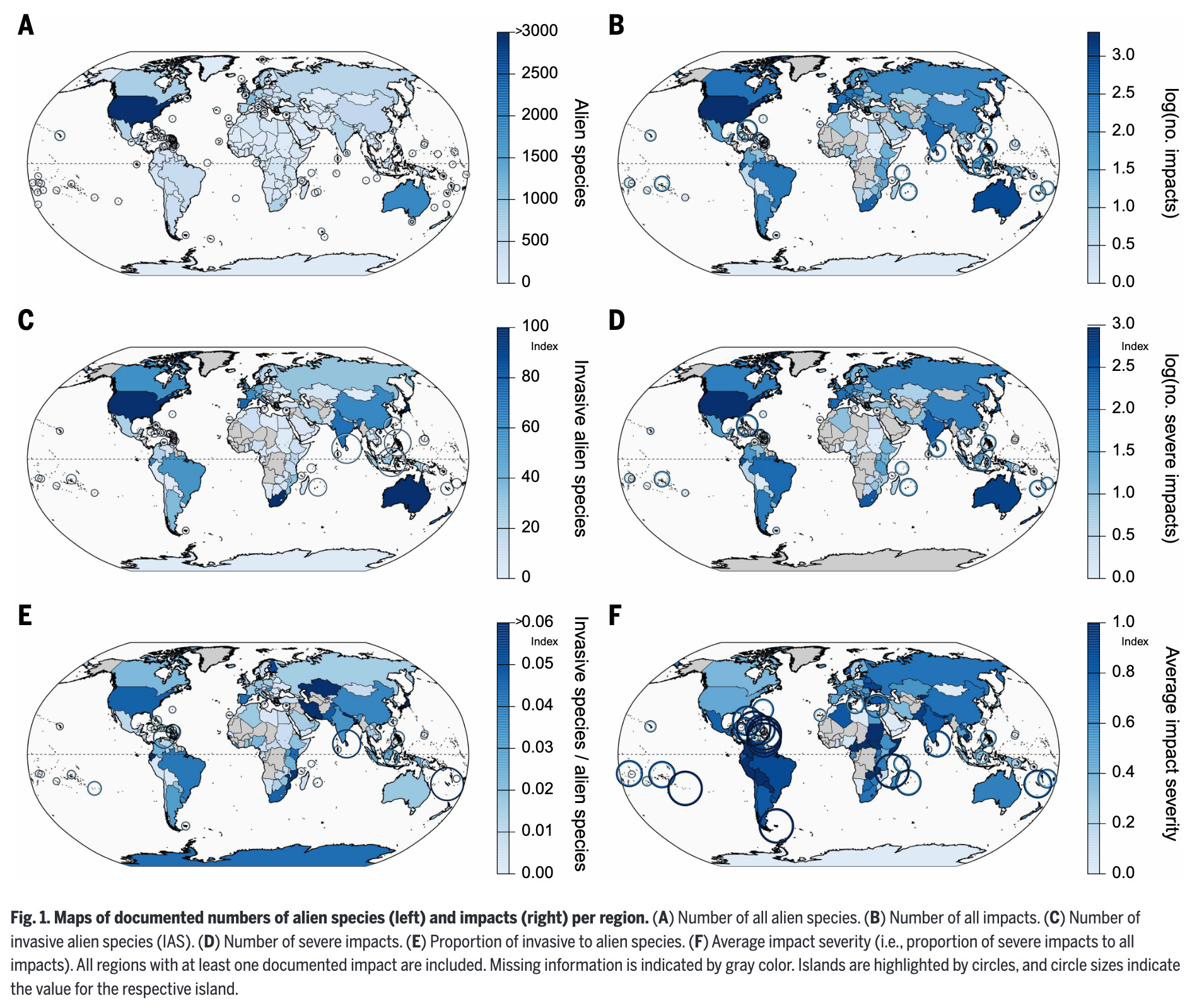
As they reveal in their massive global analysis, numbers reported and damage done are different things. Using a standardised measure of impact severity coupled with a new global dataset (>22,000 impacts for >3,300 invasive species), the real pattern emerged. This new metric measures the proportion of high impacts among all recorded impacts at a location, which means it’s independent of research effort. They compared this to another dataset comprising all records of invasive species, not necessarily with impacts documented (almost 40,000 records). Despite reporting fewer total impacts, the impacts they receive are more severe in the Global South.
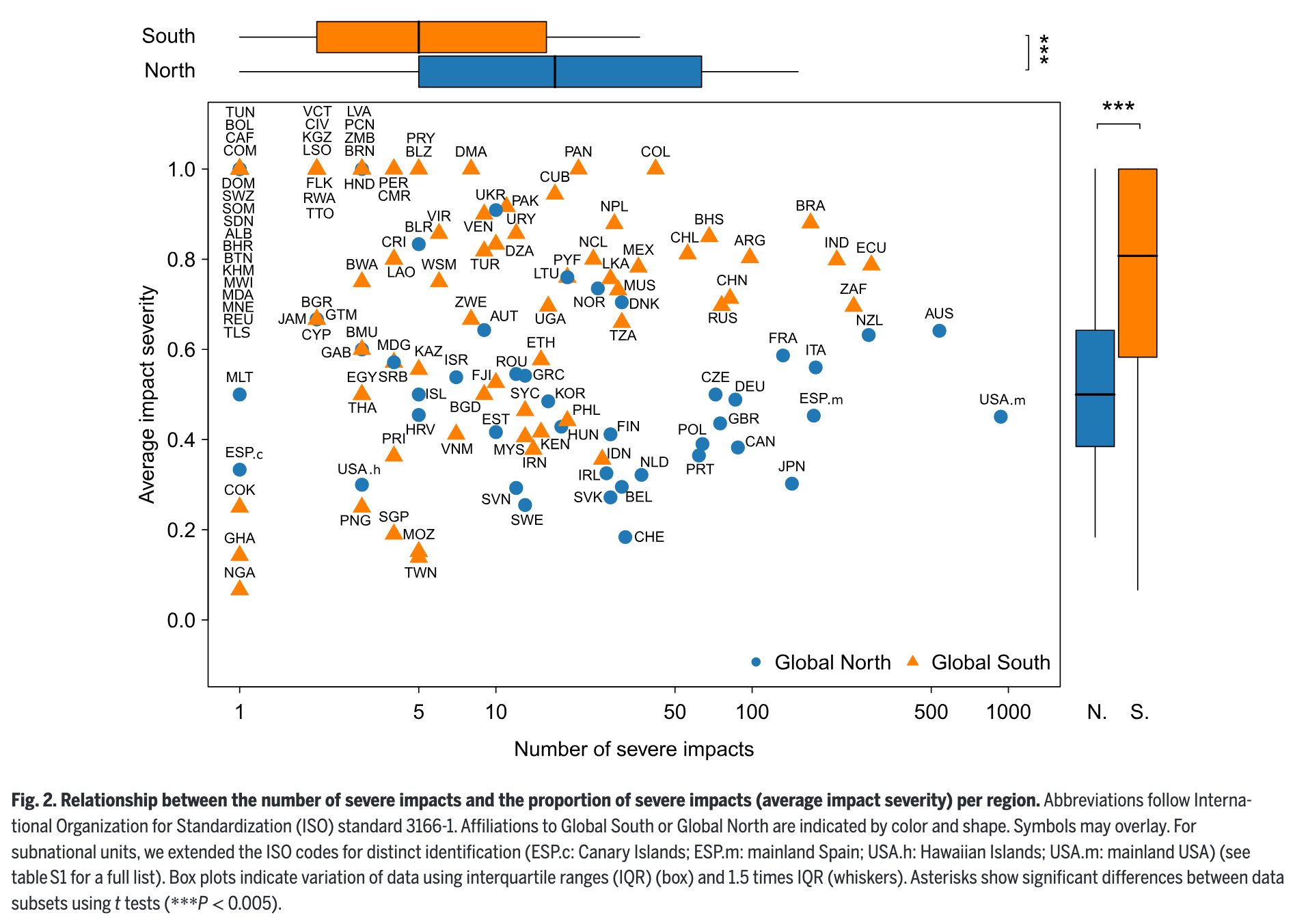
Regardless of economic status, recorded impacts scale by country size: larger countries like the USA, Australia, Brazil, and India tend to have the highest absolute numbers. But, relatively speaking, the highest impacts are recorded in countries from the Global South. And large countries like Brazil, India and South Africa are hit with a one-two punch, with both high absolute numbers and impact severity.
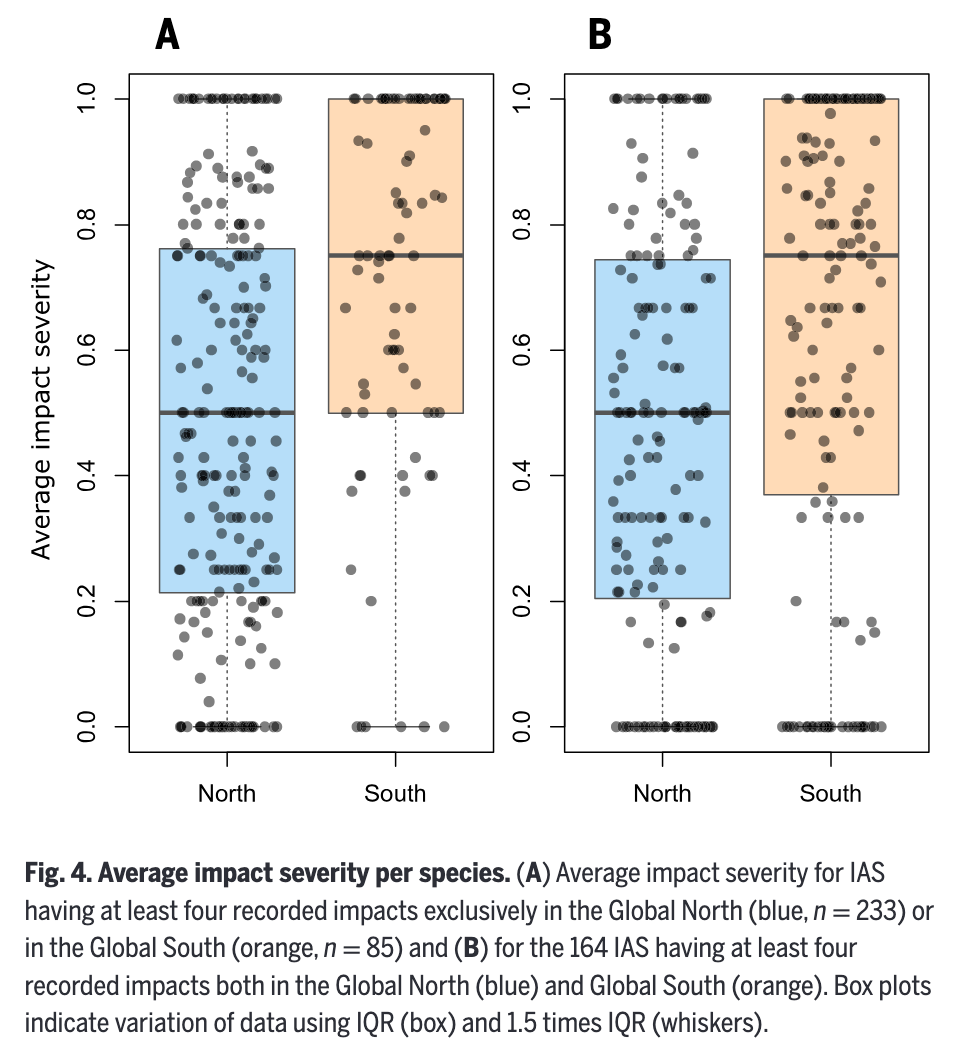
Even more importantly, when they look at the same species introduced to locations in either Global North or Global South locations, they have 50% higher impacts in the Global South. That says something: the same species are more impactful simply by landing somewhere with less capacity to respond.
I think this matters beyond the study of invasion biology. We are taught that absence of evidence isn’t evidence of absence. But we’re still prone to viewing the world through the lens of where the data are easiest to collect. This paper reminds us that where we study a problem isn’t necessarily where the problem is the greatest.
What the authors link these greater impacts to are weak governance and limited capacity to manage invasions once they arrive in Global South countries. This is important: as countries try to emerge out of lower socioeconomic conditions, they will continue to be hit by new incursions. Fast-growing trade brings species in, but if institutions haven’t caught up to manage them once they’re there, then severe impacts will accelerate.
If you’re not yet convinced that invasive species are problematic, let me divert you to my earlier post. And consider this: invasive species have contributed to 60% of all documented global species extinctions and cost more than a trillion USD over the last few decades (1970–2017).
The finding that really hit home to me wasn’t just that impacts are worse in the Global South, but that the same species often cause greater impacts there. The key story of this paper, then, is one of capacity, governance, and society’s ability to respond once invasive species arrive.
The damage caused by invasive species isn’t determined by ecology alone. Local ecological conditions matter, of course, but they sit within a broader social and institutional context. The strength of governance, the resources available for management, and the capacity to respond all help shape the severity of impacts once invasions occur.
Invasive species arrive everywhere. What differs is our ability to respond.
I’d love to hear your thoughts on this one! Drop a comment below or share it with a friend.
One more thing.
I’m starting Predirections Office Hours — a live Zoom, once a month, for paid subscribers. An hour of conversation instead of an essay.
Bring whatever’s on your mind: a question about something I've written, a study or story you've come across, or something in your own field that my writing reminds you of. Recent essays, new research, half-formed ideas, even random tangents are all fair game. There won’t be slides and there won’t be an agenda beyond just having an interesting conversation.
This is for paid subscribers. If you've been thinking about upgrading, this is as good a reason as any — first one is in two weeks (timezones below). I’ll record it, so it works even if you’re in a time zone that doesn’t fit.
Student, ECR & low-income rate
I’m genuinely looking forward to these.
Time:
Los Angeles (PDT): 2:00pm, Wednesday 12 August
Denver (MDT): 3:00pm, Wednesday 12 August
New York (EDT): 5:00pm, Wednesday 12 August
London (BST): 10:00pm, Wednesday 12 August
Berlin / Paris (CEST): 11:00pm, Wednesday 12 August
Singapore (SGT): 5:00am, Thursday 13 August
Sydney (AEST): 7:00am, Thursday 13 August
New Zealand (NZST): 9:00am, Thursday 13 August
Sometimes I love the power of social media for discovering interesting new things. Back in the day before twitter was taken over by an egomaniac, it was the main place I found new papers to read. Thankfully, LinkedIn is rebuilding that community alongside Bluesky. Join me there if you like: Bluesky and LinkedIn.
Comments
Nothing yet. Say the first thing.
Sign in to join the conversation.