
Whether we know it or not, each of has some kind of calculus for the end of the world. It’s a personal thing. One might say if you brushed your teeth this morning then you are reasonably certain you will make it to midday. On the other hand, there will be those who prefer to face death with fresh breath, and others who would sooner spite it with decay. It’s complicated.
Complicated and, for all our clicking and swiping, largely unconscious. This weekend I notice my Armageddon guesswork apparatus seems to have eased up. Last weekend I had to be firm with someone when they seemed about to go into a justified but useless lament about the state of things while I was trying to admire the shape of a cloud, and not a mushroom cloud either. The weekend before that I had felt flashes of a kind of terminal nervousness myself, to the point where I remembered I had been ‘here’ before emotionally, and not just once or twice, but often.
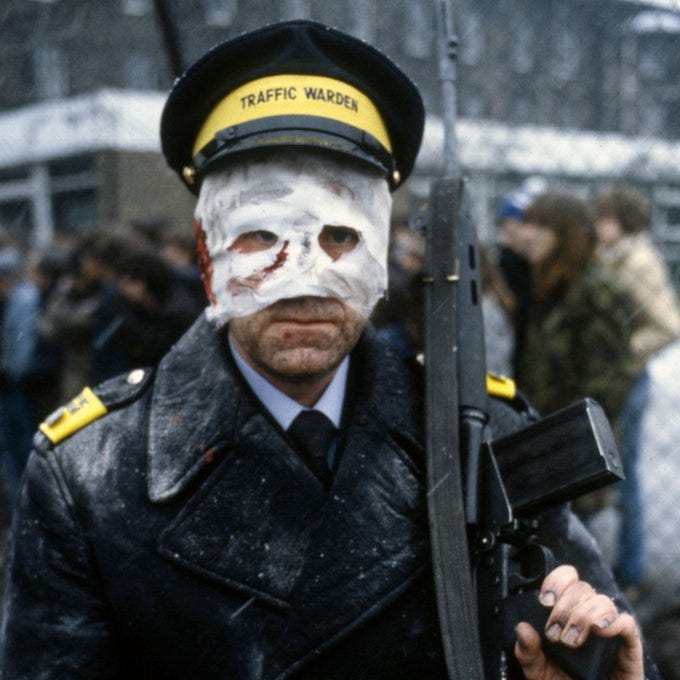
The nuclear anxieties of my generation are often lain at the feet of Threads Barry Hines’ 1984 drama (on iPlayer at the moment ). No one who has seen Kes will be unaware of Hines’ appetite for hard endings. Threads (which I missed at the time, but watched earlier this year) is relentless in this regard. It is not the nuclear war itself, but the aftermath which gets you down, the realisation that things have fallen beyond the point of reconstruction, that language and knowledge are as combustible as buildings and harder to repair. As Threads’ poisoned, post war generation struggles to its feet largely unparented, a brutal, pre-verbal ignorance descends.
Two years before Threads, however, British kids were hit with a one-two punch of nuclear pessimism which meant that by 1984 for many of us the endgame was already old news. In 1982 Mick Jackson, Threads’ director wrote and directed A Guide to Armageddon, which was shown as part of the BBC’s Q.E.D documentary strand. This I did see, and it was effective enough that having discovered, as one does, that something half-remembered is wholly intact on YouTube, it was striking (or perhaps not, given the tone of the programme and the receptive nature of an 11 year-old-mind) how many of the details I recalled more than forty years down the line.
“The human body is a fragile thing…” begins Ludovic Kennedy’s voiceover to images of a ballerina. Seconds later there is a nuclear explosion over St Paul’s cathedral, “the initial heat is intense enough to melt the great, bronze, cross.” Meat burns away to nothing in butcher’s windows. I still think of this when I pass St Paul’s. And butchers. Not, I imagine, what Christopher Wren had in mind, or the animals in the window, but such is the path of innovation.
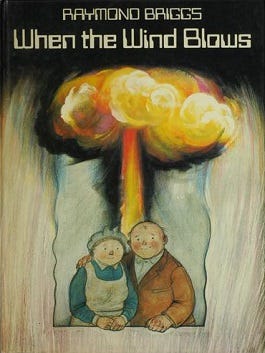
More disturbing than that for children around my age - although all these forces were working in consort - was the sharp turn in the output of the illustrator Raymond Briggs. Briggs rose to prominence in the late 70s with works like The Snowman and Fungus the Bogeyman which captured both the softer and the joyously grotesque corners of childish imagination. In 1982 Briggs dropped When the Wind Blows which deployed his homely and heartfelt illustrating style to tell the story of Jim and Hilda Bloggs, an elderly couple who die slow and painful deaths from radiation sickness huddled under a door in aftermath of a nuclear war.
Neither this nor A Guide to Armageddon would be my undoing, for I was already undone. One evening around about 1981 I was left unattended to watch BBC Nationwide (imagine some kind of midpoint between Newsnight and The One Show) where I heard a presenter say that, “nuclear war is inevitable within the next five years.” I went into the kitchen and asked my mother what ‘inevitable’ meant. “Something that’s definitely going to happen,” she answered before returning to her household business. I went off and attended to mine, which was for some time afterwards, the business of fear. By 1982 I had made peace with war. Kids freshly traumatised by Raymond Briggs or the BBC turning to me for support would be met with disdain, hauteur, and fatalism as I sketched another nuclear logo on my schoolbook, said it was inevitable, and hoped they would have to ask me what that meant. Death was certain, in the meantime it was as well to sound clever.
Like one of those states that claims to have an effective and elite military but who in practice do not, this was a bluff on my part, chiefly for my own sake. The truth played out in dreams, and when the world ended in those, as it sometimes still does, I was struck on waking that the governing emotion was not fear, but sadness.
“It should have been perfect. But in the end, we fucked it all up. It should have been so sweet, too.” The last words of Nicky Santoro in Casino, but the gangster’s lament to lost Vegas is where we ought to be, I think, with the end of everything. Fear is aimless at a real conclusion. What we want is a lament, some shame. Regret.
I knew it once in real time too. A good friend and I were walking down a high street in our hometown on a Sunday evening in the late eighties when we heard an abiding, all encompassing boom. You could feel it in your body and it rose and did not stop. There was no explanation for it or anyone around whose response you could gauge or ask. We looked at one another and understood between us that this was it. We stepped off the street into a shop doorway, like that would help, and waited for our immolation. We neither wept nor huddled (and there is no shame in either) but my overriding thought was, ‘Bollocks, there was a lot I meant I do.’ The sound stopped suddenly and the world went on. We never did get an explanation.
A button you might safely push.
Just after 9/11 someone told me they had heard a piece on the radio recorded in Central Park while the attacks were underway. The reporter had been heading towards the towers but noticed a man practicing golf shots and was so struck by this apparent dissociation that they stopped, asked him what he thought he was doing and recorded his answer, which amounted to nodding towards the inferno and asking, “what do you expect me to do about it?” I have looked for this a lot online and got nowhere. It comes to mind sometimes when I watch Bridge of Spies, set at the height of nuclear nervousness, when Tom Hanks asks Mark Rylance’s character (facing a death sentence for spying at this point) why he isn’t worried, and he answers, “Would it help?” I presume this is something the Coens (who scripted the picture) came up with, but if you were looking for a reductive but resonant distinction between an American and a Soviet mindset, that might be it.
I was with someone I love recently who was justifiably stricken with sadness and the best thing I could think of to say to them on behalf of the next few minutes was, “Come on, join the rest of us. Take your place in hell.” I think it worked, momentarily, which was all either of us might have hoped for under the circumstances. It was a joke, of sorts, but one rooted in the reality of being and – I think, a kind of optimism. It f*cking sucks, at times, and sometimes for a long time, but it is absolutely worthwhile.
My mother is 97, with dementia, and still crossing that same kitchen where I asked her about the inevitable, albeit on a wheeled walker and under constant supervision. “Bloody hell,” she said to me not so long ago, “how did I end up like this?” I could do nothing more than hold her hand and say, “consider the alternative.”
The closing sequence of Casino (and we might think of late life as such) is IMO a non-negotiable cinematic masterpiece scored by Bach’s, “Wir setzen uns mit tränen nieder” which translates as “We sit down with tears.”
This, I think, is the appropriate emotion for the ending of worlds, small, large and continuing. The egregious possibility that this is still on our agenda brings back to mind Nicky Santoro’s lament. “It turned out to be the last time that street guys like us were ever given anything that f*cking valuable again.” Swap street guys for upright apes and you have our conundrum. A last word to our leaders and to the bellicose instinct in us all might come from Sun Ra, who knew a thing or two about our place in the universe. “What,” he wondered, “you gonna do, without your ass?” It’s an excellent question.
A whole book of me sitting about wondering about love, death and meaning, hurling jokes into the void? Be my guest. The Reluctant Carer by The Reluctant Carer - Pan Macmillan
No posts
Comments
Nothing yet. Say the first thing.
Sign in to join the conversation.