
The tide is turning… DEI, a system of anti-meritocratic discrimination, is being dismantled… Government profligacy and corruption is being exposed on an industrial scale… Thanks to the end of censorship on Twitter, we have the ability to express reasonable and widely held views.
But there has been lots of bad too: if you want to understand how bad the crime problem has got, British people used to deal with crime by moving criminals to Australia. Today, British people deal with crime by moving to Australia.
We need to understand that we’ve been lied to. For decades, people went on TV and told you that your history is all bad and your country is plagued by prejudice and intolerance… [but] if you were a woman or an ethnic minority or someone who was spirit gender or whatever, where would you live rather than the West?
Decline is a choice. And the good news is this: most people don’t want managed decline… We are a civilisation that is waiting to be inspired… We’re going to die. We have nothing to lose. So we might as well speak the truth, we might as well reach for the stars, we might as well fight like our lives depend on it. Because they do.
Konstantin Kisin, ARC speech, 24/6/26
Let me take a break from my ceaseless and almost certainly futile attempts to warn people of the rapidly approaching AI tsunami to opine on a marginally less gloomy topic – the future of Great Britain.
NSW disease
First, let me present my credentials. Like many citizens of the Anglosphere, I’m an Anglophile and grateful for the magical land that gave the world parliamentary democracy, the common law, the Industrial Revolution, Newton, Darwin, Shakespeare, Milton, Dickens, Orwell, Churchill, Cleese, the BBC and the Beatles – a civilisational inheritance almost embarrassing in its richness. And that’s not even counting the contributions of foreign-born British residents such as Berlin, Conrad, Ho Chi Minh, Eliot, Freud, Handel, Hayek, Lenin, Marx and Popper.
As it happens, I’m also distantly descended from a Welshman and rather more immediately descended from one of those British migrants to Australia Kisin references.
But none of this is particularly distinctive. Even after decades of high immigration, mainly from Asia and India, around half of Australians have English, Scottish, Welsh or Irish (both types) heritage.
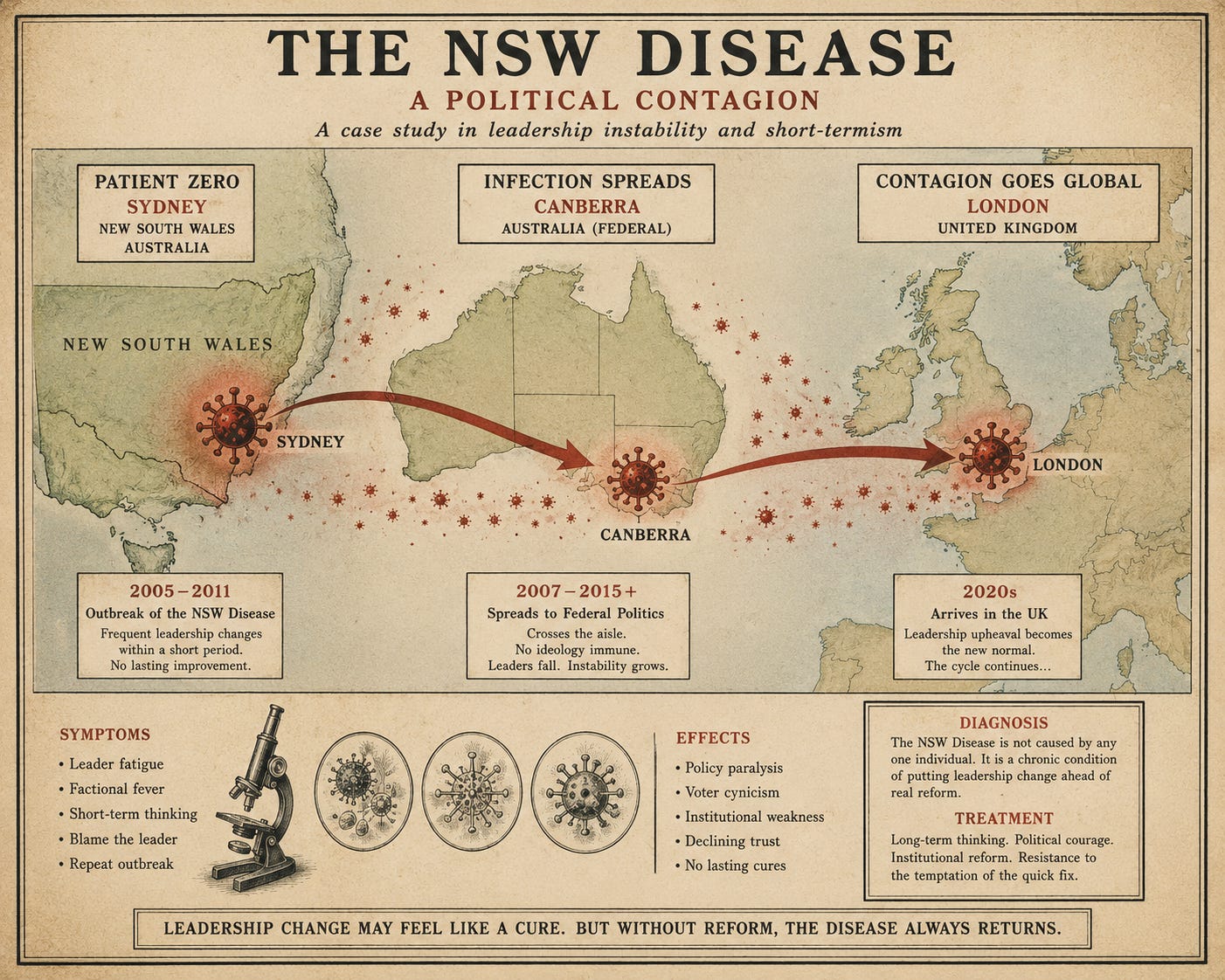
However, I can claim Patient Zero status when it comes to having your politics infected with let’s-throw-the-current-leader-under-the-bus-that-will-solve-all-our-problems! syndrome. Or the ‘NSW disease’, as it’s known in Antipodean political nerd circles.
The NSW disease refers to the New South Wales branch of the (centre-left) Australian Labor Party cycling through three different state premiers between 2005 and 2011. At the time, this was seen as excessive and didn’t pay any lasting political dividends – NSW Labor suffered a crushing defeat in 2011. It then kept cycling through leaders until it returned to power, after a period of relative leadership stability, in 2023.
The NSW disease rapidly spread to federal Labor. When it returned to power in 2007, after 11 years in the political wilderness, it chopped down its leader – Kevin Rudd – who delivered a resounding victory two and a half years after said victory. His replacement, Julia Gillard, fought the subsequent election to a draw and stitched together an ill-fated agreement to rule with the support of a couple of independents and the Greens. Then Rudd rolled Gillard before losing an election to the centre-right Coalition. (The Liberal and National parties, which traditionally govern in a coalition).
‘Great, the adults are back in charge,’ many a weary Australian voter thought to themselves.
But then the NSW disease jumped the ideological divide. Having led the Coalition to a handsome victory in 2013, the new PM Tony Abbott* fell victim to a party room coup and was replaced by Malcolm Turnbull in 2015. Turnbull suffered much a similar fate to Gillard. He fell over the line in one election and was knifed before he could face another. Turnbull’s replacement, Scott ‘ScoMo’ Morrison miraculously won an election everyone expected him to lose in 2019. But it turned out to be a loveless landslide. He led his party to a crushing defeat in 2022 at the hands of Labor leader Anthony ‘Albo’ Albanese, who remains in power to this day.
Of course, few people take much interest in NSW or even Australian politics. But then the NSW disease went global, spreading to the UK.
The morning after the night before
Leadership changes are the drinking binges of politics.
Imagine that your life is unsatisfactory. You have two choices. You can do the work to make it less unsatisfactory. However, this will require painful sacrifices, self-discipline and a lot of grindingly hard labour that you may only start seeing the results of years down the track.
Alternatively, you can take a little break from your unsatisfactory reality with the choice of your preferred intoxicant. This feels good, which is why it is such a popular option. You take your chemically assisted holiday and, for a few hours, forget about life for a while.
But here’s the rub. You wake up the next morning and your life is just as unsatisfactory as ever. Taking the edge of things might have been enjoyable, but in the sober light of day you might eventually come to conclude it’s a distraction from, rather than a solution to, your problems.
It appears British citizens are currently a few beers into the intoxication stage of the leadership-change party. The much-reviled incumbent is on the way out the door; the much more charismatic and competent challenger is well on their way to righting the ship of state.
Surely, they can’t be as bad as the last guy?
And, obviously, most of the nation’s pressing problems are simply a result of a series of dud political leaders. If a good one somehow turns up, those problems will quickly and easily be resolved.
Well, as both a New South Welshman and an Australian, I’d caution Brits to start preparing for the inevitable hangover.
The problems that will confront Andy Burnham on his first day in office are well-recognised. Decades of low productivity and stagnant wages, growing wealth inequality, a housing crisis, an overstretched and unsustainable welfare state, rising crime and urban violence, inadequate defence spending, high energy costs and a population that’s become so vibrantly diverse it’s now struggling to cohere.
The AI wildcard
But here’s what makes this leadership bloodletting – which arrives at a technological tipping point – different from all the previous ones. Great Britain may have hit bottom, much as it did in the late 1970s, and be poised for a recovery.
Disruptive AI transformation is coming regardless of who is in 10 Downing Street. Britain, almost despite itself, finds itself surprisingly well-positioned to benefit from this.
The UK tech sector is valued at approximately US$1 trillion, making it the third- largest tech ecosystem in the world, after the US and China. It employs approximately three million people and contributes around £150 billion (US$190 billion) to UK GDP annually, around 7.7 per cent of total GDP. The UK tech sector is worth more than the French and German ecosystems combined. ARM Holdings, whose processor architectures are used in 99 per cent of smartphones globally, is headquartered in Cambridge. DeepMind, widely regarded as a world-leading AI lab, is London-based. The UK has the third-highest AI research output globally.
The structural problems that have defeated every recent British government are precisely the kind that AI-driven transformation could meaningfully address. AI-assisted diagnostics and automated administration could transform NHS efficiency without endless additional spending. Broader AI adoption across ordinary businesses offers the most credible path out of Britain’s chronic productivity stagnation. Deliberate investment in regional tech clusters in Manchester, Edinburgh and Bristol could begin rebalancing an economy too heavily concentrated in London. Vast swathes of dysfunctional public administration – benefits, planning, courts – are ripe for digital transformation.
The AI-transformation tsunami I endlessly characterise as an approaching catastrophe could, in Britain’s already-near-catastrophic circumstances, become the kick up the arse that finally forces the structural reform decades of uniparty politics have failed to deliver.
This is admittedly a large undertaking for the next British PM, especially given the Labour party has now demonstrated it can be just as ruthless at dispatching leaders as the Tories. A rosier future for the average Brit still depends on its leadership class demonstrating both political will and policy consistency.
We’ll soon find out if the King of the North can deliver those. In the meantime, Brits eyeing the exits should be aware Australia has very reasonable visa processing times.
*Having Iost what was previously a heartland seat for Australia’s Liberal party (i.e. its Conservative party) in 2019, Abbott – a freakishly fit 68-year-old – is widely rumoured to be planning a political comeback. Perhaps with good reason, given recent Australian polling data, he seems to believe the times will suit him a lot better than the mid-2010s did.
No posts
Comments
Nothing yet. Say the first thing.
Sign in to join the conversation.