
My grandmother made thandai by hand, a spiced almond drink that got our family through the North Indian summer. She soaked almonds and poppy seeds overnight, ground them into a paste at dawn, and simmered the paste with milk and spices for the better part of a day. Four cups of it cost about an hour of active work, spread across eight or ten hours of soaking and cooking. It was already too much trouble for my mother, and in my own generation the recipe has all but disappeared.
Most families have a version of this, some dish or craft that once took a day of someone’s hands and now arrives in a bottle or a bag: the bread baked from scratch, or the sauce simmered from morning.
The store-bought version displaced the homemade one on cost alone, spreading its labor across a million units where my grandmother’s pot carried all of it at once. A tailored coat is a luxury; a broken toaster gets thrown out rather than fixed. That difference has shaped almost everything we own.
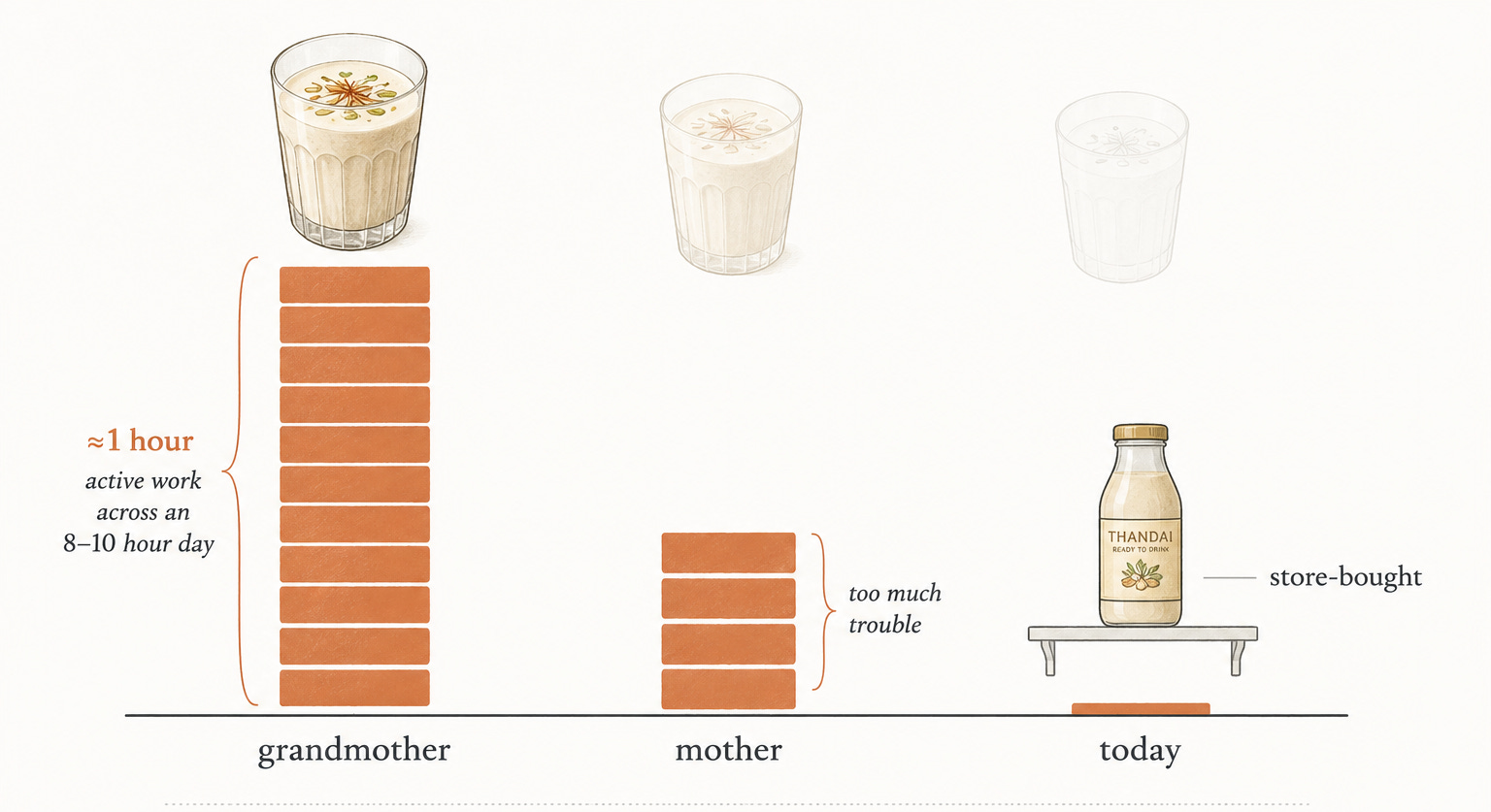
For most of the preindustrial era this was simply how everything was made, nearby and by hand and one at a time, because labor and product could not be separated. Every object was a one-off by necessity, a reflection of the limits of craft and materials, not of consumer choice.
Industrialization decoupled the worker and product: through the separation of labor, the interchangeable part, and the moving line.
A manufacturer could now spend human effort once, on the design and the tooling, and then press it into thousands of identical copies, paying the labor up front and spreading it across the whole run. This made goods cheap and abundant on a scale no earlier society had reached.
However, this economy of scale inevitably forced standardization. The same mechanism that made uniform goods cheap therefore left varied goods expensive.
The decisive variable, for any product, is whether its labor can be separated from the object and spread across many units. Where it can, as with a factory made shirt, the price per unit falls toward the cost of the materials; where it cannot, as with a fitted suit, or an alteration, the labor stays inside each unit and the price stays high. When demand is price sensitive in a world with expensive labor, we get standardized sizes, the short list of colors, the part we replace rather than repair. Henry Ford famously caught the logic when he offered the Model T in any color the buyer liked, so long as it was black.
However, maintenance and repair resists the labor separation. Each fix required fresh attention on a particular fault, impossible to spread across a run, so mending stayed expensive even as manufactured goods grew cheap. A toaster dies after a few years and no one mends it, because a new one costs less than an hour of a technician’s time.
For two centuries, then, the labor locked inside each particular thing has set the binding constraint on everything that could not be standardized: the fitted, the repaired, the small batch, the object made close to home. This structure determined not only what such things cost, but whether they get made at all.
Yet, people have always wanted things that feel particular to them, a desire for distinction that standardization could only suppress, never satisfy. Machines have started to perform physical work of the dexterous, unscripted kind that resisted automation for decades.
Theodore Wright studied the cost curve in the 1930s: every doubling of the number built shaves a fixed percentage off the cost of the next. The hardware cost is falling along the curve that once carried the computer out of the enterprise and into the hands of the community. A robot that cost roughly two hundred thousand dollars a few years ago now sells for a tenth of that, and the forecasts place a useful one near the price of a car, and eventually a laptop.
Cheap machine labor does more than lower the cost; it changes the kind of cost that labor is. Today labor varies with output and, even more, with place, which is why factories drifted from Ohio to Guangdong to Dhaka in search of lower wages. Physical AGI inverts both labor and location. Its cost is largely fixed, paid up front and then nearly flat, a matter of power and amortization, and it differs little from one country to the next. Labor thereby comes to behave less like a wage than like a utility, something one switches on and meters, priced about the same on either side of the Pacific.
When a core production component moves from owned-and-local to metered-and-everywhere, it redefines who can make what and where.
Factories once generated their own power from a waterwheel or a basement steam engine, which tied them to rivers and coalfields, until the electrical grid turned power into something a business rented from a wall socket, billed by the hour and sold on the same terms from one town to the next. Computing repeated the trend a century later, as companies that had bought and housed their own mainframes in the 1970s began renting them by the minute from someone else’s data center in the early 2000s.
If physical labor is about to cross that line, two consequences follow: production becomes free to choose location, and work that was never worth doing becomes economically accessible. Neither outcome is obvious, and neither is assured.
A product can be analyzed along three dimensions: the irreducible inputs such as the materials and the energy; the labor that turns those inputs into the finished object; and the capital tied up in the tools and the building, amortized across multiple uses.
\(\text{unit cost} = \frac{[(materials + energy) + \text{labor per unit} + capital]}{\text{units made}}\)
The labor-per-unit term carries the argument, because it behaves in opposite ways depending on whether a producer makes a lot-of-one or large runs. The two cases, with m for the materials and energy in each unit, look like this:
\(\begin{align} \text{made to order}: \quad & \text{cost per unit} ≈ m + L \\ \text{mass produced}: \quad & \text{cost per unit} ≈ m + T/N + ℓ \end{align}\)
L is the per unit manual-labor in each bespoke piece. T is the one-time labor of setting up to mass-produce, the tooling and the line; the small ℓ (≤L) is the marginal labor of creating one additional copy; and N is the size of the run. Past the crossover N*, the uniform good drops below the custom one and continues toward the materials floor.
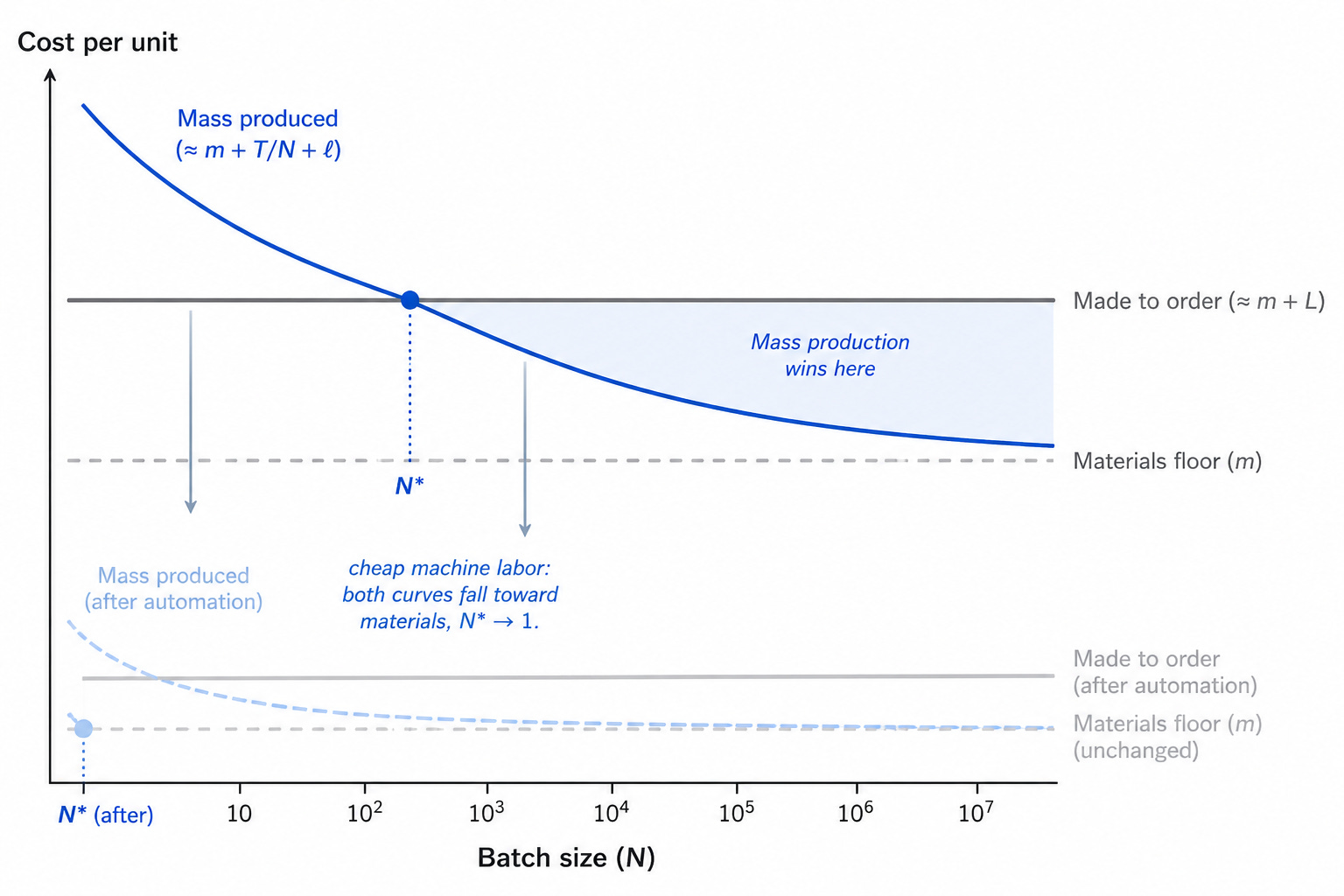
The factory’s achievement was to push N far enough to the right that the falling curve dropped below the flat line. The same curve also explains off-shoring where differential in ℓ offsets the lead time and the shipping cost.
However, this trade-off changes once labor stops being expensive. When a metered machine does the work, L falls toward the machine’s running cost, and T falls with it, because reprogramming a software-driven cell to make a different thing costs little where retooling a steel line cost a great deal. Both curves then sink toward the materials floor and toward each other, and the crossover slides back toward a small batch manufacturing, until a single custom chair costs about what each of a thousand identical chairs costs.
For two centuries the wage term in that arithmetic gave the dominant reason to move a factory, and production chased cheap labor across locales. Once labor becomes a utility priced about the same everywhere, only two location-dependent terms remain: the proximity of materials/energy and the distance to the customer. For the majority of goods, this pulls production toward the demand centers, as it removes shipping time and cost.
Utility labor, against the usual expectation, tends to deglobalize production.
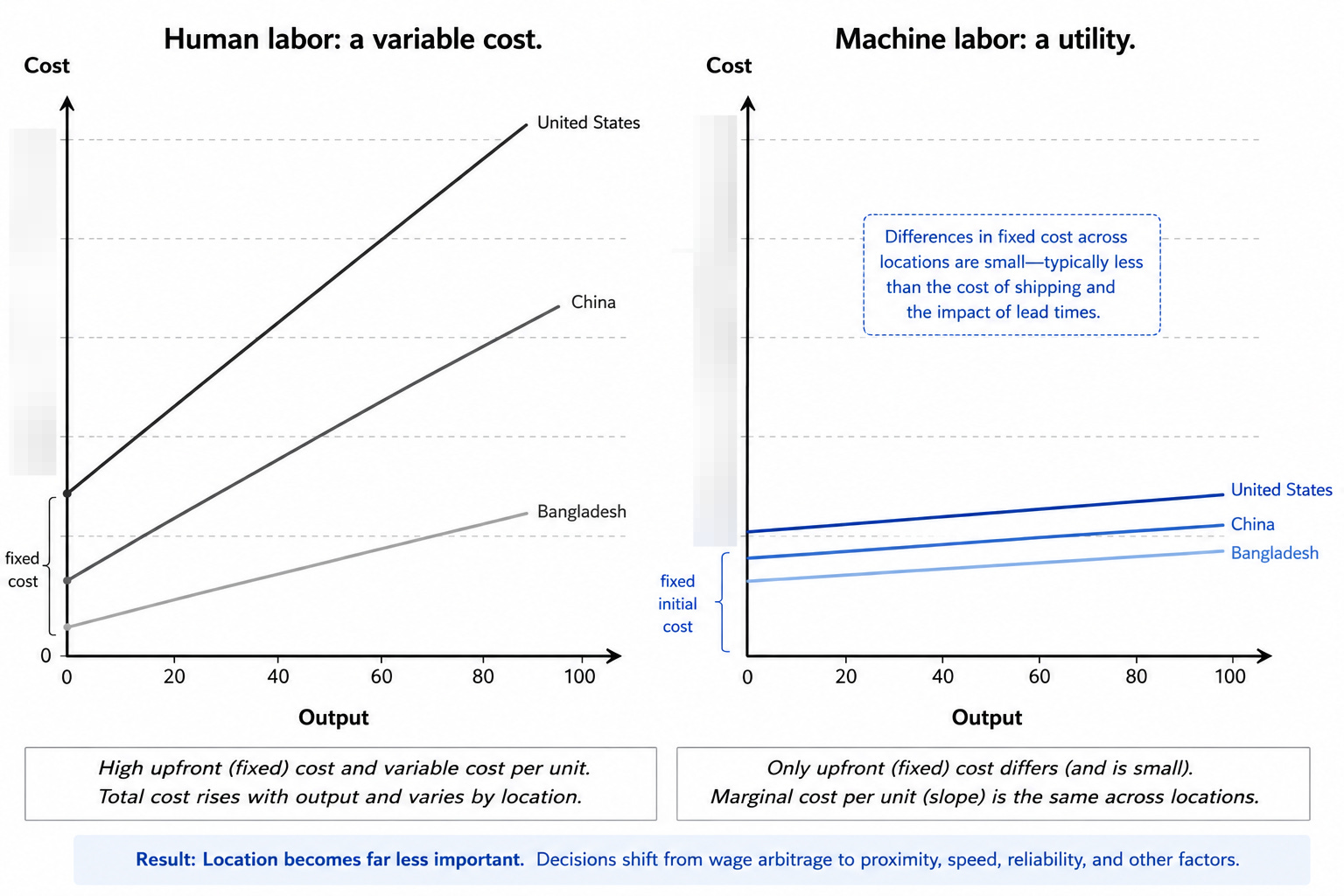
After labor, energy becomes the next constraint. Production process runs on power, and power is not yet the same price everywhere, so where energy is cheap the machines will gather, much as industry once gathered on the coalfields. A similar pull comes from the handful of countries that make the chips, the actuators, and the batteries the machines are built from.
Firms that once relocated to find cheap labor will relocate to find cheap energy and secure material components instead.
Most people misread the second consequence, picturing cheap labor as the same chores performed for less money, when the historical pattern runs the other way. As the price of a capability falls far enough, we rarely bank the savings; we consume far more of the capability itself.
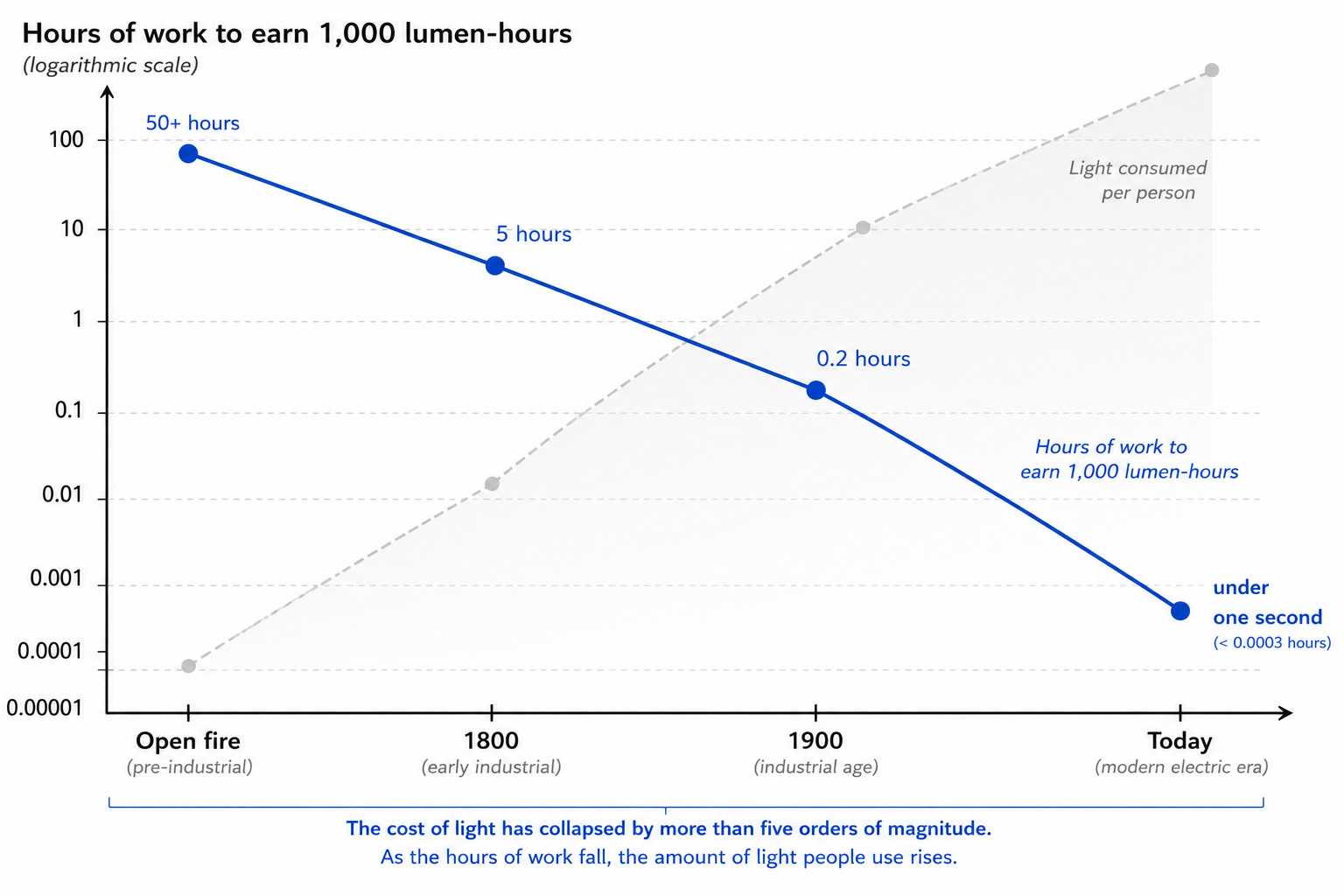
The clearest record of this is the history of light. The economist William Nordhaus traced the price of artificial light across the centuries, measured in the hours of human labor it took to earn. A thousand lumen-hours, roughly one bulb burning through an evening, cost more than fifty hours of work in the age of campfires, around five hours in 1800, and well under a second of work today. Rather than meet that collapse by sitting in the same dim rooms and saving the difference, we lit everything, indoors and out, until the glow now spills uselessly into the night sky.
Lower cost tends to enlarge demand rather than satisfy it.
Economists have long understood the dynamic: in 1865 William Stanley Jevons observed that more efficient steam engines, by making the work of coal cheaper, raised the total amount burned rather than lowering it.
Some of it will be luxury made ordinary: a full-time driver was once a rich household’s standing expense, until ride-sharing enabled a chauffeur on demand, and low-cost autonomous robots will extend this to cooking, cleaning, gardening, and care. More of it is humbler, the recipes we don’t make since they are too intensive, the maintenance we skip because preventing a failure costs more than the failure, the recycling we forgo because sorting by hand is worth less than the metal it recovers, the small repairs and inspections that never happen. And some of it has no affordable human version at all, such as tending each plant in a field on its own terms, or sitting with an aging parent through the night.
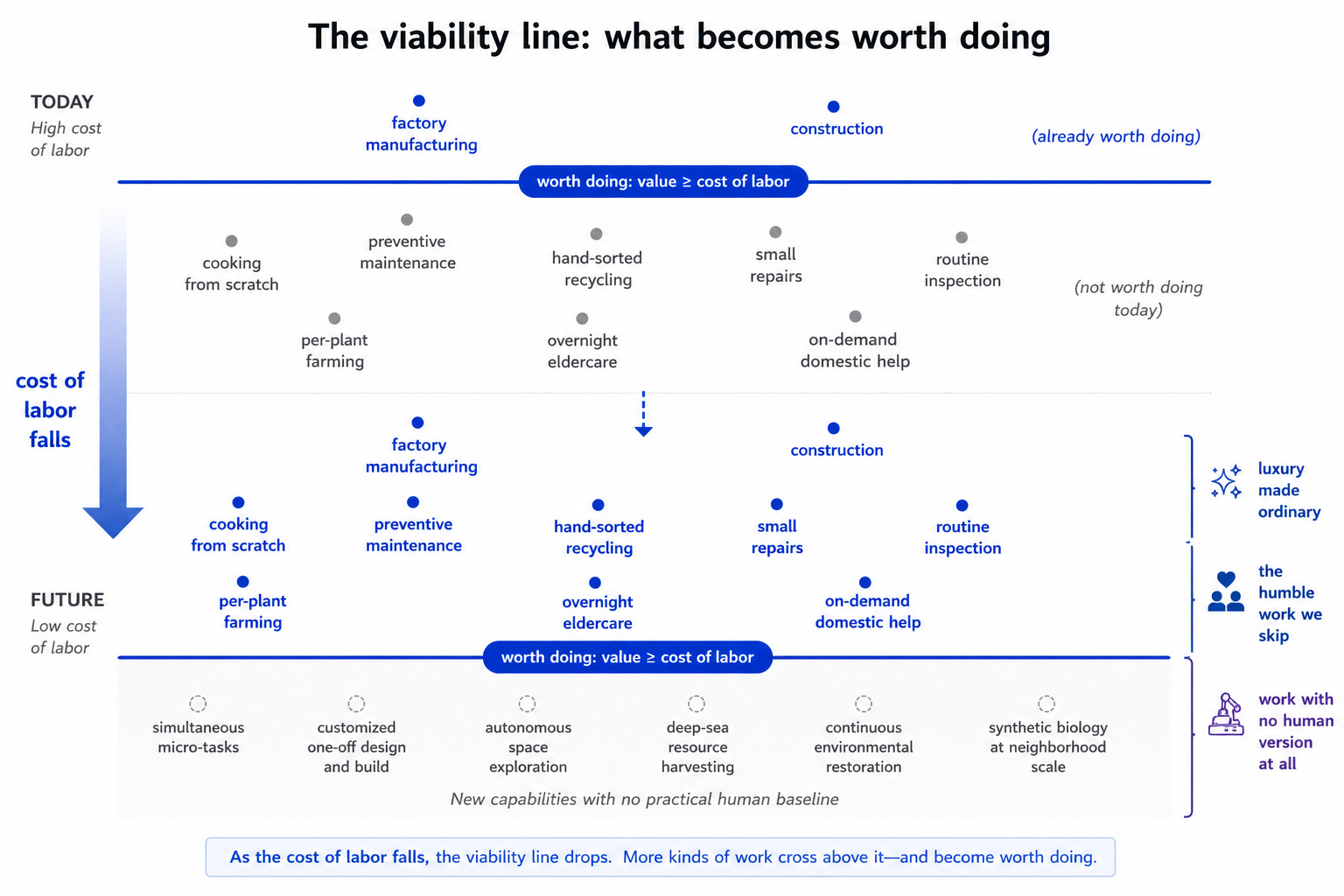
Recovering value from what we already own, by repairing it, refurbishing it, or sorting it for recycling, has always been labor intensive, which is why so much of it never happened. In an economy where materials are the binding constraint, it becomes worth paying labor to keep things in use and to mine value back out of them, closing loops that were never economic to close before. The same stock of materials then does far more work, as labor, now abundant, substitutes for the resource that is scarce.
Yet, a desirable future for the working class is not a given. When automated teller machines arrived, they were expected to eliminate bank tellers, yet cheaper branches led banks to open more of them, and teller employment held steady for two decades while the work shifted toward what a machine could not do; only later did the numbers fall, when online banking removed the reason to enter a branch at all. The opposite result is equally well documented: where industrial robots have already concentrated, the closest study of American local labor markets found them driving employment and wages down rather than up. The first effect of cheaper work is often an expansion of it into new forms, while the sharper displacement, when it arrives, tends to come from the technology that follows rather than the one in hand.
This is not the first time the cost of making something has fallen to the floor; the pattern has recurred several times within living memory. The personal computer turned anyone with a few thousand dollars into a publisher, and desktop software broke the print shop’s hold on a professional-looking pages. Rented computing let two people launch what once required a server room and a capital budget, an app store handed a teenager the distribution that had belonged to software companies, and large language models are now doing the same to writing, coding, and analysis.
The personal robot should be understood less as a domestic appliance and more as a physical computer: a general-purpose machine whose value comes from the applications others build on top of it.
As with the PC in the early 1990s and the smartphone after 2008, the important uses may not be the first-party tasks imagined by the manufacturer. They may come from prosumers, developers, small businesses, educators, artists, and technical users who discover that a new layer of the world has become programmable. The PC made documents, models, music, and code programmable. The smartphone made location, media capture, identity, and payment programmable. The personal robot would make manipulation, inspection, assembly, repair, and local physical change programmable.
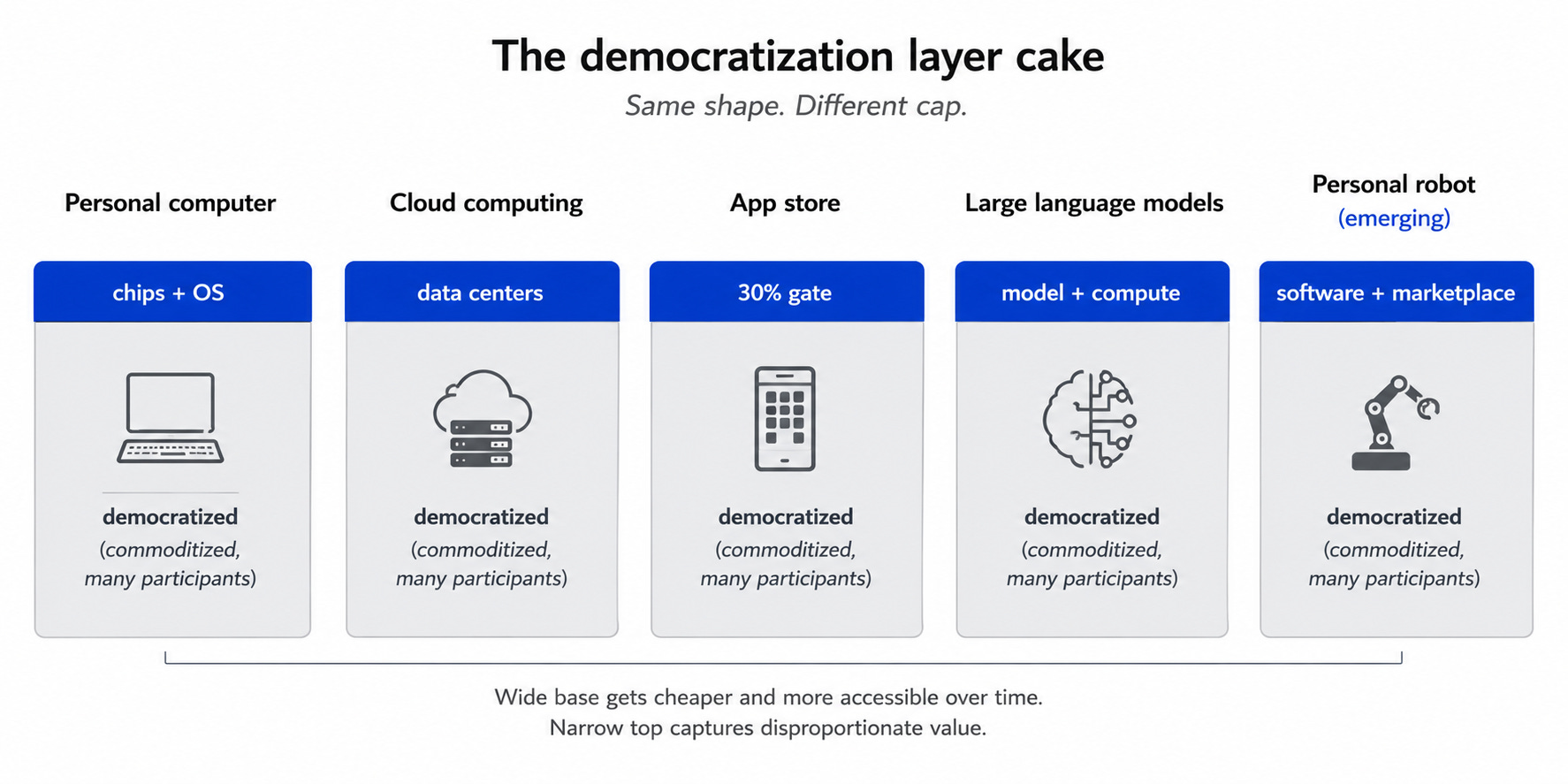
However, despite the technology democratizing the creation, the value accumulated one layer up. The personal computer democratized creation and made the firms that supplied its chips and operating system indispensable beneath it; the app store opened software to anyone and collected thirty percent at the gate; rented computing freed a generation of founders and enriched the company that owned the data centers. The same divergence should be expected in the physical world, where spreading the ability to make things will not, on its own, distribute the reward for making them.
This brings the argument back to the tailor and the baker, and to whether the small local maker can compete with the giant once labor is cheap for both. On commodity price the maker cannot, because the giant has the capital to automate the standard loaf and the basic shirt first and will always undersell on whatever everyone buys the same way. The maker’s ground lies in what is fitted, local, fresh, or repaired. These have always been the MSMEs natural advantages, but hitherto serving them required human labor, which priced them as luxuries and surrendered the broad middle of the market to whoever standardized.
The flattening of the labor cost removes this disadvantage. Once small-batch reaches parity with large-batch, customization no longer carries a surcharge, and the corner baker becomes a cheaper baker who also happens to be nearby and to make precisely what a customer asked for, so locality turns from a cost into an advantage. Moreover, true material commodities will achieve a price floor that enables a regional cooperative of small makers achieve parity with a giant producer. Aside from the newfound cost competitiveness, MSMEs will also enjoy the relational value premium that is hard for a machine to fake.
Cheap machines raise the question of ownership, and the answer depends on the machine and the process. Computing already shows the three arrangements that can coexist. A tool used often by one person and cheap enough to buy gets owned outright, the way households own a washing machine or a laptop. A tool that is expensive, or used only in bursts, gets shared, as a neighborhood once shared a laundromat, or rented by the job, as computing is now rented from the cloud. The usage arrangement is guided by: how heavily the tool would be used, how large its purchase price is, and how long its jobs can wait. A bakery owns its ovens because it runs them daily, sends a once-a-year specialty job to a shared regional shop, and rents a rare and costly capability from far away.
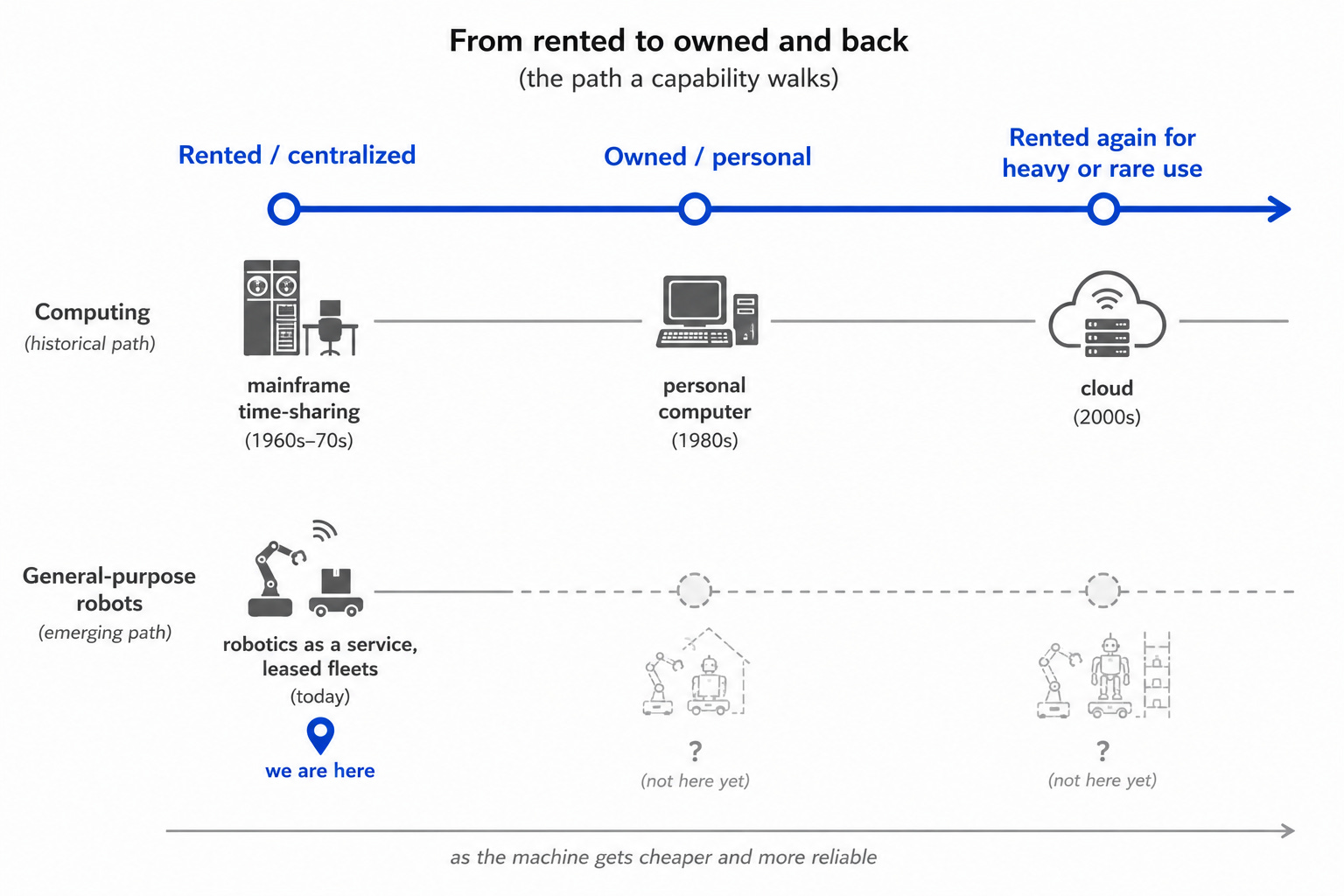
Computing began centralized, on time-shared mainframes too expensive to own, distributed into personal computers once the price fell far enough, and then partly recentralized into the cloud for work that came in spikes. General-purpose robots sit early in that same arc, nearer the mainframe than the personal computer, which is why most of robotics today is leased and run as a service rather than owned.
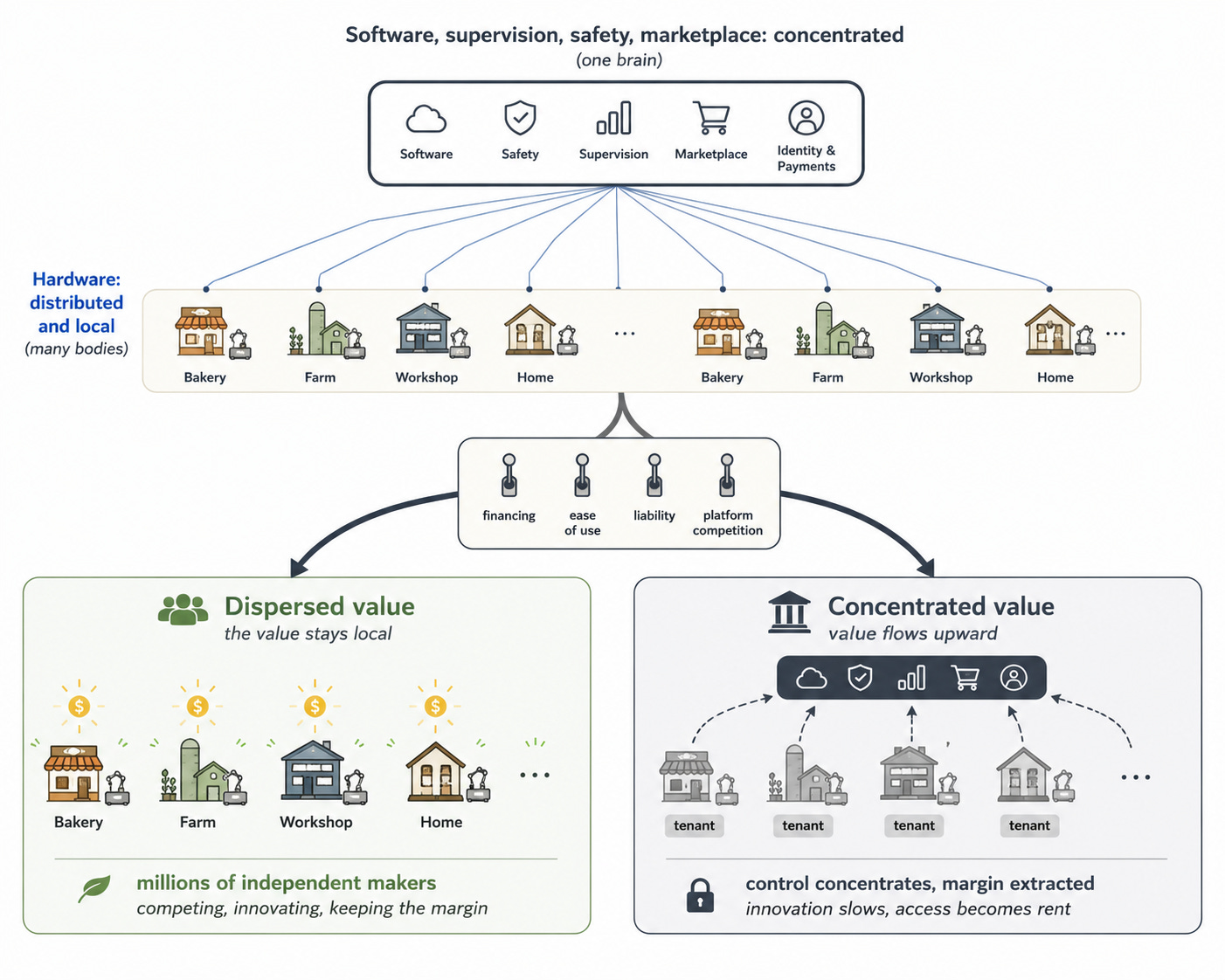
Electricity is a current that a customer meters and then forgets, whereas a robot is a body that has to be maintained and certified during the course of useful life. Both uptime and safety are largely fixed overheads. A fixed overhead is best amortized across machines. A single owner with one robot bears the whole weight, while an operator with ten thousand barely registers it. The very economics that make labor behave like a utility are therefore the economics that make it concentrate, and, left unchecked, a world of cheap robots drifts toward a few large fleets.
The hardware can be everywhere, a robot in every bakery and on every small farm, while the software, the supervision, and the safety case that make the hardware work remains with a few entities.
The first generation of these systems will not run itself due to a combination of hardware and software limitations; it will depend on remote operators who take over when a robot is stuck, on technicians who keep the fleet alive, and on people who handle the exceptions the machine cannot. In the transitional phase of the technology, the labor does not vanish but relocates off the workshop floor and into a control room, and whoever runs that control room effectively runs the fleet.
However, as the hardware achieves high reliablity and low maintenance, we move from a service to a product level dispersion.
The machines must be financeable by ordinary people rather than only affordable to the well-capitalized, in the way a loan once put a car in every driveway. People must be able to tell a robot what to make without being engineers, in the way the word processor freed writers from the print shop and coding models are enabling software engineering.
Furthermore, the certification and liability that a homemade appliance carries, and a homemade pamphlet never did, must fall on someone other than the small maker, since it decides what product a small producer can legally sell. And the platforms that connect the makers must ideally compete rather than letting one of them set the toll.
Beneath these choices lies a deeper question: who gets to accumulate the savings when physical work becomes a utility. The gains could reach customers as lower prices, workers as the operators and technicians, the owners of the fleets, the platforms that coordinate them, or the public through taxation.
History gives no assurance of any particular split; the same divergence has recurred every time. The economic historian Paul David told a version of this story about electricity: the light bulb was patented in 1880, yet by 1900 only a few percent of American homes had electric light, and factories still ran off a single steam engine that drove every machine through a tangle of belts. The payoff came a generation later, in the 1920s, after factories had been rebuilt around a small motor on each machine and could be laid out for the flow of work rather than the reach of a driveshaft. The dynamo was necessary but far from sufficient, because the gains depended on everything around it, the habits and skills and laws, and the same dependence will slow the spread of physical AI.
We stand at the crossroads of two worlds.
In one, the made-to-order life that until now belonged to the rich becomes ordinary: the local maker competes, repair is worth doing, variety costs no premium, and the power to make things spreads across millions of hands.
In the other, that making is just as real but runs almost entirely on a few platforms that own the software, meter the machines, and take the margin, so that people make nearly everything and own almost none of it.
The machines will not choose between these worlds; the choice rests with the dull, decisive arrangements around them: how the equipment is financed, who carries the liability, how hard the tools are to use, and whether the platforms beneath the makers must compete.
Labor as a utility makes the better world possible without making it inevitable, and that world, as ever, will be built by the people who want it or it will not be built at all.
No posts
Comments
Nothing yet. Say the first thing.
Sign in to join the conversation.