
I remember how easy it all seemed. In the beginning. When I was a lot more naïve than I am now. When I thought that writing was as simple as “come up with a story”, “put the story on the page”, “proofread”, “publish”, “win the Nobel Prize in Literature”, “receive vast royalties”, “buy an exotic island with said royalties.”
Of course, my writing career hasn’t quite panned out like that (!) and I now realise there are a lot of steps that come between “put the story on the page” and “proofread” if you want to have a hope in Hell of getting anywhere near the “publish” stage of that fantasy projection of what the writing life is like, never mind anything else.
And of course, those missing steps are all to do with “editing”, a word which causes many writers to break out in a sweat. Editing is hard with a capital H. To do it right, it requires time, energy and persistence. Often, it requires leaps of faith and strokes of inspiration. Sometimes, it brings on brain ache or, in extreme cases, tears and other outbursts of frustration.
To talk about “editing” under one umbrella makes it sound like a single skill. But “editing” is really made up of “distillative editing” (distilling a story down to what you actually want to say), “structural analysis” (making sure it works from beginning to end), “proportional editing” (making sure the pacing is right), “editing for USP” (making sure you’re doing enough to stand out from the crowd), “emotional analysis” (making the story sing at the emotional layer), and “thematic exploration” (embedding truth and message). Then there’s “line editing” which itself can be broken up into multiple different things.
Can we, hand on heart, say we’re good at all of those things? Many of us spend a lot of time learning how to write and then subsequently learning how to pitch / market / sell our work. But how many of us have dedicated time (and energy / persistence / brain ache) to learning how to edit? That’s why I’ve written my brand new editing course. It’s a course that focuses specifically on editing skills and aims to help writers enhance that knowledge gap between their brilliance as writers and their dreams of literary awards and exotic islands.

The course is called “The Editorial Funnel” and it’s split into two parts. The first deals with all things macro - structure, journey, originality, emotions, form - and the second peers a little closer at things like perspective, voice, theme, words and sentences. The idea is that we journey through the “editorial funnel” from out to in, from the big stuff to the small stuff, from the larger overview to the finer detail.
The first part of the course is subtitled “Structural Engineering” and we start off pondering emotional distance. One of the issues we have when it comes to editing our own work is that we’re far too close to it. How can we read a story as a reader might? How can we step back far enough to see the issues with a story’s shape? How can we understand how the emotions we think we’ve put on the page are coming across?
Here’s an exercise from the first topic of the course to hopefully help with that:
Try it out
In this first editing task, you’re going to attempt to create that sense of emotional distance I’ve talked about above.
In preparation, I want you to pick one of your stories or scenes, and if possible, to either print it out or to load it on a different device to whatever you use to write. I also want you to pick a few stories or scenes by other writers (if you want an easy resource for flash fiction stories, I have plenty of story lists on my website: https://www.mattkendrick.co.uk/resources and if you’re looking at a scene of a longer work, perhaps pick up a few novels or novellas from your bookshelf).
Once you’ve got everything you need, put yourself in a space that’s separate from the place you usually write, preferably somewhere comfortable and relaxing.
Next, I want you to use a mindfulness technique to clear your mind as much as possible. This involves first closing your eyes. Then taking a deep breath. Then picturing a river. On the surface of the river, there are large leaves floating by. Each time you have a thought or something distracts you, place it on a leaf and watch it float away. When you’re feeling calm, take another deep breath. Then, open your eyes.
Once you’ve got yourself into a mindful state, start to read. Don’t start with your own writing, start with a story or scene from a different writer. Then read through the other stories or scenes in any order, inserting your own piece about halfway through. If you’ve printed everything out, a great thing you can do is shuffle the pieces of paper so you don’t know when your own piece will be coming up. If you’re working on a tablet or computer, you might load each of the pieces in a separate browser tab and click on them at random, meaning you can simply keep reading without being aware of moving onto your own story or scene.
As you read, try to embrace that mindset of the ‘average’ reader. Have the goal in your mind to simply enjoy the piece you’re reading. Then, after you’ve read each piece, note down (a) a brief summary (what happens), (b) how you would describe the piece in terms of genre and tone, and (c) one thing you admire in the writing (even if the story or scene as a whole doesn’t quite work for you). This applies to your own piece as well as the pieces from other writers. Treat it as equal to everything else.
Hopefully that whets your appetite. There are plenty of other exercises along those lines, and hopefully a lot of variation in the different “tasks” and exercises so that participants can find the editing approach that works best for them - there are mini quizzes, there’s story analysis, there are editing tasks, writing tasks, feedback tasks and chances to interact with myself and other course participants on the course forum. There are even funky videos like the teaser video below:
Here’s a little more detail about the things we cover:
TOPIC 1: KEY CONCEPTS
Self-editing vs editing for others
The editing mindset
The editorial funnel
TOPIC 2: NARRATIVE FOCUS
Writer intent
This is a story about X
TOPIC 3: NARRATIVE STRUCTURE
Narrative journeys
Key narrative building blocks
Pacing and build
TOPIC 4: EDITING FOR USP
Originality of narrative
Originality of character
TOPIC 5: EFFECTIVE FEEDBACK
The Es of effective feedback
Mirrors, stars, wishes and ladders
TOPIC 6: THE EMOTIONAL LAYER
Motivations and barriers
Conflicts and tensions
Atmosphere and ticking clocks
TOPIC 7: UNUSUAL FORMS
Possibilities and problems
The course is fully online and fully asynchronous (meaning you can work through everything entirely at your own pace and around your own schedule). In that way, it’s hopefully rich in detail but also accessible for writers with busy lives. And hopefully, by the end of the course, a writer will feel as confident wearing their editing hat as they do when wearing the other hats a writer needs to wear.
Interested? Here’s a sprinkling of what previous course participants have had to say about my courses:
“Matt’s writing courses provide exceptional learning content and writing support. Game changing stuff from a true expert.” (Paula Turner)
“Enriching, inspiring, took my writing forward. [Matt’s] courses are superbly structured. Explanations of important writing elements, stories to illustrate, and inspiring exercises -from warm ups to final pieces- engage you with the course materials. Add a supportive group with whom to share stories and feedback, and you have a powerful writing experience.” (Elizabeth Feld)
“This was the first writing course that I did with Matt Kendrick, but it certainly won’t be my last! This was such a thoughtfully structured course with a huge range of materials and exercises, there was something truly for everyone!” (Farhana Khalique)
“The ethos of the course encouraged and challenged me and I like the way peer support and criticism is firmly structured within the course. Matt’s feedback is perceptive and kind, so much to learn from his comments on mine and others work.” (Pauline Sewards)
“Matt’s […] courses have enriched greatly my understanding of writing as a craft, and, I hope, improved my own work. Matt’s brilliant analysis of various published texts, and detailed feedback on my own - critical in the very best way, while still encouraging - have been invaluable.” (David (”D.X.”) Lewis)
“What I love most is Matt’s analytic clarity, elegant organisation, comfortable pacing, and forensic attention to detail. After one of his courses, I always feel I have somehow been lifted up to a higher level in my writing.” (Bonnie Meekums)
“I have never encountered a more imaginative and engaging set of courses than Matt Kendrick’s Write Beyond the Lightbulb series.” (Shona Ray Ferguson)
“Matt Kendrick is generous in the feedback that he provides and the resources that he makes available to his students. The course provided a high level of thoughtfully curated information that could be readily applied to works in progress.” (Robin Kalota)
Dates: 1st - 21st June 2026
Description: You’ve come up with your idea. You’ve put that idea down on the page. But how do you take that first draft and make it the best version of itself it can possibly be? How do you create enough psychological distance from your work so you can read it like a reader would? How do you identify what is and isn’t working? And how do you fix the possible issues you pick out?
Price: pay-what-you-can (£130 recommended; other price options - £115, £100, £85)
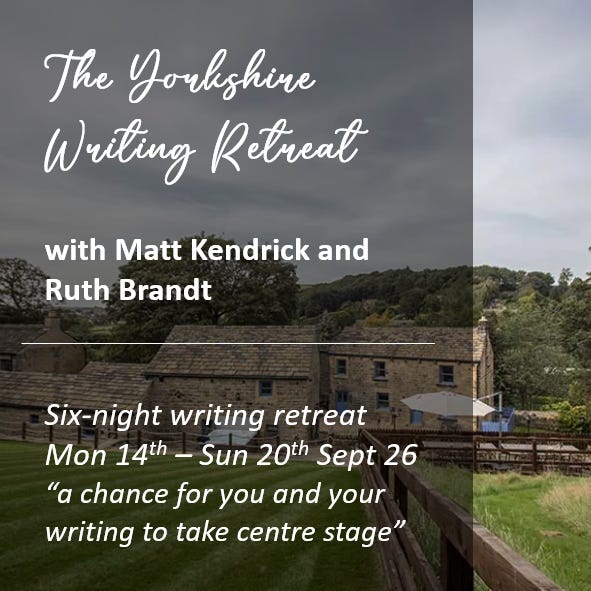
Dates: Monday 14th - Sunday 20th September 2026
Description: Join us in the idyllic landscape of the Holme Valley for a six-night writing retreat where you’ll learn from two widely experienced creative writing teachers through a series of workshops, feedback sessions and one-to-one chats. You’ll also have plenty of unstructured time dedicated to putting new words on the page.
Price: ensuite double (£975); double with shared bathroom (£875); twin room (£690)
I’m currently booking in editorial projects for April, May and June. Want help with you novel, novella or other work in progress? Want to take your short story or flash fiction to the next level? I offer editorial services at both the structural and sentence level and I’d love to work with you to make your writing shine.
Comments
Nothing yet. Say the first thing.
Sign in to join the conversation.