
I sometimes do an exercise where I write several versions of a story, each time making use of a different point of view. The purpose of the exercise is to deepen my understanding of the narrative character and to consider the scenario from different angles.
Writing in first person (“I”), I’m putting myself firmly in the narrative character’s shoes; I hear their internal thoughts, I see the world through their unique eyes.
Writing in third person (“he” / “she”), I find it easier to think about physicality—both what they look like and how they act.
Writing in second person (“you”), I’m addressing the story to a reader and I find this useful in terms of considering both the clarity of narrative and the emotional resonance of the piece I’m hoping to create.
Then, there are the possibilities in first-person, second-person and third-person plural—“we”, “you (all)” and “they.” Writing in these modes, I’m considering my character as part of a group. Perhaps this group is a “type” (what sort of person do they embody?) or perhaps this group is a “real group” (a team or an organisation they happen to belong to).
Re-writing a story like this can take a bit of time and effort, but I often find it quite illuminating. The point of view we choose can change a piece of writing in really interesting ways. So, for this month’s craft article, I thought I’d delve into each possibility in a little more depth, thinking about the pros and cons as well as providing a couple of prompts to get you writing.
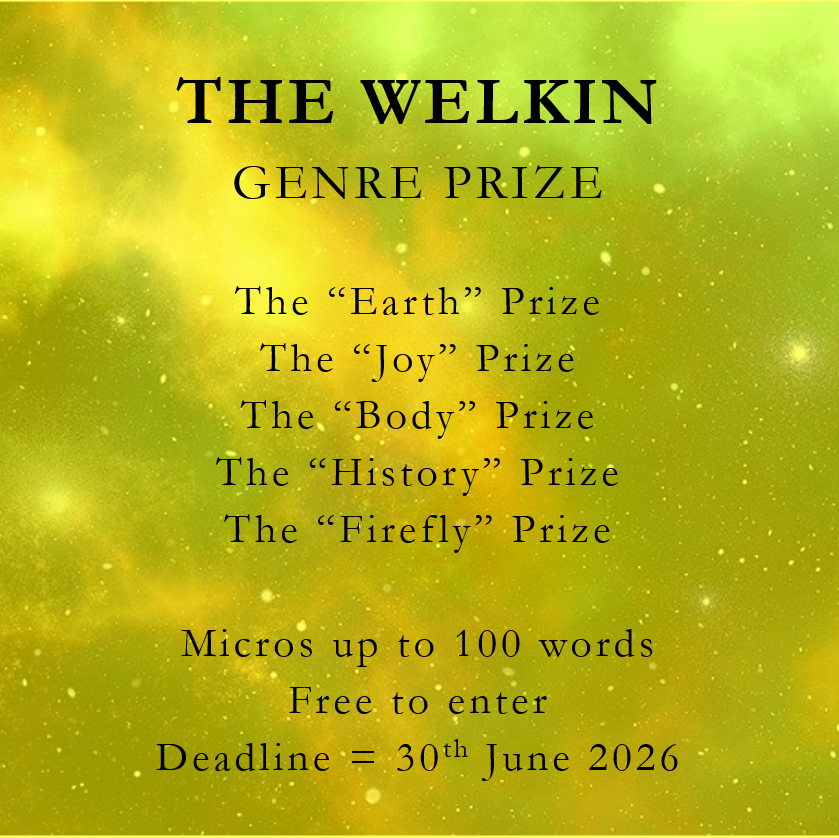
“The Welkin Genre Prize”, a new free-to-enter competition for microfiction up to 100 words that aims to celebrate writing around different genres and themes, is now OPEN FOR ENTRIES!
Check out all the details on my website.

A Snow Globe on an Iceberg: World-building in short fiction
With so little space to play with, how do we effectively bring a story’s world to life? How do we best evoke place, time, and wider context without it overwhelming the story?
Tuesday 7th July 2026 (19:00-20:30 BST) OR Saturday 11th July 2026 (09:00-10:30 BST)
What is Learnt in the Cradle: How our childhoods affect our adult selves
How do a character’s early influences affect who they become in later life? What do they inherit? What do they learn? And how do we use all of this within our writing to create character depth?
Tuesday 4th August 2026 (19:00-20:30 BST) OR Saturday 8th August 2026 (09:00-10:30 BST)
SPECIAL OFFER!!!
Book for both workshops before the 14th June and bring a friend along to one of them for free. If you’d like to take advantage of this, simply reply to your booking confirmation email letting me know your friend’s name and email address and what session they’d like to attend.
Glorious Words
How do we choose the right words to sharpen up our prose? How do we make our writing unique without it becoming obscure? Is the road to hell really paved with adverbs? This flash fiction course explores language in all its guts and glory, focussing on unique images, concision versus specificity and how to create original tone.
3rd - 16th August
SPECIAL OFFER!!!
Book for “Glorious Words” before the 14th June and attend one of my live workshops for free. If you’d like to take advantage of this, simply reply to your booking confirmation email letting me know which of the live workshops you’d like to attend.
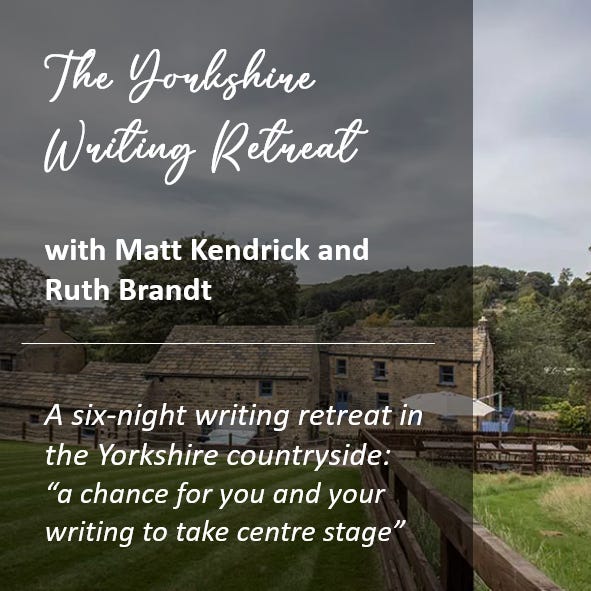
***JUST TWO PLACES LEFT***
Monday 14th - Sunday 20th September 2026 in Thurlstone (Holme Valley)
Join us in the idyllic landscape of the Holme Valley for a six-night writing retreat where you’ll learn from two widely experienced creative writing teachers through a series of workshops, feedback sessions and one-to-one chats. You’ll also have plenty of unstructured time dedicated to putting new words on the page.
5th - 25th October
You’ve come up with your idea. You’ve put that idea down on the page. But how do you take that first draft and make it the best version of itself it can possibly be? How do you create enough psychological distance from your work so you can read it like a reader would? How do you identify what is and isn’t working? And how do you fix the possible issues you pick out?
The Editorial Funnel is a two-part editing course that explores the concept of an “editorial funnel”, working through the editing process from zoomed-out to zoomed-in. Part 1 explores how we might effectively edit for narrative focus, narrative structure, originality, emotional build and structural form, considering editing as both a thing we do for our own writing and as a thing we might do for others.

First person
First person is perhaps the perspective we have the most practice with. In real life, we tell “stories” about ourselves far more often than we tell stories about others. So, it makes sense that this often feels most natural to us when it comes to our writing. There’s an intimacy to first person. We embody the narrator. We see the world through their unique eyes. We hear, smell, feel, taste as they do. The idea of “storyteller” is almost completely absent.
On the flip side, it can be hard to naturally bring in details that show us who the narrator is. Are they a man or a woman, for example? How are they “related” to the other characters? In first person, you perhaps have to work harder with things like that. And often we have to look elsewhere to find ways of showing what makes a character truly unique. One good way to do this is through voice. Everyone speaks in a way that’s entirely unique to them. So, if you’re using first person narration, can you completely embrace that?
Prompt
First-person POV can often marry really well with a stream-of-consciousness tone. Here’s an example of that:
Sisters (Cezarija Abartis | Matchbook Lit)
Write a piece in first person where the narrator has been accused of something they didn’t do. How do they react? As you write, make full use of having access to the narrator’s thoughts, emotions and voice.
Second person
Second person is a much more unusual choice. At least, it used to be. Nowadays, it feels as though there are far more stories (especially in the world of flash fiction) which are embracing the possibilities of second person narration, addressing the reader as though they themselves are the narrative character. One note of caution I might make is that there’s perhaps a danger this becomes a bit of a fad. With any choice in our writing, I always think we need to have a strong intent. So, don’t just write from second person POV because it seems fun but have a defined reason why you’ve made that choice.
For me, second person has the advantage of giving the narrator’s shoes to our reader. We’re saying “this is you” and that creates an interesting relationship between reader and story. We (as writer) have the advantage of being able to consider the character from a slightly exterior perspective but the reader is fully zoomed-in towards feelings and thoughts. There’s a strong resonance to this. But is there a danger perhaps of a reader feeling as though the writer is “pulling on their strings”?
Prompt
One of the things second-person perspective can do really well is to get a reader to reflect on something that’s central to the author’s identity. Read the following piece and think about how you might use second-person POV to ask a reader to inhabit a character whose identity overlaps with your own:
Gathered Family (Janika Oza | SmokeLong Quarterly)
Third person (close)
I often say to writers that writing in the closest possible third-person is pretty much the same as writing in first person. We still have the same access to thoughts, emotions and feelings. We’re still limited to that one point of view. However, that’s a simplification. Third person often isn’t quite as intimate as either first or second person. The benefit of this is that it’s easier to delve into the specifics of what makes them who they are. But the disadvantage is that it’s perhaps slightly harder to create a full emotional resonance.
It’s often harder, as well, to remain completely consistent in terms of perspective. Our character is Jim. They’re contemplating Janice. In first person, we’re looking at Janice and going “Janice looks sad. I wonder what she’s thinking about? I hope she isn’t still worried about that squirrel...” But in third person, writers often stray into the “wrong” character’s thoughts. Instead of “Janice looks sad”, we get “Janice is sad.” Instead of “I wonder what she’s thinking about?”, we get “Janice is thinking about that squirrel she almost hit with her mobility scooter...”
Prompt
Write a story in a close third-person where one character is contemplating another. Be really careful as you write not to jump into the “wrong” character’s thoughts.
Third person (omniscient)
Above, I’ve talked about “the closest possible third-person.” We generally talk about two options when it comes to third person (close or omniscient), but I see them more as a scale between fully zoomed-in and fully zoomed-out. I think there’s then a second axis in terms of the “cast” of narrative viewpoints, inhabiting the thoughts / feelings of just one character to inhabiting the thoughts / feelings of every character who walks onto the page.
Omniscient writing has perhaps fallen out of fashion a little bit, but I think there are some wonderful benefits to making more use of it. Sometimes, I worry that the world has become a little fixated on just one “correct” point of view and I think omniscient writing allows us to do the opposite, to prod and poke a scene or an idea from different angles.
That’s easier said than done, of course. Omniscient writing is hard to do well. It requires scaffolding. There’s a concept you might consider called the ladder of psychic distance; you can also make use of baton change moments between one character and the next.
Prompt
That shifting between characters is what I’ve attempted to do in the following piece:
Chain of Culpability (Matt Kendrick | Tiny Molecules)
The story swirls around between character viewpoints, trying to unpick why the little boy is left on the side of the road and who is to blame for not picking him up, looking for both fault and sympathy in each character.
Have a go at doing similar. Start with a question that invites different points of view—“who is to blame for [a car crash]?”, “what should we do about [an asteroid hurtling towards a town]?”, “should [whistling] be made (il)legal?”, “is [the internet] a good thing?”—and use a chain of different viewpoints to form a story around it.
Collective perspective
In an omniscient perspective, we’re delving into what makes people different, but the collective perspective in many ways does the opposite. As I’ve said in my introduction, it’s often a chance to explore what it is to be part of a group. It allows a writer to bring to life a joint experience. A family, a team, an organisation, a friendship clique, an identity group. There are so many things that connect us. This might be the connection of place (the citizens of a town for example). This might the connection of belonging (the pupils of a school for example). Or it might be the connection of identity (middle-aged men for example).
There’s then an interesting sub-dynamic to “we”, “you (all)” and “they”. “We” might be seen as a combination of first and second person singular (both the writer and reader are invited to be the narrator hand in hand). “You (all)” is not only asking a reader to put themselves firmly in a character’s shoes, it’s asking them to bring others along for the ride. “They” meanwhile can be an easier access point than third-person singular to writing with omniscience. And with any collective perspective, we can separate out the individuals from the group in interesting ways.
Prompt
Consider this story which uses a first-person plural narrator to embody the collective experience but shifts right at the end towards separation:
When We Were Young (Christopher M. Drew | trampset)
Choose a similar group and explore the collective identity in a shared experience. What are the individual identities that exist within that group?
If you enjoy reading this newsletter, could you do me a favour and share it with all your writing friends using the “share” button below? Word of mouth is so important to a freelancer like myself.
And if you’re able to spare a couple of pennies, I’m very grateful to those of you who choose to buy me a virtual coffee each month. It allows me to keep this newsletter free and accessible to all.
Comments
Nothing yet. Say the first thing.
Sign in to join the conversation.